Does EDI 180 Automate Retail Merchandise Returns?
Learn what EDI 180 covers, how it differs from EDI 812 and 861, and where retail return authorization still needs manual carrier coordination.


What data fields does an EDI 180 transaction actually carry?
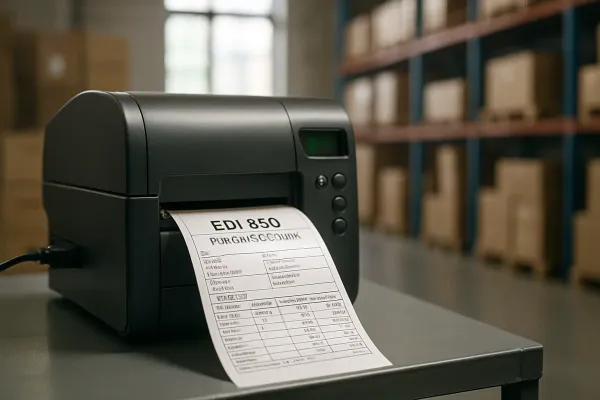
An EDI 180 carries the RMA number, the reference back to the original purchase order, item and quantity detail, a return reason code, and disposition instructions telling the receiving party what to do with the goods. It's one of the few X12 transaction sets built to be genuinely bidirectional in purpose rather than direction.
This transaction set can include details such as requests for returns, shipping information, return notifications, notifications of consumer returns and authorization of returns. That's the part people miss when they first look at a routing guide entry for "180" and assume it's a single, fixed document. Because EDI 180 can be sent bi-directionally for multiple types of communications, the document also needs to specify its specific use case. A qualifier buried in the BGN or a code in a reference segment tells the receiving system whether this is a request, an authorization, or a notice, and your mapping logic needs to branch on that, not treat every inbound 180 the same way.
At the segment level, you're typically dealing with a beginning segment carrying the RMA and transaction-purpose code, reference segments (N9) tying back to the original PO or invoice number, item detail loops carrying UPC or SKU and quantity, and reason/disposition segments spelling out why the item is coming back and what should happen to it. The EDI 180 typically includes the following essential components: Return Reason, details about why the merchandise is being returned; Item Information, product details, quantities, and original order information; and Return Authorization, indicating whether the return is authorized or not. Return Instructions give specific guidelines for the return process, and the document can also include the RMA number and return instructions tied to the authorization itself.
How is EDI 180 different from EDI 812 and EDI 861?
The 180 authorizes the return. The 812 handles the resulting financial credit or debit. The 861 confirms what actually showed up at the dock and in what condition. They're three separate documents doing three separate jobs, and confusing them is one of the more common mapping errors on new implementations.
EDI 812 Credit/Debit Adjustments are only used for financial adjustments and do not authorize product returns; for this, businesses should instead use EDI 180 Merchandise Authorization/Notification. On the receiving side, the EDI 861 transaction set is an electronic version of a Receiving Advice/Acceptance Certificate, used to report the receipt of shipments or as a formal acceptance of returned defective items. Put the sequence together and you get: 180 authorizes the return, the physical goods move, the warehouse issues an 861 documenting condition and quantity discrepancies against what was authorized, and only then does an 812 settle the money. The EDI 861 can provide detailed information about the received goods, including discrepancies between what was ordered and what was received, the condition of the goods upon arrival and any returns or rejected items, which is exactly the data that should drive whether the 812 pays full credit or a partial one.
Every leg of that chain closes with its own acknowledgment. After receiving an EDI 180 transaction, the receiving party will reply with an EDI 997 Functional Acknowledgement, and the same pattern applies to the 861 and 812. If you're only monitoring for 997s on your inbound 850s and 856s, you're missing the returns lane entirely, and that's where reconciliation breaks quietly.
Who sends the EDI 180, the retailer or the supplier?
Either side can originate it, and which one does depends on the return type and the trading partner agreement. Retailers or buyers send an EDI 180 to suppliers to request permission to return merchandise, including reasons for the return, such as item defects or incorrect shipments. On the other side, manufacturers and suppliers can use EDI 180 to request a return, authorize the retailer to ship returned items, and notify the retailer when the merchandise has been received.
In practice you'll see three patterns layered on top of each other in a single retailer relationship: a retailer-initiated request for damaged or defective stock, a supplier-issued authorization in response to a store's consumer return, and a vendor-initiated recall or overstock return. Retailers can also use this document to notify suppliers about consumer returns to their store, which is the volume driver most EDI managers actually feel every January. Manufacturing and automotive trading partners use the same transaction set for a narrower purpose, core returns and warranty parts, but the field structure barely changes. The complexity in retail apparel comes from reason code proliferation, not from the schema itself.
What happens after the EDI 180 is transmitted?
The receiver acknowledges with a 997, then either issues or confirms an RMA number that has to travel with the physical shipment, or kicks the request into a manual exception queue if something doesn't match. The paperwork trail and the freight trail have to stay in sync, and that's exactly where things go wrong.
The most common failure isn't in the EDI transmission itself, it's downstream. A warehouse refuses inbound freight because the RMA number on the physical label doesn't match what's in the 180. An item/UPC mismatch between the authorization and what's actually inside the box causes the resulting 861 to reject or flag a discrepancy that then cascades into a disputed 812. None of this is an EDI protocol failure. It's a data governance failure between the document and the box.
Does EDI 180 connect to freight pickup and TMS scheduling?
No. The 180 only carries the authorization data. Someone, or some system, still has to schedule the actual carrier pickup, and that's a separate action outside the EDI document entirely. This is the gap that catches teams who assume "authorized" means "moving."
Consumer-facing reverse logistics has largely solved this on the parcel side with API-driven label generation. The B2B vendor-return lane hasn't followed the same path, mostly because freight carriers that move LTL and FTL loads run mostly on EDI, a standard from the 1970s that is still widely required across established freight networks, while parcel carriers like FedEx, UPS, and DHL run mostly on modern REST APIs. An authorized vendor return that needs an LTL pickup still has to be tendered to a carrier, typically through an EDI 204 load tender or a TMS booking, once the 180 has cleared. Platforms like MercuryGate, Descartes, Rose Rocket, or Cargoson exist specifically to take that authorized return and turn it into a booked, tracked pickup instead of leaving the RMA sitting as a document nobody has acted on. If your returns process ends at "180 sent, 997 received," you've automated the paperwork and left the truck part manual. For more on where EDI and carrier APIs split on the freight side, TrueCommerce's EDI 180 explainer covers the document itself, and Cargoson's piece on carrier connectivity goes into what closing that pickup gap actually looks like operationally.
Is EDI 180 being replaced by API-based returns management?
Not for B2B vendor returns. Large retailers still write EDI 180 into their vendor compliance guides, and that isn't changing in 2026. What's moved to API and SaaS tooling is the consumer-facing side: return portals, label generation, drop-off scheduling.
EDI handles the LTL/FTL freight side, where many carriers still require it, while REST APIs handle parcel and express carriers like FedEx, UPS, and DHL, and that same split maps onto returns. Consumer returns increasingly run through parcel-carrier APIs and dedicated returns platforms. Vendor-to-retailer returns still run through the 180/861/812 chain because that's what the compliance guide specifies. The retailers making EDI compliance a vendor requirement in 2026 are not doing it to collect more chargebacks, they're doing it because a supply chain that runs on accurate, real-time data performs better everywhere it counts, returns included. Build for both protocols coexisting long-term. Don't plan a rip-and-replace that assumes EDI 180 disappears just because your consumer returns portal moved to an API.
Do you need EDI 180 if you already exchange 850, 855, and 810 with a retailer?
Only if the retailer's routing guide specifically calls for it. Not every retailer uses 180 for returns; some fold return authorization into a modified 850 or handle low-dollar returns manually outside EDI entirely. Check the compliance guide before you build a map nobody asked for.
A practical checklist before you commit development time:
- Confirm in the specific trading partner's routing guide whether 180 is required, optional, or absent for returns.
- Set up 997 acknowledgment handling and monitoring for the 180, not just for your 850/856/810 flows.
- Map the RMA number through to your WMS so warehouse receiving can validate inbound freight against the authorization.
- Decide whether the return freight moves through an EDI 204 load tender and carrier EDI, or through a portal-generated parcel label, and build the handoff between authorization and pickup explicitly rather than assuming it happens on its own.
Get that last point wrong and you'll have a perfectly compliant 180/997 exchange sitting next to a pallet nobody scheduled a truck for.