The Agentic AI Trading Partner Onboarding Implementation Guide: How to Build Bounded Autonomy Frameworks That Accelerate EDI Integration Without Breaking Compliance Controls in 2026

AI-powered trading partner onboarding automation has moved from experimental to operational reality in 2026. 81% of enterprises are already running or piloting autonomous AI agents, and supply chain leaders can embed autonomous AI agents into EDI workflows to alert, interpret, act on, and optimize data in real time. But there's a problem: unchecked autonomy breaks things faster than humans can fix them.
The solution isn't avoiding agentic AI. It's implementing what industry leaders call "bounded autonomy" — giving agents clear operational limits, mandatory escalation paths to humans for high-stakes decisions, and comprehensive audit trails. This framework lets you accelerate partner onboarding from months to days while keeping compliance controls intact.
The Critical Bounded Autonomy Architecture Framework
Most organizations deploying agentic AI for EDI onboarding follow a pattern: they start with pilot programs that have tight constraints, then gradually expand agent capabilities as confidence grows. Singapore's framework calls out two important concepts critical to managing agentic AI risks: 1) the agent's "action-space" (the tools and systems the agent may, or may not, access); and 2) the agent's autonomy (defined by instructions governing the agent, and human oversight).
The architecture works on four control layers. First, you define what agents can touch through narrowing the scope of the agent's "action-space" by limiting access to tools and external systems. Second, you establish decision boundaries - which actions require human approval versus autonomous execution. Third, you implement escalation triggers that automatically route high-risk situations to humans. Fourth, you maintain audit trails for every agent decision.
The 2026 trend is an "API-First" approach, serving as a low-friction gateway for partners while EDI handles the heavy lifting behind the scenes. This means your agentic AI can interact with partners through modern APIs while translating everything to established EDI protocols internally. Partners get the experience they want; you keep the governance controls you need.
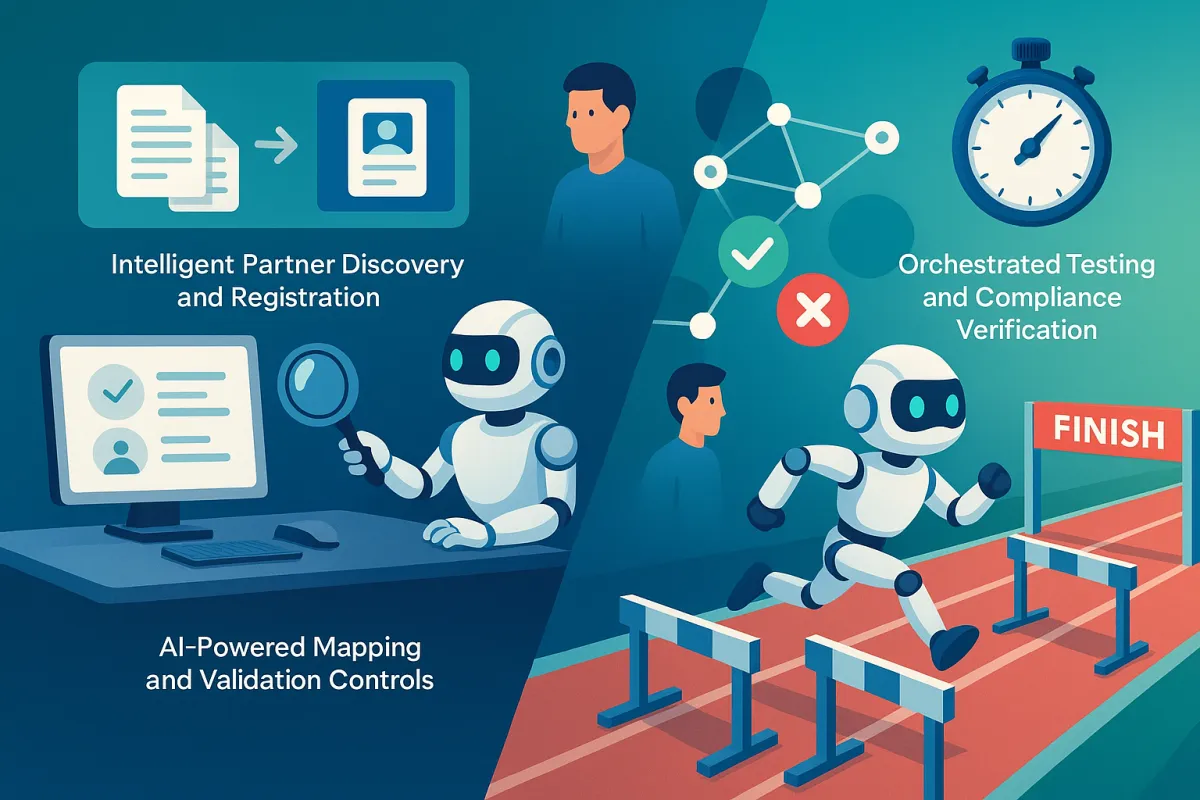
Phase 1: Intelligent Partner Discovery and Registration
Traditional partner onboarding starts with manual data collection: contact forms, capability questionnaires, and technical requirement documents. The EDI Agent Template provides pre-built tools that connect an AI agent directly to your Partner Manager instance, turning complex onboarding tasks into simple, guided workflows. Authorized users can upload trading partner specifications, and the agent can automatically create the corresponding partner profiles, configure endpoints, and set up SFTP connections.
The intelligent discovery phase works by having agents analyze partner specifications and automatically populate profile fields, connection parameters, and document format requirements. By automating onboarding tasks such as partner profile creation, document format mapping, and validation, businesses can cut weeks of manual setup into hours or days.
One transportation company using Cargoson alongside solutions like MercuryGate and Descartes found that AI-powered partner discovery reduced initial setup time by 70%. The system automatically extracted technical requirements from partner documentation, pre-populated connection profiles, and flagged any missing information for human review.
Phase 2: AI-Powered Mapping and Validation Controls
AI is now accelerating this process by learning from semantic models and automating field matching, reducing setup time and simplifying updates over time. But here's where bounded autonomy becomes essential: mapping errors can cascade through your entire partner network if left unchecked.
The control framework starts with AI generating mapping proposals based on historical patterns and semantic analysis. With AI-assisted mapping, companies can auto-generate integration logic and business process flows by analyzing historical data and deployed maps. However, every auto-generated mapping must pass through validation checkpoints before going live.
Smart validation works in layers. The AI first checks for obvious mismatches - like trying to map a purchase order number to an invoice date field. Then it runs test transactions through the proposed mapping to verify data integrity. Finally, human reviewers approve mappings that involve critical business fields like pricing, quantities, or delivery dates. Companies using Orderful's Mosaic platform alongside IBM Sterling and Cargoson report 85% fewer mapping errors with this controlled approach.
Phase 3: Orchestrated Testing and Compliance Verification
Testing used to be the longest phase of EDI onboarding because it required coordination between internal teams and external partners. Cleo's standout capability is its Supplier Testing Portal, which automates the most time-consuming phase of onboarding and removes the "wait time" between internal IT teams and external partners. This is a major reason CIC supports a 24-hour onboarding goal, because suppliers can self-serve progress without getting stuck in email chains or handoffs.
Agentic AI changes this by orchestrating test scenarios automatically. The agent generates test transactions, sends them through the mapping logic, validates responses, and identifies configuration errors. Orderful simplifies pre-launch workflows with built-in, automated testing protocols. Instead of sending files back and forth with EDI partners, you can test, validate, and approve EDI messages in one place.
The compliance verification layer runs parallel checks against industry standards, partner-specific requirements, and internal data governance policies. One company integrated this approach across Blue Yonder, FreightPOP, and Cargoson and found that 85% of configuration errors were caught during automated testing, preventing production issues.
Phase 4: Production Deployment with Monitoring Guardrails
Once testing passes, the agent handles production deployment with continuous monitoring. AI continuously monitors transaction patterns to spot abnormal behaviors—whether delays, compliance risks, or unusual data exchanges. This proactive EDI AI solution ensures potential issues are flagged before they impact customer satisfaction, enabling faster resolution and greater reliability in supply chain operations.
The monitoring framework tracks performance against established baselines and automatically adjusts agent behavior based on transaction patterns. If error rates spike above normal thresholds, the system automatically escalates to human oversight. If transaction volumes exceed capacity limits, the agent can throttle throughput or redirect traffic to backup systems.
This self-evolving capability means the system gets smarter over time. As agents process more transactions, they build better baseline models and can predict potential issues earlier. Companies using Oracle TM, SAP TM, and Cargoson report that this approach reduces manual intervention by 60% while maintaining higher reliability than purely manual processes.
Governance Controls and Risk Management Framework
Multi-agent systems introduce unique governance challenges because multiple AI agents interact, communicate, and make interdependent decisions, creating emergent behaviors that are harder to predict and control. Organizations must extend governance frameworks to address agent-to-agent communication protocols, coordination mechanisms, and collective decision-making processes.
The governance framework must evolve from reactive oversight to proactive risk management. Before deploying an AI agent, organizations should assess the agent's potential risk based on such factors as the scope of actions the agent can take, the reversibility of those actions, and the level of autonomy the agent will be granted. Early management of these risks can include narrowing the scope of the agent's "action-space" by limiting access to tools and external systems.
Practical governance means defining clear decision rights for every type of action. List the decisions that matter: use case approval, data approval, deployment approval, autonomy approval, exception approval, suspension, and rollback. Assign a single accountable owner for each decision and a backup owner.
Leading organizations implement kill switches and purpose binding controls. Kill switch capabilities — Organizations must be able to immediately terminate or override autonomous agent behavior when it deviates from intended parameters. Purpose binding — Agents should be constrained to their documented purposes, with technical controls preventing scope expansion.
Implementation Roadmap and Success Metrics
Start with low-risk, high-volume scenarios where the cost of errors is manageable but the efficiency gains are significant. Partner profile creation, basic mapping validation, and standard test case execution are good candidates. Decreasing EDI onboarding times from months to days means going live sooner, resulting in increased revenue and an improved bottom line. Our customers no longer spend their resources reviewing complex guidelines, building one off integrations, going through weeks of manual testing, or managing complex infrastructure.
Measure success through business outcomes, not just technical metrics. Track time-to-revenue for new partners, error rates in production, manual intervention frequency, and partner satisfaction scores. Pre-built connectors, robust B2B gateway, and intuitive mapping tools enable businesses to connect with partners up to 9 times faster than traditional methods. Century Supply Chain Solutions reduced partner onboarding time from 3 months to 2 weeks with Cleo.
The implementation roadmap should expand agent capabilities gradually. Start with partner registration automation, then add mapping assistance, then automated testing, and finally production monitoring. Each phase should demonstrate clear value before moving to the next level of autonomy.
Companies deploying early with solutions like Cargoson are building competitive advantages through faster partner onboarding, better error detection, and more predictable operations. The key is balancing speed with control - letting agents handle routine decisions while keeping humans accountable for strategic choices and exception handling.
The bounded autonomy framework isn't about limiting AI capability. It's about deploying that capability responsibly so you can scale partner onboarding without creating compliance risks or operational chaos. Done right, it transforms EDI from a bottleneck into a competitive advantage.