The AI-Powered Error Detection Framework for EDI Automation: How to Build Intelligent Document Validation Systems That Eliminate 90% of Manual Exception Handling and Prevent the $2.3M Data Quality Disasters Breaking Supply Chain Operations in 2026

Your EDI validation team just processed 347 documents this morning. Twelve required manual review, four triggered compliance alerts, and one nearly derailed a $200K purchase order due to a missing ship-to code. ML algorithms can detect recurring patterns of errors based on historical data, helping to avoid costly disruptions downstream. Yet here's what most EDI managers don't realize: companies implementing automated data validation solutions have reduced manual effort by up to 70% and cut validation time by 90%, from 5 hours to just 25 minutes.
The challenge isn't that your current validation processes don't work. They do. But they're bleeding resources and creating bottlenecks that compound across your entire supply chain. Errors in EDI transactions can disrupt supply chains and damage partner relationships. With trading partner volumes increasing 15-20% annually, that manual review queue will only grow larger.
The Hidden Cost Crisis of Manual EDI Error Handling
Finance teams lose as many as 72 workdays per year to manual invoice processing alone. That's nearly three months of productivity lost to tedious typing and validation. Scale that across your entire EDI operation, and you're looking at hundreds of thousands in hidden labor costs.
Take a mid-size manufacturer managing 200 trading partners. Their EDI coordinator spends 15 minutes manually reviewing each flagged document. With 50-80 exceptions daily, that's 12-20 hours of manual work before lunch. Businesses that carry on with traditional EDI systems struggle with the opportunity costs incurred by rigid formats, manual intervention, and slow integrations.
The real damage happens downstream. A missing product code in an ASN triggers a retailer chargeback. An incorrect ship-date delays production scheduling. A format violation from your transportation provider creates a cascade of manual corrections across multiple systems. One Fortune 500 retailer recently reported $2.3M in annual chargeback penalties - 60% traced back to preventable EDI validation failures.
Legacy TMS platforms like SAP TM and Oracle Transportation Management struggle with these validation bottlenecks because they were built for batch processing, not real-time exception handling. But traditional EDI systems often rely on manual mapping, custom integrations, and lengthy onboarding cycles that slow growth. As supply chains demand faster partner connectivity and tighter compliance controls, modern EDI platforms fueled by AI are reshaping what's possible. Modern platforms like Cargoson, Cleo, and SPS Commerce have moved to event-driven architectures that catch errors in milliseconds, not hours.
Why Traditional EDI Validation Approaches Are Breaking Down
Your current validation rules were written three years ago for trading partners who sent clean, consistent documents. Today's reality looks different. Partners upload PDFs in fifteen different formats. Ship-from addresses change without notice. Product codes get updated quarterly. EDI transactions often span multiple partners and systems, leading to fragmented, outdated, or non-standardized datasets.
Traditional rule-based validation operates like a security checkpoint with a fixed set of questions. It checks for required fields, validates formats, and confirms data types. But it can't distinguish between a legitimate address variation and a critical error. It flags everything for manual review, creating the validation bottleneck you're experiencing.
Modern hybrid PDF/EDI environments compound this problem. Your automotive partners send ASNs as structured 856 transactions. Your retail partners upload PDF delivery confirmations. Your 3PL providers submit spreadsheet-based manifests. Each requires different validation logic, but your legacy systems apply the same rigid rules across all document types.
The AI-Powered Error Detection Framework Architecture
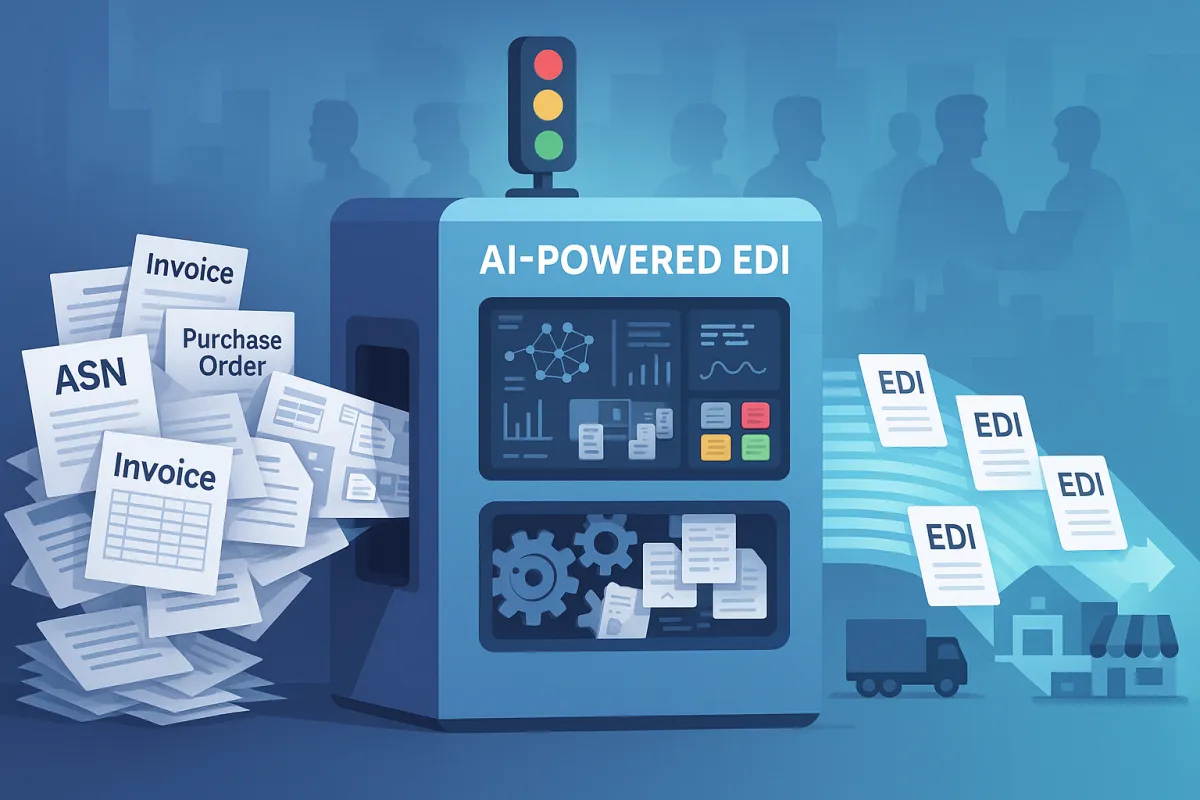
AI-Powered EDI is electronic data interchange technology that uses artificial intelligence and machine learning to automate document exchange, error detection, compliance validation, and trading partner communication - with minimal to no human intervention. The framework contains four interconnected components that work together to eliminate manual validation bottlenecks.
First, intelligent document classification identifies document types and formats automatically. AI can leverage OCR-powered processing to help extract, categorize, and format information for EDI transmission. When a document arrives, machine learning models trained on thousands of examples instantly recognize whether it's a purchase order, ASN, or invoice - regardless of whether it arrives as PDF, XML, or traditional EDI format.
Second, confidence-based routing determines which documents require human review. Patterns with ≥95% confidence (validated through multiple human resolutions) are auto-fixed. Unknown patterns are escalated with AI-generated diagnostic reports. Documents scoring above 95% confidence proceed automatically. Those between 85-95% get flagged for quick review. Anything below 85% triggers detailed exception handling workflows.
Third, predictive error detection catches problems before they impact downstream systems. AI-powered EDI is predictive - it identifies potential issues before documents are transmitted. The system analyzes historical patterns to predict when a trading partner might send incorrect data based on seasonal changes, recent system modifications, or communication gaps.
Fourth, continuous learning loops improve accuracy over time. Each time a correction is made, the AI models improve through continuous learning and get more accurate. Every manual correction trains the system to handle similar cases automatically in the future, gradually reducing the exception queue.
Platforms like Orderful's Mosaic, Boomi's B2B management, and Cargoson implement these components differently, but all share the common goal of reducing manual intervention through intelligent automation.
Machine Learning Models for EDI Data Quality Prediction
Pattern recognition for common error types focuses on the 80/20 rule: 80% of validation errors fall into predictable categories. Missing required fields, incorrect date formats, invalid product codes, and format violations account for most manual reviews. AI acts as a first layer of error detection, identifying format issues, missing values, or invalid entries before a document is sent. ML algorithms can detect recurring patterns of errors based on historical data, helping to avoid costly disruptions downstream.
Predictive analytics for document processing issues analyze seasonal patterns, trading partner behavior, and system integration changes. For example, if a retail partner typically increases order volumes by 200% during Q4, the system automatically adjusts validation thresholds to handle the surge without triggering false positives.
Self-learning validation rules adapt to trading partner variations automatically. AI and ML reduce the complexity of mapping internal systems to standardized EDI formats by suggesting field matches based on past patterns. When a partner starts using a new ship-from location, the system recognizes the pattern and updates validation rules without requiring manual configuration.
Implementation Strategy for Different Business Scales
Enterprise-level implementations require integration with existing master data management systems and trading partner portals. Fortune 500 companies typically start with pilot programs covering 10-15 high-volume partners. These platforms, led by Orderful's AI-native Mosaic, can reduce onboarding from months to days by using machine learning to eliminate manual data transformation. Success metrics focus on chargeback reduction, processing time improvement, and exception queue volume.
Mid-market practical frameworks prioritize quick wins over comprehensive coverage. Companies with 50-200 trading partners benefit most from hybrid approaches combining API connectivity for major partners with AI-powered PDF processing for smaller suppliers. Platforms like Cleo Integration Cloud, SPS Commerce, and Cargoson offer scalable solutions that grow with transaction volumes.
Small business automation options focus on eliminating the most time-consuming validation tasks first. Companies processing fewer than 1,000 documents monthly should prioritize invoice automation and ASN validation. Automated compliance validation verifies EDI documents meet trading partner expectations before sending, reducing rejections and chargebacks. Intelligent error detection analyzes transaction patterns locating issues early before documents move downstream, preventing disruptions in order processing.
Vendor comparison reveals interesting trade-offs. Traditional players like ABBYY and OpenText excel at document extraction but require significant configuration. Modern platforms like Orderful and Cargoson offer API-first approaches with built-in intelligence, reducing implementation time but potentially limiting customization options.
Integration with Popular TMS and EDI Platforms
API-first integration approaches eliminate many traditional connectivity headaches. The zero-mapping API architecture integrates once and connects across trading partners, while API-first design enables seamless ERP integration reducing custom development. Instead of building point-to-point connections for each trading partner, modern platforms create unified APIs that translate between different document formats automatically.
Hybrid EDI-API validation workflows acknowledge the reality that your trading partners use different technologies. Large retailers mandate EDI. Smaller suppliers prefer email and PDFs. 3PL providers often use proprietary formats. Boomi eliminates the complexity of data transformations by automatically mapping fields between different document formats. This reduces manual effort, ensures consistency, and accelerates data exchange.
Platform-specific implementation guides vary significantly. Manhattan Active and Blue Yonder provide comprehensive TMS functionality but require extensive configuration for validation workflows. FreightPOP offers simpler setup but limited customization. Cargoson positions itself as a flexible middle ground, providing API-native connectivity with customizable validation rules that adapt to different trading partner requirements.
ROI Measurement and Success Metrics
Vendor dashboards show extraction accuracy, processing speed, and throughput. Those matter, but the business cares about different metrics: days to close, cost per invoice processed, approval cycle time, error rate in financial reporting.
Building business cases for AI validation investment requires baseline measurements of current manual effort. Track validation time per document type, exception resolution time, and chargeback frequency. Most companies discover their actual validation costs exceed estimates by 40-60% when they include downstream correction time and partner communication overhead.
Performance benchmarking against manual processes should measure multiple dimensions. Speed improvements often reach 85-90% for routine documents. Real-time validation and centralized visibility enforce compliance rules before documents reach downstream systems. Rapid partner onboarding connects companies to existing networks, reducing testing feedback loops and minimizing chargeback risk while supporting fast onboarding and scalable growth. Accuracy improvements vary by document type but typically range from 15-30% for complex validation scenarios.
ROI calculations must include indirect benefits. Reduced chargeback penalties, faster partner onboarding, improved cash flow from faster invoice processing, and reduced IT support overhead often exceed direct labor savings. One mid-size distributor calculated $180K in annual savings: $120K from reduced validation labor, $35K from eliminated chargebacks, and $25K from faster cash collection.
Advanced Exception Handling and Human-in-the-Loop Design
HITL AI combines human judgment with machine intelligence to ensure accuracy, fairness, and trust in high-stakes workflows. Industries such as healthcare, finance, and customer service utilize HITL to minimize errors, comply with regulatory standards, and enhance performance. However, when combined with a human-in-the-loop (HITL) validation process, accuracy improves dramatically to over 95%, ensuring higher data quality and significantly reducing costly errors.
Escalation workflows for complex edge cases require careful design to avoid recreating manual bottlenecks. In most cases, once Compleo has confirmed documents meet a high accuracy confidence score, they can be passed on to the ERP without intervention. An intuitive form review workflow lets you handle any exceptions quickly and painlessly. The key is presenting exceptions with sufficient context for quick resolution. Instead of showing raw document data, effective interfaces highlight specific fields requiring attention, suggest likely corrections, and provide one-click approval options.
Training data feedback loops create the foundation for continuous improvement. The system starts conservative and earns autonomy as patterns are validated — only fully validated corrections reach SAP. Every manual correction becomes training data for future similar cases. The system gradually expands automatic processing as confidence levels increase, eventually handling 90%+ of routine validations without human intervention.
Future-Proofing Your Validation Infrastructure
Preparing for emerging EDI standards and regulatory changes requires platforms built for adaptability. For AI to add value—whether in error detection, automated mapping, or predictive analytics—organizations need strong data governance practices and a clear strategy for capturing, validating, and organizing EDI data before deploying AI solutions, which means standardizing formats, investing in automated validation tools, and enforcing a governance framework early on.
AI model evolution and continuous learning depend on data quality and feedback mechanisms. As we approach 2030, one truth becomes increasingly clear: the most successful AI systems will not be the fastest or most autonomous. They will be the most trustworthy. That trust comes from balance, pairing automation speed with human expertise. Systems that prioritize explainability and human oversight will outperform purely autonomous approaches in enterprise EDI environments.
Vendor consolidation survival strategies become more important as AI capabilities democratize. Major players like IBM Sterling, SAP, and Microsoft will acquire smaller AI-focused vendors. Mid-size companies should evaluate platforms based on integration capabilities and avoid vendor lock-in. Cargoson, Orderful, and similar platforms that offer API-first architectures provide more flexibility for future technology migrations than monolithic solutions.
Your next step: audit your current validation bottlenecks and identify the top three document types consuming the most manual effort. Start there with a pilot AI validation project, measure results, and expand systematically. The 90% automation rate isn't theoretical - it's achievable with the right framework and implementation approach.