The API-First EDI Partner Onboarding Cost Reality Check: How to Build a Complete Assessment Framework That Reveals True Implementation Costs and Prevents the 73% Failure Rate Hitting Supply Chain Teams in 2026

European manufacturers are discovering that API-first partner onboarding promises of 9 days or less are colliding with reality. While platforms like Orderful market aggressive timelines, most real-world integrations introduce complexity that extends beyond standardized conditions, and additional development, testing, and exception handling are often required.
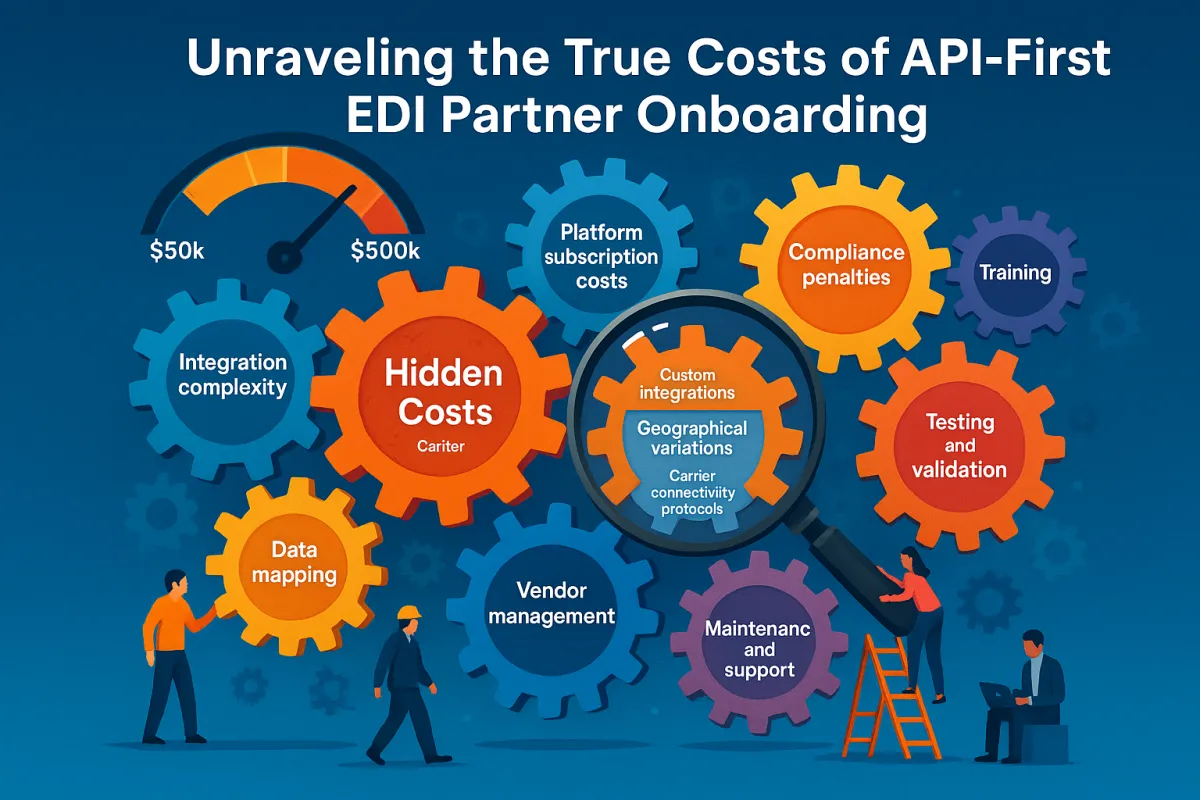
The data tells a different story than the marketing materials. Full API-first transformations range from USD 50k for a single-lane pilot to USD 500k for a global rollout, while more accessible projects begin in the low five figures but often pay back inside a year. However, 66% of organizations reported losing up to $500,000 in 2020 due to non-compliance issues, with each failure coming with its own financial penalty that compounds implementation inadequacies.
The Hidden Cost Components Most Procurement Teams Miss
Most companies focus on platform subscription costs while missing the bigger picture. Orderful's Web EDI platform costs $189/month per partner with no hidden costs, but basic API integrations cost €5,000-€15,000, while complex ERP connections exceed €50,000, and a basic domestic shipper requires 10-15 integrations minimum, potentially totaling 1,000-1,500 hours of labor.
The mathematics become unforgiving quickly. Where EDI is all about standardization, API formats vary, requiring custom integrations with each partner, which can be costly and time-consuming in multi-partner environments. Adding new carrier API integrations can cost €5,000-€10,000 each and take months to implement, while complex pricing structures, extensive EDI requirements, multiple integrations, and significant customization needs require 9-12+ months for implementation.
Geographic variations compound these costs. European manufacturers dealing with EDIFACT complexity face different challenges than North American companies using X12 standards. Carrier connectivity protocols vary dramatically by country—French carriers might use different API standards than German logistics providers, while Scandinavian forwarders often require specialized integration approaches.
Traditional TMS platforms handle these variations differently. While solutions like MercuryGate, Descartes, and nShift offer various approaches to carrier connectivity, Cargoson builds true API/EDI connections with carriers, not just accounts in software or standardized EDI messages that carriers must implement themselves, potentially reducing integration complexity and ongoing maintenance overhead.
The Complete Pre-Implementation Assessment Framework
Building an effective cost assessment requires systematic evaluation across four dimensions that most teams overlook. Start with technical readiness evaluation beyond basic system compatibility.
Your ERP integration complexity depends on data mapping requirements that aren't obvious during demos. Customer-specific requirements like ASNs, EDI 856 ship notices, specific label formats, or custom packing lists surface during implementation—or worse, after go-live—forcing expensive customizations and timeline delays. Document every system touching transport data: your ERP platform, warehouse management system, customer portals, carrier EDI connections, and reporting tools.
Partner ecosystem analysis reveals hidden scaling costs. Most shippers today require an average of 40 integrations, spanning carrier connections, customs systems, telematics platforms, and internal ERP systems, with each connection requiring testing, documentation, and ongoing maintenance that compound implementation costs. Map your current trading partner mix against projected growth to identify integration bottlenecks.
Internal resource auditing exposes capacity gaps that derail timelines. Stedi is built for developers, which means most implementations require ongoing involvement from software engineering teams, increasing both cost and complexity, especially for organizations that want business users to manage integrations. Assess whether your team has the technical depth for API-first platforms or needs managed service approaches.
Regulatory compliance requirements add another cost layer. Failure to comply with mandates carries significant risks, including administrative fines starting at €1,500 in Belgium, blocked invoices, and the loss of VAT deduction rights. European manufacturers must also consider eFTI compliance requirements that take effect July 2027.
Building Your Trading Partner Complexity Matrix
Create a scoring system that accounts for document volume versus customization requirements. High-volume partners using standard EDI formats score differently than low-volume partners requiring custom data mappings. Big brands police EDI on a sliding scale, from "EDI-only" with charge-backs for any slip, through buyers that tolerate fax or email with small penalties, to companies that let smaller suppliers use web portals.
Integration architecture assessment should distinguish between cloud-native and hybrid approaches. Cloud-native platforms usually handle spikes better because they scale automatically, so during busy periods like Black Friday or quarter-end, you won't see delays or failed messages just because volume increased. This affects both costs and performance under load.
Realistic partner onboarding timeline projections depend on your platform choice and internal capabilities. Orderful eliminates expensive mapping projects and ongoing consultant fees with transparent per-partner pricing, reducing total cost of ownership by 40-60% compared to traditional managed services, but this assumes standardized implementations without complex customizations.
Platform Evaluation Beyond Marketing Claims
API-first architecture delivers real benefits, but limitations surface under operational pressure. Rolling out APIs gives you data in seconds, but any mistake shows up just as fast—if a partner's old system can't connect, planners end up re-keying loads; if a security token expires, trucks can't be booked.
Managed services versus self-service trade-offs become apparent during crisis scenarios. Most legacy EDI systems integrations leave you in the dark when something goes wrong—a file fails, but you're not told why, and there's no intuitive dashboard to track status, no alerting system to flag issues in real time. Modern platforms address this with real-time monitoring, but implementation quality varies significantly.
Scalability considerations matter more for European cross-border operations than domestic shipping. When your TMS can't handle carrier connectivity protocols that vary dramatically by country, you're looking at costly custom development work that wasn't in your original budget. Evaluate vendor European regulatory expertise over generic functionality claims.
The vendor consolidation landscape affects platform stability. WiseTech Global's $2.1 billion acquisition of E2open and Descartes Systems Group's $115 million acquisition of 3GTMS represents the most significant TMS vendor consolidation wave in over a decade, with companies undergoing integration often experiencing 12-18 months of reduced innovation.
Modern solutions like Cargoson focus on European manufacturers and cross-border operations, alongside established players like MercuryGate, Descartes, and nShift. Each takes different approaches to API-first architecture and regulatory compliance readiness.
The Real Implementation Timeline Framework
Realistic timelines depend on your complexity matrix, not marketing promises. Phase 1 platform setup and basic connectivity requires 2-4 weeks for straightforward implementations, but this is possible only with minimal customization, very clean data, simple business processes, experienced internal project team, and significant vendor support—even then, you're likely sacrificing proper training and change management.
Phase 2 partner testing and validation spans 4-6 weeks when everything goes smoothly. This assumes your trading partners can dedicate resources to testing and don't require custom data mappings. Real-world implementations often extend this phase when partner readiness requires confirming each carrier or supplier can connect to the new channel or keep sending a backup EDI file, with cut-over plans running short pilots while keeping old file feeds open.
Phase 3 production rollout and monitoring requires 2-3 weeks minimum, but operational stability takes longer. Live monitoring and rollback capabilities trigger alerts on the first failed call and fall back to EDI until success rates stay above 99.9%, which requires establishing baseline performance metrics first.
Cost Optimization Strategy for Different Business Models
SME approach decisions center on Web EDI versus full API implementation cost analysis. For small businesses, Web EDI means fewer manual tasks, less risk, and faster setup times, with cloud-based solutions not requiring specialized hardware or support staff. Everything runs online, making it easier to bring on trading partners and configure EDI workflows.
Enterprise approach requires hybrid EDI-API strategies and vendor negotiations. EDI and APIs are not mutually exclusive—many organizations use them together to support different B2B integration needs, combining EDI's standardization and reliability with APIs' flexibility and responsiveness. A hybrid approach blends the advantages of both, offering the stability of EDI for large-scale transactions while providing the real-time adaptability of APIs for dynamic processes.
European manufacturers face specific eFTI compliance cost integration requirements. As of 9 July 2027, the eFTI Regulation will apply in full, giving you roughly two and a half years to get ready, with Member State authorities required to accept information shared electronically by operators via certified eFTI platforms. This affects platform selection and integration timelines significantly.
Different TMS platforms address European requirements with varying levels of native support. While global solutions like Oracle TM and SAP TM offer comprehensive functionality, regional specialists understand cross-border complexity better. Platforms like Cargoson build specialized European capabilities, while nShift focuses on Nordic and Benelux regions with strong parcel carrier networks.
The True ROI Calculation Framework
Hidden maintenance costs accumulate beyond initial implementation expenses. Many EDI platforms require highly specific, hard-coded workflows for each system—if your process changes, the entire flow can break, forcing businesses into endless cycles of development and testing just to make small adjustments. Factor ongoing platform updates, carrier connectivity changes, and regulatory compliance modifications.
Support requirements vary dramatically between self-service and managed platforms. Traditional services can be costly, with companies facing long onboarding timelines that delay new relationships, while many legacy providers depend on manual processes or consultant-heavy workflows that limit flexibility when requirements change. Calculate support costs across different operational scenarios.
Break-even analysis for different transaction volumes reveals platform sweet spots. Orderful reduces total cost of ownership by 40-60% compared to traditional managed services through transparent per-partner pricing that includes unlimited transactions, but this applies to specific use cases and transaction patterns.
Risk-adjusted return calculations should include compliance failure costs. For automotive manufacturers, downtime costs an astonishing $22,000 per minute, demonstrating why proper EDI implementation is not merely a technical concern but a critical financial imperative. Include penalties, operational inefficiencies, and competitive disadvantage costs in your ROI models.
Implementation Success Prevention Framework
Red flags during vendor selection become obvious once you know what to watch for. Vendors promising universal carrier connectivity without acknowledging integration complexity should raise immediate concerns. Orderful promotes rapid onboarding timelines as short as nine days for standardized X12 transactions with minimal customization, but most real-world integrations introduce complexity that extends beyond those conditions.
Proof-of-concept testing methodology should validate realistic timeline projections before committing to implementation contracts. Statements like "We need to be live in 4 months" almost guarantee implementation failure, so establish realistic expectations during POC testing with actual trading partner scenarios.
Change management for internal teams requires specific attention during transitions from legacy EDI. The supply chain workforce is changing—some professionals are retiring, while others joining don't know much about EDI and want to go forward with API-first strategies. Plan training programs that bridge knowledge gaps between traditional EDI specialists and modern API approaches.
Start your assessment with comprehensive auditing of current technology stack and trading partner requirements. Focus on platforms with proven European regulatory compliance capabilities and realistic implementation timelines. The vendors who understand this convergence of API-first technology and European compliance requirements are positioning themselves for the next decade of supply chain operations.