The API-First Partner Onboarding Revolution: How to Eliminate EDI Implementation Delays and Cut Trading Partner Setup Time from 10 Weeks to 9 Days Without Breaking TMS Operations in 2026

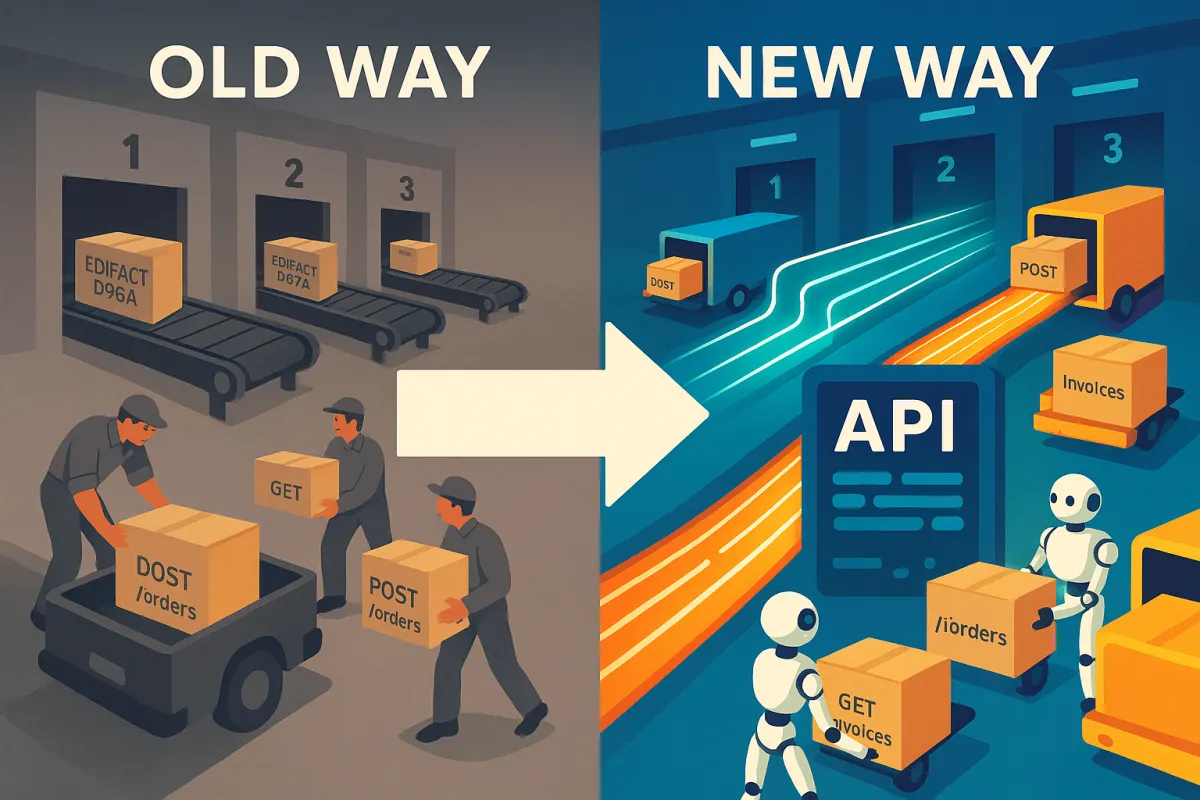
Your trading partners submit API requests, your backend processes EDI-standard transactions, and you meet compliance requirements without forcing every supplier to learn EDIFACT syntax. The fact is, onboarding in 2026 is quite difficult and cumbersome to achieve. Yet companies implementing API-First partner onboarding frameworks are reducing setup times from 10 weeks to 9 days while maintaining the TMS compatibility that keeps their operations running.
The Critical API-First Implementation Crisis Facing Supply Chain Teams in 2026
In theory, it should take 1-2 weeks to onboard a new EDI customer. However, in practice, it can take 1-2 months or even longer. The current reality is even worse than that optimistic assessment. New client onboarding typically takes 2-6 weeks for simpler operations, but complex integrations with ERPs, WMS, and e-commerce platforms extend it to 45-90 days. Larger firms over $25M revenue often see 60-90 day delays due to custom API development and testing, creating revenue opportunity costs.
Each delay compounds your competitive disadvantage. When your competitors onboard partners in days while you're stuck in 90-day implementation cycles, market share slips away. Traditional services can be costly, and companies often face long onboarding timelines that delay new relationships. Many legacy providers depend on manual processes or consultant-heavy workflows, which limit flexibility when requirements change.
The cost impact extends beyond lost revenue. Traditional managed service providers like SPS Commerce and TrueCommerce typically charge based on transaction volume, number of trading partners, and custom mapping requirements, often with hidden fees that increase over time. Costs can range from $1,000 to $10,000+ monthly depending on complexity and partner count.
Why Traditional EDI-First Approaches Break Down at Scale
The problem starts with architecture. When APIs update systems instantly but EDI runs on a delay, timing mismatches create chargebacks and compliance penalties. This is why many organizations describe traditional EDI systems as slow and brittle. Your partners expect real-time confirmation, but batch-processing EDI delivers updates hours later.
Incorrect freight documents and typos in shipping notifications cost U.S. shippers and brokers an estimated $1.5 billion annually in billing disputes and delays. Each chargeback triggered by a shipping error can actually cost you 2.5 times the original transaction amount when you factor in fees, lost labor, and wasted inventory.
Technical debt accumulation accelerates with each new partner connection. Every integration requires custom mapping, unique testing protocols, and separate maintenance procedures. Many companies still rely on older EDI platforms that haven't updated their interfaces or capabilities. These legacy EDI systems often require complex configurations, custom code, or third-party connectors for every new integration.
The API-First Architecture Framework That Transforms Partner Connectivity
An API-First strategy uses APIs as the primary, simple entry point for trading partners, eliminating the need for them to have deep EDI expertise. The system then translates these API inputs into standard EDI formats in the backend, accelerating onboarding times while maintaining internal data standardization.
The framework consists of three core components working in concert. First, an API gateway provides the customer-facing interface where partners submit JSON payloads using familiar REST endpoints. Second, a translation layer converts API requests into appropriate EDI transaction sets while handling data validation and error checking. Third, backend EDI processing maintains compliance with trading partner requirements and TMS integration points.
Modern TMS platforms like Cargoson, MercuryGate, and Descartes are building native support for this hybrid approach. It offers direct API/EDI integrations with carriers across all transport modes (FTL, LTL, parcel, air, and sea freight), allowing you to compare rates, book shipments, and track imports and deliveries from a single platform. This means your API-First onboarding strategy integrates seamlessly with existing transportation workflows.
A hybrid approach is emerging where APIs handle real-time status updates while EDI manages complex, high-volume document exchanges. You maintain EDI for bulk transaction processing where standardization matters most, but layer APIs on top for everything requiring speed and flexibility.
Building the Translation Layer That Preserves EDI Standardization
The translation engine becomes your integration's most important component. It validates incoming API data against EDI segment requirements, converts JSON structures to X12 or EDIFACT formats, and handles error conditions before they reach trading partners. Legacy EDI often detects errors after transmission. Modern API workflows can validate data instantly before propagation.
Data mapping automation reduces human error while maintaining compliance. Your system maps customer IDs to trading partner references, converts measurement units between metric and imperial systems, and applies business rules specific to each relationship. When validation fails, partners receive immediate feedback through the API instead of waiting for EDI acknowledgment cycles.
Error handling mechanisms provide rollback capabilities when transactions fail validation. If a shipment notice contains invalid carrier codes, the system rejects the API request immediately and provides specific error descriptions. This prevents downstream processing of incomplete data and eliminates the manual cleanup required with traditional EDI workflows.
The 9-Day Implementation Methodology: From Partner Request to Live Transactions
Optimized processes with pre-built integrations can reduce this to 21 days or less. Think about project delivery: instead of months-long implementations, modern API-first platforms are allowing for 27% shorter order lead times and significantly faster onboarding of new clients. But advanced frameworks can compress this timeline even further through automation and standardization.
Days 1-3: Initial Setup and API Endpoint Configuration
Partner provides basic company information and preferred data formats through a self-service portal. Your system automatically generates API keys, configures authentication, and establishes secure endpoints. Testing credentials are provisioned immediately, allowing partners to begin integration work while documentation is completed.
Days 4-6: Data Mapping and Validation Testing
Automated mapping tools analyze partner data structures and suggest field mappings based on common patterns. Partners test API calls in a sandbox environment while validation rules are configured. Any data transformation requirements are identified and implemented through configuration rather than custom code.
Days 7-9: Live Testing and Production Cutover
Partners submit real transaction samples through the API while your system generates corresponding EDI outputs for verification. TMS connectivity is validated to ensure shipment data flows correctly to platforms like Cargoson or existing transportation management systems. Production access is enabled after successful transaction validation.
Automated Validation and Real-Time Error Prevention
EDI relies on batch processing, which can delay data by hours, while APIs allow for real-time, event-driven communication, enabling instant inventory and shipping updates. Real-time validation prevents the compliance violations and chargebacks that plague traditional EDI implementations.
Validation engines check data completeness, format compliance, and business rule adherence before accepting API requests. Address validation confirms shipping locations exist and are accessible to selected carriers. SKU verification ensures product codes match master data maintained in your ERP system. Weight and dimension checks prevent shipping errors that trigger carrier penalties.
Monitoring systems track transaction success rates, processing times, and error patterns across all API endpoints. When validation failure rates increase for specific partners or transaction types, automated alerts notify operations teams before problems cascade into customer-visible issues.
Platform Evaluation Framework: Assessing TMS and iPaaS Compatibility
The separation between EDI translators and API management is ending. The trend for 2026 is the migration toward platforms that handle everything in one place. When you unify these systems, you reduce vendor sprawl and future-proof your tech stack.
Technical requirements for TMS integration focus on real-time data exchange and standardized API interfaces. Your evaluation should prioritize platforms supporting RESTful APIs, webhook notifications for status updates, and standard data formats that work across multiple TMS providers. Major vendors like Oracle TM and SAP TM price complex ERP connections based on data volume and customization requirements, while European specialists including nShift, Transporeon, Alpega, and Cargoson often provide more transparent pricing models built specifically for cross-border European operations.
iPaaS platforms like MuleSoft, Boomi, and Jitterbit provide the middleware layer connecting API-First onboarding to existing TMS infrastructure. B2B (EDI) integration: Manages trading partner connections with prebuilt EDI templates and VAN support. These platforms handle the protocol translation and data transformation required to maintain compatibility with legacy systems during the modernization process.
When evaluating vendors, test their ability to handle both lightweight API transactions and heavy-duty EDI processing simultaneously. The platform should support transaction volumes ranging from hundreds of API calls per hour to thousands of EDI documents per day without performance degradation.
Avoiding Vendor Lock-In Through Composable Architecture
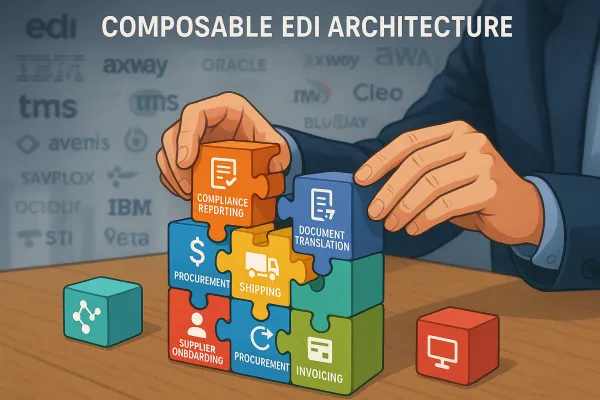
Traditional EDI systems were often built as monolithic platforms—rigid, tightly coupled, and difficult to modify. The future lies in Composable EDI: a modular approach where components can be independently deployed, replaced, or upgraded without impacting the entire system. By adopting clean architectural principles, organizations gain the flexibility to evolve their integrations, introduce new capabilities, and adapt to changing business requirements without disrupting core operations.
Standards-based API design principles ensure your framework works with multiple vendors. Using OpenAPI specifications, standard HTTP status codes, and common authentication methods like OAuth 2.0 prevents architectural dependencies on specific platform implementations. Your API contracts become portable assets that can move between integration platforms.
Multi-vendor compatibility strategies include maintaining abstraction layers between business logic and vendor-specific implementations. When your mapping rules and validation logic exist independently from platform APIs, switching providers becomes a configuration change rather than a complete rewrite.
Cost-Benefit Analysis: ROI of API-First vs Traditional EDI Approaches
Modern API-first platforms like Orderful use transparent, predictable pricing with flat per-partner rates that eliminate surprise fees and reduce total cost of ownership by 40-60% compared to traditional managed services. The economic advantage extends beyond direct cost savings.
When you go from legacy EDI to API-first in your fulfillment business, you reduce the process time to onboard new clients by even 75%, improve time-to-revenue, shorten processing time of orders and can achieve 35% average operational cost savings. Time-to-value acceleration delivers measurable business impact.
Hidden cost elimination through automated processes reduces manual intervention requirements. Traditional EDI implementations require ongoing consultant support for mapping changes, partner additions, and system maintenance. API-First frameworks handle these tasks through self-service interfaces and automated workflows.
Budget predictability improves when per-partner pricing replaces transaction-based models. You can forecast integration costs based on partner growth rather than guessing transaction volumes. This transparency enables better planning and removes the financial risk of unexpected usage spikes.
Compared to enterprise TMS solutions commanding six-figure annual contracts, modern platforms like Cargoson offer cost-effective alternatives specifically designed for API integration. Carrier network: Builds true API/EDI connections with carriers, not just accounts in software or standardized EDI messages that carriers must implement themselves. This approach eliminates the integration overhead that drives costs up in traditional enterprise implementations.
The API-First partner onboarding revolution isn't coming—it's already transforming how supply chain teams connect with trading partners. Companies implementing these frameworks today gain competitive advantages that compound over time: faster partner acquisition, reduced operational costs, and the flexibility to adapt to changing market requirements. Your choice isn't whether to modernize EDI connectivity, but whether you'll lead the transformation or follow it.