The Complete Trading Partner Onboarding Speed Benchmark Guide: How to Measure, Compare, and Optimize Your EDI Setup Times Against 2026 Industry Standards That Cut Onboarding from 12 Weeks to 9 Days

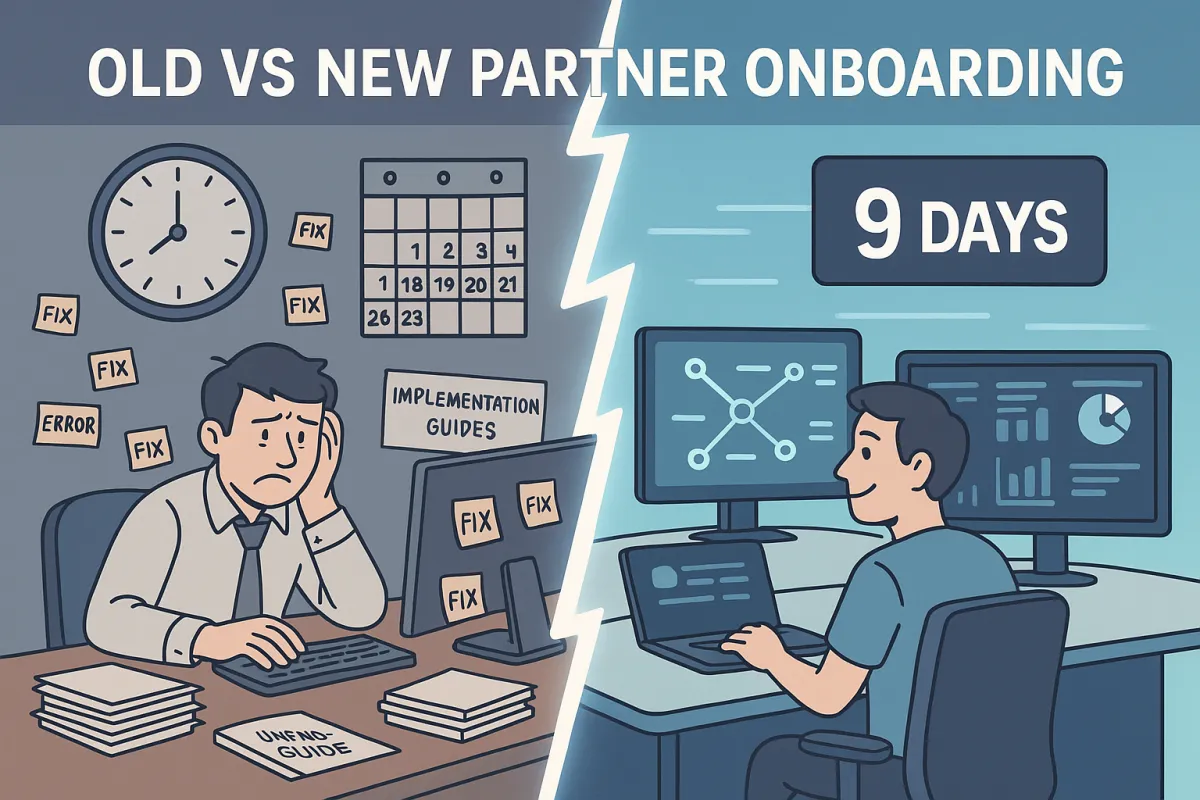
Your trading partner onboarding speed in 2026 directly impacts your revenue timeline. The average trading partner onboarding takes 8-12 weeks using legacy methods. That's three months before a signed customer can place their first order. However, AI mapping automatically builds and validates trading partner maps from specifications, eliminating one of the most time-intensive onboarding steps.
The Hidden Cost of Slow Trading Partner Onboarding in 2026
Most EDI managers focus on connectivity metrics while missing the bigger financial picture. 57% of leaders say onboarding friction directly impacts revenue realization. When your new retail partnership takes 12 weeks to activate, you're not just dealing with delayed transactions - you're hemorrhaging opportunity cost.
Consider this scenario: Your team closes a major retailer deal in January. With traditional EDI onboarding, you won't process your first live order until April. That's an entire quarter of lost revenue. In high-speed retail environments, waiting 60 to 90 days to onboard a new trading partner can mean missed seasonal windows, delayed purchase orders, and stalled expansion into major marketplaces like Amazon or Costco. Even short delays can create downstream bottlenecks that impact inventory planning, fulfillment, and cash flow.
The longer it takes to activate a partner, the greater the risk of missed service-level agreements (SLAs), disrupted launch timelines, or lost sales opportunities. When you factor in the internal costs - development cost for 2–4 weeks of an integration engineer's time at $100–$150/hour equals $8,000–$24,000 in internal cost - the true expense of slow onboarding becomes staggering.
Why Traditional Onboarding Takes 8-12 Weeks: The Legacy Bottlenecks
The breakdown reveals why legacy systems create such delays. Traditional EDI onboarding with a new trading partner takes 6 to 10 weeks, broken down roughly as: Weeks 1–2 — EDI provider reads the retailer's implementation guide (50–200 pages) and builds the initial field mapping manually. Weeks 2–4 — Internal test cycle: documents generated, rejections received, mapping corrected, retry. Weeks 4–8 — Formal certification testing with the retailer's EDI team. They run their own scenarios, flag issues, require corrections. Weeks 8–10 — Final certification sign-off and production cutover.
Here's what kills me about this process: Every error cycle requires a support ticket, a wait, a fix, a redeploy, and another test — which is why the timeline stretches. Your team spends weeks fixing problems that modern AI systems identify and correct in minutes.
Even for experienced teams, a single map can take days from start to finish. Multiply that across dozens, or hundreds, of trading partners each year, and it becomes a bottleneck that consistently delays onboarding and slows time-to-value.
The 2026 Speed Benchmarking Framework: Measuring Your Current Performance
You can't optimize what you don't measure. Most companies track basic metrics like "days to go-live" but miss the nuanced indicators that reveal bottlenecks and opportunities.
Your trading partner onboarding speed benchmark should include these key performance indicators:
- Request-to-first-transaction time: From initial partner request to the first live production document exchange
- Mapping completion velocity: Time to build and validate initial field mappings
- Test cycle efficiency: Average number of testing rounds before certification approval
- Partner complexity scoring: Standardized rating system for different partner requirements
- Resource allocation tracking: Total IT hours and project management time per onboarding
The benchmarking framework needs to account for partner segmentation. Classify the partner by revenue impact, transaction volume, technical complexity, and SLA risk. Your onboarding speed targets should reflect these differences - a high-volume retail partner deserves faster treatment than a small regional distributor.
Industry Benchmark Categories by Partner Type
Different partner types require different speed expectations. Retail partners with standardized EDI requirements should onboard faster than complex manufacturing suppliers with custom compliance needs. International partners add regulatory complexity that extends timelines but shouldn't triple them.
Transportation management system integrations often create additional complexity. Modern platforms like Cargoson, Descartes, and MercuryGate handle these challenges differently, with cloud-native solutions typically offering faster integration paths than legacy on-premise systems.
The AI-Powered Onboarding Revolution: How Modern Platforms Achieve Sub-10-Day Setup
The transformation happening right now changes everything. TrueCommerce is embedding agentic AI across its platform to transform how customers onboard, integrate, and scale with trading partners. This isn't incremental improvement - it's fundamental restructuring of how onboarding works.
AI-generated mappings will soon integrate with orchestration engines, enabling real-time validation and correction during partner onboarding. Instead of weeks spent manually interpreting implementation guides, AI reads the trading partner's implementation guide PDF, understands the retailer's specific requirements, and generates a complete field mapping that connects your ERP data to their EDI specification in minutes instead of days.
The speed difference is dramatic. With AI-generated mapping that reads the implementation guide PDF automatically and produces an 80–90% correct mapping in minutes, the same onboarding can complete in 2 to 3 weeks because the longest phase (manual mapping construction) collapses to a review step, and fewer error cycles are needed during certification.
This approach dramatically cuts onboarding time to under one day, reduces errors, and removes one of the most burdensome technical challenges in EDI modernization.
Speed Optimization Technologies That Cut Setup Time by 80%
Orderful connects trading partners in 9 days or less through automated validation, standardized configurations, and real-time monitoring. The platform eliminates the consultation-heavy workflows that bog down traditional implementations.
Modern cloud-based platforms offer several speed advantages: pre-built connector libraries, automated testing frameworks, real-time error detection, and self-service partner setup tools. 10x faster onboarding into the Cleo Network of retailers, shippers, suppliers, marketplaces, logistics providers, and distributors.
Integration capabilities with freight management platforms like FreightPOP, Uber Freight, and Cargoson also accelerate deployment by providing pre-configured connections to common transportation management systems.
Implementation Roadmap: Moving from 12 Weeks to 9 Days
The transition requires strategic planning. You can't flip a switch and expect 90% time reduction without proper change management and stakeholder alignment.
Start with current state assessment. Document your existing onboarding process step-by-step, including handoffs, approval cycles, and common delay points. To improve partner onboarding, enterprise teams need operational metrics that connect integration activity to business outcomes. Track both speed and quality.
Platform evaluation criteria should prioritize automation capabilities over feature breadth. Look for solutions that can demonstrate actual implementation timelines with real customer examples, not marketing claims about "rapid deployment."
Migration planning needs to account for existing partner networks. You don't want to disrupt live trading relationships while implementing new onboarding processes. Most successful implementations use a phased approach - new partners get the modern experience while existing connections migrate gradually.
TMS and ERP Integration Considerations for Faster Onboarding
System compatibility determines deployment speed. Platforms that integrate natively with your ERP system reduce implementation complexity. Cleo simplifies EDI integration with nearly all major ERPs, including SAP, Oracle, NetSuite, Acumatica, Microsoft Dynamics, and Sage, through APIs.
Transportation management system integration varies significantly. Cloud-based TMS solutions like SAP TM Cloud and Cargoson typically offer faster API-based connectivity than legacy on-premise systems requiring custom development.
Avoiding the Common Speed Traps That Keep You Stuck in 8-Week Cycles
Even with modern platforms, certain mistakes can sabotage your speed gains. Over-customization kills velocity. Custom mapping for every onboarding request makes growth harder. Reuse patterns wherever possible, then isolate true exceptions.
Template standardization prevents the scope creep that extends timelines. Instead of building unique solutions for each partner, develop reusable frameworks that handle 80% of requirements with configuration rather than coding.
Testing automation eliminates the manual bottlenecks that create delay cycles. A file can pass syntax validation but still fail ERP, WMS, TMS, invoice, shipment, or inventory workflows. Modern platforms catch these integration issues before certification testing, not during it.
Resource allocation mistakes compound delays. Customers may lack dedicated personnel for onboarding. If their IT team is juggling multiple priorities, availability can be limited to address testing and other tasks as quickly as needed, causing bottlenecks and extending the timeline. Factor partner bandwidth constraints into your timeline planning.
The competitive advantage goes to companies that can onboard trading partners faster than their competitors. The platform delivers 10x faster partner onboarding (9 days vs. 4-8 weeks with legacy providers), transparent per-partner pricing with unlimited transactions that reduces costs by 40-60%. Speed isn't just operational efficiency - it's revenue acceleration that compounds over time.