The Composable EDI Architecture Revolution: How to Escape Monolithic Integration Systems Using Packaged Business Capabilities and Build Future-Proof Supply Chain Data Exchange in 2026

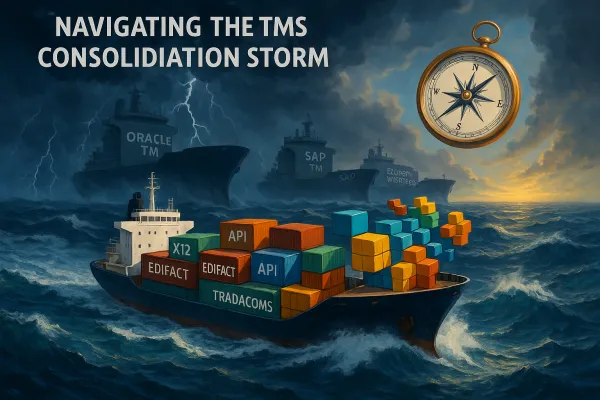
The wave of monolithic EDI system failures is accelerating across supply chains. WiseTech Global's $2.1 billion acquisition of E2open in 2025, alongside Descartes Systems Group's $115 million acquisition of 3GTMS in March 2025, represents the most significant TMS vendor consolidation wave in over a decade. Your traditional EDI stack just became a business risk.
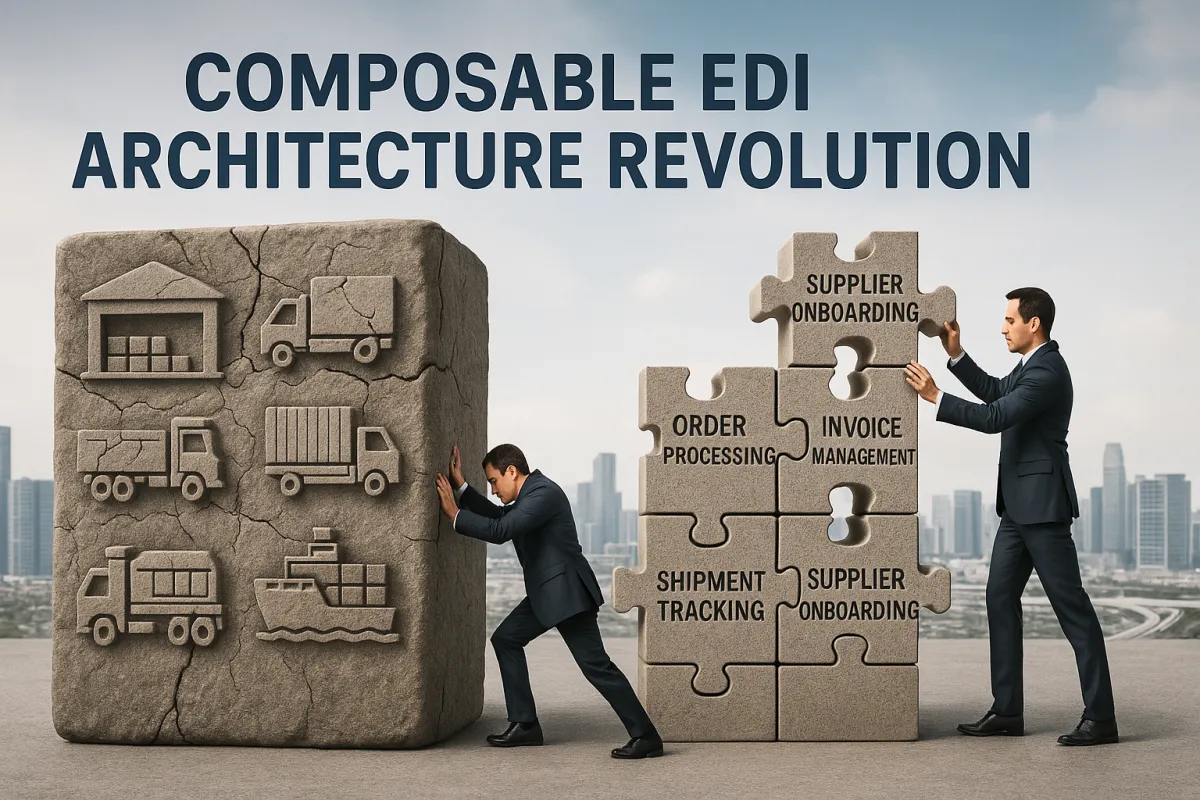
Here's the reality: Gartner forecasts that by 2026, 60% of enterprises will adopt composable architectures to enable AI-driven agility. Meanwhile, traditional EDI systems were often built as monolithic platforms—rigid, tightly coupled, and difficult to modify. The future lies in Composable EDI: a modular approach where components can be independently deployed, replaced, or upgraded without impacting the entire system.
The stakes couldn't be higher. 61% of organizations expect to achieve a fully composable architecture by 2026. Organizations using composable architecture can implement new features 80% faster than competitors.
The Death of Monolithic EDI: Why 2026 Marks the Tipping Point
The vendor consolidation happening right now is devastating traditional EDI architectures. WiseTech's acquisition of E2open in 2025, Descartes' purchase of 3GTMS for $115 million in March 2025, and Körber's transformation of MercuryGate into Infios following their 2024 acquisition. Companies undergoing integration often experience 12-18 months of reduced innovation while they harmonize platforms and teams.
Your monolithic EDI system locks you into this chaos. When your vendor gets acquired, you inherit integration complexity without controlling the project timeline. First, you lose control over technology roadmaps. Your feature requests get deprioritized as the new parent company focuses on platform consolidation rather than customer-specific enhancements.
The consolidation creates three distinct vendor categories: global mega-vendors (Infios/MercuryGate, Descartes, SAP TM, Oracle TM, E2open/WiseTech), European specialists (Alpega, nShift, Transporeon/Trimble), and emerging European-native solutions (including Cargoson) that focus specifically on cross-border European operations.
Notice the pattern? Traditional EDI providers are either getting acquired or struggling to maintain development velocity across multiple integration projects. 76% of implementation failure rate speaks volumes about the current approach.
Understanding Packaged Business Capabilities in EDI Context
Packaged Business Capabilities (PBCs) are self-contained software components that represent a specific business function — such as catalog management, pricing, or order orchestration — and are designed to be used as modular building blocks within a flexible commerce architecture. Each PBC typically includes a collection of APIs, services, data schemas, and event channels that work together to deliver a complete, business-facing capability.
In EDI terms, think of PBCs as business-aligned modules rather than technical microservices. They are encapsulated software components representing well-defined business capabilities. A PBC bundles data schemas, services, APIs, and events, offering a more business-centric and composable approach to building applications.
For example, instead of a monolithic EDI system handling everything from order processing to invoice management, you'd have separate PBCs for:
- Order Processing PBC - handles purchase orders, acknowledgments, and order changes
- Invoice Management PBC - manages billing documents, payment terms, and disputes
- Shipment Tracking PBC - coordinates ASNs, shipping notices, and delivery confirmations
- Supplier Onboarding PBC - manages trading partner setup, testing, and certification
Unlike abstract technical services, PBCs reflect the language of the business. A merchandiser doesn't care if three microservices power their promotions engine — they care that they can launch and manage promotions quickly. The same applies to your EDI operations team.
The TMS Integration Challenge
Traditional TMS-EDI integration exemplifies the monolithic problem. Integration timelines are extending as merged vendors focus on internal platform consolidation rather than customer-specific connectivity projects. This directly impacts European shippers whose carrier networks span multiple countries with varying technological capabilities.
When your TMS vendor gets acquired, your EDI connections often break. Product roadmap uncertainties are already surfacing. When two TMS platforms merge, customers inevitably face decisions about which system to standardize on, what features will be deprecated, and how long dual support will continue.
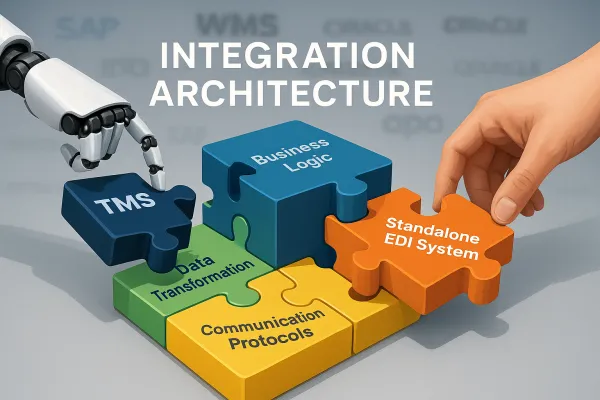
PBC-based EDI solves this by creating vendor-agnostic integration points. Your Order Processing PBC can connect to any TMS that supports standard APIs, whether that's Descartes, Cargoson, or the next platform your transport team selects.
Building Your Composable EDI Strategy
Start with a dependency assessment. Map every EDI function in your current monolithic system and identify which ones could become independent PBCs. Focus on business capabilities, not technical functions.
Ask these questions:
- Can this function operate independently with its own data store?
- Does it have clear business ownership and defined outcomes?
- Would trading partners benefit from direct API access to this capability?
- Could we replace this component without affecting other EDI functions?
By adopting clean architectural principles, organizations gain the flexibility to evolve their integrations, introduce new capabilities, and adapt to changing business requirements without disrupting core operations.
API-first design becomes mandatory. The 2026 trend is an "API-First" approach, serving as a low-friction gateway for partners while EDI handles the heavy lifting behind the scenes. Every PBC must expose well-defined interfaces that work with both traditional EDI protocols and modern REST APIs.
Hybrid Migration Approach
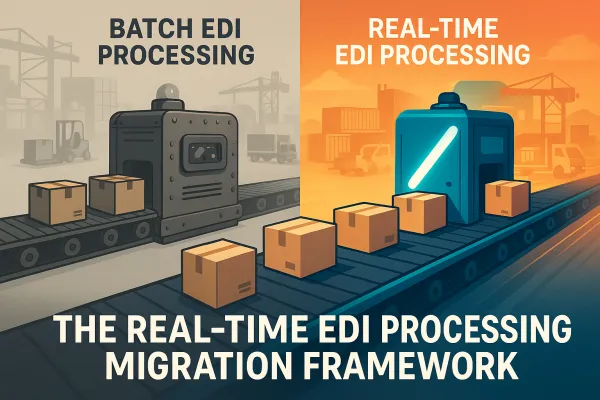
Don't attempt a complete migration overnight. Use the strangler pattern to gradually replace monolithic components with PBCs while maintaining trading partner relationships.
Start with non-critical functions like reporting or analytics. Build confidence with internal teams before migrating high-volume transaction processing. Keep your existing EDI connections active during the transition to minimize business risk.
Trading partners won't notice the change if you maintain consistent message formats and response times. The beauty of composable EDI architecture is that external interfaces remain stable while internal architecture evolves.
PBC Implementation Framework for EDI Systems
Your technical architecture needs three foundational elements: event-driven communication, standardized data schemas, and API-first integration patterns.
Event-driven communication allows PBCs to operate independently while maintaining data consistency. When your Order Processing PBC receives a purchase order, it publishes events that trigger actions in Inventory Management and Shipping PBCs without direct coupling.
Packaged Business Capabilities (PBCs) represent modular, business-aligned building blocks that encapsulate people, processes, data, and technology to deliver specific outcomes. These capabilities are designed to function independently yet integrate seamlessly within broader enterprise architectures.
Data schema standardization prevents integration nightmares. Define canonical data models for core business objects like orders, invoices, and shipments. Each PBC translates between internal formats and these standard schemas.
Security becomes distributed but more granular. Each PBC manages its own authentication and authorization, allowing fine-grained access control. Your suppliers might access Order Processing APIs directly while logistics providers only interact with Shipping PBCs.
Vendor Evaluation Criteria
Assess vendor composability readiness before making any decisions. For procurement leads managing transport management software decisions, vendor consolidation creates a double-edged scenario: fewer independent options but potentially stronger, more comprehensive platforms. The question becomes whether your organization can navigate the integration risks while capitalizing on expanded capabilities.
Red flags include:
- Vendors who can't demonstrate API-first architecture
- Platforms requiring custom integration for every new trading partner
- Solutions where one component failure brings down the entire system
- Vendors without clear data export capabilities
Ask potential vendors about their PBC support:
- Can we deploy individual components independently?
- How do you handle data consistency across distributed PBCs?
- What happens to our integrations if you get acquired?
- Can we replace individual PBCs with competitors' solutions?
Platforms like Cargoson demonstrate composable approaches compared to traditional monolithic TMS-EDI bundles. Evaluate how easily you can integrate their transport management capabilities with your existing EDI PBCs.
Real-World Implementation Patterns
The most successful composable EDI transitions follow predictable patterns. Start with read-only PBCs like reporting and analytics before migrating transactional capabilities. Build confidence with low-risk components first.
A mid-sized manufacturer recently transitioned their supplier onboarding from a monolithic EDI platform to PBC-based architecture. The results: 60% faster partner onboarding and ability to support new document types without system upgrades.
Common pitfalls include over-decomposition and under-investment in event architecture. Don't create PBCs that are too granular—they become meaningless to business users. If a PBC is too small, it becomes meaningless to the business. If it's too large, it risks unnecessary complexity or unused features. The right-sized PBC aligns with how your teams think, plan, and execute commerce strategies.
ROI calculations show compelling results. Organizations using composable architecture can implement new features 80% faster than competitors. Significant improvements in time-to-market for new features (27%). Applied to EDI operations, this translates to faster trading partner onboarding and reduced integration costs.
Cost analysis reveals hidden savings. While initial PBC implementation might cost more than monolithic system maintenance, the ability to avoid vendor lock-in and reduce integration complexity pays dividends over 3-5 year periods.
Future-Proofing Your EDI Investment
The vendor consolidation wave will continue through 2026 and beyond. The TMS market will continue consolidating throughout 2026 and beyond. European shippers investing in acquisition-resistant vendor selection frameworks today position themselves to navigate this consolidation successfully.
Building acquisition-resistant architecture requires strategic thinking about component dependencies. Composable architecture reduces lock-in by standardizing on open interfaces and portable components, so teams can move workloads and change providers without full rewrites.
Skills development becomes critical. Your team needs to understand both business capabilities and technical architecture patterns. PBCs enable organizations to respond quickly to market changes, reuse components, standardize offerings, and simplify ecosystem integration.
Train your EDI team to think in terms of business capabilities rather than technical protocols. When someone requests a new trading partner integration, evaluate which PBCs need extension versus building new monolithic connections.
Your 2027-2030 technology roadmap should assume continued vendor consolidation and increasing API adoption. Some businesses are exploring solutions like self-service APIs and web services. These alternatives are more likely to work alongside EDI rather than replace it.
The window for strategic EDI modernization is narrowing. The window for strategic TMS selection is narrowing rapidly. The convergence of capacity shortages and vendor consolidation creates urgency, but rushed decisions amplify hidden costs and implementation risks.
Start your composable EDI architecture assessment now. Identify which business capabilities can become independent PBCs and begin building API-first integration patterns. The companies that transition from monolithic EDI to composable architectures before the next acquisition wave will control their integration destiny rather than inheriting vendor consolidation chaos.
The future of EDI isn't monolithic. It's composable, intelligent, and mission-critical. Build your architecture accordingly.