The Composable EDI Architecture TMS Vendor Selection Framework: How to Evaluate Integration Capabilities That Survive Vendor Consolidation and Future-Proof Your Transportation Operations in 2026

When you're evaluating TMS vendors in 2026, WiseTech's $2.1 billion acquisition of E2open and Descartes Systems Group's $115 million acquisition of 3GTMS represent the most significant TMS vendor consolidation wave in over a decade. Your integration architecture decisions today determine whether these market changes become operational advantages or expensive disruptions.
66% of technology projects end in partial or total failure, while 17% of large IT projects threaten the very existence of the company. When your TMS vendor gets acquired, you inherit integration risks without controlling the project. The answer lies in adopting composable EDI architecture principles that survive vendor consolidation and protect your transportation operations against future disruption.
Why Composable EDI Architecture Matters for TMS Vendor Selection in 2026
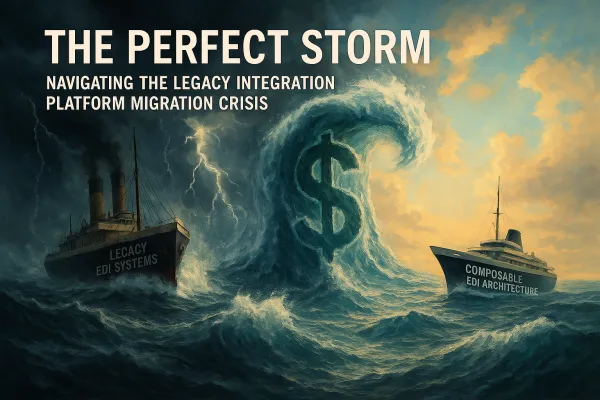
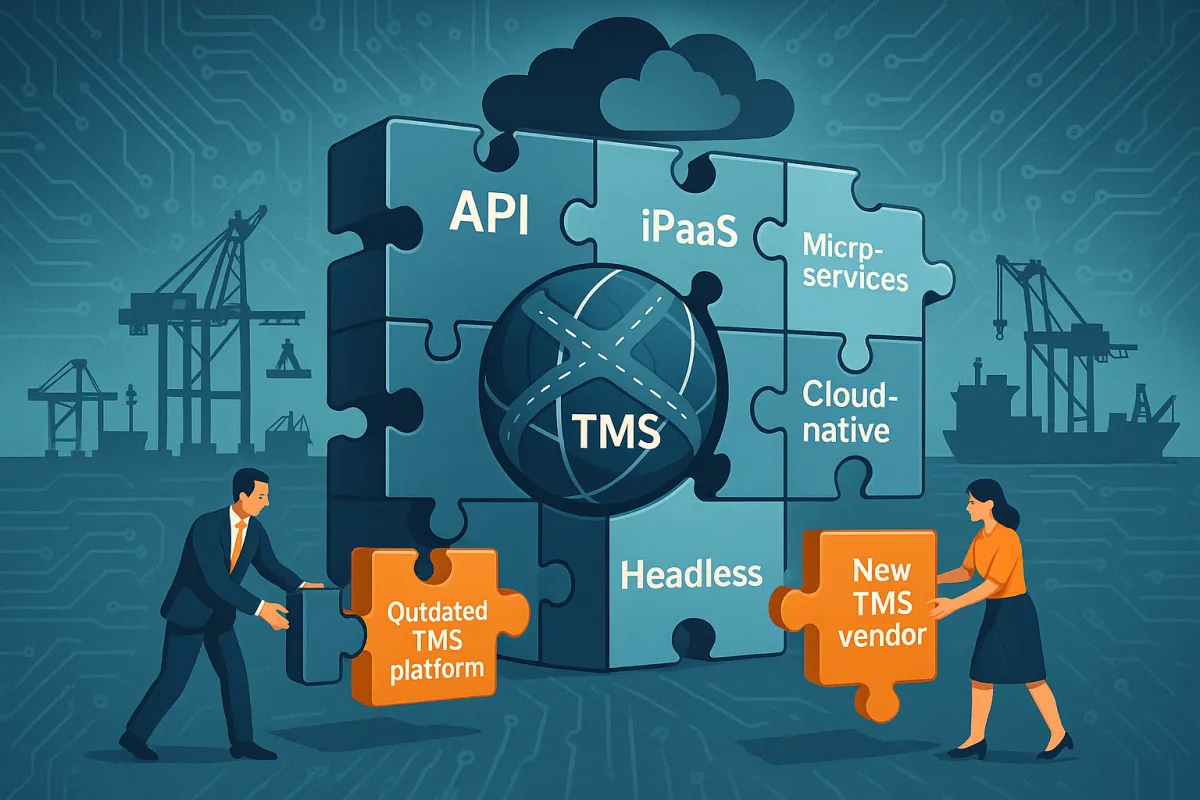
Traditional EDI systems were built as monolithic platforms: rigid, tightly coupled, and nearly impossible to modify without affecting the entire system. Composable Commerce is built on the principles of MACH architecture (Microservices-based, API-first, Cloud-native, and Headless). When applied to EDI integration, this modular approach means each component can be independently deployed, replaced, or upgraded without impacting your entire transportation management ecosystem.
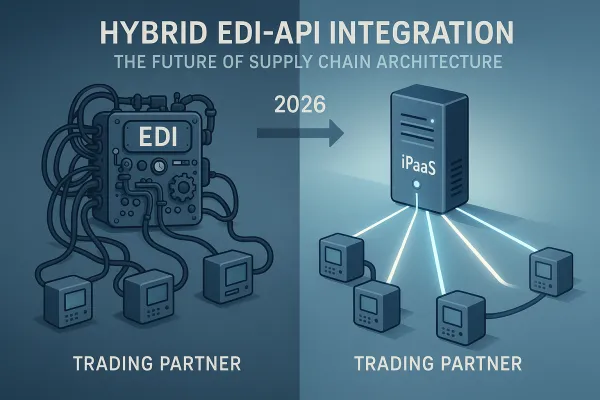
The combined strengths of modern B2B Integration and API/iPaaS offers a flexible and future-ready approach to integration that supports both legacy and modern systems, enables hybrid deployments, and helps organizations move toward unified, composable architectures. For TMS evaluation, this means your integration layer becomes vendor-agnostic.
Consider this scenario: Your chosen TMS vendor gets acquired six months after implementation. With traditional monolithic EDI integration, you'd face months of system reconfiguration and potential carrier connectivity disruptions. A composable architecture allows you to swap out the TMS platform while maintaining your established EDI flows and carrier connections.
The Vendor Consolidation Risk That's Reshaping TMS Procurement
The procurement window for securing optimal TMS platforms before vendor consolidation eliminates choices and capacity shortages worsen cost structures runs through Q1 2026. There have been rumblings that 2026 is setting up to be a big year for logistics M&A.
Product roadmap uncertainties are already surfacing. When two TMS platforms merge, customers inevitably face decisions about which system to standardize on, what features will be deprecated, and how long dual support will continue. The timeline pressure is real: Companies that haven't initiated TMS selection processes by mid-2026 will find significantly fewer viable options as vendors focus resources on existing customer compliance rather than new client acquisition.
Your procurement strategy needs to account for three risk scenarios. First, your preferred vendor becomes an acquisition target during your evaluation process. Second, a competing vendor you didn't select gets acquired by your chosen platform, potentially eliminating future competitive pressure. Third, post-acquisition platform rationalization eliminates features your operations depend on.
The Composable EDI Architecture Evaluation Framework for TMS Vendors
An iPaaS is a cloud-based platform designed to connect all your applications, databases, and systems. It enables seamless, automated, real-time communication between them, regardless of location or technology. When evaluating TMS vendors, an iPaaS solution enables enterprises to build and deploy integration flows that connect applications and data that is hosted in public and private clouds and between the cloud and on-premises data centers.
Start your vendor evaluation with integration architecture, not feature checklists. Does the TMS vendor support iPaaS-based integration patterns? Can their platform connect through standardized APIs rather than proprietary protocols? Modern EDI integration solutions demonstrate how modern iPaaS solutions support integration patterns across apps, data warehouses, B2B (EDI), APIs, and events, all through a single interface.
Evaluate whether potential vendors can integrate with platforms like Cargoson, SAP TM, Oracle OTM, MercuryGate, and Descartes through unified integration layers rather than point-to-point connections. This architectural decision determines your flexibility when market consolidation forces platform changes.
API-First Integration Pattern Assessment
An API-first strategy eliminates the need for trading partners to have deep EDI expertise. The iPaaS works as a cloud-based solution that uses APIs to simplify and automate integrations without the need for custom code. The system accepts API inputs from your carriers and trading partners, then translates these into standard EDI formats in the backend.
When evaluating TMS vendors, demand demonstration of their API-first capabilities. Can carriers submit shipment updates through REST APIs instead of traditional EDI protocols? Do they support real-time data exchange for order status and inventory visibility? Gaining competitive edge, improving agility and API reuse by adopting an API-led connectivity strategy becomes critical when vendor consolidation threatens traditional EDI relationships.
Platforms like Cargoson, nShift, and ShippyPro have built their architectures around API-first principles, reducing the complexity of partner onboarding and system integration. This approach protects your operations when vendor changes disrupt established EDI connections.
Protecting Against Vendor Lock-in Through Modular Architecture
A German automotive parts manufacturer discovered their €800,000 TMS implementation mistake the hard way. Six months into deployment, they realized their new system couldn't handle their complex carrier network across 12 European countries. The core issue? Tightly coupled EDI integration that couldn't adapt to changing requirements.
The challenge of EDI inside an ERP, TMS, or WMS explains how when an enterprise grows and is looking to implement a new ERP or TMS, the switch will impact EDI with its trading partners. The average company that performs EDI has anywhere from 100-200 partners.
Build integration strategies that treat the TMS as a replaceable component within your broader transportation ecosystem. Your EDI integration layer should connect to multiple TMS platforms simultaneously, allowing gradual migration or A/B testing of vendor capabilities. This approach protects the 100-200 partner relationships most companies maintain while providing flexibility to change TMS vendors based on evolving requirements.
This consolidation creates three distinct vendor categories for European shippers: global mega-vendors (Oracle TM, SAP TM, E2open/WiseTech), European specialists (Alpega, nShift, Transporeon), and emerging European-native solutions like Cargoson that focus specifically on cross-border European operations. Your modular architecture should support integration across all three categories.
The iPaaS vs. Embedded EDI Decision Matrix
EDI modernization roadmaps aim to improve business automation and developer support, making it an attractive option for general iPaaS needs. The decision between standalone iPaaS platforms and embedded EDI capabilities within your TMS depends on several factors.
Choose embedded EDI when your carrier network is stable, your transaction volumes are predictable, and you're confident in your TMS vendor's long-term viability. The integration overhead is lower, and maintenance requirements are reduced.
Select standalone iPaaS when vendor consolidation risks are high, when you need to integrate multiple TMS platforms, or when your carrier network spans different technological capabilities. iPaaS platforms handle millions of records and dozens of integrations while quickly responding to new business opportunities with fast integrations.
Consider cost implications: embedded EDI typically costs 20-30% less initially but creates switching costs of 200-400% when vendor changes are required. iPaaS implementations cost more upfront but reduce switching costs to 50-75% of embedded solutions.
Technical Architecture Requirements for Future-Proof TMS Integration
Your technical specifications must address multi-vendor preparedness from the start. Demand API-first architecture that doesn't depend on proprietary connections. This hybrid model gives enterprises the flexibility to onboard any partner using their preferred method, integrate with any internal system, and maintain full visibility, scalability, and compliance across all transactions.
Require standardized integration frameworks that support common protocols: REST APIs for real-time communication, SFTP/HTTPS for secure file transfer, and webhook capabilities for event-driven updates. Your architecture should accommodate platforms like FreightPOP, E2open/BluJay (CargoWise), Alpega, and Cargoson without requiring different integration approaches for each vendor.
Move from ad-hoc integrations to a centralized API and event-driven model. Business agility: easily plug in new apps or microservices that inherit existing workflows, rules, and security. This architectural pattern ensures your transportation management capabilities can evolve independent of vendor-specific platforms.
Zero-Trust Security and Governance Requirements
Zero-Trust security assumes no transaction is safe by default, requiring continuous verification from every established trading partner. Built-in compliance and security: encryption, auditing, and access controls (SSO, OAuth2/OIDC, RBAC) become essential when your integration layer spans multiple vendor environments.
Implement security architecture that works consistently across different TMS platforms. Your authentication mechanisms, data encryption standards, and audit capabilities should remain constant even when underlying TMS vendors change. This approach protects your supply chain from security gaps that emerge during vendor transitions.
Document governance requirements that survive vendor consolidation: data retention policies, compliance reporting capabilities, and partner certification processes that work across different TMS platforms. Multi-vendor environments increase complexity, but consistent governance frameworks reduce risk.
Implementation Roadmap: From Assessment to Go-Live
Start immediately with financial stability assessment of your vendor shortlist. Member States authorities may start accepting data stored on certified eFTI platforms for inspection from January 2026. The regulatory timeline creates urgency, but proper evaluation prevents expensive mistakes.
Week 1-4: Complete vendor financial stability analysis and architectural assessment. Focus on integration capabilities rather than feature comparisons. Evaluate how well each vendor supports composable architecture principles and multi-vendor integration scenarios.
Week 5-8: Conduct proof-of-concept implementations with your top three vendors. Test API connectivity, data transformation capabilities, and integration with your existing carrier network. Include scenarios for vendor consolidation and platform migration.
Week 9-12: Negotiate contract protections for acquisition scenarios, test integration capabilities, and validate regulatory compliance roadmaps. Select vendors demonstrating both technical capabilities and acquisition resistance that protects your implementation investment.
Organizations that modernize their EDI environments report one consistent advantage: speed. No-code, low-code interfaces enable both technical and non-technical teams to quickly build, manage, and scale integrations, enabling faster innovation and reducing IT overhead. For many businesses, this marked a turning point from slow, IT-heavy integrations to agile, scalable, and cloud-based connectivity.
Consider multi-carrier shipping software options like ShipStation, Sendcloud, EasyShip alongside traditional TMS vendors and Cargoson. Your composable architecture should accommodate specialized solutions for different aspects of transportation management without requiring complete platform replacement.
Cost-Benefit Analysis of Composable vs. Monolithic EDI Integration
Total cost of ownership models must account for capacity shortage scenarios and vendor consolidation risks. The framework includes base licensing (typically 20-30% of total costs), implementation expenses (25-40%), carrier integration fees (15-25%), ongoing support and maintenance (10-15%).
Composable architectures require 15-25% higher initial investment but reduce long-term switching costs by 60-80%. When vendor acquisition introduces premium compliance modules, additional licensing costs can reach €800,000 annually. Modular integration architectures provide alternatives when vendor pricing becomes unreasonable.
Calculate ROI over 5-7 years, including scenarios for vendor acquisition, platform migration, and regulatory changes. Evaluate total contract value over 5-7 years, not just year-one costs. Include scenarios for business growth, regulatory changes, and potential vendor acquisition that could affect pricing or service levels.
Your procurement strategy should evaluate platforms like Uber Freight, 3Gtms/Pacejet, Transporeon alongside Cargoson with consistent TCO models. Composable architectures allow you to optimize costs by selecting best-in-class solutions for specific functions rather than accepting compromised capabilities from monolithic platforms.
The TMS vendor landscape will look dramatically different by the end of 2026. Your integration architecture decisions determine whether these changes create competitive advantages or operational disruptions. Build composable EDI capabilities that survive vendor consolidation, protect your carrier relationships, and maintain transportation operational flexibility regardless of which TMS platforms remain independent.