The Critical Agent Sprawl Prevention Framework: How to Build Orchestration Efficiency Metrics That Eliminate the 50+ Agent Management Crisis and Maintain Supply Chain Data Flow Integrity in 2026

European shippers across the manufacturing and logistics sectors are facing a crisis that barely existed 18 months ago. According to Gravitee's State of AI Agent Security 2026 report, more than 3 million AI agents are now operating within corporations. Only 47.1% are actively monitored or secured. For supply chain organizations already struggling with complex EDI integrations across TMS platforms, the rapid proliferation of AI agents creates what experts call "the 50+ agent management crisis."
With the global agentic AI market surging past $9 billion in 2026 and Gartner projecting that 40% of enterprise applications will embed task-specific AI agents by year-end, supply chain leaders find themselves managing specialized agents for carrier onboarding, customs compliance, exception handling, and order processing. Each agent operates with different protocols, data requirements, and governance frameworks.
However, when this decentralized development occurs without a unifying strategy, the result is "agent sprawl"—a costly and uncontrolled proliferation of siloed, insecure, and duplicative AI agents. Agent sprawl creates immense technical debt, multiplies security vulnerabilities, and wastes resources on redundant development.
The Hidden Costs: How Agent Sprawl Breaks TMS Environments
That German automotive parts manufacturer running 47 different AI agents across their supply chain operations discovered the problem six months into 2026. Each agent handled different aspects of their European transport network: one managed MercuryGate EDI connections, another processed Descartes customs documentation, while a third monitored nShift parcel integrations. The agents couldn't communicate effectively, creating data silos and requiring constant human intervention.
More than 4 in 5 IT leaders believe the proliferation of AI agents will yield more complexity than value due to integration challenges and silos, according to the 2026 Salesforce Connectivity Benchmark Report published Thursday. The Salesforce report found that agents working in silos can lead to disjointed workflows, redundant automations and a higher risk of shadow AI — the unauthorized use of AI tools.
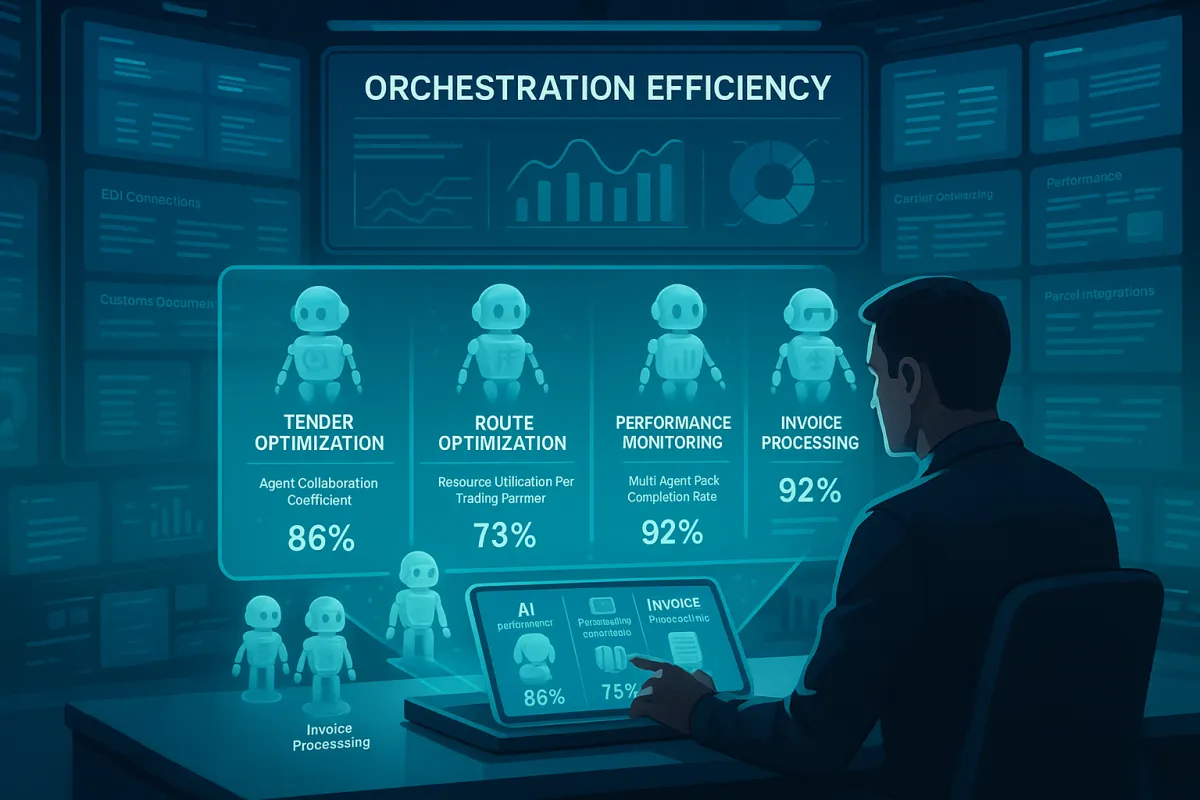
In EDI/TMS environments, agent sprawl manifests in predictable patterns. Your procurement team deploys an agent for tender optimization. Transport planners launch another for route optimization. Carrier management implements a third for performance monitoring. Finance adds agents for invoice processing and dispute resolution. Each operates independently, creating what one supply chain director called "a coordination nightmare."
A recent Security Boulevard analysis described this as "permission sprawl meeting governance drift." Permissions have accumulated across enterprise environments without review, and AI agents are now operating within those unaudited permission structures.
The financial impact compounds quickly. The 73% of CIOs who regret AI vendor decisions aren't regretting moving too slowly. They're regretting moving without the infrastructure to govern what they deployed. When 71% of those same CIOs say their AI budget faces cuts if ROI targets aren't met by mid-2026, the pressure to get governance right has never been higher.
Orchestration Efficiency: The New Performance Metric That Matters
Traditional EDI metrics focused on transaction volume and error rates. But when you're managing dozens of specialized agents across TMS platforms like Cargoson, Transporeon, nShift, and MercuryGate, these metrics become insufficient. You need orchestration efficiency (OE) metrics that measure how effectively your agent ecosystem collaborates to complete complex multi-step processes.
The new measurement framework includes three core components:
Agent Collaboration Coefficient: This measures successful handoffs between agents during end-to-end processes. A well-orchestrated order-to-cash process might involve a tender agent, pricing agent, compliance agent, and tracking agent. The collaboration coefficient tracks how seamlessly these handoffs occur without human intervention or error.
Resource Utilization Per Trading Partner: Instead of measuring total API calls, this metric evaluates whether agents are duplicating work. If your carrier onboarding agent and performance monitoring agent both pull the same carrier data independently, you're experiencing orchestration inefficiency.
Multi-Agent Task Completion Rate: This measures end-to-end process success across your entire agent ecosystem. A 95% transaction success rate means little if it requires three different agents to complete manual reconciliation afterward.
AI orchestration promises to close this gap by coordinating decisions across the supply chain at machine speed. Businesses are using AI to manage inventory, forecast demand and coordinate vendors at machine speed—reducing delays, errors and human bottlenecks.
Multi-Agent Architecture Patterns for Supply Chain Systems
The most successful multi-agent implementations follow a consistent architectural pattern: one orchestrator agent that owns the overall plan, delegates tasks to specialized agents, and manages the integration points. This isn't revolutionary thinking—it mirrors how effective supply chain teams operate.
In EDI environments, this translates to specific role-based agents with clear boundaries. Your orchestrator agent manages the overall flow: when a new purchase order arrives via EDI, it determines which specialized agents need to process different aspects. The Trading Partner agent validates carrier capabilities and availability. The Compliance agent verifies customs and regulatory requirements. The Exception Handling agent manages disruptions or data quality issues.
A strategic orchestration framework should provide a flexible roadmap to guide organizations from initial strategy to a cohesive ecosystem of intelligent agents. Each agent maintains a limited toolset and clear mandate, preventing the scope creep that leads to agent sprawl.
Platform compatibility becomes critical. When evaluating solutions across vendors like Manhattan Active, Blue Yonder, and Oracle TM, ensure your orchestration framework can manage agents regardless of their underlying platform. AI vendors have worked to build open standards for agentic AI that will allow tools to communicate with each other across vendor platforms.
Governance Frameworks That Scale Without Breaking Operations
At the root of everything related to scalable AI is responsible AI — and that means governance. Chopra explains how Microsoft, through Copilot Studio, has addressed the challenge of scaling without losing control through a series of innovations, including lifecycle management, embedded enterprise controls, and Agent Evaluation, which enables automated agent testing within the Copilot Studio environment.
For EDI/TMS environments, governance starts with access controls. Not every agent needs direct database access. Your carrier performance agent might only need read access to delivery confirmations and tracking updates. The invoice processing agent requires write access to financial systems but shouldn't modify transport planning data.
Implementation requires integration with existing systems. Your governance framework must connect with ERP platforms, WMS systems, and TMS solutions from vendors like Alpega, Blue Yonder, and Cargoson. This integration enables single-source-of-truth visibility across your agent ecosystem.
The monitoring requirements extend beyond traditional system metrics. You need audit trails showing which agent made specific decisions, when those decisions were made, and what data influenced the outcome. When a carrier delivery fails and costs spike, you must trace the decision path across multiple agents to identify improvement opportunities.
Agent sprawl is already becoming an issue in the agentic AI industry. That's why leaders in the field are developing methods to contain it (think ServiceNow's AI Agent Orchestrator, Workday's Agent System of Record, or Microsoft's Agent 365).
Cost Control and ROI Measurement
Enterprise deployments of agentic AI are returning an average of 171% on investment, with US enterprises seeing even higher returns at 192%. These figures exceed traditional automation ROI by a factor of three, according to Deloitte's 2026 State of AI in the Enterprise report.
However, ROI measurement in multi-agent supply chain environments requires sophisticated attribution models. When your orchestrated agent system reduces carrier onboarding time from 48 hours to 6 hours, which agents contributed to this improvement? The data integration agent that automated document collection? The compliance agent that streamlined verification? The communication agent that managed stakeholder notifications?
Practical metrics include agent utilization rates measured against specific EDI transaction volumes. If your ASN processing agent handles 10,000 transactions daily but remains idle 40% of the time, you might consolidate this functionality with your invoice processing agent. Cost per EDI transaction should decrease as orchestration efficiency improves.
Trading partner onboarding time reduction provides a clear ROI indicator. A well-orchestrated agent system can reduce new carrier onboarding from weeks to days by automating compliance verification, EDI testing, and integration setup across platforms like Shiptify, Uber Freight, and 3Gtms.
Implementation Roadmap: 90-Day Framework
Yet, while early pilots often succeed, only one in 10 companies actually scaled their AI agents. One major issue: AI agents are only as effective as the data foundation supporting them.
Your implementation roadmap must account for this scaling challenge. Start with a single use case that provides clear value measurement. Pick carrier performance monitoring across your TMS environment. Define KPIs around delivery performance, cost optimization, and exception management. Run this orchestrated system in shadow mode for 30 days, comparing agent-driven decisions against current human processes.
Days 1-30: Foundation and Orchestrator Setup Implement your orchestrator agent with read-only access to core EDI and TMS data streams. Focus on data quality and integration stability rather than automation. Your orchestrator should successfully identify patterns and handoff opportunities without making autonomous decisions.
Days 31-60: Specialist Agent Deployment Add specialized agents for carrier management, compliance monitoring, and exception handling. Each agent operates in advisory mode, providing recommendations that human operators can accept or reject. Monitor collaboration patterns and handoff success rates.
Days 61-90: Orchestrated Autonomy Enable autonomous decision-making within defined guardrails. Your system should handle routine carrier selection, compliance verification, and exception escalation without human intervention. Maintain human oversight for high-value transactions and complex exception scenarios.
Integration checkpoints with shipper TMS systems become critical during this implementation. Whether you're using Oracle TM, SAP TM, or solutions like Alpega and Cargoson, your orchestration framework must maintain platform-neutral operation while leveraging platform-specific capabilities.
Future-Proofing Your Orchestration Strategy
In 2026, AI agent sprawl is likely to increase across different programming languages, frameworks, infrastructure, and communication protocols. Your orchestration framework must accommodate this growing complexity while maintaining operational stability.
The vendor landscape continues evolving through consolidation and innovation. Building vendor-neutral orchestration becomes essential as TMS providers like MercuryGate, Descartes, and newer platforms like Cargoson develop different approaches to agent integration. Your framework should support multiple TMS platforms simultaneously without requiring complete re-implementation when switching vendors.
Gartner® predicts that, by 2028, "33% of enterprise software applications will include agentic AI, up from less than 1% in 2024, with at least 15% of day-to-day work decisions being made autonomously through AI agents." This proliferation makes orchestration frameworks more valuable over time rather than temporary solutions.
Regulatory compliance adds another future-proofing requirement. European transport regulations continue evolving rapidly, requiring your agent ecosystem to adapt automatically. Your orchestration framework should enable policy updates that cascade across all relevant agents without manual reconfiguration.
According to an estimate, more than 40% of today's agentic AI projects could be cancelled by 2027, due to unanticipated cost, complexity of scaling, or unexpected risks. Organizations with robust orchestration frameworks will avoid these cancellations by maintaining visibility, control, and measurable value across their agent ecosystems.
The competitive advantage belongs to supply chain organizations that treat agent sprawl prevention as a strategic capability rather than a technical problem. By implementing orchestration efficiency metrics and governance frameworks now, you position your operations to leverage the expanding agent ecosystem while maintaining the operational control that drives business results.