The Critical Agentic AI-EDI Governance Crisis: How 73% of Supply Chain AI Implementations Fail Due to Poor Oversight and Your Complete Prevention Framework for 2026

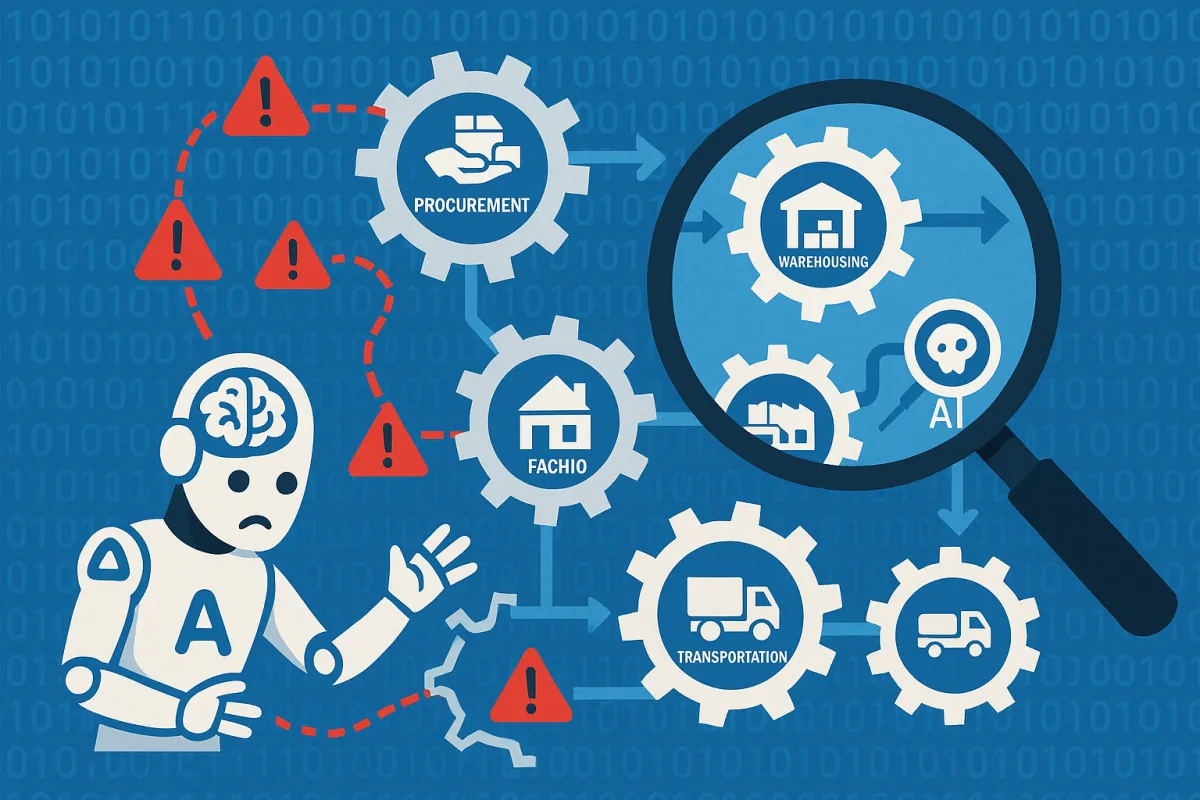
You're fighting a losing battle against agentic AI governance failures that affect 70-85% of implementations, creating what MIT researchers now identify as a 95% failure rate for enterprise AI projects. While senior management chases headlines about autonomous AI revolutionizing supply chains, two thirds of respondents haven't begun rolling out AI agents in any meaningful way, and those who have are discovering that trust in devolving decisions to AI agents is still shaky due to lack of transparency and issues with consistent outputs.
The scale isn't small. The Barracuda Security report identified 43 different agent framework components with embedded vulnerabilities, while mid-market security teams face unprecedented challenges as autonomous agents introduce emerging risks including prompt injection, tool misuse, memory poisoning, and cascading failures. Organizations deploying agentic AI systems faster than they can secure them are creating competitive gaps - but not in the way they expected.
The Hidden Scale of Agentic AI Governance Failures in Supply Chain EDI Systems
62% of the 2,000 enterprises McKinsey surveyed said they were experimenting with AI agents, but the gap between experimentation and actual deployment reveals the governance crisis. Despite $30-40 billion in enterprise investment, about 5% of AI pilot programs achieve rapid revenue acceleration while the vast majority stall, delivering little to no measurable impact on P&L.
What makes this particularly dangerous in EDI environments is that agents in procurement workflows can cascade failures through vendor verification, purchase order processing, and payment execution - by the time you realize something is wrong, the payment agent has already wired funds.
The financial implications extend beyond operational failures. Companies face administrative fines, blocked invoices, and loss of VAT deduction rights when AI agents make decisions without proper oversight. Major TMS vendors like MercuryGate, Descartes, and Transporeon are experiencing these governance gaps, while newer platforms like Cargoson are building governance frameworks into their architectures from the ground up.
Why Traditional EDI Governance Frameworks Cannot Handle Agentic AI Systems
Fully autonomous agentic AI is still way off, but AI agents are making inroads within enterprise workflows and have the potential to upend workflows, organizational structures, supply chains, and entire industries. Unlike traditional AI models that respond to input with structured output, agentic AI goes significantly further by transitioning from supply chain task automation to autonomous decisions.
Traditional governance practices like data validation, risk assessments, and continuous monitoring remain necessary but insufficient. Systems of governance need to be established and agentic AI solutions need to incorporate better security technology before meaningful deployments can scale.
The fundamental challenge is that AI agents cannot scale without clean, governed, and interoperable data, and data readiness is now AI readiness - without it, advanced capabilities like automated forecasting and risk sensing will fail. Traditional TMS providers like Oracle TM, SAP TM, and Manhattan Active struggle with these architectural transitions, while modern solutions like Cargoson design for agent-ready infrastructure.
The Four Critical Governance Gaps Breaking Agentic AI-EDI Integration Projects
Singapore IMDA has launched the Model AI Governance Framework for Agentic AI for reliable and safe deployment, recommending technical and non-technical measures to establish critical foundations for AI agent assurance. Their framework identifies four key areas that most organizations miss:
First, assessing and bounding risks upfront through AI agents must know not only what to optimize, but how far they are allowed to go. Second, increasing human accountability with human-in-the-loop governance directly embedded into AI agents through policies, guardrails, and auditability, including compliance with regulatory requirements and internal risk controls.
Third, implementing technical controls with context-aware permissions that define agent "action-space" and autonomy levels. Fourth, enabling end-user responsibility through clear escalation triggers when agents encounter scenarios outside their defined parameters.
Leading TMS implementations from Blue Yonder, 3Gtms, and Shipwell are retrofitting these governance layers, while Cargoson's governance-first approach builds these controls natively into the platform architecture.
The Complete Agentic AI Governance Implementation Framework for EDI Systems
Successful governance starts with staged autonomy where agents are deployed most likely across less critical functions, with businesses carefully monitoring their effectiveness before expanding permissions. This parallels how you'd onboard new employees - limited access initially, expanding privileges as trust develops.
Implementation requires observability frameworks with visibility into the servers and tools agentic systems are calling on, clear pictures of data flows and token cost estimates, plus inbuilt security measures like metadata locking to prevent tool poisoning. Deploy "governance agents" that monitor other AI systems and "security agents" that detect anomalous behavior.
Technical implementation steps include:
- Define agent permissions and data access boundaries before deployment
- Implement context-aware authentication and authorization
- Deploy continuous monitoring with dashboard alerts
- Establish incident response procedures for policy violations
- Create audit trails for all agent decisions and actions
Major platforms like E2open/BluJay, Alpega, and nShift are implementing these patterns, while Cargoson's governance-by-design approach demonstrates how modern architectures can embed these controls natively.
Human-in-the-Loop Design Patterns That Actually Work in Production EDI Environments
To prevent cascading failures and misaligned behavior, implement human-in-the-loop checkpoints for actions with financial, operational, or security impact - an agent should never transfer funds, delete data, or change access control policies without explicit human approval, creating a circuit breaker that provides a critical safety net.
The most effective pattern isn't viewing human oversight as acknowledging AI limitations, but designing digital co-pilot for logistics where success isn't about replacing humans but augmenting them. Evolutionary implementation starts with human validation for all decisions, transitioning to autonomy as confidence grows through proven reliability metrics.
Practical escalation triggers include:
- Financial transactions above predefined thresholds
- Supplier onboarding or status changes
- Route modifications affecting delivery commitments
- Inventory allocation decisions during supply constraints
FreightPOP, ShippyPro, and Sendcloud demonstrate these patterns in production, while Cargoson's human-AI collaboration model shows how native governance design can make oversight seamless rather than burdensome.
Building Future-Proof AI Governance That Survives TMS Vendor Changes
As we look toward 2030, the key characteristic of successful operations is no longer just efficiency; it is intelligence at scale, and this shift to an ecosystem or network model is critical for 2026 and beyond. Integration complexity requires seamless coordination among TMS, WMS, ERP and external data sources.
By 2029, 45% of G2000 companies will have adopted agentic AI-driven channel management and orchestration, and this interoperability amplifies agility - when market conditions shift, changes cascade across partners in hours, not months.
Vendor-agnostic governance strategies focus on:
- API-first architecture that doesn't lock into proprietary formats
- Standardized data models that transfer across platforms
- Governance policies defined independently of implementation technology
- Audit and compliance frameworks that work across vendor ecosystems
This approach protects your governance investment across the competitive landscape including ShipStation/ShipEngine, AfterShip, and EasyPost, while positioning solutions like Cargoson as platform-agnostic governance enablers rather than vendor lock-in risks.
2026 Action Plan: Immediate Steps to Prevent AI Governance Failures
Supply chain disruption is the new normal, and most organizations aren't ready - industry surveys confirm that 78% of supply chain leaders anticipate disruptions to intensify over the next two years, but only 25% feel prepared. 2026 marks the reckoning when meaningful enterprise-wide bottom-line impact from AI continues to be rare, though respondents who attribute EBIT impact of 5 percent or more represent about 6 percent of organizations.
Your 90-day implementation checklist:
Days 1-30: Conduct comprehensive data audit to address data quality issues that consume 60-70% of project budgets and derail 70% of projects. Map current AI experiments and identify which have governance frameworks versus which are operating without oversight.
Days 31-60: Implement governance controls for existing AI agents. Deploy monitoring systems and establish human approval workflows for high-risk decisions. Train teams on escalation procedures and audit requirements.
Days 61-90: Pilot AI applications in high-impact areas like demand forecasting or route optimization where 25-30% improvements are achievable within months, but with governance controls built from day one rather than retrofitted later.
Budget planning should account for governance infrastructure representing 30-40% of total AI implementation costs - not an overhead expense, but the foundation that separates the successful 5% from the failing 95%.
The organizations that solve agentic AI governance first will gain sustainable competitive advantage. Those that deploy AI agents faster than they can secure them will join the 73% of implementations failing due to poor oversight. Position your organization among the governance leaders by implementing frameworks that handle non-deterministic outcomes while maintaining the operational reliability your supply chain depends on.