The Critical Agentic AI TMS Vendor Selection Framework: How to Evaluate Transportation Management System Autonomous Capabilities That Prevent the 76% Implementation Failure Rate and Future-Proof Your Supply Chain Operations in 2026

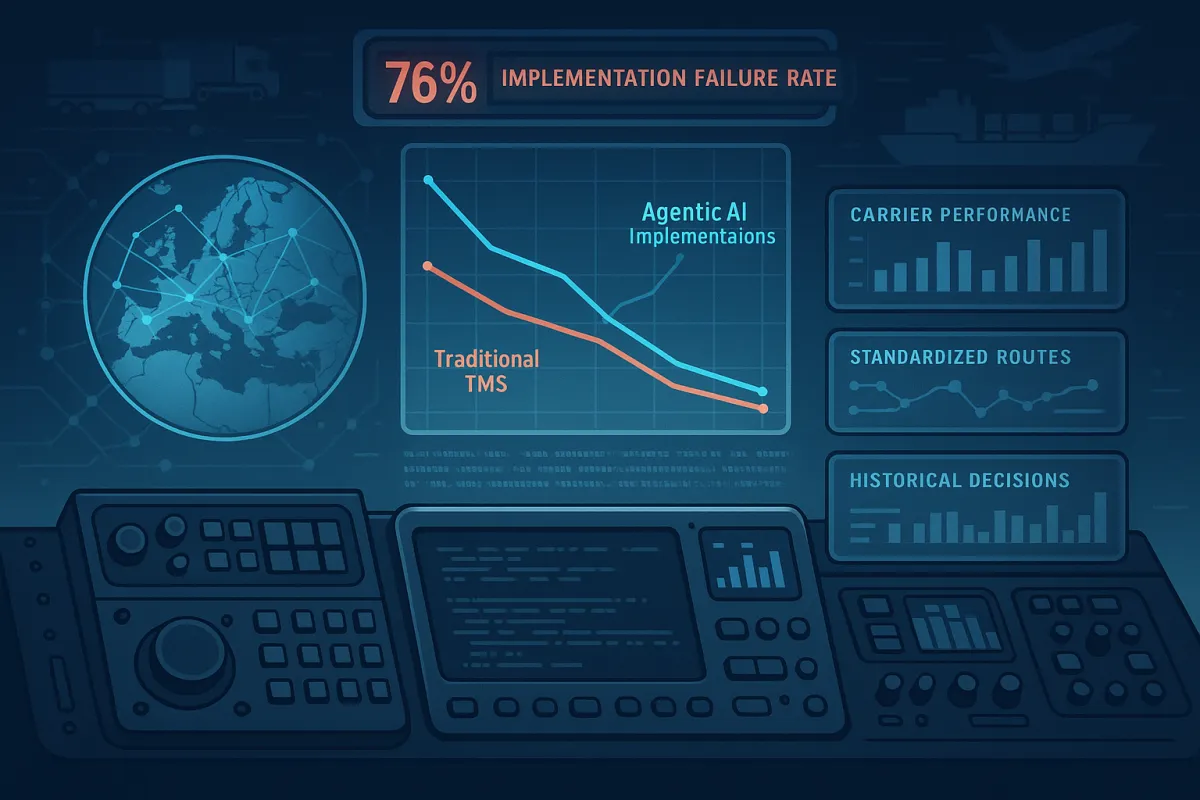
European shippers evaluating agentic AI TMS selection capabilities face a harsh reality: 76% of logistics transformations never fully succeed, failing to meet critical budget, timeline or KPI metrics, while Gartner predicts over 40% of agentic AI projects will be canceled by end of 2027. The challenge isn't the technology maturity—it's the evaluation framework most procurement teams use.
The stakes for getting this right have never been higher. 61% anticipating fully autonomous agentic AI within the next five years for TMS, yet many European logistics teams lack the technical background to properly evaluate or implement modern TMS platforms, making implementation a blind leading the blind scenario when companies select Transporeon, nShift, or Alpega without adequate technical resources.
The Agentic AI TMS Reality Check: Why 76% of Implementations Fail
Understanding autonomous transportation management systems requires acknowledging what separates successful deployments from the majority that never deliver their promised value. MIT research shows 95% of agentic AI pilots fail. The problem isn't technology limitations—it's approach. Only 15-20% deployed agents in production workflows touching real customers or critical business processes.
The implementation crisis stems from fundamental misunderstandings about what agentic AI actually means. Most failures stem from treating agentic AI as a technology deployment rather than an organizational transformation. Organizations succeed when they invest equally in governance frameworks, change management, and cultural adaptation alongside technical implementation.
European shippers face additional complexity that amplifies these risks. European agentic AI implementations must handle regulatory requirements as core functionality, not add-on features. From July 1, 2026, vans weighing 2.5-3.5 tons performing international transport will be subject to second-generation smart tachographs (G2V2). Your agents must automatically process this data for compliance reporting.
The vendor consolidation landscape creates additional uncertainty. Vendor consolidation trends create both risks and opportunities for European buyers. The three emerging categories—global mega-vendors (Oracle TM, SAP TM, E2open/WiseTech), European specialists (Alpega, nShift, Transporeon), and emerging European-native solutions like Cargoson—offer different risk profiles for long-term strategy planning.
Understanding Agentic AI vs Traditional TMS Automation
Most organizations confuse rule-based automation with true autonomous decision-making. Traditional TMS platforms suggest actions based on predefined criteria—agentic systems independently execute decisions within defined boundaries.
The distinction matters for TMS vendor evaluation framework design. Rather than pursuing universal AI assistants, successful implementations focus on specific use cases where autonomous decision-making provides clear business value. This bounded approach reduces risk while building organizational confidence.
This creates opportunities for European-focused solutions like Cargoson, Transporeon, and Alpega that understand specific operational requirements of cross-border European freight. European vendors develop capabilities that global platforms often miss—automatic carrier selection based on corridor-specific regulations, autonomous customs documentation handling, and real-time adjustment to member state variations.
The Data Foundation Prerequisites Most Vendors Ignore
Agentic AI implementation success depends entirely on data foundation quality, yet most organizational data isn't positioned to be consumed by agents that need to understand business context and make decisions. The 80% effort rule applies here—data engineering consumes most implementation resources, not feature configuration.
Master data requirements include clean carrier performance metrics, standardized route definitions, and historical decision patterns your agents can learn from. Assess whether you have clean master data for carriers, routes, and historical performance metrics. Without this foundation, even sophisticated agentic capabilities become expensive experimentation rather than operational assets.
European operations compound data complexity through multiple VAT rates, varying carrier protocols, and cross-border documentation requirements. Your evaluation framework must verify how vendors handle this complexity—not just whether they claim to support it.
The 7-Dimension Agentic AI TMS Evaluation Matrix
Standard feature-checklist approaches ignore the fundamental risks that derail European implementations. Use weighted scoring methodology evaluating technical capabilities (30%), European compliance (25%), implementation risk (20%), AI readiness (15%), and total cost of ownership (10%).
The evaluation matrix must address both technical architecture and business process autonomy. Vendors approaching agentic capabilities differently—European vendors like Cargoson, nShift, and Transporeon are implementing these capabilities differently than global platforms. While Oracle TM and SAP TM offer agentic features designed for worldwide markets, European specialists understand the nuanced requirements of cross-border operations.
Technical Architecture Assessment
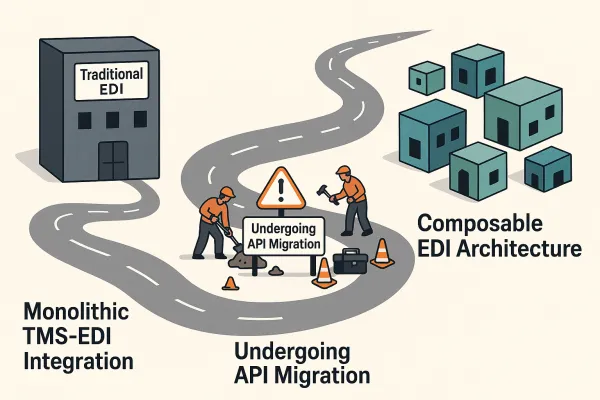
Integration patterns determine implementation complexity and long-term flexibility. Modern platforms require hybrid EDI-API capabilities that bridge legacy carrier connections with real-time decision execution.
Alpega connects to 80,000+ European transport professionals, MercuryGate offers broad North American coverage, and Cargoson focuses on European API/EDI connections. Cargoson builds true API/EDI connections with carriers, not just accounts in software or standardized EDI messages that carriers must implement themselves.
Real-time decision execution capabilities separate true agentic platforms from batch-processing systems. Your evaluation should test how quickly platforms can adjust routing decisions when capacity becomes available or disruptions occur. The competitive advantage comes from systems that continuously optimize rather than plan once per day. When traffic conditions change or capacity becomes available, intelligent route planning adjusts automatically.
Business Process Autonomy Evaluation
Bounded decision-making scope defines where agents can act independently versus when human oversight remains required. Stage 1: Recommend (Agent suggests, Human acts). Stage 2: Execute-with-Approval (Agent acts, Human clicks 'Confirm'). Stage 3: Narrow Autonomy (Agent acts independently within a $500/task limit).
Exception handling and escalation protocols become critical when agents encounter scenarios outside their training parameters. European operations create unique exception scenarios—unexpected border delays, carrier documentation failures, or regulatory changes—that your agentic system must handle gracefully.
European Regulatory Complexity and Agentic AI Requirements
eFTI represents the most significant European transport digitalization mandate since the introduction of electronic customs systems. As of January 2026, eFTI platforms can start preparing for operations, while July 9, 2027 brings full mandatory compliance.
The regulatory convergence creates both opportunities and risks for agentic implementations. European-native TMS vendors like Cargoson and Alpega maintain development resources focused exclusively on European market needs, providing advantages over global vendors treating European compliance as secondary requirements.
Cross-border decision algorithms must factor in varying regulatory requirements between member states. Cross-border complexity affects agentic decision-making algorithms directly. French carriers use different API standards than German logistics providers. Scandinavian forwarders require specialized integration approaches. Your agentic system must understand these variations and route decisions accordingly.
GDPR compliance and data residency requirements add another layer of complexity. GDPR compliance and data residency requirements add complexity to marketplace integration evaluation. Cargoson focuses specifically on European compliance requirements and GDPR-compliant carrier verification. Global platforms often require careful assessment of their European data handling practices.
The Phased Implementation Strategy That Prevents Failures
European regulatory timelines provide natural implementation phases: core functionality validation in Q2-Q3 2025, eFTI readiness by January 2026, G2V2 integration by July 2026. This phased approach reduces risk while ensuring your organization benefits from agentic AI capabilities without joining the majority of implementations that fail to deliver their promised value.
The phased approach aligns with vendor capability maturity. The next-gen Freight Procurement and next-gen Time Slot Management tools are currently in a beta phase that is planned to run until the first quarter of 2026. Starting with bounded pilots allows you to validate vendor claims before committing to full-scale deployment.
Pilot Program Success Metrics
Successful pilots focus on measurable business outcomes rather than technology demonstrations. Track cost per shipment, inventory accuracy, dwell time, and exception rates alongside response time improvements. European operations should monitor regulatory compliance accuracy—incorrectly processed customs documents or tachograph violations create expensive consequences.
ROI validation frameworks should encompass operational improvements beyond rate savings. Organizations typically see 5–10% savings on freight budgets by automating rate comparisons, with manual processes generating billing errors that automated systems eliminate through real-time validation.
Red Flags and Vendor Lock-in Prevention
Vendor consolidation accelerates faster than most procurement teams anticipate. WiseTech Global's $2.1 billion acquisition of E2open and Descartes Systems Group's acquisition of 3GTMS for USD 115 million signal the most significant vendor consolidation wave in TMS market history. This creates both immediate and long-term risks for agentic AI implementations.
Contract protection becomes essential during consolidation periods. Acquisition-resistant contracts require specific protections including 12-18 months advance notice for ownership changes, guaranteed functionality preservation for minimum periods, and migration assistance rights. Include specific clauses requiring 12-18 months advance notice of ownership changes, with automatic contract review rights triggered by acquisition announcements. Price protection clauses should lock pricing for 24 months following ownership changes.
Platform evaluation should specifically address vendor independence and development focus. European specialists including Cargoson maintain development focus on regional requirements, while global vendors spread resources across multiple markets. This focus difference affects both feature development priority and long-term platform stability.
Your TMS agentic capabilities assessment framework should evaluate each vendor category's risk profile: mega-vendors offer comprehensive functionality but come with integration complexity, European specialists provide market-specific knowledge but may lack global scaling capabilities, and European-native solutions offer rapid deployment and local expertise.
The procurement window narrows rapidly. The convergence of capacity shortages and vendor consolidation creates urgency, but rushed decisions amplify hidden costs and implementation risks. European shippers who act decisively within the next 90 days—with proper frameworks that account for both capacity and consolidation scenarios—position themselves to navigate 2026's perfect storm successfully. Those who delay risk joining the statistics of failed implementations and budget overruns.
Start your vendor evaluation now using this framework, but avoid the temptation to deploy everything simultaneously. Start with bounded scope: Single workflow, clear success criteria, measurable ROI. For European shippers, this might mean testing agentic route optimization for specific corridors or automating customs documentation for particular trade lanes rather than attempting full-scale transformation immediately.
The organizations that successfully navigate agentic AI TMS selection will be those that balance technological capability assessment with realistic implementation planning. The 76% failure rate serves as a reminder that technology selection alone doesn't guarantee success—but the right evaluation framework significantly improves your odds of joining the minority that actually deliver their promised value.