The Critical AS4 Protocol Migration Decision Framework: How to Evaluate AS2-to-AS4 Transition Requirements Without Breaking Trading Partner Networks and Build Future-Proof EDI Architecture for 2030 Compliance Mandates

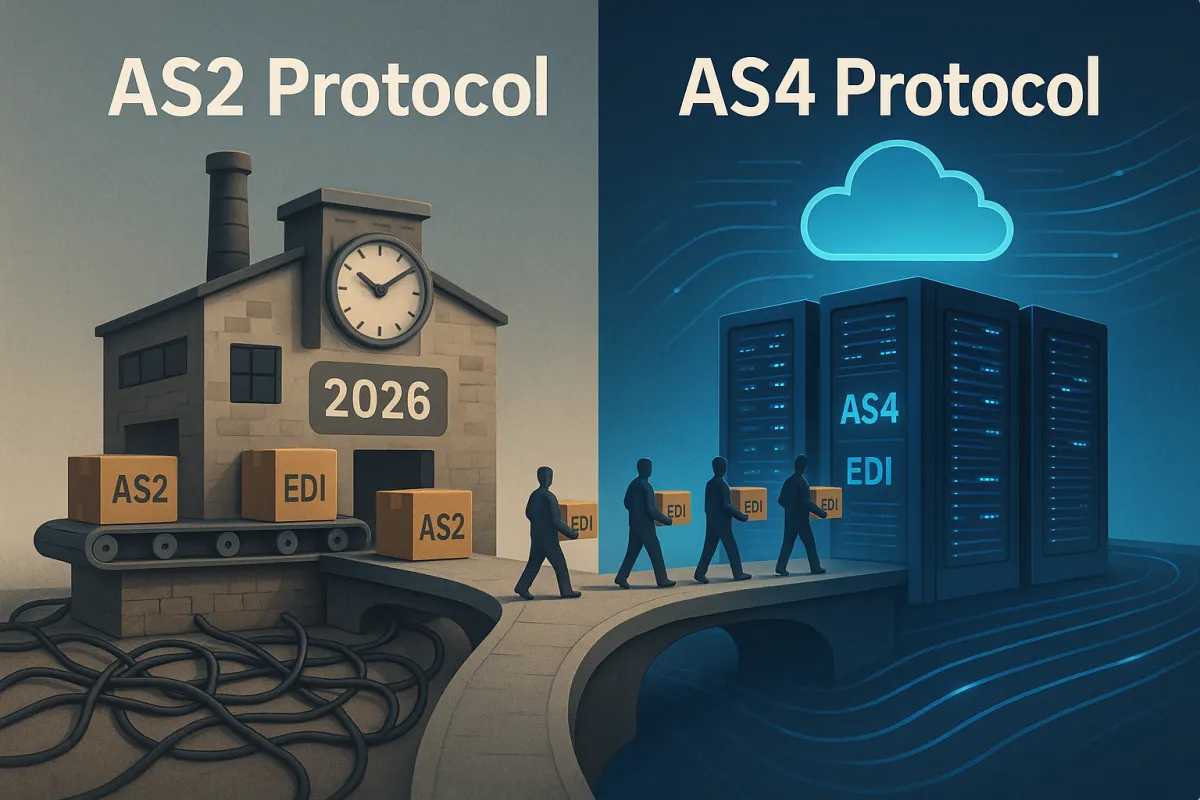
Multiple regulatory forces are converging to make AS4 migration a mandatory consideration for EDI teams in 2026. The EU's ViDA reform will require all intra-EU B2B and B2G invoicing to use the Peppol standard by July 1, 2030, and the PEPPOL network makes AS4 mandatory for its access points. Meanwhile, many major retailers and organizations still use AS2 and have not yet upgraded to AS4, creating a complex migration challenge that demands careful strategic planning.
The AS4 Migration Imperative Driving 2026 EDI Strategy Decisions
European regulatory mandates are reshaping EDI protocol decisions faster than most organizations anticipated. Countries are already phasing in national mandates (France, Belgium, Poland, Romania, Germany, Spain), and from 1 July 2030, intra-EU B2B transactions must use structured e-invoices. Belgium leads this transformation, implementing mandatory electronic invoicing for all B2B transactions starting January 1, 2026, based on the Peppol BIS 3.0 standard.
The technical implications run deeper than compliance checkboxes. AS4 is an exchange standard recommended by the European Commission for delivery and electronic invoicing projects, positioning it as the de facto protocol for future-proofing European operations. Companies operating across multiple EU markets face a stark choice: maintain separate protocol stacks for different jurisdictions or standardize on AS4 to align with emerging requirements.
Understanding AS4's Technical Advantages Over AS2
AS4 is layered over HTTP and built on web services standards such as SOAP, making it a strong successor to earlier Applicability Statement protocols such as AS3 and AS2. This architectural shift addresses fundamental limitations that have plagued AS2 implementations for years.
The most significant advantage lies in AS4's bidirectional messaging capabilities. AS4 supports both push and pull, so that recipients don't have to be connected at all times to listen for messages. This firewall-friendly design eliminates the connectivity challenges that force many organizations into complex network configurations with AS2. The newer AS4 protocol supports cloud computing environments and firewall-friendly systems, making it particularly attractive for organizations migrating to cloud-native architectures.
Compared to AS2, AS4 provides more agility and reliability for the modern B2B ecosystem thanks to SOAP-driven exchanges, XML, metadata, and WS-Security. However, this technical superiority comes with migration complexity that many EDI teams underestimate.
The Complete AS4 Readiness Assessment Framework
Your organization's readiness for AS4 migration depends on factors beyond technical capability. Start with infrastructure assessment: evaluate your current message volumes, peak processing requirements, and existing security frameworks. AS4 EDI transfers rely heavily on encryption and signatures, so even a small certificate mismatch or expiration can lead to message failures.
Document your trading partner landscape comprehensively. Create a matrix showing which partners currently support AS4, their migration timelines, and any hybrid requirements. Many organizations discover that their largest trading partners operate on different migration schedules, forcing extended periods of dual-protocol operation.
Cost-benefit analysis requires examining both obvious and hidden expenses. Implementation costs include software licensing, testing infrastructure, and staff training. However, AS4 is more compatible with standard environments than AS2, potentially reducing long-term integration complexity. Factor in the operational efficiency gains from AS4's ability to transport any type of payload (multiple if needed), including: legacy MFT, binary, XML, JSON and more.
Trading Partner Network Impact Analysis
The reality check: major retailers like Walmart mandate AS2 for supplier communications, establishing it as the dominant protocol in retail supply chains. This creates a strategic tension between regulatory compliance requirements and trading partner preferences.
AS2 remains the dominant standard, particularly for retail and healthcare sectors, due to its robust security features, widespread adoption, and comprehensive non-repudiation capabilities. EDI teams must navigate this landscape carefully, avoiding the assumption that regulatory mandates will automatically drive universal AS4 adoption.
Conduct trading partner interviews to understand their migration plans. Some partners may resist AS4 adoption due to internal constraints or competing priorities. Document these discussions and develop contingency plans for extended AS2 support periods. Remember that you do not require your EDIINT AS2 partners to migrate to AS4, but regulatory requirements may force your hand regardless of partner preferences.
Hybrid AS2-AS4 Implementation Strategy
Running both protocols simultaneously requires careful architectural planning. MFT tools provide certified support for AS2, AS3, and AS4, offering a "single pane of glass" for administration. However, dual-protocol environments introduce complexity in monitoring, troubleshooting, and staff training.
Design your hybrid architecture with clear separation between AS2 and AS4 message flows while maintaining unified monitoring and alerting. Using reliable AS4 software with strong logging and monitoring features can significantly reduce operational issues. Establish separate testing environments for each protocol to prevent cross-contamination during troubleshooting.
Consider integration platforms that support both protocols natively. Solutions from IBM Sterling, Cleo, SPS Commerce, TrueCommerce, and Cargoson each offer different approaches to dual-protocol management. Evaluate their monitoring capabilities, failover procedures, and upgrade paths when making vendor decisions.
TMS Integration Considerations for Protocol Migration
Transportation Management Systems add another layer of complexity to AS4 migration planning. EDI enables computer-to-computer information exchange over file transfer protocols (FTP, SFTP) or API-based systems (AS4, AS2). Your TMS architecture directly affects protocol migration feasibility and timeline.
EDI and TMS systems are tightly intertwined. Everything from tendering a load to confirming delivery relies on structured, automated data flows between shippers, carriers, and brokers. This tight coupling means protocol changes can trigger cascading effects throughout your transportation workflows.
Modern TMS platforms from MercuryGate, Descartes, Transporeon, nShift, and Cargoson generally support multiple protocol options, but implementation details vary significantly. The complexity of transportation EDI often stems from outdated protocols, brittle connections, or limited visibility into message failures. AS4's web services foundation can address these issues, but migration requires careful coordination between EDI and TMS teams.
Implementation Roadmap and Risk Mitigation
Phase your AS4 implementation to minimize operational disruption. Begin with low-volume trading partners who already support AS4, using these connections to validate your technical implementation and operational procedures. Teams that are not from a technical background often struggle with the initial learning curve of the AS4 communication protocol.
Create comprehensive testing protocols covering not just happy-path scenarios but also error conditions and recovery procedures. Many companies face challenges when coordinating between multiple partners, each with different AS4 server setups or security expectations. Your testing framework must account for these variations.
Develop rollback procedures for each migration phase. Document the specific steps required to revert to AS2 for critical trading partners if AS4 implementation encounters issues. This preparation proves invaluable when facing tight deadline pressures or unexpected technical problems.
Staff training requires both technical and operational components. Technical teams need deep understanding of AS4's WS-Security features for message integrity and non-repudiation to protect sensitive data during EDI exchanges. Operations teams need practical knowledge of monitoring, troubleshooting, and partner communication procedures.
Cost-Benefit Analysis Framework for AS4 Migration
AS4 implementation often proves less expensive than AS2 in the long term due to reduced infrastructure complexity. Many organizations use API technologies for internal integrations, so AS4 provides a natural way to extend integrations to external sources. This alignment with existing enterprise architecture can reduce training costs and simplify maintenance procedures.
Calculate total cost of ownership over a three-year period, including software licensing, implementation services, staff training, and ongoing support. Factor in potential cost savings from simplified certificate management, reduced firewall configuration complexity, and improved automation capabilities.
Consider the compliance cost avoidance factor. Organizations operating in EU markets face potential penalties and business disruption if they fail to meet regulatory deadlines. These risk mitigation benefits often justify AS4 migration costs even when direct operational savings aren't immediately apparent.
Future-Proofing Your EDI Architecture for 2030 Compliance
The ViDA package introduces a real-time digital reporting system based on electronic invoicing for cross-border B2B trade within the EU, requiring businesses to issue e-invoices according to the European e-invoicing standard EN 16931. This regulatory framework extends far beyond simple protocol compliance, establishing new data quality and timing requirements.
PEPPOL implements specific standards for message construction, as well as a communications network based on Access-Points that guarantee total interoperability between all network nodes using AS2 and AS4 as the communications protocol. Understanding this four-corner model architecture becomes essential for organizations planning European operations beyond 2030.
Strategic technology partnerships prove increasingly valuable in this environment. Companies that choose integration platforms with demonstrated AS4 expertise and European regulatory knowledge position themselves for smoother transitions. Cargoson and other forward-thinking integration providers offer not just technical capability but also regulatory guidance and implementation support.
The 2030 compliance landscape demands EDI architecture that can adapt to evolving requirements without massive rework. Although the initial implementation poses challenges, particularly for businesses that need to invest in e-invoicing technology, the ViDA package promises substantial long-term benefits: reduced fraud, lower administrative burdens, simplified compliance for cross-border trade.
Your AS4 migration decision framework should balance immediate trading partner needs against regulatory requirements and long-term architectural goals. Organizations that approach this transition strategically, with proper assessment, phased implementation, and strong vendor partnerships, position themselves to thrive in the post-2030 compliance environment while maintaining operational excellence throughout the migration period.