The Critical EDI Agent Sprawl Prevention Framework: How to Build Orchestrated Agentic AI Systems That Eliminate the 50+ Agent Management Crisis and Maintain Supply Chain Data Flow Integrity in 2026

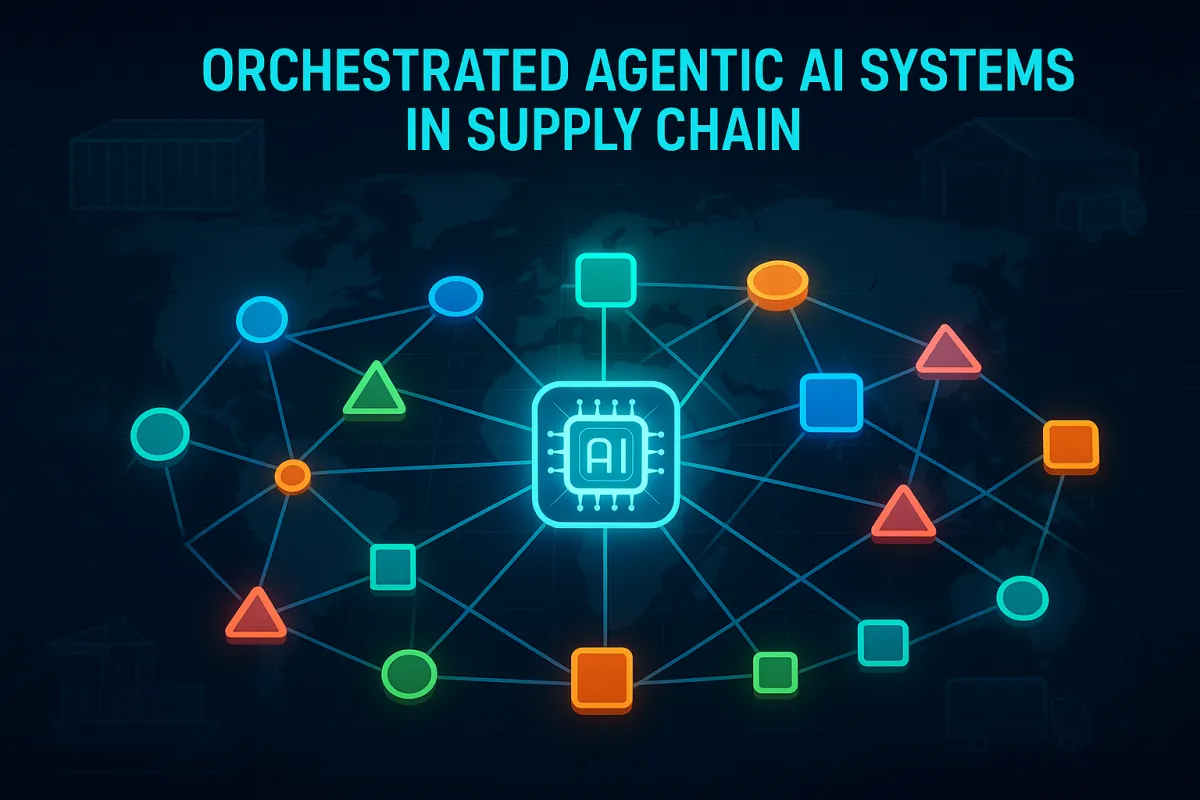
By early 2026, the novelty phase of AI agents has officially ended and been replaced by a looming systemic liability. If 2025 was the year of the pilots, 2026 is the year of the collision. Gartner recently predicted that 40% of enterprise applications will feature task-specific AI agents by the end of this year. For the average organization, this translates to a fleet of 50+ specialized agents, becoming the new "Shadow IT" if left unmanaged.
The picture is stark for EDI managers facing this new reality. When your marketing agent, supply chain agent, and HR bot all operate in silos, you don't have an automated workforce; you have a digital riot. Uncoordinated agents lead to "token hemorrhaging", where redundant API calls and overlapping compute tasks quietly erode ROI. This creates a dangerous compound effect when procurement agents, logistics agents, and compliance agents all attempt to process the same EDI transactions, often triggering conflicting actions across your trading partner network.
The Hidden Crisis of EDI Agent Sprawl That's Breaking 80% of Supply Chain AI Implementations
When this decentralized development occurs without a unifying strategy, the result is "agent sprawl"—a costly and uncontrolled proliferation of siloed, insecure, and duplicative AI agents. While individual teams may achieve localized successes, this bottom-up approach paradoxically undermines the enterprise-wide ROI of AI.
In EDI operations, agent sprawl manifests as multiple uncoordinated AI systems handling different aspects of trading partner relationships. One agent manages ASN processing while another handles invoice validation, and a third monitors supplier compliance—all pulling from the same EDI data feeds but lacking coordination. More than 4 in 5 IT leaders believe the proliferation of AI agents will yield more complexity than value due to integration challenges and silos.
The financial impact hits faster than most expect. McKinsey found that while 88% of organizations use AI, only 39% can point to any EBIT impact. In EDI environments, this translates to multiple agents consuming expensive API calls to the same ERP systems, duplicate data mapping processes, and overlapping compute resources across X12, EDIFACT, and custom format processing.
TMS vendors face particular challenges here. Major platforms like MercuryGate and Descartes now integrate with multiple AI agents for route optimization, carrier selection, and shipment tracking. But without orchestration, these agents often compete for the same transportation data, creating bottlenecks that defeat the automation purpose. Even newer solutions like Cargoson require proper orchestration foundations to prevent their AI capabilities from contributing to sprawl rather than solving operational challenges.
The Core Architecture Components of Successful EDI Agent Orchestration
Handoff orchestration: Agents dynamically delegate tasks to one another without the need for a central manager. Each agent can assess the task and decide to either handle it or transfer it to another agent with more appropriate expertise, similar to a referral system. This pattern works particularly well for EDI workflows where different agents handle various transaction types—purchase orders, advance ship notices, invoices—but need to coordinate based on trading partner requirements.
The distinction between centralized and decentralized orchestration matters significantly in production EDI environments. Centralized orchestration is the simplest: one manager controls everything. Great for prototypes, terrible for production scale because that single point of failure will bite you. Decentralized setups let agents communicate peer-to-peer, which scales beautifully but makes debugging a nightmare when something goes wrong at 3am. Hybrid approaches combine centralized control with decentralized execution, which is what most enterprises actually need but also the hardest to implement correctly.
Data governance layers prevent conflicts between agents operating on the same EDI data streams. When procurement agents need real-time PO status while logistics agents require ASN validation, proper orchestration ensures both get accurate information without creating duplicate API calls to your ERP systems. This pattern is helpful for highly regulated or distributed environments. It enables collaboration across different organizational silos or systems while maintaining data governance and security.
Modern platforms increasingly rely on emerging standards. Anthropic's Model Context Protocol (MCP) is becoming critical infrastructure here. It standardizes how agents access tools, preventing the sprawl where every agent needs custom integrations. This becomes essential when Cargoson's TMS agents need to coordinate with enterprise EDI platforms without creating proprietary integration complexity.
The Three-Pillar Governance Framework for Production-Ready EDI Agents
Safe integration requires reliable APIs with rollback paths, particularly when agents make autonomous decisions affecting trading partner relationships. They will likely adopt frameworks and solutions to integrate human judgment into agentic workflows for higher confidence, quality, and accountability. Additionally, a progressive "autonomy spectrum"—humans in the loop, on the loop, and out of the loop—will emerge based on task complexity, business domain, workflow design, and outcome criticality.
Authority boundaries become critical when AI agents can auto-execute EDI transactions versus requiring approval. Purchase orders under $10,000 might process automatically, while anything above requires human validation. Invoice discrepancies below 5% could trigger automatic supplier notifications, while larger variances escalate to procurement teams. Clear system-of-record ownership prevents conflicts when multiple agents access the same supplier master data.
Human-in-the-loop versus human-on-the-loop models vary by EDI transaction type. Routine 850 purchase orders might operate with humans on the loop—monitoring dashboards and handling exceptions. But 832 price catalogs affecting thousands of SKUs require humans in the loop for validation before processing. Agents gain "execution authority" but within defined policies. Humans retain strategic roles, not tactical oversight. The shift is from "approve every action" to "define boundaries and handle exceptions."
Compliance and auditability requirements intensify in regulated industries. Healthcare EDI transactions processing 837 claims need full audit trails showing which agent made decisions and based on what data. Agent orchestration platforms will also need to incorporate regulatory compliance, an area where international efforts are advancing. The European Union AI Act sets requirements around risk assessment, transparency measures, technical safeguards, and human oversight.
Preventing the "Agent Collision" Scenario in Multi-Vendor EDI Environments
Enterprises who fail to implement an orchestration layer by mid-year will spend the rest of 2026 cleaning up "agent collisions" and explaining budget overruns. Agent collisions occur when multiple AI systems attempt to process the same EDI data simultaneously, creating race conditions that can corrupt transaction processing or trigger duplicate actions.
In mixed TMS environments, these collisions become particularly dangerous. Consider an organization using MercuryGate for LTL shipments, Descartes for international freight, and Cargoson for final-mile delivery. Without orchestration, an agent monitoring shipment delays might simultaneously trigger notifications through all three systems when a single delay affects a multi-modal shipment, overwhelming both internal teams and trading partners with redundant communications.
Orchestration efficiency (OE) metrics provide measurable frameworks for preventing these scenarios. Each framework was executed 100 times, and we measured pipeline latency, token usage, agent-to-agent transitions, and the agent-to-tool execution gap to isolate true orchestration overhead. However, LangGraph finished 2.2x faster than CrewAI, while LangChain and AutoGen showed 8-9x differences in token efficiency. High OE means agents collaborating effectively; low OE indicates resource competition.
The measurement reveals infrastructure requirements. Redis consolidates vector search, memory management, state coordination, and messaging into one in-memory product, replacing separate vector databases, caching layers, and message queues with complete multi-modal capabilities. Redis delivers fast semantic retrieval for agent context management. Redis reduces vendor sprawl, simplifies operations, and can cut infrastructure costs while meeting the latency requirements important for real-time multi-agent coordination.
The Step-by-Step Implementation Roadmap for EDI Agent Orchestration
Design orchestration foundation instead of connecting agents directly to core systems. Rather than having procurement agents directly query your ERP for PO status while logistics agents separately poll for shipment updates, create an orchestration layer that coordinates data exchange, permissions, and event handling across ERP, WMS, and TMS systems.
We predict, in 2026, the most advanced businesses will begin to lay the foundation of shifting toward human-on-the-loop orchestration. This means developing systems where agents handle routine EDI transaction processing while humans monitor performance dashboards and step in for exceptions rather than approving individual transactions.
Phased rollout strategy minimizes risk by starting with low-stakes decisions. Begin with agents handling 810 invoice notifications—information-only transactions with minimal business impact. Once confidence builds, expand to 855 purchase order acknowledgments, then eventually to 850 purchase orders that trigger procurement actions.
Testing and validation frameworks become essential for multi-agent EDI workflows. We measured agent-to-agent latency by calculating the average time between one agent's completion and the next agent's start across 100 runs, but the differences were minimal at the millisecond level. This reveals that framework architecture matters most for tool execution patterns and context management, not agent handoffs. The performance differences between frameworks stem from tool deliberation and context synthesis, not the time spent switching between agents.
Create sandbox environments that mirror production EDI transaction volumes. Test agent coordination under scenarios like trading partner format changes, unexpected data quality issues, and peak transaction periods. Validate that orchestration maintains data integrity when multiple agents process related transactions simultaneously.
Real-World Case Studies and ROI Measurement for Orchestrated EDI Systems
A leading financial institution reported deploying 117 agentic solutions that touch every part of its operations, delivering tangible bottom-line impact. These systems handle end-to-end workflows—such as supplier onboarding or contract renewal—without requiring a professional to oversee each step, thereby multiplying productivity across all lines of business.
Orchestration efficiency metrics measure the ratio of successful multi-agent tasks versus total compute cost. What separates organizations that prove ROI from those that do not is the metrics they track. Successful teams focus on the metrics that matter to CFOs: How quickly can a request move from initiation to contract signature? How accurate are supplier risk assessments?
Based on analysis of 150+ enterprise implementations, typical ROI exceeds 300% by year three with break-even occurring at 18 months. However, the key differentiator lies in measuring what AI prevents, not just what it produces. CFOs demanding ROI need metrics that capture what AI prevents, not just what it produces. Traditional KPIs weren't designed for proactive intervention. Our executive guide introduces five next-generation metrics — including Revenue-at-Risk Mitigation and Mean Time to Recovery — with formulas you can implement today.
Cost-benefit analysis shows concrete savings. Recent research shows that 46% of organizations are already using AI in their supply chains, with companies reporting significant improvements: transportation costs reduced by 5-10%, delivery reliability improved by up to 20%, and logistics costs cut by 15%. In EDI environments, these translate to reduced trading partner onboarding times, fewer manual interventions for exception handling, and decreased chargebacks from transaction errors.
Future-Proofing Your EDI Orchestration Strategy for 2027 and Beyond
In 2026, AI in the supply chain will move from proof‑of‑concept experiments to embedded, agentic capabilities that sit inside core business processes. Instead of only delivering dashboards and recommendations, AI agents will identify risks and opportunities, propose workarounds, onboard suppliers, and even trigger corrective actions automatically within trusted guardrails. This does not replace planners and logistics experts; it augments them. The emerging pattern is "human plus machine," where copilots embedded in planning workspaces and logistics processes handle repetitive analysis while people focus on scenario choice, exception management, and stakeholder communication.
Emerging trends in agent collaboration focus on autonomous decision-making capabilities. The next frontier in EDI intelligence involves agentic AI frameworks that bring autonomous decision-making to supply chains. These systems can execute bounded tasks like reconciling mismatched EDI fields or proposing replenishment orders while escalating complex cases to humans. Recent tests have demonstrated that generative AI models can now autonomously manage inventory and logistics decisions, signaling a breakthrough. Autonomous agents monitor shipments, validate invoices, analyze trading partner behavior, and even detect compliance issues shifting supply chain management from reactive firefighting to strategic orchestration.
Integration with newer technologies involves expanding beyond traditional EDI formats. The integration of the Internet of Things (IoT) with EDI represents the "physical-to-digital" bridge of the modern manufacturing and logistics sectors. The global IoT in manufacturing market is projected to reach USD 1.51 trillion by 2030, driven by the need for deeper operational visibility.
Scalability considerations require planning for exponential trading partner network growth. EDI technology trends and forecasts projects that the EDI market is anticipated to reach USD 74.36 billion by 2030. This growth demands orchestration frameworks that can handle thousands of trading partners without linear increases in management complexity.
Solutions like Cargoson must evolve alongside major enterprise vendors by building native orchestration capabilities rather than assuming external systems will handle coordination. The winners in 2027 will be platforms that treat orchestration as core infrastructure, not an optional add-on, enabling seamless integration within complex multi-vendor EDI environments while maintaining the agility that modern supply chains demand.