The Critical EDI Orchestration Gap Assessment Framework: How to Evaluate Platform Capabilities That Transform Document Exchange Into True Supply Chain Coordination and Prevent the 73% Implementation Failure Rate in 2026

When EDI systems fail to deliver supply chain orchestration capabilities, 73% of discrete manufacturing ERP implementations fail, often because organizations treat document exchange as equivalent to end-to-end business coordination. Data movement does not equal execution. Legacy integration platforms were built to connect systems and exchange documents. They do that job well, but they often break down when the supply chain shifts from "business as usual" into disruption mode.
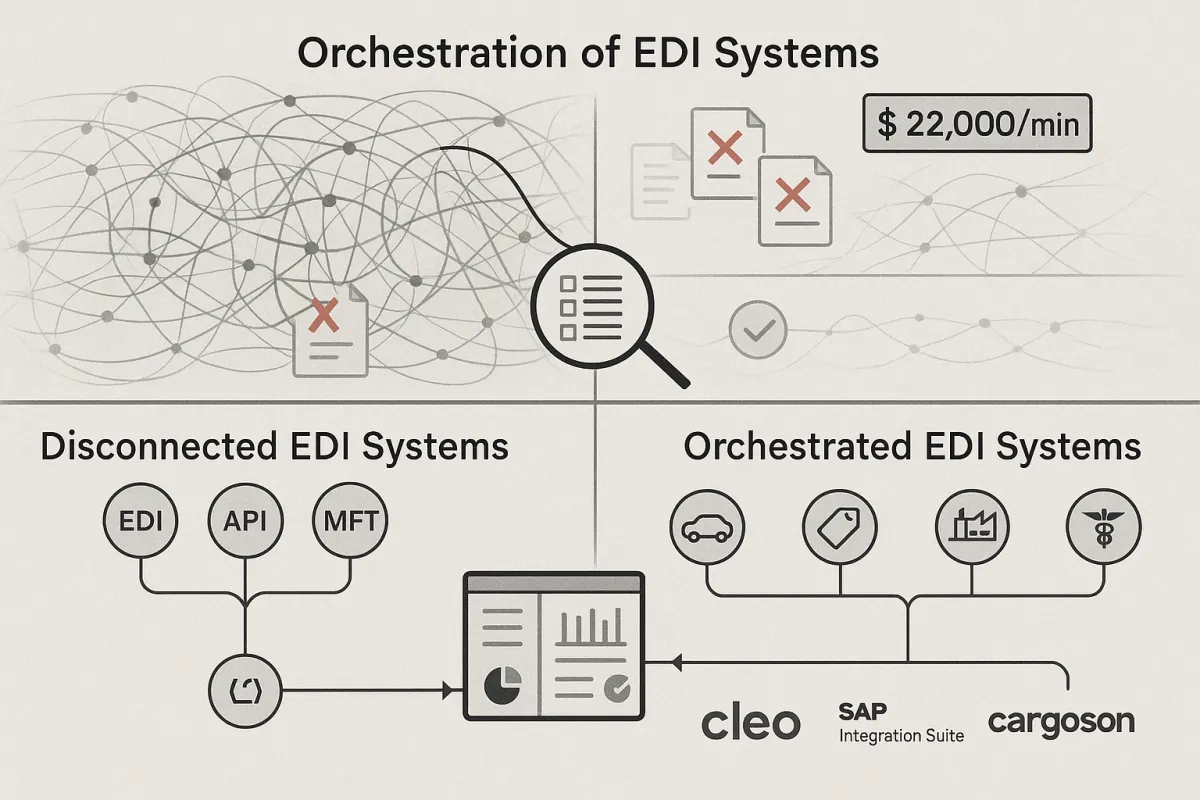
The difference matters more than most IT leaders realize. Document exchange handles the "what happened" part of supply chain operations. Orchestration handles "what happens next" and "who needs to act." For automotive manufacturers, downtime costs an astonishing $22,000 per minute. This figure alone demonstrates why proper EDI implementation is not merely a technical concern but a critical financial imperative.
Hidden beneath the surface of failed implementations lies a consistent pattern: organizations invest in integration tools that excel at moving data but lack the intelligence to coordinate actions across multiple trading partners. Nearly two-thirds (63%) of IT decision-makers report that the EDI onboarding process takes too long due to customized partner requirements. That's a symptom, not the root cause. The real issue is evaluation frameworks that focus on connectivity features instead of orchestration capabilities.
Core Assessment Framework: Five Critical Capability Areas
Building an effective EDI orchestration gap assessment requires evaluating platforms across five distinct capability areas that separate basic integration from true supply chain coordination.
Hybrid Integration Architecture Assessment examines whether platforms can unify EDI, API, and MFT protocols within a single orchestration layer. Evaluate platforms based on whether they unify API, EDI, and MFT, deliver real-time network visibility, and support coordinated action at scale. Most supply chains use a mix of automated EDI, APIs, and managed file transfer (MFT) to work with different partners, systems, and compliance requirements. When those connection types sit in different tools, data fragments across teams and processes. In disruption mode, that fragmentation slows response and weakens resilience.
Test this capability by mapping your current integration architecture. Count how many separate tools handle EDI transactions, API calls, and file transfers. Platforms like Cleo, SAP Integration Suite, and Cargoson offer unified approaches, but with varying degrees of orchestration intelligence.
Real-Time Visibility and Exception Management measures how platforms detect, prioritize, and escalate supply chain exceptions before they cascade into broader disruptions. Supply chain orchestration depends on three capabilities. Unified connectivity, real-time visibility, and actionable intelligence. This is what smart supply chain orchestration looks like in practice, a system that helps teams prioritize and act, not just monitor.
Automated Workflow Orchestration evaluates whether platforms understand document relationships and business process dependencies. Most legacy EDI tools simply move files from one point to another — they don't understand workflow dependencies or business context. As a result, they can't automatically detect when documents are sent out of sequence. Cleo addresses this through full workflow orchestration and business process visibility. The platform understands document relationships and sequence expectations, automatically validating order flows and notifying users when a step is skipped or delayed. This ensures complete, correct EDI exchanges every time.
Multi-Partner Governance and Compliance Controls assess how platforms manage trading partner requirements, compliance mandates, and data governance across complex supplier networks. When comparing SCM platforms, there are several critical features to consider: Starting with planning accuracy, real-time visibility, and integration with ERP/WMS/TMS, followed by scalability, embedded analytics/AI, supplier collaboration tools, and the platform's ability to support end-to-end process orchestration within a modern supply chain management system.
AI-Powered Decision Support and Autonomous Actions measure platforms' ability to move beyond reactive monitoring toward predictive orchestration. In 2026, AI in the supply chain will move from proof‑of‑concept experiments to embedded, agentic capabilities that sit inside core business processes. Instead of only delivering dashboards and recommendations, AI agents will identify risks and opportunities, propose workarounds, onboard suppliers, and even trigger corrective actions automatically within trusted guardrails.
Orchestration Maturity Assessment Matrix
Score your current platform and evaluate alternatives using this five-level maturity framework:
Level 1: Basic Document Exchange handles standard EDI transactions (850, 810, 856) with manual exception handling. Most legacy VAN-based systems operate at this level. Organizations score 1-2 points if they rely primarily on email notifications and spreadsheet tracking for exceptions.
Level 2: Connected Visibility provides real-time status tracking across trading partner networks with basic dashboard capabilities. Score 3-4 points if your platform offers centralized monitoring but requires manual intervention for most exceptions.
Level 3: Automated Exception Handling detects process deviations and triggers workflow actions based on predefined rules. This platform offers real-time supply chain planning and control, as well as what-if simulation. Its concurrent planning model helps break down silos across demand, inventory, and capacity planning. Score 5-6 points for platforms that automate exception escalation and basic corrective actions.
Level 4: Predictive Orchestration uses AI to anticipate supply chain disruptions and recommend proactive responses. Score 7-8 points if your platform provides predictive analytics and suggested actions before exceptions occur.
Level 5: Autonomous Supply Chain Coordination operates with minimal human intervention, automatically adjusting workflows and trading partner interactions based on real-time conditions. By using an agent orchestration platform to connect procurement, logistics, and customer service agents, the organization achieves seamless end-to-end optimization, driving both cost reductions and service improvements. By 2026, supply chains will operate as living systems, balancing cost, risk, and sustainability dynamically in real time. Score 9-10 points for platforms with proven autonomous capabilities.
Technical Evaluation Criteria for 2026
Technical assessment goes beyond feature checklists to examine how platforms handle integration complexity at enterprise scale.
Integration Layer Assessment evaluates native connectivity with ERP systems (SAP, Oracle, Microsoft Dynamics), warehouse management systems, and transportation management platforms. Test bi-directional data synchronization, not just one-way document exchange. Platforms should maintain data integrity during high-volume peak periods without requiring custom coding.
Data Model Unification measures how platforms standardize data across different systems and partners. Invalid or unexpected data is a significant cause of EDI integration failures. When data coming from a partner doesn't match what your data maps expect, it can create an error. Look for platforms that normalize data formats automatically and provide semantic mapping capabilities between different standards.
Exception Detection Frameworks should identify deviations from expected business processes, not just technical transmission failures. Evaluate how platforms handle sequence-dependent transactions, missing acknowledgments, and business rule violations. Advanced platforms use machine learning to improve exception detection accuracy over time.
For transportation management integration specifically, evaluate how platforms connect with TMS vendors like BluJay, Transporeon, and nShift. Cargoson provides orchestration capabilities that extend beyond basic EDI connectivity to include shipment planning and execution coordination across multiple carriers.
Financial Impact Assessment Methodology
Quantifying the financial difference between document exchange and orchestration requires measuring both direct costs and hidden operational impacts.
Hidden Cost Analysis reveals the true expense of orchestration gaps. A simple approach is to score your exposure across four areas: chargebacks, labor, errors, and opportunity cost. Once you've scored each category, patterns start to emerge. High exposure across multiple areas is a clear signal that manual EDI processes are creating measurable financial and operational risk.
Calculate manual intervention costs using this framework: For chargebacks multiply average rate by annual shipment value as baseline. For labor sum weekly hours across all manual EDI activities. For errors estimate revenue impact from delayed orders and fulfillment disruptions. For opportunity cost assess delayed partner onboarding or missed expansion due to system limitations.
ROI Calculation Framework for orchestration platforms differs significantly from traditional EDI assessments. A modern integration platform like DCKAP Integrator aims to deliver seamless EDI integration that boosts your "Gains" and cuts down your "Costs" in the ROI equation. Automating documents like Purchase Orders (850), Invoices (810), and Advance Ship Notices (856) cuts out manual entry. This also reduces costly errors. This directly reduces chargebacks and operational overhead.
Include strategic value calculations: improved trading partner satisfaction, faster onboarding of new suppliers, and reduced compliance risk. Organizations save approximately $30,000 annually per EDI integration, but orchestration platforms can multiply these savings by eliminating manual coordination across the entire partner network.
Risk Quantification should account for compliance penalties, trading partner chargebacks, and business continuity threats. In a comprehensive analysis of EDI integration failures, 66% of organizations reported losing up to $500,000 in 2020 due to non-compliance issues. Orchestration platforms reduce these risks by automating compliance monitoring and exception handling.
Implementation Risk Prevention Framework
Prevention starts with recognizing the difference between integration complexity and orchestration complexity.
Common Failure Patterns include treating orchestration as an integration upgrade, underestimating partner coordination requirements, and focusing on technical features instead of business process capabilities. Studies reveal that between 50%-75% of ERP transformation projects ultimately fail, frequently because end-users incorrectly use systems due to inadequate training.
Proof-of-Concept Testing should simulate real-world exception scenarios, not just successful transaction flows. Test how platforms handle document sequence errors, partner communication failures, and multi-step approval workflows. Include trading partners in POC testing to validate orchestration capabilities under realistic conditions.
Change Management Considerations must address the shift from reactive to proactive supply chain operations. Teams accustomed to manual exception handling need training on workflow automation and exception escalation procedures. If your stack looks like a set of capable tools with messy handoffs between them, orchestration is the layer that reduces the friction. It doesn't replace every system you already rely on. It makes them work together in a way that scales across sites, regions, and changing requirements.
Vendor Lock-In Prevention requires evaluating data export capabilities, API accessibility, and integration portability. Ensure platforms support standard data formats and provide migration tools for future platform changes.
2026 Future-Proofing Checklist
Future-proofing extends beyond current requirements to anticipate emerging supply chain orchestration needs.
AI and Agentic Capabilities Assessment should examine platforms' roadmaps for autonomous orchestration. Collectively, these advancements established the structured transaction data, cross-enterprise process visibility, and regulated execution environment required for agentic supply chain operations. With a trusted, auditable information layer now in place across a 310,000+ partner network, TraceLink enters 2026 positioned to activate governed AI agents capable of operating across real, multienterprise workflows.
Compliance Readiness includes evaluating platforms' support for emerging regulations like PEPPOL mandates, eFTI requirements, and carbon reporting standards. New US regulations, like California's SB-253, require Scope 1 and 2 emissions reporting starting in 2026. Your ERP must track this data automatically.
Hybrid Architecture Scalability measures how platforms handle increased transaction volumes, additional trading partners, and new integration protocols without performance degradation. In the supply chain world, orchestration also depends on connectivity. That's why some enterprise teams look at platforms like Cleo—not just as an integration layer, but as a way to unify how processes and partner interactions execute across a multi-enterprise network (EDI, APIs, and managed file transfer), with visibility and governance across the flow.
Integration with Control Tower Platforms should support emerging supply chain command centers that coordinate across multiple logistics providers, suppliers, and internal systems. Platforms need API connectivity with control tower solutions and data sharing capabilities that maintain security and governance standards.
Build your assessment framework around orchestration capabilities, not integration features. The 73% failure rate reflects organizations that treat supply chain coordination as a technology problem rather than a business process challenge. Focus your evaluation on platforms that understand the difference.