The Critical Hybrid EDI-API Integration Selection Framework: How to Build Future-Proof iPaaS Architecture That Eliminates Partner Onboarding Bottlenecks and Survives TMS Vendor Consolidation in 2026

Most mid-market supply chain teams know the feeling: you're managing 150+ suppliers, your TMS vendor just got acquired by a company you've never heard of, and that new retail partner is demanding API-first integration while your legacy EDI system requires six weeks to onboard anyone. Sound familiar?
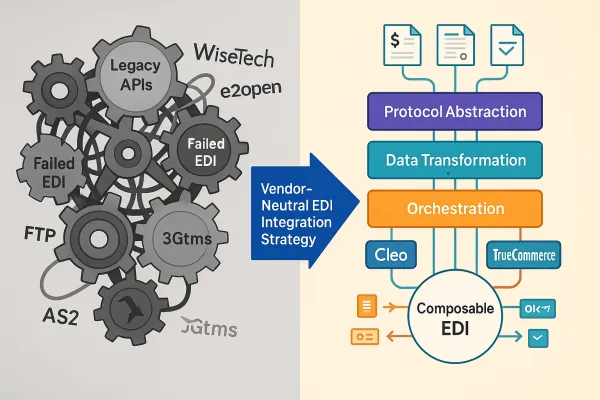
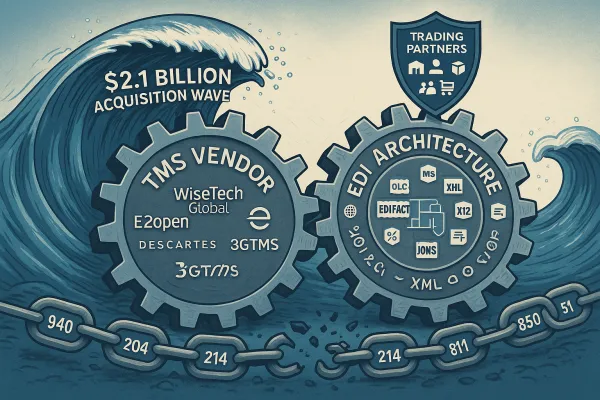
The 2026 supply chain integration landscape has reached a tipping point. The most critical trends include the shift toward Composable EDI architectures and the adoption of iPaaS for unified integration, while WiseTech's acquisition of e2open for $2.1 billion and Descartes' acquisition of 3Gtms for $115 million represent just the beginning of a massive vendor consolidation wave that's eliminating your options faster than you can evaluate them.
The Hidden Crisis in Traditional Integration Architecture
Your siloed EDI systems aren't just outdated—they're becoming dangerous business liabilities. Partners demand immediate visibility into order status and inventory, cloud applications require EDI integration with APIs, and IT managers need protection from evolving cyber threats. Traditional point-to-point connections that worked five years ago now create bottlenecks that cost real revenue.
Here's what's breaking: Nearly two-thirds (63%) of IT decision-makers say that the EDI onboarding process takes too long because of all the different customized requirements demanded by trading partners, while up to 47% of IT managers say that slow EDI supplier onboarding is currently keeping their businesses from capturing new revenue opportunities. When your integration architecture can't handle the basic requirement of connecting new partners quickly, you're not just losing efficiency—you're losing deals.
The numbers are stark: Nearly a quarter of companies (24%) are losing $500K or more to integration issues related to their supply chains. Traditional EDI platforms that were designed for predictable, static partner relationships can't adapt to the dynamic requirements of modern supply chains where approximately 40% of enterprises require over 30 days to onboard a new trading partner.
Why Hybrid EDI-API Integration Is No Longer Optional in 2026
Stop believing the myth that APIs will replace EDI. APIs are unlikely to fully replace EDI in the near future because of EDI's entrenched role and robust standardization for batch processing, with a hybrid approach emerging where APIs handle real-time status updates while EDI manages complex, high-volume document exchanges. The reality? You need both, working together intelligently.
The hybrid model isn't theoretical anymore. Logistics companies are using EDI for core transaction processing—purchase orders, invoices, advanced shipping notices—while APIs provide real-time tracking updates, inventory status checks, and exception notifications. Hybrid integration lowers costs by routing data through the most efficient channel, using low-cost APIs for frequent status checks and reserving EDI bandwidth for massive batch files.
Major TMS vendors have recognized this reality. Oracle Transportation Management, Manhattan Active TMS, and emerging platforms like Cargoson are building native hybrid capabilities rather than forcing customers to choose between EDI reliability and API responsiveness. The platforms that survive the current consolidation wave will be those that deliver both seamlessly.
The iPaaS Advantage Over Point-to-Point Solutions
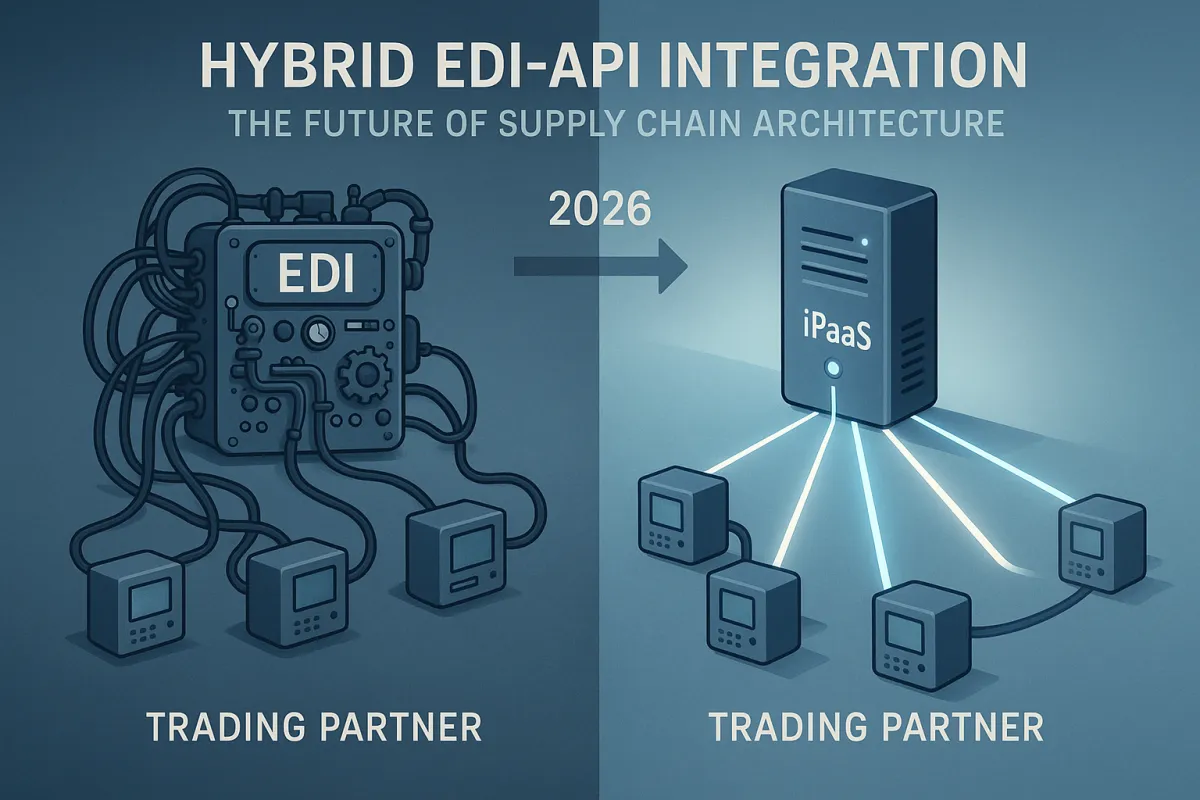
Traditional EDI relies on siloed, on-premise software focused solely on B2B exchange. iPaaS (Integration Platform as a Service) unifies EDI, APIs, and internal applications in the cloud, providing a single view of all data flows, offering better scalability and reducing the need for multiple vendors.
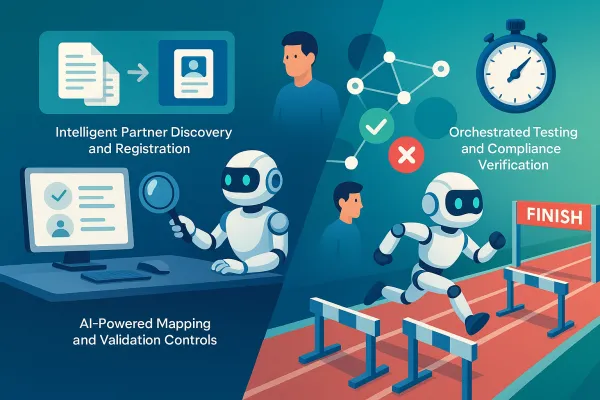
The iPaaS market reflects this shift: The Global Integration Platform as a Service Market is projected to expand from USD 16.21 Billion in 2025 to USD 64.74 Billion by 2031, achieving a CAGR of 25.96%. But the growth isn't just about market size—it's about capability. Modern iPaaS solutions are evolving from simple data transport tools into intelligent hubs that leverage machine learning to predict mapping requirements and automate workflows, thereby lowering technical barriers and allowing non-technical staff to manage integrations.
Leading iPaaS providers like Boomi, MuleSoft, and specialized EDI platforms have moved beyond basic cloud hosting. They're delivering pre-built connectors that reduce integration time by 80%, AI-assisted mapping that eliminates manual configuration errors, and event-driven architectures that trigger automated responses to supply chain exceptions. Platforms like BluJay TMS, Transporeon, and Cargoson are embedding these capabilities directly into transportation management workflows.
The Partner Onboarding Bottleneck That's Costing You Revenue
Partner onboarding isn't just an operational challenge—it's the primary constraint limiting your supply chain growth. Every week you spend configuring EDI mappings and testing connections is revenue left on the table. Clearly one of the biggest challenges businesses have with successfully executing an EDI strategy is the onboarding of new trading partners. Most EDI solutions including those recommended by a partner, an ERP provider, or a marketplace are still bringing trading partners on line electronically the same way as they've been doing for years.
The problem compounds when you consider security requirements. The exchange of sensitive business information in EDI transactions raises concerns about data integrity, security, and privacy. Meeting regulatory requirements, especially in highly regulated industries or across borders, adds complexity to ensuring secure data transfer. Traditional approaches treat security as an afterthought, requiring separate authentication processes for each partner.
Modern transportation challenges amplify these delays. Whether you're working with established carriers like C.H. Robinson, regional providers, or emerging platforms like nShift and Cargoson, each partnership requires unique integration patterns. The traditional approach of custom-coding each connection doesn't scale when market pressures demand rapid partner expansion.
The API-First Onboarding Strategy
An API-First strategy uses APIs as the primary, simple entry point for trading partners, eliminating the need for them to have deep EDI expertise. The system then translates these API inputs into standard EDI formats in the backend, accelerating onboarding times while maintaining internal data standardization.
This isn't just theory. Companies implementing API-first onboarding report partner activation times dropping from 30+ days to under a week. The approach works because it separates partner-facing complexity from internal system requirements. New partners connect through standard REST APIs while your core systems continue receiving properly formatted EDI transactions.
TMS platforms are adapting accordingly. SAP TM's "Joule" AI assistant, Manhattan Active's unified platform approach, and 3Gtms/Pacejet integration capabilities (now part of Descartes) all emphasize simplified partner interfaces. Platforms like Cargoson have built API-first architectures from the ground up, eliminating the technical debt that slows traditional EDI onboarding.
The TMS Vendor Consolidation Risk Assessment Framework
The transportation management software landscape is experiencing unprecedented consolidation that threatens integration stability. Market consolidation will continue, with experts expecting more of the same at least through the first couple of quarters of 2026. The European TMS market, valued at €1.4 billion in 2024 and growing at a compound annual growth rate of 12.2 percent, is forecasted to reach €2.5 billion by 2029. This growth is happening alongside unprecedented consolidation that's eliminating choice and creating new risks for procurement teams.
Recent major acquisitions include WiseTech's purchase of e2open, Descartes' acquisition of 3Gtms, and Körber's transformation of MercuryGate into Infios. Due to their size and numerous divisions, large retailers, manufacturers and 3PLs will be consolidating their various TMS vendors and systems into one larger "legacy" TMS system through a multi-year transformation effort.
The consolidation creates immediate risks: integration compatibility changes, support team transitions, roadmap redirections, and price increases. When your TMS vendor gets acquired, you inherit integration risks without controlling the outcome. You face a perfect storm: regulatory deadlines approaching, vendor consolidation accelerating, and 66% of technology projects end in partial or total failure, while 17% of large IT projects go so badly, they threaten the very existence of the company. When your TMS vendor becomes an acquisition target, you inherit these integration risks without directly managing the project.
Smart procurement teams are building acquisition-resistant strategies. This means choosing platforms with open integration architectures, avoiding vendor lock-in through proprietary connectors, and maintaining relationships with multiple TMS providers. Whether you're evaluating Oracle TM, Blue Yonder, Uber Freight, or emerging platforms like Cargoson, ensure your integration strategy survives ownership changes.
Implementation Framework: 6-Phase Hybrid Integration Selection
Phase 1: Current State Integration Audit
Document every integration touchpoint: EDI connections, API endpoints, file transfers, and manual processes. Map data flows between your ERP, TMS, WMS, and trading partner systems. Identify bottlenecks where manual intervention breaks automation. Measure actual onboarding times versus target requirements.
Phase 2: iPaaS Platform Evaluation Criteria
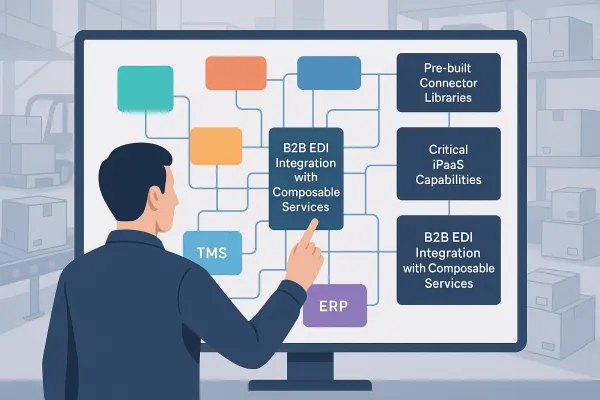
Evaluate platforms based on pre-built connector libraries, not just generic integration capabilities. Most modern EDI iPaaS solutions offer connections to over 1,000 trading partners through a single integration platform. From one dashboard, users can easily connect systems, automate workflows, and monitor all transactions with minimal effort. Focus on platforms offering connectors for your specific ERP (SAP, Oracle, Microsoft Dynamics), TMS providers, and key trading partners.
Phase 3: Hybrid Architecture Design
Design integration patterns that leverage both EDI and API strengths. Use EDI for high-volume, structured transactions like purchase orders and invoices. Reserve APIs for real-time status updates, exception notifications, and dynamic routing changes. Ensure your chosen platform supports both patterns without forcing architectural compromises.
Phase 4: Pilot Implementation and Testing
Start with your most complex trading partner relationship—if the platform handles that successfully, simpler connections will follow easily. Onboarding a new partner and configuring an integration that works with their unique system can require mapping changes, multiple rounds of testing, clear coordination and communication, and time. Templates for common partner configurations can help accelerate the onboarding process. Test both happy path scenarios and exception handling.
Phase 5: Security and Compliance Validation
To protect the organization and its partners, integrations should incorporate security measures such as encryption for data in transit and at rest and secure authentication protocols. Regular security reviews help organizations spot weaknesses in their security posture. Validate compliance with industry standards like GDPR, SOX, and sector-specific regulations.
Phase 6: Scaling and Optimization
Implement monitoring and analytics that provide actionable insights, not just transaction logs. Organizations with poor data integration achieve only 3.7x ROI from AI vs. 10.3x for well-integrated enterprises. Plan for AI-powered optimization features that modern platforms like Workato, Celigo, and Cargoson are building into their integration workflows.
Future-Proofing Your Integration Investment
The integration platforms that will dominate 2026 and beyond share common characteristics: they treat AI as a core capability, not an add-on; they provide unified visibility across EDI and API transactions; and they democratize integration management for business users, not just technical teams.
AI is transforming EDI by automating complex data mapping and predicting supply chain disruptions. Tools like Agentic AI can autonomously resolve transaction errors, optimizing workflows and reducing manual intervention in real-time. Leading platforms are embedding these capabilities directly into integration workflows.
The competitive advantage goes to companies that can onboard partners in days, not weeks, while maintaining the reliability and compliance that EDI provides. Whether you choose established platforms like Boomi and IBM Sterling, specialized EDI providers like Cleo and TrueCommerce, or emerging unified platforms like Cargoson, ensure your architecture supports both current requirements and future innovations.
Your integration strategy determines whether your supply chain thrives or merely survives the challenges ahead. By embracing these trends, organizations can acquire the means to pivot more quickly to new market opportunities and significantly reduce the time it takes to get up and running with new partners. Organizations that modernize their EDI environments consistently report one major advantage: speed.
The question isn't whether to modernize your integration architecture—it's how quickly you can implement hybrid EDI-API capabilities before the next acquisition wave eliminates your preferred vendors. Start your evaluation now, because in 2026's consolidating market, the platforms that survive will be those that solve partner onboarding bottlenecks while delivering the reliability that supply chains demand.