The Critical iPaaS-EDI Integration Evaluation Framework for TMS Selection: How to Prevent the 73% Implementation Failure Rate by Properly Assessing Composable Architecture Capabilities Before Vendor Selection in 2026

A staggering 76% of logistics transformations never meet their budget, timeline, or performance targets, yet European manufacturers continue racing toward TMS implementations without understanding the iPaaS EDI integration capabilities that determine success or failure.
The iPaaS market has surpassed $1 billion and is expected to reach $7 billion by 2026, but this growth masks a critical gap: most organizations evaluate Transportation Management Systems like standalone software purchases instead of strategic integration platforms. When that automotive parts manufacturer realizes six months in that their shiny new TMS can't handle their carrier network across 12 countries—after spending €800,000—the architectural decisions that seemed minor during vendor demos become business disasters.
The Hidden iPaaS-EDI Integration Crisis in TMS Selection
The numbers are brutal. Seventy-six percent of logistics transformations never fully succeed, failing to meet critical budget, timeline or key performance indicator (KPI) metrics, with more than 80% of respondents attempting four transformations in fewer than five years. Yet most failure analyses focus on change management or technical complexity while missing the real culprit: inadequate iPaaS-EDI integration architecture evaluation during vendor selection.
Because TMS and EDI systems are deeply connected, even minor mismatches between the two systems can lead to costly disruptions. When your EDI connections break during a TMS migration, the result isn't just technical debt—it's operational chaos. When a TMS system is swapped out or reconfigured without an EDI continuity plan, the result is often delays, chargebacks, or failed deliveries, which can damage partner relationships.
Traditional evaluation approaches compound the problem. Procurement teams focus on feature checklists and license fees while the real financial impact lives in implementation complexity, carrier integration charges, and ongoing maintenance expenses. Hidden costs in TMS procurement consistently add 25-30% more than initial estimates, and a basic domestic shipper needs 10-15 integrations minimum, totaling 1,000-1,500 hours of labor, while most shippers today require an average of 40 integrations.
Understanding Composable EDI Architecture vs. Traditional Integration
Composable architecture is a software design philosophy that emphasizes building systems with modular, self-contained components with clear functionalities and well-defined interfaces. In the EDI context, this represents a fundamental shift from monolithic systems where integration capabilities are locked within rigid vendor ecosystems.
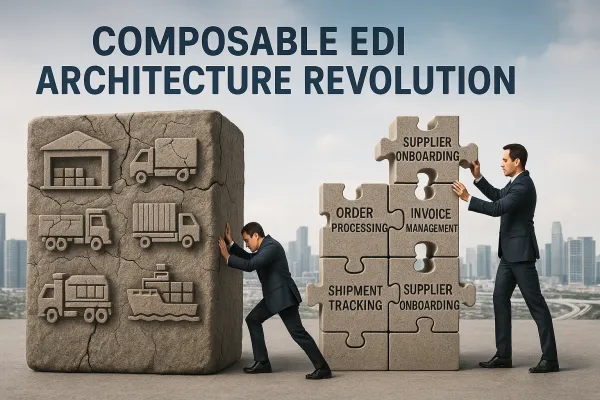
Think of composable EDI as building with interchangeable blocks rather than carved stone. Composable architectures use a modular approach, where the system is built from independent, interchangeable components, allowing you to build like Lego sets – the independent components snap together with the flexibility to adapt and scale as business needs evolve.
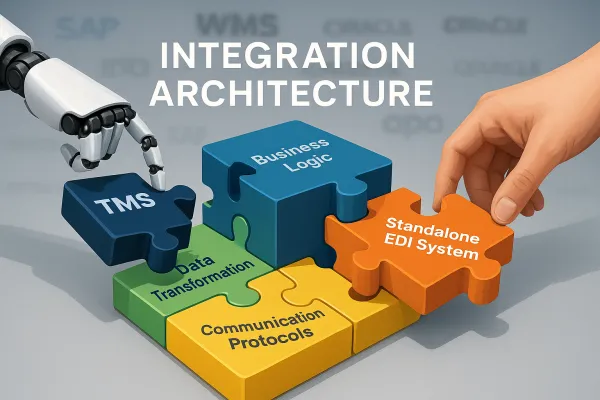
Traditional point-to-point integrations create vendor lock-in scenarios where changing your TMS means rebuilding your entire EDI infrastructure. The first challenge of EDI inside an ERP, TMS, or WMS is that it will be tightly tied to the ERP. When an enterprise grows and is looking to implement a new ERP or TMS, the switch will impact EDI with its trading partners. The average company that performs EDI has anywhere from 100-200 partners, and 400-500 maps—all of which will be impacted by the switch.
Leading TMS vendors like MercuryGate, Descartes, and Transporeon are adapting their architectures, while emerging solutions like Cargoson are built natively for composable integration patterns. The difference isn't just technical—it's strategic. API-driven workflow engines treat every EDI integration as a composable pipeline instead of baking logic into static endpoints that require engineering rewrites for every new requirement.
The 7 Critical iPaaS Capabilities Every TMS Evaluation Must Include
Your vendor evaluation checklist needs radical surgery. Beyond basic EDI support, modern TMS platforms require sophisticated iPaaS capabilities that enable true composable integration:
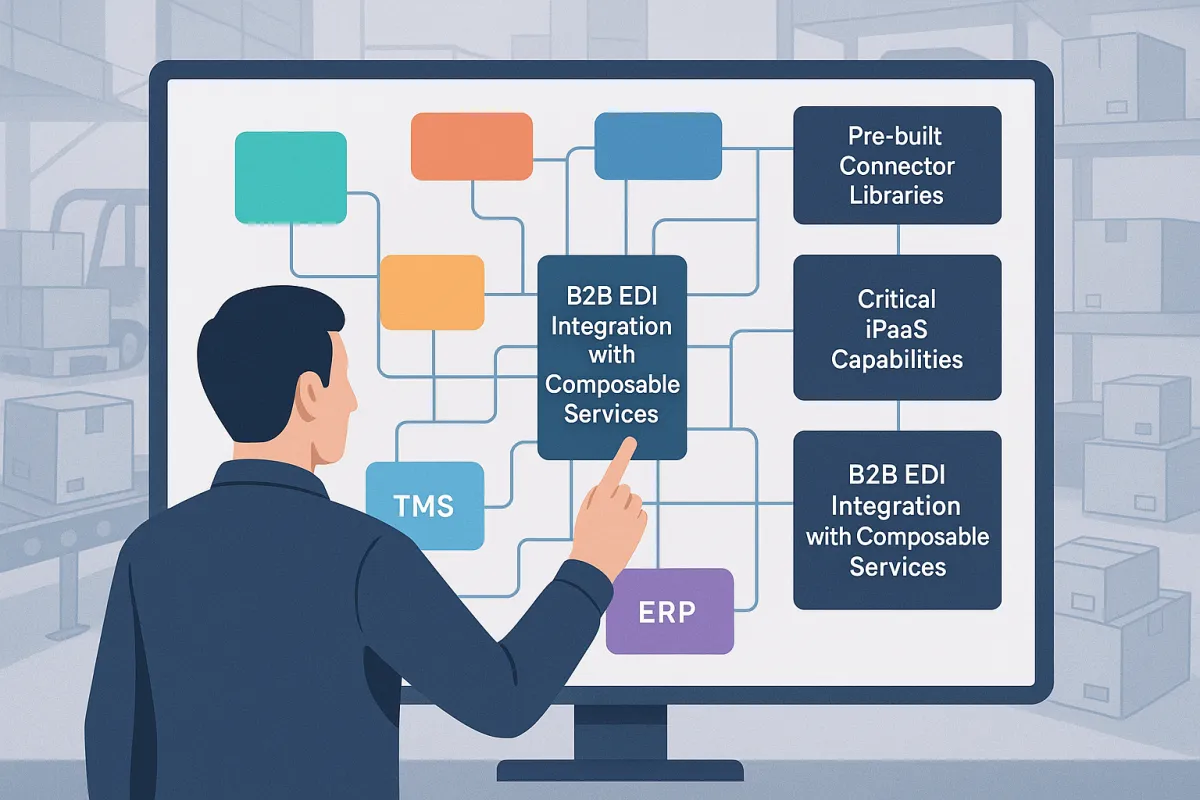
Pre-built Connector Libraries: With a library of 1,500+ pre-built connectors for top ERPs like NetSuite, SAP and Dynamics, plus WMS, TMS and e-commerce platforms such as Shopify, BigCommerce and Magento, integrations become plug-and-play. Don't accept vendors who require custom development for standard ERP connections.
B2B EDI Integration with Composable Services: In the EDI context, iPaaS platforms specialize in transforming data between various EDI formats such as EDIFACT, ANSI X12, and XML. They offer pre-built connectors and templates for popular EDI standards, consequently reducing implementation time and effort. The critical difference: these services should be reusable as APIs, not locked into proprietary formats.
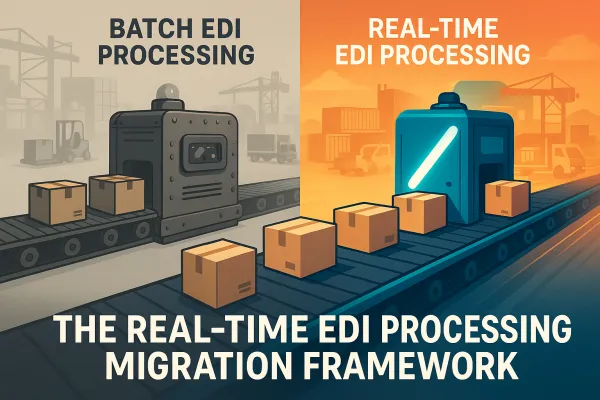
Event-Streaming Architecture: Powered by an event-streaming architecture, the platform enables real-time data exchange and sub-second updates. This eliminates the batch processing bottlenecks that plague traditional EDI systems. When a shipment status changes, your entire ecosystem should know instantly.
Hybrid Integration Support: Flexible transport protocols, including HTTPS, SFTP, AS2 and email, ensure seamless communication across systems. Built-in data transformation normalizes EDI, XML, JSON and CSV into clean, actionable formats, eliminating manual workarounds. Your evaluation should test both cloud-native and on-premises connectivity scenarios.
When evaluating vendors like Blue Yonder, Manhattan Active, or Cargoson, focus on their native iPaaS capabilities rather than bolt-on middleware solutions. An organization that plans to integrate several internal systems with an EDI platform, has limited developmental resources, or expects to consistently add new partners and integrations might choose an iPaaS platform that helps centralize integrations and provides some pre-built connectors and low-code solutions.
Avoiding the "Hybrid Tax" - Integration Cost Assessment Framework
Here's where most procurement teams get blindsided: the true cost of hybrid iPaaS-EDI integration extends far beyond license fees. Whether your applications reside on premises or in the cloud, the right EDI platform can facilitate hybrid data flows, improve operational workflows, and potentially reduce costs associated with development and maintenance.
Superior Scalability Analysis: Traditional integration platforms hit practical limits as transaction volumes grow. Modern iPaaS solutions should demonstrate unlimited scalability without predetermined subscription tiers that penalize growth. Test this with your actual volume projections, not vendor-provided scenarios.
Total Cost of Ownership Reality Check: For a company with €2 million annual transport spend, a properly scoped cloud TMS migration typically costs €150,000-€300,000 over five years. This includes licensing (20-30%), implementation (25-40%), data migration (15-25%), and ongoing management (10-15%). Factor in the hidden costs of maintaining multiple integration points.
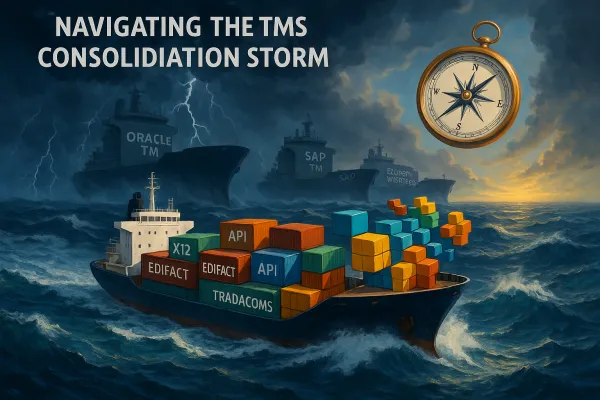
Compare solutions from major vendors like Oracle TM and SAP TM with emerging European players like Cargoson that focus specifically on cross-border operations. The choice isn't always about size—it's about architectural fit. This consolidation creates three distinct vendor categories for European shippers: global mega-vendors (Oracle TM, SAP TM, E2open/WiseTech), European specialists (Alpega, nShift, Transporeon), and emerging European-native solutions like Cargoson that focus specifically on cross-border European operations.
TMS Vendor Integration Assessment Questions
Ditch the feature comparison spreadsheets. Your vendor assessment needs scenario-based testing that exposes integration weaknesses before you sign contracts.
Event-Driven API Coverage: Ask vendors to demonstrate real-time APIs for core transport events—not just file drops and batch syncs. While EDI handles structured transactions, APIs enable real-time B2B connectivity and new integration patterns. Modern B2B integration extends beyond traditional EDI to include real-time API connectivity.
System Behavior Under Pressure: Force vendors to prove their platforms during edge case scenarios. What happens when a carrier API goes down? How does the system handle malformed EDI documents? Different customers can have completely different workflows for the same transaction types. Our DAG foundation enables true multi-tenancy where each customer gets their own optimized processing pipeline while sharing our robust core infrastructure.
When evaluating platforms from Uber Freight, 3Gtms, or Cargoson, focus on their specific answers to integration complexity, not generic marketing responses. Set up scorecards or decision matrices that weigh... It's also smart to run a pilot or proof of concept. Choose one key use case and evaluate how quickly you can implement it on each platform, how well it performs, and how easy it is to maintain.
Implementation Risk Mitigation Strategy
The 24% of TMS implementations that succeed share common characteristics: they treat integration architecture as a strategic transformation, not a technical upgrade. The organizations that successfully implement agentic AI TMS platforms will be those that treat the technology as a strategic transformation rather than a software upgrade.
Scenario-Based Demos: Set up scorecards or decision matrices that weigh... Choose one key use case and evaluate how quickly you can implement it on each platform, how well it performs, and how easy it is to maintain. Test specific carrier onboarding scenarios, not generic demonstrations.
Phased Implementation Approaches: Phased migration is the key for risk-averse teams. Instead of a big-bang cutover, you validate one module at a time... Roll out modular EDI onboarding for a single high-value trading partner, then scale that template across the network. This reduces both technical and business risk.
Change Management for iPaaS: Adopting this less common approach dramatically improved the odds of transformation success by 62%. The prevailing urgency approach, characterized by directive leadership, limited stakeholder engagement, and a "get with the program" mindset, led to a 47% decrease in the odds of transformation success.
Reference successful implementations across various TMS platforms including emerging solutions that demonstrate composable integration patterns. The goal isn't perfection—it's predictable, manageable transformation.
2026 Future-Proofing Your Integration Architecture
The integration landscape is shifting toward autonomous systems. Next-generation platforms are expected to adopt AI agents that independently make key decisions like scheduling appointments, choosing routes, and negotiating rates, with 61% anticipating fully autonomous agentic AI within the next five years for TMS.
Agentic AI for Automated Flow Design: Some iPaaS solutions offer AI-assisted configuration that generates connection logic based on natural language descriptions. Others provide drag-and-drop visual editors with pre-built connectors. Your 2026 platform should support both approaches.
Regulatory Compliance Automation: The introduction of Electronic Freight Transport Information could save the EU transport and logistics sector up to €1 billion per year. Companies implementing eFTI-compatible systems now gain operational advantages while competitors struggle with compliance deadlines.
Vendor-Agnostic Integration Strategies: An API-driven workflow engine that treats every EDI integration as a composable pipeline protects your investment regardless of future vendor consolidation. Position your architecture for the next wave of M&A activity reshaping the TMS landscape.
Forward-thinking vendors including Cargoson alongside traditional leaders are building platforms that support this composable future. By December 2026, every serious organization will be running at least one agentic 'factory' directly tied to revenue growth or risk reduction. In 2026, experimentation gives way to execution; agentic systems move from pilot to mainstream production.
The window for strategic TMS selection is narrowing. Your implementation timeline should align with this industry trajectory while maintaining the careful governance approach that separates successful deployments from the 76% that fail to meet their objectives. The choice isn't whether to embrace composable iPaaS-EDI integration—it's whether you'll architect for success or join the majority that failed to evaluate what matters most.