The Critical Speed-to-Value TMS EDI Assessment Framework: How to Evaluate Transportation Management System Integration Capabilities That Eliminate Implementation Delays and Accelerate Trading Partner Onboarding in 2026

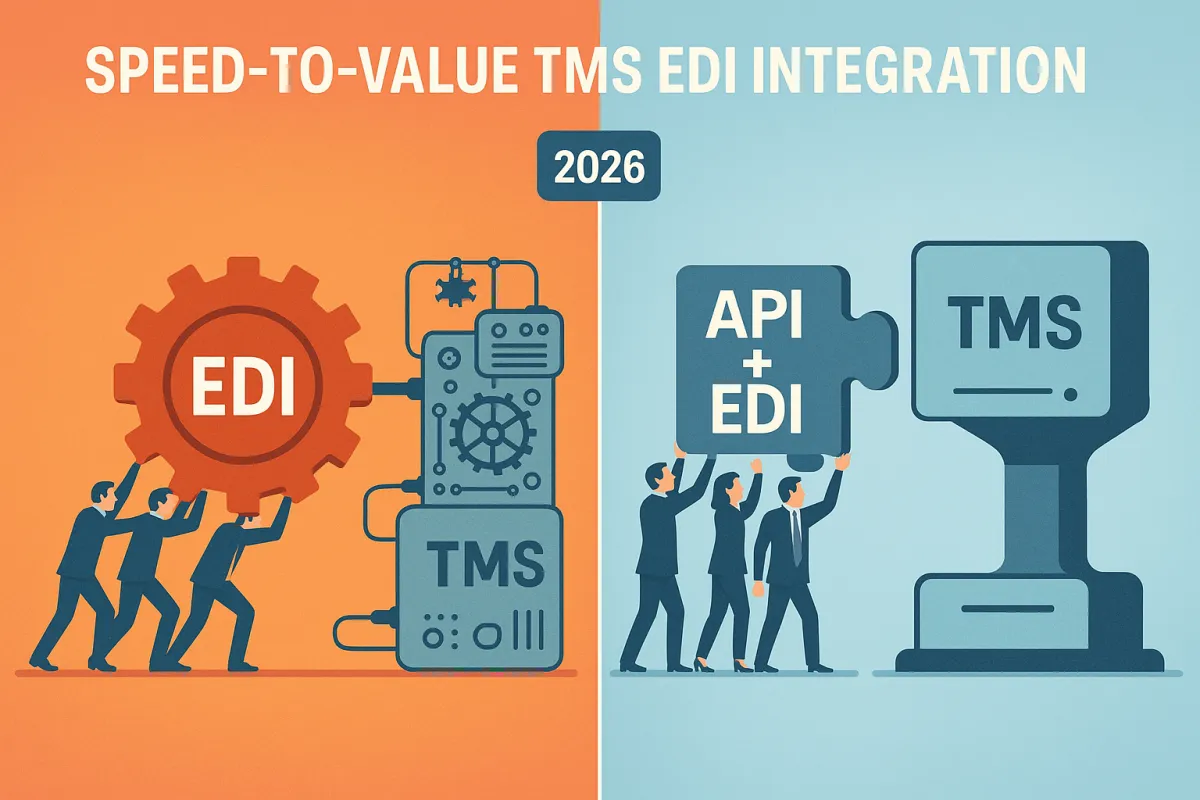
In 2026, organizations that modernize their EDI environments consistently report one major advantage: speed. The ability to move from planning to production quickly changes how IT teams support the business. Transport Management System (TMS) procurement has fundamentally shifted from feature shopping to execution risk management, where implementation speed depends on data complexity, integrations, and customization needs. Building a speed-to-value assessment framework for TMS vendor EDI capabilities has become the defining factor in competitive advantage and operational success.
Why Speed-to-Value Has Become the Defining TMS EDI Metric in 2026
The transportation management landscape underwent a seismic shift in 2026. Modern transportation software increasingly integrates via APIs. They provide real-time rate access, smoother onboarding, and high-fidelity shipment status updates across ecosystem partners. A growing trend in the freight industry is the move from Electronic Data Interchange (EDI) integrations to Application Programming Interface (API) integrations that provide improved access to real-time carrier rates, shipment statuses, carrier onboarding, and more.
The financial stakes are higher than ever. Up to 47% of IT managers say that slow EDI supplier onboarding is currently keeping their businesses from capturing new revenue opportunities. Nearly a quarter of companies (24%) are losing $500K or more to integration issues related to their supply chains. The license is typically only about 20–25% of total cost; the rest hides in integration, add-on modules, and disruption.
The Hidden Revenue Impact of Slow TMS EDI Deployment
Slow order processing due to manual workflows leads to delivery delays, customer dissatisfaction, and loss of business opportunities. Many customers using an effective TMS cite measurable benefits, including reported savings of 5%–20% in freight spend through improved planning and carrier selection, 2-3x increase in productivity related to load coverage per employee, and an on-time delivery percentage greater than 98%.
The real cost of implementation delays extends beyond immediate project overruns. For high-volume transportation environments, like ecommerce fulfillment, even small disruptions can cascade into larger issues downstream. Missed delivery windows can lead to chargebacks or strained relationships with partners and customers. Companies miss revenue opportunities while competitors gain market share through faster partner activation.
The Complete Speed-to-Value Assessment Framework for TMS EDI Capabilities
Successful TMS vendor evaluation requires structured assessment criteria that prioritize deployment velocity without compromising functionality. Modern mid-market TMS: 4-8 weeks - Traditional mid-market TMS: 8-16 weeks - Enterprise TMS: 6-24 months Implementation speed depends on data complexity, integrations, and customization needs.
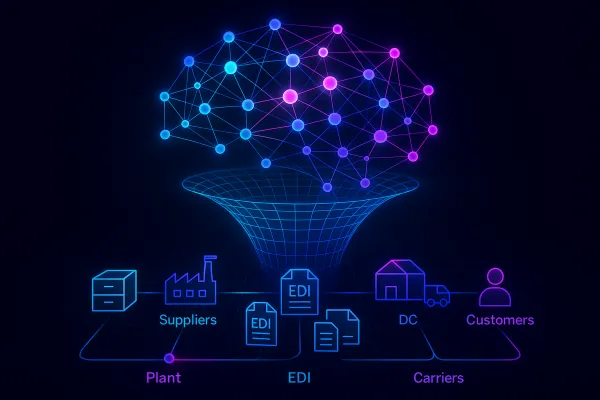
The framework begins with architectural fundamentals. You often need both: EDI messaging plus real-time API data. Ask if the platform natively supports hybrid EDI + API workflows. Confirm how it handles legacy XML/flat file formats. Vendors like Cargoson, Oracle TM, SAP TM, and 3Gtms each offer different approaches to this hybrid architecture, but your evaluation should focus on implementation timelines rather than feature breadth.
Critical Integration Architecture Questions to Ask TMS Vendors
Template availability separates rapid deployment platforms from custom-build systems. Fast trading partner onboarding: New trading partner connections shouldn't require custom development or extended lead times, especially under tight transportation deadlines. Prebuilt TMS document flows: Templates for common documents, such as 204s and 210s, can shorten implementation time and improve reliability.
Test environment capabilities reveal vendor maturity. Orderful simplifies pre-launch workflows with built-in, automated testing protocols. Instead of sending files back and forth with EDI partners, you can test, validate, and approve EDI messages in one place. You go live faster and with fewer errors. Compare this approach against platforms like TrueCommerce and SPS Commerce, which may require more manual testing coordination.
Support for composable architectures indicates future-proofing. Traditional EDI systems were often built as monolithic platforms—rigid, tightly coupled, and difficult to modify. The future lies in Composable EDI: a modular approach where components can be independently deployed, replaced, or upgraded without impacting the entire system. By adopting clean architectural principles, organizations gain the flexibility to evolve their integrations, introduce new capabilities, and adapt to changing business requirements without disrupting core operations.
Rapid Trading Partner Onboarding Strategies That Accelerate TMS ROI
An API-First strategy uses APIs as the primary, simple entry point for trading partners, eliminating the need for them to have deep EDI expertise. The system then translates these API inputs into standard EDI formats in the backend, accelerating onboarding times while maintaining internal data standardization. This approach contrasts sharply with traditional EDI-first methodologies that require extensive partner technical expertise.
Modern platforms demonstrate measurable acceleration. With Orderful, Owlet went live with its first connection in just two weeks. The company was able to accelerate its launch timeline and improve reliability across its entire fulfillment network, all while seeing a cost savings of 65%. The brand was able to cut onboarding time by 75% and greatly reduce the need for IT intervention.
Eliminating the Common Integration Bottlenecks
Different EDI Versions: Work with partners to establish compatible versions or use translation software. Technical Expertise: Consider working with EDI specialists during implementation. Legacy Systems: Use middleware solutions to bridge the gap between older systems and modern EDI requirements.
Data mapping automation represents the next evolution in acceleration technology. Traditional projects can take months to complete, but modern integration partnerships help businesses accelerate that process with prebuilt connections, templates, and API-driven frameworks. Instead of starting from scratch for every new connection, you can onboard trading partners and integrate new applications in days, not months.
Testing protocols prevent the most common go-live delays. Support for multiple protocols and formats: AS2, FTP, APIs, and standardized formats such as ANSI X12 should all be supported. Cloud-native deployment: A cloud-based system offers better scalability, real-time monitoring, and fewer on-premise maintenance headaches. Built-in data validation: Spot and fix errors before they cause failed transmissions or chargebacks.
Measuring and Optimizing Speed-to-Value Metrics Post-Implementation
Success metrics focus on velocity rather than complexity. Expect early wins (faster quoting, fewer exceptions) in weeks; billing/analytics gains as integrations mature across months. A proven TMS implementation cadence is designed for quick, staged value. These benchmarks apply across leading platforms including Blue Yonder, FreightPOP, E2open/BluJay, and Cargoson.
Performance indicators reveal platform effectiveness. Start with visibility, carrier onboarding and rate feed integrations that eliminate the most manual work and produce measurable improvements quickly. Expect early wins (faster quoting, fewer exceptions) in weeks; billing/analytics gains as integrations mature across months.
Red Flags That Indicate Slow TMS EDI Implementations
Integrating EDI with TMS can be technically challenging, especially for organizations with outdated systems or limited IT resources. Businesses may need to invest in middleware solutions to bridge the gap between legacy systems and modern EDI requirements. Vendors unable to demonstrate prebuilt connector libraries signal prolonged implementation timelines.
Plan for 8–12 months to implement properly—not the "weeks" you'll hear in sales calls. A proper implementation can take 8–12 months, not weeks. Put milestones and acceptance criteria in the contract. Plan for remediation costs if timelines get 'compressed'. Vendor claims of rapid deployment without demonstrable proof cases indicate unrealistic expectations.
Future-Proofing Your TMS EDI Strategy for Continued Acceleration
Emerging technology trends shape 2026 procurement decisions. The separation between EDI translators and API management is ending. The trend for 2026 is the migration toward platforms that handle everything in one place. When you unify these systems, you reduce vendor sprawl and future-proof your tech stack.
Cloud-first strategies enable scalable growth. Cloud TMS is the standard choice in 2026 for most companies. Benefits include faster implementation, accessibility from anywhere, automatic updates, and no server maintenance. Modern platforms from Alpega, Uber Freight, and Cargoson demonstrate this architectural approach.
eFTI platforms can start operations in January 2026, with full enforcement on July 9, 2027. If you touch EU freight, treat data exchange as a contractual requirement. Get dates, scope, and remedies in writing (not 'roadmap'). European compliance requirements add urgency to platform modernization efforts.
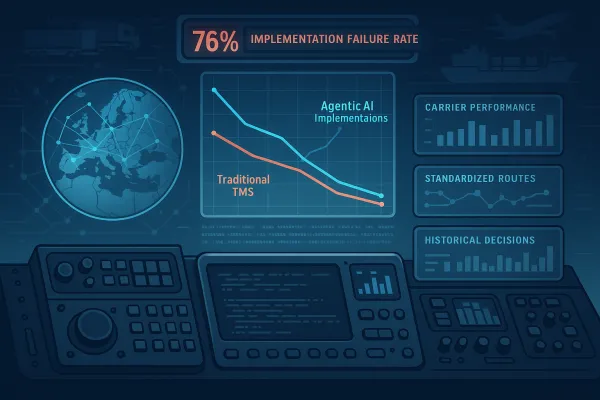
The assessment framework reveals that speed-to-value has become the primary differentiator in TMS vendor selection. In 2026, TMS selection has shifted from feature shopping to execution risk management. The evidence points to a 76% failure rate for logistics transformations, with integration friction (legacy formats vs JSON APIs) and hidden costs as recurring drivers. Organizations that prioritize implementation velocity through structured assessment criteria accelerate their competitive positioning while avoiding the execution risks that plague the majority of transformation initiatives.