The Critical TMS Vendor Hybrid EDI-API Assessment Framework: How to Evaluate Integration Capabilities That Eliminate the $2.3M "Hybrid Tax" and Future-Proof Your Transportation Operations in 2026

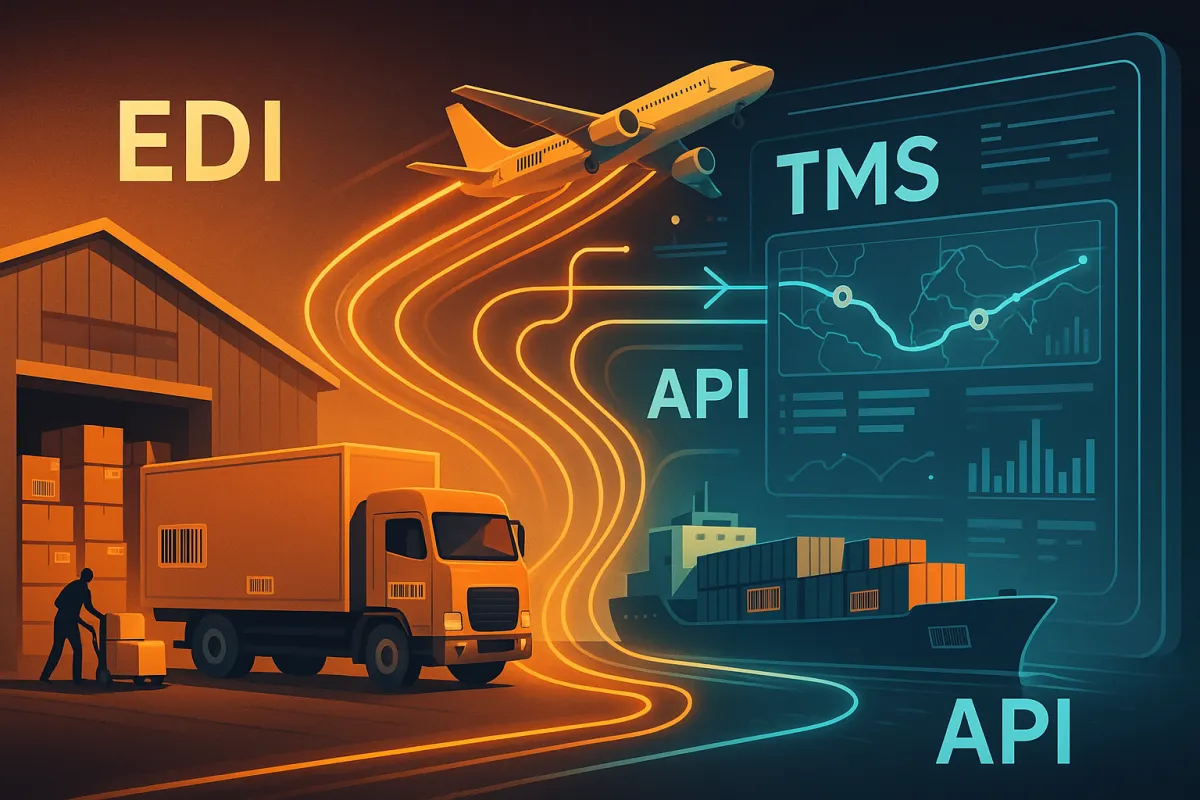
Most logistics professionals understand the "hybrid tax" crushing their integration budgets without realizing how deeply it's sabotaging their TMS vendor selection process. When a TMS system is swapped out or reconfigured without an EDI continuity plan, the result is often delays, chargebacks, or failed deliveries, which can damage partner relationships, yet 76% of TMS migrations struggle because they skip the planning, underestimate the complexity, and treat their TMS like a simple software purchase rather than a strategic transformation.
The Hidden "Hybrid Tax" Crisis Breaking TMS Integration Budgets
The "hybrid tax" isn't just a buzzword. According to a 2024 survey of transportation industry leaders by G2, it takes on average 14 months to see a positive ROI on a new TMS for buyers. That said, this report also notes an average user adoption rate of 80%, which means one in five implementations fails to deliver expected value. The real cost comes from maintaining parallel EDI and API infrastructures that essentially accomplish the same goal: moving data between systems.
Integration complexity connecting your TMS to a Warehouse Management System (WMS) or ERP (like SAP or Oracle) often requires custom API work, mapping, and testing. That can add $5,000 to $25,000 (or more) in professional services. Add EDI VAN fees, duplicate development efforts, and ongoing maintenance overhead, and the total cost easily reaches six figures for mid-sized operations.
Small to mid-sized businesses find cloud/SaaS TMS costs often landing between $50 and $500 per user per month, while enterprise programs include deep integrations, global visibility, and complex rules commonly requiring implementation work in the $100,000 to $500,000 range, plus ongoing support and platform fees.
Real-World Impact: Why 73% of TMS Migrations Fail Integration Tests
It's easy to underestimate the scope of a TMS migration until you're in the middle of it. Each trading partner has unique technical requirements. EDI standards vary. The average company performing EDI has anywhere from 100-200 partners, and 400-500 maps—all of which will be impacted by the switch.
Legacy protocol issues create the biggest problems: Older EDI connections often rely on protocols like FTP or AS2. If the new TMS doesn't support those methods or supports them differently, message delivery can fail entirely. Some organizations are forced to re-onboard all trading partners when switching systems. Limited testing environments mean migration teams often lack a staging environment that accurately mirrors production, making it more challenging to identify issues before going live.
A mid-sized German automotive parts manufacturer thought their TMS implementation was going smoothly. Six months into implementation, €800,000 spent, they realized their new system couldn't handle their complex carrier network across 12 countries.
Essential TMS Vendor Hybrid Integration Evaluation Criteria
The key insight separating successful TMS implementations from costly failures lies in protocol agnosticism capability assessment. Plenty of shippers use both EDI and API. The simple approach is just to split workloads. Live, decision-driving data travels via API while audit-critical records that make more sense in a document anyway stay on EDI.
When evaluating TMS vendors, focus on their unified API layer over EDI systems capability. Whether it's EDI, API, or hybrid systems, this partnership makes compliance effortless. Digital integrations reduce manual data entry, saving time and minimizing costly mistakes. From tenders to status updates, your operations flow smoothly with fewer bottlenecks bringing data directly into your TMS.
Leading TMS providers like Manhattan Active and Blue Yonder offer comprehensive hybrid approaches, but emerging solutions like Cargoson are specifically designed around protocol agnosticism. Cargoson offers direct API/EDI integrations with carriers across all transport modes (FTL, LTL, parcel, air, and sea freight), allowing you to compare rates, book shipments, and track imports and deliveries from a single platform.
Technical Architecture Assessment Framework
By integrating an API layer on top of existing EDI systems, companies can modernize without disrupting critical trading partner connections. This API layer enables faster onboarding of new trading partners, provides real-time monitoring and alerts, and reduces testing time through prebuilt maps and standardized data flows.
Cloud-native architecture evaluation becomes crucial in 2026. TMS connectivity has improved significantly, with vendors shipping more prebuilt connectors and cleaner links between TMS applications and enterprise systems. The difference between real-time and batch processing capabilities can make or break your operational efficiency.
With cloud-based solutions, API allows transportation management systems (TMS) to transmit data in less than a second. API is a helpful tool for freight brokers, freight forwarders, third-party logistics providers, various other logistics service providers, and bulk shippers who need to access TMS data, such as shipment status updates or inventory levels, without using an intermediary system.
The Complete Vendor Capability Assessment Scorecard
Trading partner onboarding speed evaluation reveals dramatic differences between TMS vendors. A modern EDI integration platform makes it easy to onboard and maintain partners: Libraries of prebuilt trading-partner profiles (e.g., Walmart, Target, Costco) with ready-to-use maps and rules.
Data mapping automation capabilities separate mature platforms from basic tools. Modern EDI software should dramatically cut down the tedious work of mapping and testing: Graphical mapping tools for building and maintaining maps without deep EDI expertise. AI or rules-based auto-mapping to suggest field matches and transformations.
AI is accelerating this process across leading TMS platforms. After years of development and experience with thousands of carrier pricelists, Cargopipe has now been upgraded with AI handling some of the recurring tasks that previously required human manual input. AI supports uploads by extracting and interpreting pricelist data. Solutions like Oracle TM and SAP TM are integrating similar capabilities, while Cargoson's AI-powered approach focuses on practical freight pricing automation.
Error handling and monitoring systems provide the clearest differentiation between enterprise-ready and basic TMS solutions. Real-time dashboards of all EDI transactions across partners and business systems. Drill down to document-level status (accepted, rejected, in error, reprocessed). Configurable notifications on failures, SLAs, or specific partner flows. Exception queues with root-cause context and tools to automatically fix and retry.
ROI and Cost Structure Analysis Framework
Per-transaction versus flat-fee pricing models fundamentally change your cost structure and vendor relationship. Modern integration partnerships replace unpredictable per-transaction models with predictable pricing and managed automation, so your IT and finance teams can budget with confidence. Automation also minimizes the human element that leads to costly errors or compliance gaps.
SaaS subscriptions deliver speed and predictable spend, but can hide add-on fees for connectivity, modules, and support. Small to mid-sized businesses find cloud/SaaS TMS costs often landing between $50 and $500 per user per month, depending on features, carrier connectivity, and support.
Implementation and maintenance cost calculations reveal hidden expenses. The most apparent cost of a new TMS is the direct implementation cost. This includes factors like the direct price tag on your access to the software, whether on a subscription, per transaction, or user-based licensing basis. This also takes into account any add-ons you may have purchased, such as access for more users and carriers, or usage of cloud-based storage.
Future-Proofing Your TMS Integration Strategy
AI and automation readiness assessment becomes critical as many ERP, TMS and WMS platforms now come with native AI and even agentic capabilities. These features still need configuration and time to learn, but are increasingly available right out of the box.
Agentic AI capabilities are transforming how logistics professionals interact with complex datasets. Advanced solutions help quickly identify trade patterns, trends and anomalies across large datasets using natural language queries, making complex global trade data more accessible and actionable.
Scalability and flexibility evaluation should focus on vendors' ability to adapt to changing requirements without costly re-implementations. Solutions like E2open/BluJay and Alpega offer established enterprise capabilities, while FreightPOP targets mid-market simplicity. Cargoson provides access to over 1,500 carrier connections via EDI and API, with new carrier integrations added free on request with no setup or additional monthly fees.
Implementation Risk Mitigation Framework
Parallel system testing protocols prove essential for avoiding the 73% failure rate. Real-time exception handling means when a carrier misses a cut-off, the TMS can instantly re-issue the load without a planner's phone call. Your customer portal shows actual dock departure, not yesterday's batch EDI time stamp.
Pick one partner and run the new API alongside the old file for a short pilot. If API errors stay below 0.1% and staff effort drops, keep the dual feed running for a full quarter, then shut the file off on that lane. This approach minimizes risk while proving system reliability.
Rollback and contingency planning requirements often get overlooked until problems emerge. Build a rollback plan. Even with the most careful preparation, surprises can happen. A documented fallback strategy gives you room to revert or reprocess messages without disrupting the supply chain.
2026 Vendor Landscape and Recommendations
Shippers want more from their transportation systems, and that pressure is reaching vendors of all sizes. Newer TMS providers are now held to the same standards as long-established platforms. Many of these vendors have been in the market for 10 years or less, yet users expect them to match the capabilities and maturity of systems that have evolved over several decades.
Current market positioning reveals clear winners in different categories. nShift and Uber Freight represent established players with extensive carrier networks, while innovative solutions like Cargoson focus on protocol agnostic integration for European manufacturers.
Strategic vendor selection recommendations depend heavily on your specific requirements. If you are in the middle, with real operational pain but no appetite for a six-figure rollout, consider a hybrid approach: keep your core TMS simple, then build targeted tools around your bottlenecks. For example, you might build an internal rate approval and exception hub that sits on top of your current tools.
The key success factor isn't choosing the most feature-rich platform—it's selecting a vendor whose hybrid EDI-API integration approach eliminates the hybrid tax while future-proofing your transportation operations. Look for partners who understand protocol agnosticism isn't just a technical capability, but a strategic advantage that transforms transportation management from a cost center into a competitive differentiator.