The Graph RAG EDI Implementation Framework: How to Build Relationship-Aware Supply Chain Intelligence That Connects Trading Partner Networks, Transaction Patterns, and Operational Dependencies Beyond Standard Document RAG in 2026

When your EDI system encounters a query like "How will delays in Component X shipments from Supplier A impact our Q3 delivery schedule for Customer Y?" traditional vector-based RAG systems hit a wall. They might retrieve documents about Component X, supplier performance metrics, and delivery schedules as separate pieces, but they cannot connect these relationships to provide actionable intelligence. The vector store doesn't "know" that Component X is part of Client Y's deliverable, because it captures similarity but misses structure.
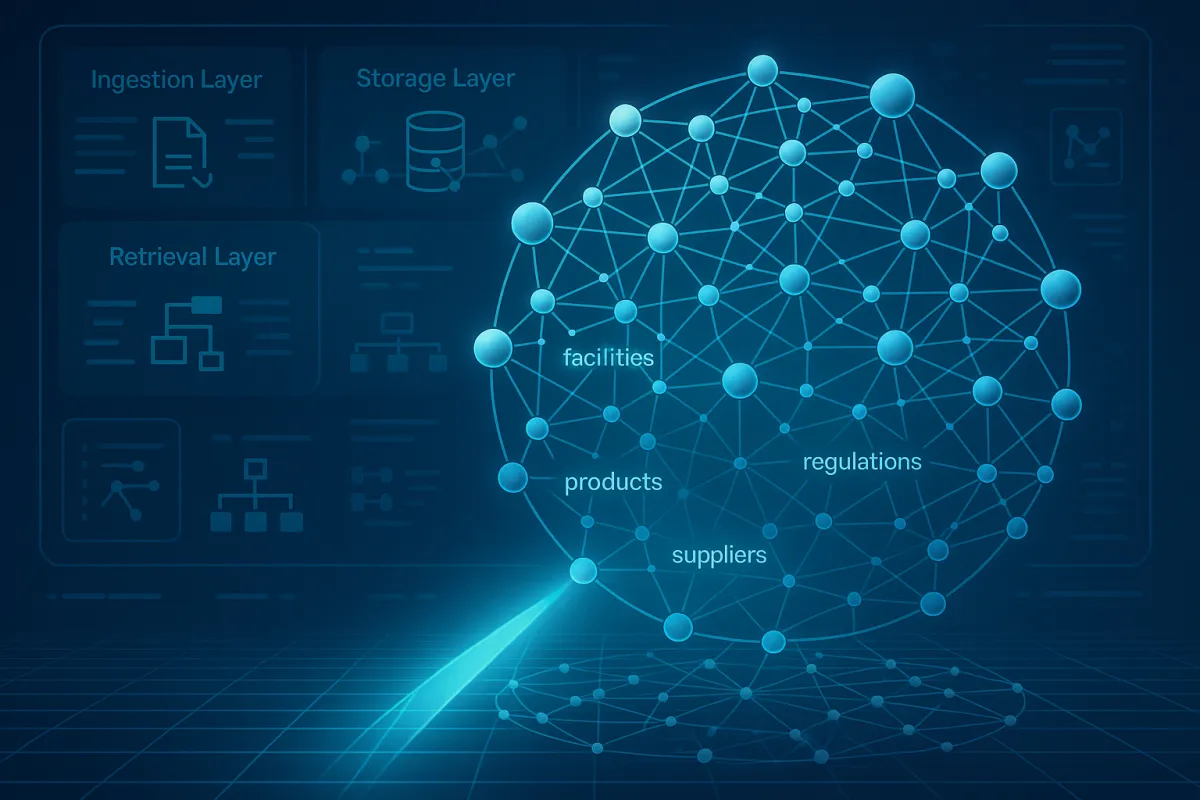
This is where Graph RAG implementation becomes critical for EDI systems in 2026. Supply chains are complex, interrelated networks composed of entities—suppliers, facilities, products, and regulations—all linked by dependencies, risks, and transactions. Yet most EDI implementations and AI tools treat this information like disconnected lists rather than the interconnected systems they actually represent.
The Critical Knowledge Graph Gap in Current EDI Architecture
Standard EDI batch processing excels at moving structured transaction data between systems, but falls short when you need to understand the complex web of trading partner relationships, dependencies, and cascading impacts that define modern supply chains. EDI is not disappearing, but it showed its limitations in 2025 in handling the multi-hop reasoning that Graph RAG enables.
Consider a successful proof of concept that demonstrates this capability: A directed supply chain graph encompassing 4,644 nodes and 8,341 edges, covering three of the largest contract manufacturers in the electronics industry. This RAG-powered implementation shows how extracting entities and relationships from unstructured data sources like SEC filings creates a comprehensive view of supply chain dependencies that traditional EDI cannot capture.
Graph RAG vs. Standard Vector RAG for Supply Chain Data
Traditional AI systems, even when enhanced with RAG, often struggle to synthesize network-level insights. Graph RAG is designed to navigate these interdependencies more naturally. The difference becomes clear when you examine how each approach handles complex supply chain scenarios.
Vector RAG works well for simple lookups: "What's the ASN format for Trading Partner X?" But ask "Which downstream customers will be affected if Port Y experiences delays?" and vector similarity cannot traverse the network of relationships needed to answer accurately. Samsung Electronics acquired Oxford Semantic Technologies to build next-generation knowledge graphs for AI systems, improving accuracy in tasks like supply chain optimization.
Fujitsu's enterprise-wide generative AI solution, which integrates knowledge graph extended RAG, has reduced decision-making latency by 40% in supply chain operations. These implementations demonstrate that Graph RAG enables reasoning across networked operating environments rather than treating data as isolated documents.
Building the Graph RAG Architecture for EDI Systems
Graph RAG requires a fundamentally different approach to data ingestion and retrieval compared to standard RAG implementations. We must extract entities (nodes) and relationships (edges) during ingestion. We can use an LLM or named entity recognition (NER) model to extract entities from text chunks and link them to existing records in the graph.
The architecture involves three core layers that work together to create relationship-aware intelligence:
Ingestion Layer: Unlike traditional EDI processing that focuses on transaction validation and routing, Graph RAG ingestion identifies and maps relationships between trading partners, products, contracts, and operational dependencies. During EDI document processing, the system extracts not just the transactional data but the contextual relationships: which suppliers provide which components, how facilities connect in the distribution network, and what dependencies exist between different shipments.
Storage Layer: We use a graph database (like Neo4j) to store the structural graph. Vector embeddings are stored as properties on specific nodes (e.g., a RiskEvent node). This hybrid approach maintains the semantic search capabilities of vector RAG while enabling structural queries that traverse relationships.
Retrieval Layer: Vector scan finds entry points in the graph based on semantic similarity. Graph traversal then traverses relationships from those entry points to gather context. This two-stage process ensures your system can both understand what the user is asking about and navigate the network of relationships to provide comprehensive answers.
Entity Extraction and Relationship Mapping for Trading Partners
Graph RAG implementation centers on three critical processes: node extraction, relationship identification, and cluster summarization. Microsoft's hierarchical community detection (Leiden algorithm in GraphRAG) groups related entities into communities that can be summarized independently.
For EDI systems, this means automatically identifying patterns like supplier-carrier-shipper relationships, contract dependencies, and rate structures from both structured EDI transactions and unstructured communications. When an EDI 850 Purchase Order references a specific supplier and delivery location, the Graph RAG system maps these entities to existing knowledge about that supplier's capabilities, historical performance, and network connections.
Real-world implementation requires handling the complexity of multi-modal supply chains. A transportation management system processing both EDI 204 Motor Carrier Load Tenders and API-based tracking updates needs to understand how these different data streams relate to the same underlying shipment network. Graph RAG enables this by maintaining persistent entity relationships regardless of how the data arrives.
Real-World Graph RAG Implementation Challenges in EDI
Building initial knowledge graphs from EDI data presents significant challenges in data aggregation, cleaning, and normalization. Knowledge graph extraction costs 3–5× more than baseline RAG and requires domain-specific tuning. However, organizations that invest in proper implementation see substantial returns.
The core innovation lies in the RAG framework implementation, where OpenAI's GPT-3.5 Turbo performs sophisticated entity extraction to identify supplier-customer relationships embedded within the unstructured text. These extracted relationships are then systematically converted into a directed graph using NetworkX, where nodes represent companies and directed edges represent supply chain relationships.
Enterprise implementations must address several critical challenges. Data consistency becomes paramount when integrating multiple EDI transaction types, API feeds, and unstructured communications. If Supplier A stops supplying Factory Y, but the edge remains in the graph, the RAG system will confidently hallucinate a relationship that no longer exists. Graph relationships must have Time-To-Live (TTL) or be synced via Change Data Capture (CDC) pipelines from the source of truth (the ERP system).
Performance and Scalability Considerations
Real-time performance poses the greatest challenge for Graph RAG in EDI environments where batch processing has traditionally dominated. Vector-only RAG achieves ~50-100ms retrieval time, while Graph-enhanced RAG requires ~200-500ms retrieval time (depending on hop depth).
Smart caching strategies help bridge this gap. Semantic caching serves cached graph results when a user asks a question similar (cosine similarity > 0.85) to a previous query. For EDI systems processing thousands of transactions daily, this approach dramatically reduces the computational overhead of complex graph traversals.
Organizations must also plan for the exponential growth of graph complexity as they onboard more trading partners and transaction types. A mid-sized manufacturer might start with a few hundred entities but quickly scale to thousands of nodes representing suppliers, products, facilities, and regulatory requirements across multiple geographic regions.
Graph RAG Integration with Modern TMS and Multi-Carrier Platforms
In 2026, graph reasoning becomes an expected component of enterprise planning. Vendors will integrate graph frameworks directly into control towers and network design tools. Leading transportation management systems are beginning to implement these capabilities to solve complex operational challenges.
Modern TMS platforms like those from Manhattan Active, Blue Yonder, and Cargoson are integrating Graph RAG capabilities to handle multi-carrier optimization scenarios that traditional rule-based systems cannot address. When a shipper needs to evaluate carrier options across different modes (rail, road, ocean) while considering factors like carbon emissions, cost, and transit time, Graph RAG enables the system to reason across the complex network of carrier capabilities, lane restrictions, and performance histories.
AI capabilities, real-time data integration, predictive analytics, and autonomous decision-making are reshaping what a TMS can and should do for your operation. Graph RAG supports this transformation by providing the contextual intelligence needed for automated decision-making across complex logistics networks.
API-First Graph Integration Strategies
Companies turned to APIs because they deliver faster implementation and real-time data exchange. Leading carriers increasingly positioned APIs as their preferred integration pathway. Graph RAG complements this trend by maintaining unified relationship models regardless of whether data arrives via traditional EDI or modern APIs.
Hybrid EDI-API-Graph architectures provide the flexibility to support both legacy trading partners using EDI and modern partners preferring API integrations. The graph layer abstracts these integration differences, ensuring that relationship intelligence remains consistent across all communication channels. When a carrier provides tracking updates via API while still sending invoices through EDI 810 transactions, Graph RAG maintains the connection between these related data streams.
This approach proves particularly valuable for freight management platforms handling diverse carrier networks. Some carriers offer sophisticated API capabilities for real-time tracking and dynamic pricing, while others still rely on traditional EDI workflows. Graph RAG enables unified intelligence across this mixed technology environment.
Future-Proofing EDI Infrastructure with Graph Intelligence
Supply chain technology is shifting from isolated tools to integrated operational intelligence. Companies that modernize their data layers, adopt AI thoughtfully, and focus on execution will gain resilience faster than those chasing hype. The year 2026 will reward organizations that can interpret signals quickly, synchronize decisions, and act decisively across their networks.
Graph RAG represents a foundational shift in how EDI systems handle intelligence rather than just data processing. A practical framework for A2A coordination, MCP, and graph-enhanced reasoning in modern supply chain systems enables AI to move beyond isolated copilots and into coordinated, operational decision systems.
Organizations building Graph RAG capabilities today position themselves for the next generation of supply chain orchestration. As regulations become more complex, trading partner networks expand globally, and customer expectations for real-time visibility increase, the ability to reason across interconnected systems becomes a competitive advantage rather than a nice-to-have feature.
The integration extends beyond immediate operational benefits. Graph RAG supports regulatory compliance by maintaining comprehensive audit trails of decision-making processes, enables predictive analytics by understanding historical relationship patterns, and facilitates strategic planning by revealing hidden dependencies and optimization opportunities across the supply chain network.
For EDI professionals and supply chain technology leaders, the choice is not whether to implement Graph RAG, but when and how to begin the transition. Start with a focused use case—perhaps mapping critical supplier relationships or optimizing carrier selection logic—and expand the graph as you prove value and build organizational capabilities. The companies that master relationship-aware intelligence will define the next decade of supply chain technology leadership.