The Graph RAG EDI Revolution: How to Transform Transaction Data Into Intelligent Supply Chain Networks That Enable Relationship-Aware AI Decision-Making Across Trading Partner Ecosystems in 2026

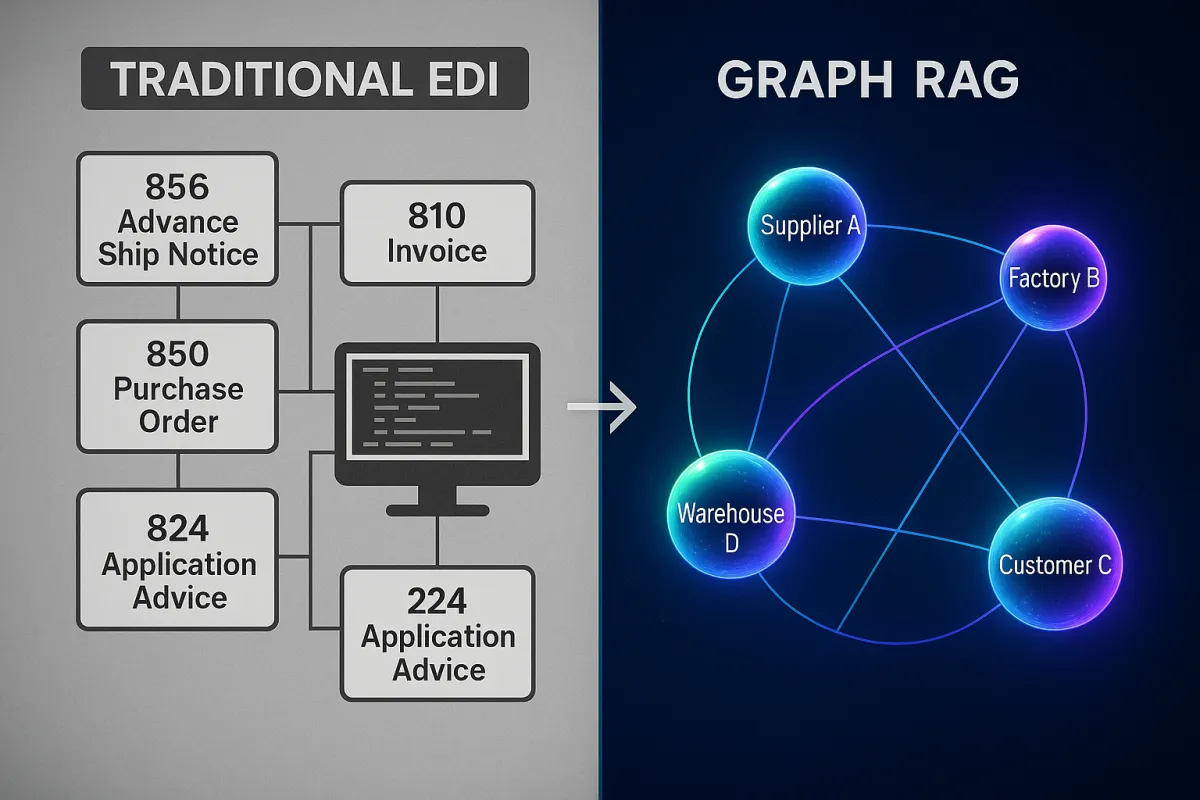
Your EDI system is parsing millions of purchase orders, invoices, and ASNs each month, but every transaction exists in isolation. When your largest supplier's production line goes offline in Bangkok, traditional EDI can't tell you which orders across your entire network are at risk.
This is the fundamental limitation that supply chains are not flat systems; they are complex, interrelated networks composed of entities, including suppliers, facilities, products, and regulations, all linked by dependencies, risks, and transactions. Yet most EDI implementations still treat each document as a standalone event, missing the cascading relationships that define modern supply networks.
Graph RAG combines RAG's retrieval and generation capabilities with a knowledge graph that models entities and the relationships between them, transforming your EDI data from isolated transactions into an intelligent network that enables relationship-aware AI decision-making across trading partner ecosystems.
Why Traditional EDI Data Processing Fails AI-Powered Supply Chains
Most EDI systems process transactions sequentially without understanding connections. An 856 Advance Ship Notice from Supplier A doesn't inherently link to the production schedule at Factory B or the delivery commitment to Customer C. For enterprise domains characterized by highly interconnected data (supply chain, financial compliance, fraud detection), vector-only RAG often fails.
It captures similarity but misses structure. It struggles with multi-hop reasoning questions like, "How will the delay in Component X impact our Q3 deliverable for Client Y?" because traditional systems lack the relationship context needed for intelligent analysis.
Gartner's 2026 GraphRAG analysis notes that many RAG initiatives fail when high accuracy thresholds are required, especially for complex use cases that need more contextual structure. In supply chain environments, this manifests as AI systems that can summarize documents but cannot reason across interconnected risks, dependencies, and impacts.
Consider this scenario: flooding hits a key port in Southeast Asia. Your traditional EDI system can process status updates from affected suppliers, but it cannot automatically identify which downstream orders, alternative routes, or backup suppliers should be activated. The data exists across multiple 850 Purchase Orders, 856 ASNs, and 214 Transportation Carrier Shipments, but the relationships remain invisible.
Understanding Graph RAG Architecture for Supply Chain Intelligence
Graph RAG represents the convergence of structured reasoning and unstructured understanding, enabling AI systems to evaluate interdependencies rather than isolated events. Instead of storing EDI transactions as flat documents, Graph RAG creates a knowledge graph where entities (suppliers, products, facilities, regulations) and relationships (supplies, ships to, depends on, governed by) form the foundation for intelligent reasoning.
The architecture combines three core components:
- Entity Extraction: We extract entities (nodes) and relationships (edges) during ingestion using an LLM or named entity recognition (NER) model to extract entities from text chunks and link them to existing records in the graph
- Graph Storage: We use a graph database (like Neo4j) to store the structural graph. Vector embeddings are stored as properties on specific nodes
- Intelligent Retrieval: Vector scan to find entry points in the graph based on semantic similarity, then graph traversal to traverse relationships from those entry points to gather context
This approach enables supply chain AI to understand that a delay at Port of Los Angeles affects not just individual shipments, but specific product lines, customer commitments, and backup routing options across your entire network. Graph RAG systems combine retrieval architectures with knowledge graphs capable of representing relationships between entities explicitly. Instead of retrieving isolated documents alone, the system can reason across interconnected operational structures.
The EDI-to-Graph Transformation Framework
Converting traditional EDI data into Graph RAG architecture requires mapping transaction sets to graph entities and relationships. An 850 Purchase Order becomes a node connected to supplier entities, product nodes, delivery location entities, and regulatory requirement nodes. An 856 ASN links shipment entities to transportation routes, carrier capabilities, and delivery windows.
Unstructured data like "Flooding in Thailand has halted production at Supplier A's facility" can be linked through graph relationships to determine which downstream factories are at risk, while standard vector search lacks the context to link that report to specific factory outputs.
The transformation process follows this pattern:
- Entity Identification: Extract suppliers, products, facilities, transportation routes, and regulatory constraints from EDI transaction sets
- Relationship Mapping: Define connections like "supplies," "ships via," "regulated by," and "depends on" between entities
- Graph Construction: Build the knowledge graph with vector embeddings as node properties for semantic similarity
- Continuous Updates: Update relationships as new EDI transactions flow through the system
Modern TMS platforms like MercuryGate and Oracle Transportation Management, along with agile solutions like Cargoson, are beginning to integrate graph-based reasoning capabilities to enhance route optimization and carrier selection based on network-wide constraints and relationships.
Multi-Hop Intelligence: Reasoning Across Trading Partner Networks
Supply chain disruptions rarely remain isolated. A port delay affects transportation schedules, inventory positioning, manufacturing sequencing, customer commitments, and supplier coordination simultaneously. Understanding those cascading relationships becomes increasingly important in volatile operating environments.
Graph RAG enables AI to traverse these relationships and understand multi-hop dependencies. When news breaks about a production facility shutdown, the system can:
- Identify all active purchase orders dependent on that facility
- Trace downstream impact to customer delivery commitments
- Recommend alternative suppliers with available capacity
- Suggest transportation route modifications
- Flag regulatory compliance issues for substitute products
Fujitsu's enterprise-wide generative AI solution, which integrates knowledge graph extended RAG, has reduced decision-making latency by 40% in supply chain operations. This demonstrates the practical impact of reasoning across interconnected operational structures rather than processing isolated data points.
Consider a real-world scenario: Your main electronics supplier in Vietnam reports a COVID-related facility closure via an EDI 856 status update. Graph RAG can immediately identify that this affects 23 active purchase orders, impacts delivery schedules for 8 major customers, and triggers the need for expedited shipping from your secondary supplier in Malaysia. Traditional EDI processing would require manual analysis to uncover these connections.
Implementation Architecture and Integration Patterns
Deploying Graph RAG for EDI requires integration with existing platforms without disrupting current operations. At Meta, working on the Shops logging infrastructure, we learned that structure must be enforced at ingestion. The same principle applies to EDI Graph RAG implementation.
The technical architecture follows this pattern:
- Ingestion Layer: EDI transactions flow through normal processing while entities and relationships are extracted in parallel
- Graph Database: Neo4j or similar graph database stores the network structure with vector embeddings attached to nodes
- AI Layer: LLMs enhanced with graph traversal capabilities for intelligent reasoning
- API Gateway: RESTful interfaces for integration with existing ERP, WMS, and TMS systems
Leading EDI platforms are evolving their architectures to support this approach. Solutions like Cleo Integration Cloud Platform, IBM Sterling B2B Integrator, and emerging platforms like Cargoson are incorporating AI-driven relationship mapping to enhance traditional transaction processing with graph-based intelligence.
In 2026, graph reasoning becomes an expected component of enterprise planning. Vendors will integrate graph frameworks directly into control towers and network design tools, making Graph RAG a standard component of supply chain intelligence architecture.
Production Deployment and ROI Measurement
While 75% of organizations pilot GenAI, most struggle to prove ROI, but Graph RAG addresses this by enabling high-value use cases like supply chain risk analysis. The structured nature of EDI data provides a solid foundation for graph construction, reducing the data preparation overhead that often derails AI initiatives.
Performance benchmarks show significant improvements over traditional approaches. By 2026, 85% of enterprises will adopt hybrid RAG systems combining vector and graph databases to balance speed and depth, with some implementations achieving 92% accuracy in complex analysis tasks.
ROI measurement focuses on these key metrics:
- Decision Speed: AI accelerates analysis from weeks to hours, enabling faster response to supply chain disruptions
- Risk Detection: Early identification of cascading supply chain impacts reduces emergency expediting costs
- Partner Onboarding: Automated relationship mapping reduces new supplier integration time from weeks to days
- Exception Handling: Intelligent routing of EDI exceptions based on relationship context
Organizations implementing Graph RAG for supply chain intelligence typically see 25-40% improvement in decision-making speed and 15-30% reduction in supply chain disruption costs within the first year.
Future-Proofing Your EDI Architecture for Agentic AI
The rise of Agentic AI is redefining what EDI can do. With structured, complete, and accurate EDI data, supply chain leaders can embed autonomous AI agents into EDI workflows to alert, interpret, act on, and optimize data in real time.
Model context, knowledge graphs, and retrieval-based architectures matter because agentic AI needs more than messages. It needs a shared representation of the operating environment. Graph RAG provides this foundation by creating persistent relationship models that autonomous agents can navigate and reason across.
Early implementations show promising results. As the world's first Agentic EDI AI, Eddie doesn't just manage data – it intelligently learns, adapts, and ensures flawless document flows across supply chains, saying goodbye to bottlenecks, costly errors, and slow partner onboarding.
Leading EDI providers are building agent capabilities into their platforms. TrueCommerce is embedding agentic AI across its platform to transform how customers onboard, integrate, and scale with trading partners, delivering personalized guidance based on each customer's ERP, transaction type, and account context.
This shift suggests a move away from manual troubleshooting of EDI onboardings, mappings and transactions toward using AI to free up resources to solve bigger supply chain challenges, with AI-generated mappings soon integrating with orchestration engines for real-time validation.
For supply chain leaders, this means preparing EDI infrastructure now for autonomous operations. Ensure your EDI data includes sufficient relationship context, implement graph-capable storage systems, and design integration patterns that support both current operations and future agentic capabilities.
The convergence of Graph RAG and agentic AI represents a fundamental shift from reactive EDI processing to proactive supply chain intelligence. Organizations that invest in this architecture today will have the foundation for autonomous, relationship-aware trading partner networks that can adapt, learn, and optimize without human intervention.