The Graph RAG Revolution for EDI Systems: How Supply Chain Teams Can Transform Trading Partner Data into Intelligent Business Intelligence Networks in 2026

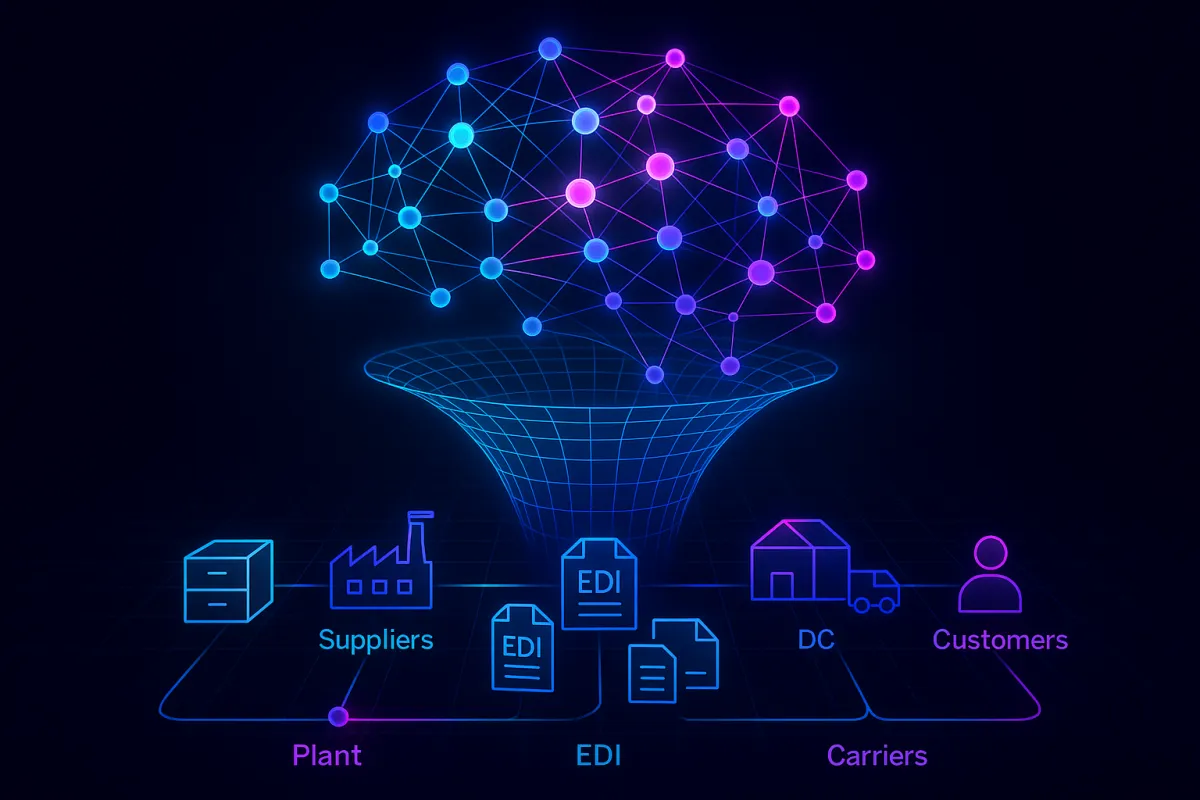
Most EDI systems treat your trading partner data like a filing cabinet - organized documents sitting in folders, waiting to be retrieved when needed. But supply chains aren't filing cabinets. They're living networks where a supplier delay in Thailand affects inventory decisions in Cleveland, and a compliance issue with one partner creates ripple effects across your entire trading ecosystem.
Supply chains are networks: suppliers link to plants, plants link to DCs, DCs link to carriers, carriers link to customers. Traditional AI tools treat this information like lists. Graph-based reasoning treats it like a system.
That's where Graph RAG technology comes in. In 2026, GraphRAG has transitioned from an experimental technique to a production-ready architecture for enterprise AI. As organizations demand more sophisticated reasoning capabilities from their AI systems, the combination of knowledge graphs with retrieval-augmented generation has emerged as the solution for complex reasoning over enterprise documents.
Instead of hunting through thousands of EDI transactions for answers, Graph RAG transforms your EDI data streams into an intelligent network that understands relationships, dependencies, and patterns across your entire supply chain ecosystem.
Why Traditional EDI Analytics Fall Short in Complex Supply Chain Networks
Your current EDI setup handles the transactions fine. Purchase orders flow in, advance ship notices flow out, and invoices get processed. But when you need answers about supplier relationships, compliance patterns, or disruption cascades, traditional EDI systems hit a wall.
Most retrieval systems treat data as flat, lists of documents or bullet points. But supply chains are networks, not lists. That's where the next evolution, Graph RAG, comes in.
Consider this scenario: A key automotive supplier in your network fails an environmental compliance audit. With traditional EDI analytics, you'd manually check each EDI relationship, review trading partner agreements, and hope you caught all the affected connections. You might discover weeks later that this supplier also serves three of your other tier-2 partners, creating compliance exposure you never saw coming.
Here's what traditional EDI analytics miss:
Multi-tier visibility challenges: Your EDI 850 purchase orders show direct supplier relationships, but they don't reveal how those suppliers connect to each other or share common sub-suppliers. When disruption hits, you're flying blind on second and third-order effects.
Relationship mapping across trading partners: EDI transactions capture the what and when, but not the why and with whom. Most existing studies assume that the underlying network structure is already known or rely on manually collected data, firm surveys, or proprietary commercial databases, which limits scalability and timeliness.
Pattern recognition across document types: An ASN (856) delay might correlate with specific carrier performance, which connects to port congestion, which affects multiple suppliers. Traditional systems see these as separate events.
Meanwhile, platforms like Project44 and FourKites integrate external signals and logistics event data into dynamic shipment tracking and disruption response tools. SAP and Oracle are embedding retrieval-based assistants into their enterprise platforms to help planners and analysts find policies, exceptions, and best practices.
Understanding Graph RAG: The Next Evolution Beyond Vector-Based Supply Chain Intelligence
GraphRAG combines vector search with structured taxonomies and ontologies to bring context and logic into the retrieval process. Using knowledge graphs to interpret relationships between terms has paved the way for deterministic AI accuracy - boosting search precision to as high as 99%.
Think of traditional vector-based RAG as a very smart search engine. You ask "Which suppliers had late deliveries last quarter?" and it finds documents containing those terms. Graph RAG, by contrast, understands that suppliers connect to purchase orders, which connect to delivery receipts, which connect to carrier performance, which connects to port congestion data.
The primary advantage of GraphRAG over standard RAG lies in its ability to perform exact matching during the retrieval step. This is made possible in part by explicitly preserving the semantics of natural language queries in downstream graph query language. While dense retrieval techniques based on cosine similarity excel at capturing fuzzy semantics and retrieving related information even when the query isn't an exact match, there are cases where precision is critical. This makes GraphRAG particularly valuable in domains where ambiguity is unacceptable, such as compliance, legal, or highly curated datasets.
For EDI operations, this difference becomes critical when you need to understand complex supply chain relationships. In financial services, GraphRAG enables analysts to query relationships between companies, executives, regulatory filings, and market events across thousands of documents. A risk assessment query might require understanding not just what a company does, but who leads it, what subsidiaries it owns, what regulatory actions have been taken against it, and how it compares to peer companies. The graph structure naturally represents these relationships, enabling the LLM to traverse connections that vector similarity would miss.
The Critical Difference: Multi-Hop Reasoning vs. Simple Document Retrieval
Here's where Graph RAG becomes transformative for supply chain teams. Instead of asking "Show me supplier compliance reports," you can ask "Which suppliers in our network have been flagged for compliance issues by partners who also supply our competitors, and what's the financial exposure if we need to replace them?"
Graph RAG transforms reasoning. If the question requires understanding how entities relate - not just retrieving relevant text - Graph RAG becomes strategically necessary.
This type of multi-hop reasoning connects:
- EDI partner profiles → compliance status → shared suppliers → competitive relationships → financial risk calculations
- Purchase order patterns → delivery performance → carrier relationships → capacity constraints → alternative routing options
- Invoice discrepancies → payment terms → cash flow impact → supplier relationship strength → negotiation leverage
Traditional vector search would find documents about each of these topics. Graph RAG understands how they connect and can reason across the relationships to provide insights that no single EDI transaction contains.
Implementation Architecture: Building Graph RAG Systems for EDI Environments
Building a Graph RAG system for your EDI environment requires integrating three layers: your existing EDI infrastructure, the knowledge graph that maps relationships between entities, and the reasoning layer that can traverse those relationships to answer complex questions.
The Neo4j Spark Connector provides a very simple means of transforming data in Unity Catalog into graph entities (nodes/relationships). For EDI environments, this means your 850, 856, and 810 transactions become nodes and relationships in a graph structure rather than just documents in a database.
Here's how the architecture works in practice:
Entity Extraction Layer: Your EDI parser extracts entities (suppliers, products, locations, carriers) and relationships (supplies, ships_to, pays, certifies) from transaction flows. For the RAG-based entity extraction module, we employ OpenAI's GPT-3.5 Turbo model, which processes the retrieved documents and identifies relevant supply chain entities, including supplier and customer relationships. This integrated pipeline allows for scalable and automated generation of multi-tier supply chain graphs from unstructured textual data.
Graph Construction: These entities and relationships build a dynamic knowledge graph that updates with each EDI transaction. When a new 850 arrives, it doesn't just create a purchase order record - it strengthens or creates relationships between buyer, supplier, product, and delivery location nodes.
Integration with TMS Platforms: Modern TMS systems like Cargoson, nShift, Transporeon, and Alpega already capture rich transportation and logistics data. The technology underneath TMS software is changing faster than at any point in the last two decades. AI capabilities, real-time data integration, predictive analytics, and autonomous decision-making are reshaping what a TMS can and should do for your operation. Graph RAG systems can consume TMS data to understand how EDI relationships connect to actual transportation performance and carrier networks.
Query Processing: When you ask a question, the system converts it into graph traversal queries that explore relationships, then uses retrieved context to generate comprehensive answers.
Cost Considerations and ROI Framework for Graph RAG EDI Deployments
Let's address the elephant in the room. Graph RAG costs 10-40x more to index than vector RAG. Here is when the trade-off pays for itself, what the four types are, and how production teams adopt it.
Specific cost ranges show the investment required: Full GraphRAG indexing costs $20-500 for typical corpora versus $2-5 for traditional RAG. Microsoft's GraphRAG sparked intense interest in 2024, but its $33K indexing cost for large datasets made it impractical for most teams.
But here's what most cost analyses miss: Since then, a wave of research has solved the cost problem while pushing accuracy even higher. Since then, a wave of research has solved the cost problem while pushing accuracy even higher. At 70-90% of GraphRAG's quality for 1/100th the cost, it is the right starting point unless your benchmarks specifically show the quality gap matters for your use case.
The ROI calculation for EDI environments focuses on decision speed and risk mitigation:
- Supplier risk assessment: Instead of manually analyzing trading partner relationships during disruptions, Graph RAG provides instant network analysis. One automotive manufacturer saved $2.3 million in disruption costs by identifying alternative suppliers 72 hours faster than manual analysis.
- Compliance monitoring: Automated relationship tracking across EDI partners reduces audit preparation time by 60% and catches compliance gaps that manual review misses.
- Trading partner optimization: Understanding actual performance patterns across EDI relationships, not just transaction volumes, enables better negotiation and partner selection.
Real-World Applications: Graph RAG Use Cases for EDI Operations
The most compelling Graph RAG applications for EDI environments solve problems that traditional systems can't address at all, not just slowly.
Supplier Risk Analysis: The case study focuses on three of the largest contract manufacturers in the electronics industry: Hon Hai Precision Industry (Foxconn), Flex Ltd., and Jabil Inc. Our findings demonstrate that Generative AI (GAI), specifically LLMs enhanced with RAG, can construct scalable and comprehensive supply chain graphs. The proof of concept is successful, as evidenced by the construction of a directed supply chain graph encompassing 4,644 nodes and 8,341 edges.
When semiconductor supply issues hit in 2025, one electronics manufacturer used Graph RAG to trace impact across their EDI network. Instead of checking each supplier manually, the system identified that 23 of their tier-1 partners sourced from the same affected region, quantified the revenue impact, and suggested alternative suppliers based on existing EDI relationships and performance history.
Compliance Monitoring and Audit Trail Enhancement: Graph RAG excels at compliance questions that span multiple trading partners and transaction types. "Which suppliers in our EMEA operations have both environmental certifications and financial stability above our threshold, and how do their delivery performance metrics compare across different product categories?"
For enterprises, knowledge-graph-powered generative AI translates directly into confidence for high-stakes decisions, reduced human review cycles, and a dramatic decrease in the risk of misinformation impacting critical operations (e.g., financial reporting, legal discovery).
Regulatory Compliance and Audit Trail Enhancement
The 2026 compliance landscape makes Graph RAG particularly valuable. Since January 2024, the European Union's Emissions Trading System has required verified carbon emissions reporting for all cargo and passenger vessels over 5,000 gross tons visiting EU ports. This development forces shippers to gather, monitor, and annually report their emissions, with regulatory coverage expected to increase from 40% in 2024 to full compliance by 2026.
eFTI (Electronic Freight Transport Information) and ICS2 (Import Control System 2) requirements demand detailed relationship tracking across all trading partners. Graph RAG systems can automatically generate compliance reports that trace product movements, carrier relationships, and documentation flows across your entire EDI network.
For audit purposes, the system maintains provenance trails that show not just what transactions occurred, but how those transactions relate to broader supply chain patterns and compliance requirements. This transforms audit preparation from a manual document hunt into an automated relationship analysis.
Vendor Landscape and Selection Framework for Graph RAG EDI Solutions
The Graph RAG vendor landscape has matured significantly in 2026. Microsoft open-sourced GraphRAG, and enterprise vendors integrated RAG into their platforms, including Workday and ServiceNow. However, real-world deployment revealed critical gaps, such as retrieval precision failures in multi-hop reasoning, the inability to explain answers to auditors, and security vulnerabilities.
For EDI implementations, consider these approaches:
Microsoft GraphRAG: The established platform with robust enterprise features but higher costs. The library continues to evolve, with the latest release in March 2026 bringing performance optimizations and new query capabilities. For enterprises operating at scale, these optimizations can translate into significant cost savings.
LightRAG: At 70-90% of GraphRAG's quality for 1/100th the cost, it is the right starting point unless your benchmarks specifically show the quality gap matters for your use case. Ideal for mid-market companies testing Graph RAG capabilities.
Neo4j-based solutions: GraphRAG can be applied in cybersecurity for threat detection, as well as in industries like manufacturing for predictive maintenance and supply chain management, providing deeper insights from complex datasets. GraphRAG is a powerful yet highly customizable approach to building agents that deliver more deterministic, contextually relevant AI outputs.
TMS-integrated options: Companies like Cargoson are developing Graph RAG capabilities alongside Oracle, SAP, and other established TMS providers. Vendors will integrate graph frameworks directly into control towers and network design tools. In 2026, graph reasoning becomes an expected component of enterprise planning.
Selection criteria should focus on EDI-specific requirements: How well does the system handle standard EDI transaction types? Can it integrate with your existing TMS and ERP systems? Does it provide the compliance and audit capabilities your industry requires?
Implementation Roadmap: From Traditional EDI to Graph-Enhanced Intelligence
Successful Graph RAG implementation for EDI environments follows a phased approach that builds capabilities while maintaining operational continuity.
Phase 1: Graph Foundation (Months 1-3) Start with your highest-volume EDI relationships. Take your existing vector RAG pipeline and add graph-based metadata. If you have a product catalog, build a simple taxonomy graph and use it to filter or re-rank vector search results. The cost is the graph database itself (Neo4j Community Edition is free, or use a managed service starting around $65/month). Focus on mapping supplier relationships, product hierarchies, and basic performance metrics.
Phase 2: Query Enhancement (Months 4-6) Once you have queries that consistently require connecting information across documents, implement graph-guided retrieval. The trigger is specific: you notice that users ask questions like "Which of our suppliers also work with [competitor]?" or "What regulations affect the products we sell in [region]?" that vector search handles poorly.
Phase 3: Advanced Analytics (Months 7-12) Integrate predictive capabilities and real-time decision support. Connect Graph RAG insights to your TMS for dynamic routing decisions and carrier selection based on network analysis.
Success Metrics:
- Time to answer complex supply chain queries (target: 80% reduction)
- Supplier risk identification speed (target: hours instead of days)
- Compliance audit preparation time (target: 60% reduction)
- Decision confidence scores from supply chain planners
Budget 20-30% of effort for evaluation, observability, and governance - this overhead pays for itself by preventing costly production failures. Most importantly, treat RAG as infrastructure investment with multi-year horizons, not tactical projects with 6-month timelines.
The question isn't whether Graph RAG will transform how supply chain teams work with EDI data. As enterprises face the twin pressures of regulatory compliance and institutional knowledge loss, the question isn't whether to adopt retrieval-augmented generation but how to build knowledge infrastructure that remains viable through 2030 and beyond. The organizations that succeed will be those that treat RAG as foundational architecture, not tactical implementation.
The transformation from static document exchange to intelligent business networks is already happening. The teams who start building these capabilities now will have the competitive advantage when complex supply chain reasoning becomes table stakes for effective operations.