The Hidden $1.2 Million Reality: Complete EDI Cloud Migration Cost Framework for Supply Chain Professionals in 2025

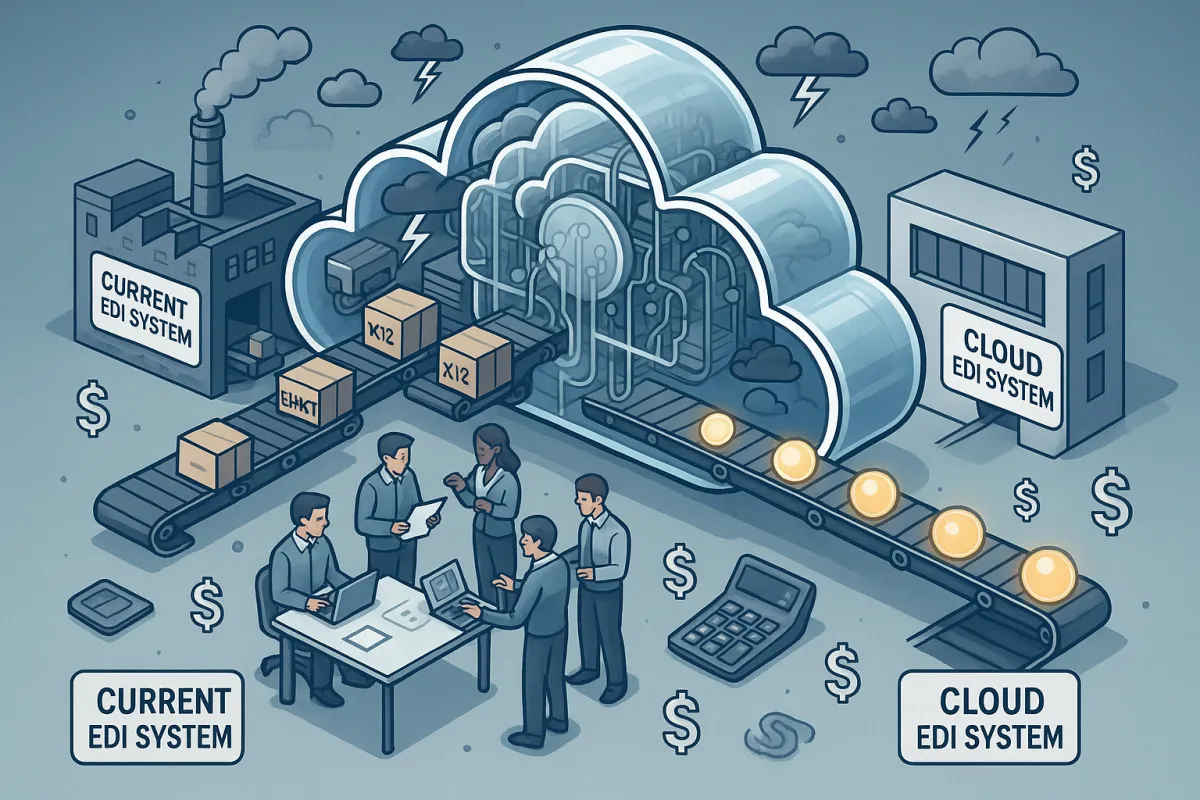
Most CFOs think they understand EDI cloud migration costs. Then reality hits. The average cloud migration project costs around $1.2 million for an enterprise org. But here's what you won't find in those vendor pitches: that $1.2 million figure only covers the basics. For supply chain operations managing complex supplier networks and TMS integrations, you're looking at significantly higher costs and hidden expenses that can derail your entire migration budget.
If you're evaluating EDI cloud migration costs for 2025, you need a realistic framework that accounts for the full picture. Around 32% of cloud spending is often wasted according to Forbes, which means getting your cost calculations wrong from the start can burn through hundreds of thousands in unnecessary expenses.
This framework breaks down every cost component you'll encounter during your EDI cloud migration, from the obvious monthly subscriptions to the budget-killing surprises that catch 70% of organizations off guard. We'll also show you how to calculate genuine ROI and avoid the migration pitfalls that turn a strategic initiative into a financial nightmare.
The True Cost of EDI Cloud Migration in 2025
Let's start with the numbers that matter. By the end of 2025, over 94% of organizations will use cloud infrastructure, with 85% transitioning to a cloud-first approach. Cloud migration projects deliver an average of 20–30% cost savings. Sounds promising until you dig into what those migration costs actually entail.
The enterprise average of $1.2 million breaks down differently for supply chain operations. Companies with extensive EDI networks typically see costs 40-60% higher than this baseline because of the complexity involved in migrating trading partner connections, mapping legacy data formats, and ensuring zero disruption to critical supply chain communications.
Why should you care about these costs now? These migration costs are an important consideration to factor into your decision. The window for competitive advantage through cloud EDI is narrowing rapidly. Companies that delay their migration are finding themselves paying premium rates for rushed implementations and struggling with compatibility issues as vendors phase out legacy support.
The real driver behind these migrations isn't just cost savings. Modern supply chain demands require real-time visibility, API integrations, and scalability that on-premises EDI simply can't deliver. You're not just migrating technology; you're future-proofing your entire data exchange infrastructure.
Breaking Down the EDI Migration Cost Components
Monthly subscription fees are just the tip of the iceberg. Your actual EDI cloud migration costs include several categories that most budget estimates completely miss.
**Data migration and transformation costs** hit harder than expected. If your applications need to be cloud-native, they may require rewriting, depending on the programming language or database used. The biggest challenge here is estimating how long this will take, which directly affects the cost. Timeframes can range from a few days to several months, so budgeting becomes a guessing game without expert input.
**Professional services and consulting** typically consume 30-40% of your total migration budget. Most organizations underestimate the specialized expertise needed for mapping existing EDI transactions, configuring cloud environments, and managing the cutover process. Expert consultant fees range from $200-400 per hour for EDI specialists, with most projects requiring 200-500 consulting hours.
**Integration complexity with existing systems** creates another cost layer. Your EDI migration must connect seamlessly with ERP systems, warehouse management platforms, and crucially for transportation companies, TMS solutions. This integration work often requires custom development and middleware solutions that can add $50,000-150,000 to your project budget.
**Testing and validation phases** eat up more time and money than planned. You can't afford EDI failures in production, so comprehensive testing across all trading partner scenarios becomes mandatory. Budget 15-25% of your total migration timeline just for testing phases.
The Hidden Expenses That Inflate Budgets by 300%
Here's where most migration budgets explode. Business downtime during poorly planned migrations can cost $5,000-50,000 daily in lost revenue. Data quality issues requiring post-migration cleanup add $2,000-10,000 to your budget. For supply chain operations, these numbers get much worse because EDI downtime breaks your entire trading partner ecosystem.
**Legacy system compatibility** creates the biggest headaches. Many organizations discover their current EDI maps and trading partner configurations don't translate cleanly to cloud environments. You might need to rebuild entire transaction sets from scratch, which means additional development costs and extended timelines.
**Trading partner onboarding complications** multiply your workload. Every existing trading partner connection must be validated and potentially reconfigured in the cloud environment. With enterprise supply chains managing 100+ trading partners, this validation process can stretch for months and require dedicated resources.
**Unexpected licensing and compliance costs** surface after migration begins. Cloud EDI providers often charge separately for advanced features, additional transaction volumes, or regulatory compliance modules that were included in your on-premises setup. GDPR compliance, industry-specific security requirements, and audit trail capabilities frequently carry additional monthly fees.
**Change management and training expenses** get overlooked completely. Your team needs extensive training on new interfaces, monitoring tools, and troubleshooting procedures. Plan for 40-80 hours of training per team member and potential temporary productivity drops during the learning curve.
EDI-TMS Integration Cost Considerations
Transportation management system integration represents one of the most complex aspects of EDI cloud migration. By integrating EDI with a TMS, companies can automate their transportation operations by exchanging shipment data and other information electronically with carriers, brokers, and other trading partners. But this automation comes with specific cost challenges.
TMS EDI integration may take some time to set up, and that timeframe directly impacts your costs. Integration with major TMS platforms like MercuryGate, Manhattan Active, or Cargoson requires specialized knowledge of both EDI standards and transportation workflows. Each platform has unique data structures and API requirements that influence your migration approach.
**Technical complexity costs** escalate quickly. Integrating EDI with TMS can be technically challenging, especially for organizations with outdated systems or limited IT resources. Businesses may need to invest in middleware solutions to bridge the gap between legacy systems and modern EDI requirements. These middleware solutions can cost $25,000-75,000 depending on the complexity of your integration requirements.
**Document mapping and workflow configuration** for transportation adds another layer. Standard EDI transaction sets like EDI 204 (load tender), EDI 214 (shipment status), and EDI 210 (freight invoice) must be mapped correctly to your TMS data fields. Mistakes in this mapping create operational disruptions that are expensive to fix post-migration.
**Benefits justify the investment** when done correctly. Automating the flow of standardized documents promotes synergy, reduces reliance on manual document processes, and improves supply chain visibility and efficiency. Companies typically see 25-40% reduction in manual processing time and significantly improved shipment visibility after successful EDI-TMS integration.
ROI Calculation Framework and Cost Optimization
Calculating real ROI requires looking beyond simple cost comparisons. By implementing effective cost optimization strategies, businesses can reduce their total cost of ownership as much as 40%. But your ROI calculation must account for both quantifiable savings and strategic value creation.
**Direct cost savings** include infrastructure reduction, maintenance elimination, and operational efficiency gains. Cloud migration projects deliver an average of 20–30% cost savings. Cloud migration drives an average 20% to 30% reduction in cloud costs compared to maintaining on-premises EDI infrastructure. Calculate your current EDI infrastructure costs including hardware, software licensing, maintenance, and staffing to establish your baseline.
**Operational efficiency improvements** generate substantial but harder-to-measure returns. Cloud EDI typically reduces transaction processing time by 50-70%, eliminates manual intervention in routine processes, and provides better visibility into data exchange issues. Assign dollar values to time savings, error reduction, and improved partner relationships.
**Scalability value** becomes critical for growing organizations. Cloud EDI scales instantly to handle increased transaction volumes during peak seasons or business expansion. Compare this flexibility against the costs of upgrading on-premises infrastructure to support growth.
**Cost transparency benefits** shouldn't be overlooked. Cloud platforms typically offer subscription based pricing, which makes budgeting more predictable than the variable costs of maintaining aging hardware and software systems. This predictability has real value for budget planning and financial forecasting.
**Timeline optimization** accelerates your ROI realization. Phased migration approaches let you start capturing cloud benefits immediately while spreading implementation costs over time. Focus on migrating your highest-volume trading partners first to maximize early returns.
Migration Planning and Risk Mitigation Strategies
Poor planning destroys migration budgets faster than any technical challenge. The best approach starts with proper design and planning, to help shippers avoid missed implementation deadlines and several incremental requests for capital approval for project overruns. Your planning framework must address both technical and operational risks.
**Comprehensive assessment** forms your foundation. Catalog every trading partner connection, document every EDI transaction type, and map all system dependencies before migration begins. This assessment typically takes 4-8 weeks but saves months of troubleshooting later. Missing even minor trading partners during planning can cause expensive delays during cutover.
**Vendor selection criteria** must go beyond basic functionality. Evaluate EDI providers on their experience with your industry, their TMS integration capabilities, and their support model. Providers like SPS Commerce, TrueCommerce, IBM Sterling, and Cleo offer different strengths, but your choice should align with your specific integration requirements.
**Phased implementation strategy** reduces risks and spreads costs. Start with low-volume trading partners to validate your migration approach, then move to critical high-volume connections after proving the process works. Leverage pragmatic options like 'Crawl, Walk, Run' and purpose-built iPaaS solutions to minimize costs while still gaining marginal benefit for your desired future state capabilities.
**Contingency planning** protects against disaster scenarios. Maintain parallel systems during cutover periods, establish rollback procedures, and prepare communication plans for trading partners. Budget 15-20% contingency funds for unexpected issues that always emerge during complex migrations.
**Change management execution** often determines migration success more than technical factors. Employees may resist adopting new technologies due to fear of the unknown or concerns about job security. It is essential to address these concerns through effective communication and training. Invest in comprehensive training programs and clear communication about how the migration benefits both the organization and individual team members.
Future-Proofing Your EDI Cloud Investment
Your EDI migration investment must support business needs beyond 2025. Cloud migration reduces the need for costly infrastructure, allowing businesses to pay for only the resources they use, which significantly lowers operating costs. Additionally, cloud-based EDI systems offer scalability, enabling organizations to adjust their capacity in response to fluctuating transaction volumes easily.
**API integration capabilities** become increasingly important as more trading partners modernize their systems. Your cloud EDI platform should support hybrid EDI/API communications, allowing you to gradually transition to API-based connections while maintaining EDI backward compatibility. This flexibility prevents future migration costs when partners upgrade their systems.
**Advanced analytics and monitoring** provide competitive advantages that justify migration costs. Modern cloud EDI platforms offer real-time transaction monitoring, predictive analytics for partner performance, and automated exception handling. These capabilities reduce operational overhead and improve supply chain visibility.
**AI and automation integration** represents the next evolution in data exchange. AI-driven migration tools grow by 28%, suggesting this trend will accelerate. Cloud platforms that incorporate AI for document processing, exception handling, and partner onboarding will deliver ongoing operational improvements that extend your migration ROI.
**Compliance and security evolution** requires adaptable platforms. Regulatory requirements continue evolving, and your cloud EDI solution must accommodate new security standards, audit requirements, and data protection regulations without requiring system replacements. Choose providers with strong compliance track records and flexible security configurations.
Getting your EDI cloud migration costs right in 2025 requires honest assessment of both obvious and hidden expenses. The $1.2 million enterprise average only tells part of the story. Supply chain operations with complex TMS integrations and extensive trading partner networks should budget 50-80% above baseline estimates to account for real-world complexities.
But don't let these costs discourage migration. Organizations that execute well-planned cloud EDI migrations typically achieve 25-35% operational cost reduction within 18 months while gaining scalability and capabilities that drive competitive advantage. The key lies in comprehensive planning, realistic budgeting, and choosing implementation partners who understand supply chain EDI requirements.
Your migration timeline matters more than perfect cost optimization. Companies that delay cloud migration face increasing legacy system maintenance costs and competitive disadvantages that outweigh migration expenses. Start planning now, budget realistically, and focus on long-term value creation rather than short-term cost minimization.