The Hidden $480K EDI Modernization Cost Crisis: Your Complete Hybrid API-EDI TCO Assessment Framework That Prevents Budget Disasters and Vendor Lock-In Before the 2026 Consolidation Wave Eliminates Your Options

Mid-sized manufacturers managing complex supplier networks are discovering a brutal financial reality: their EDI modernization projects are costing 40-60% more than budgeted, with manual intervention being the biggest hidden cost. When teams constantly fix ASN mismatches, invoice discrepancies, or inventory timing gaps, labor costs quietly accumulate. Over time, these operational inefficiencies outweigh software subscription expenses. The problem gets worse when you factor in the current vendor consolidation wave crushing your negotiating power.
Three recent acquisitions have fundamentally altered your TCO calculations: WiseTech Global's completion of the acquisition of E2open for $3.30 per share in cash equating to an enterprise value of $2.1 billion, alongside Descartes' acquisition of 3GTMS, means the TMS vendor landscape you planned around no longer exists. When your chosen platform becomes an acquisition target, you inherit integration risks without directly managing the project.
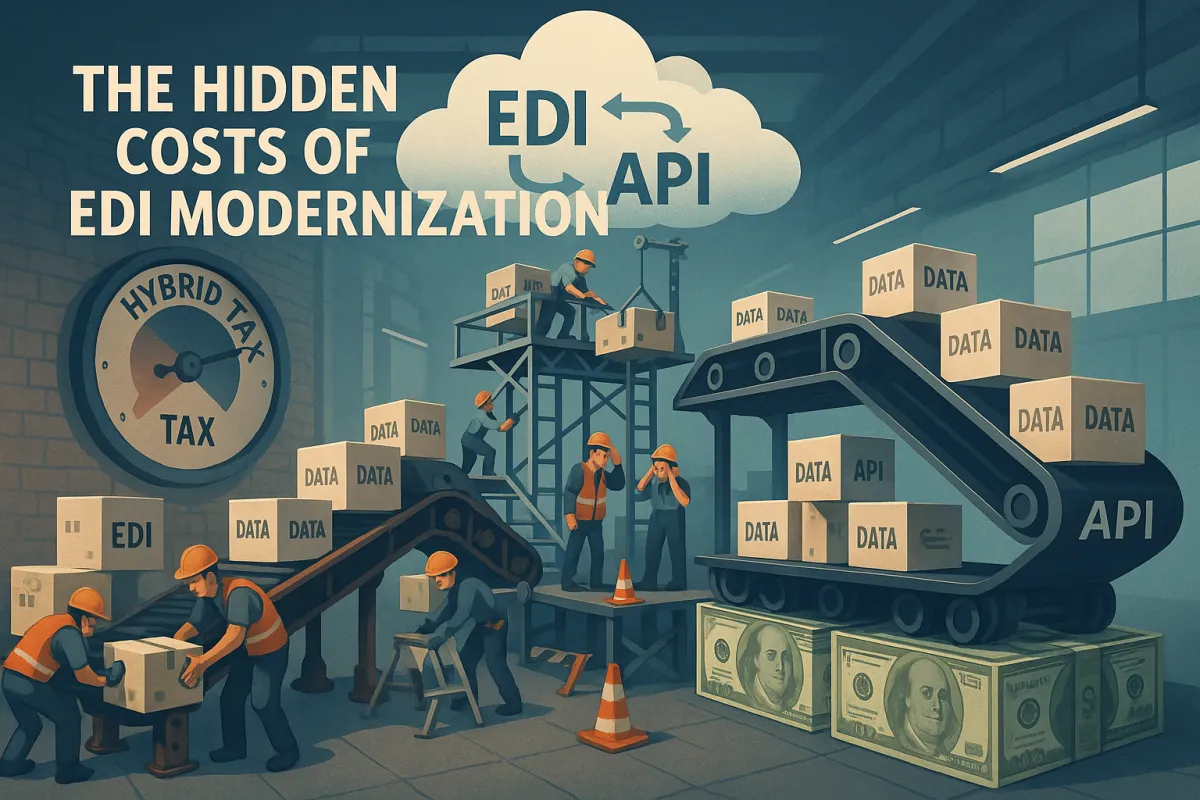
The financial impact hits harder than most teams anticipate. Basic API integrations cost €5,000-€15,000, while complex ERP connections exceed €50,000, but European operations often require 15-25% of their transport budget for emergency reactive changes when regulatory deadlines arrive without preparation. The hidden costs multiply when you're running a "Hybrid Tax", the literal and operational cost of running two completely different technical infrastructures to accomplish the exact same goal: moving data from Point A to Point B.
Why Traditional ROI Calculations Miss 40-60% of Actual Integration Costs
Your finance team approved the EDI modernization based on software licensing and obvious implementation costs. Nobody calculated the "operational drag" that traditional EDI systems operating on scheduled batch windows create. Documents extract, translate, and transmit every 15-60 minutes, but the hidden expense comes from everything that breaks between those windows.
Hidden fees can include extra charges for trading partners, custom document mapping, data storage, onboarding, migration, and premium support. Transaction and network fees can also be "silent budget killers". Most teams discover these costs three months into deployment when their first major retailer integration goes live and VAN fees spike beyond their flat-rate estimates.
The dual-system operation period during migration creates unexpected expense layers. Per-document, per-message, and mailbox storage fees are where the legacy VANs make their money. Some even bill extra for AS2 or FTP connectivity. When you're maintaining both old and new systems during transition, you're essentially paying twice for the same data movement.
Your ERP connectivity assumptions prove consistently wrong. Connecting to your ERP or WMS is never as simple as "out of the box." Whether it's NetSuite, SAP, Dynamics, or legacy AS400, integration costs hint at complexity most teams underestimate by 200-300%. Testing often takes 30-40% of the total development time, while annual maintenance usually costs 15%-25% of the total integration price.
The Complete Hybrid EDI-API TCO Assessment Matrix for 2026
Building an accurate TCO model requires systematic cost capture across three distinct operational phases. This framework accounts for vendor consolidation risks while quantifying the true expense of hybrid architecture decisions.
Phase 1: Current State Cost Inventory (Days 1-30)
Start by documenting every EDI-related expense in your current operation. For 10 users, a managed service with integration could cost $300 - $1000+ per month. Hidden fees can include extra charges for trading partners, custom document mapping, data storage, onboarding, migration, and premium support. Transaction and network fees can also be "silent budget killers".
Capture labor costs by tracking how much time your team spends on manual reconciliation. The biggest hidden cost is manual intervention. When teams constantly fix ASN mismatches, invoice discrepancies, or inventory timing gaps, labor costs quietly accumulate. Document these hours for one complete month, including weekend exception handling and month-end closing support.
VAN fees represent the most variable cost component. Legacy providers structure pricing around mailbox fees, per-document charges, and minimum data record lengths. EDI provider fees have varying structures (per-transaction, monthly subscriptions, setup fees). Be aware of potential hidden charges, such as minimum record lengths for volume calculations. Your current VAN bill provides the baseline, but seasonal volume spikes can double these costs.
Phase 2: Hybrid Architecture Design Costs (Days 31-60)
Modern hybrid approaches require architectural decisions that affect long-term costs. API-hybrid platforms address this complexity by combining APIs, EDI, and file-based integration within a single environment. This allows organizations to support both modern and legacy requirements without introducing additional tools, custom code, or fragmented workflows.
Platform selection directly impacts your total cost structure. Solutions like Orderful, TrueCommerce, SPS Commerce, IBM Sterling, and Cargoson offer different pricing models that affect your three-year projections. Orderful eliminates that frustration with transparent, partner-based pricing that scales with business growth. Orderful's flat pricing model is built around active trading partner connections rather than per-transaction billing, for a single, predictable cost. Every plan includes built-in mapping, testing, validation, and support.
API development requires technical resources most teams underestimate. Basic API integrations cost €5,000-€15,000, while complex ERP connections exceed €50,000. Factor in testing environments, security compliance, and real-time monitoring infrastructure when calculating implementation budgets.
Phase 3: Long-term Operation and Scale Projections (Days 61-90)
Build 36-month cost models that include vendor acquisition scenarios. The acquired companies—E2open under WiseTech and 3GTMS under Descartes—are undergoing integration processes that create uncertainty for existing customers. When your TMS vendor becomes an acquisition target, you inherit integration risks without directly managing the project.
Forecast operational scaling costs based on transaction volume growth and partner additions. It's easy to assume adding a new customer or supplier is a one-time event. In reality, growth means onboarding can be a weekly occurrence. Many legacy solutions charge per trading partner and sometimes by document type per partner—a sneaky way costs multiply.
Include compliance and regulatory change management in your projections. European operations face specific regulatory requirements that affect integration architecture. As of 9 July 2027, the eFTI Regulation will apply in full, ICS2 version 3 messaging becomes mandatory from 3 February 2026. Your API connections must adapt to regulatory changes without manual intervention.
Vendor Consolidation Risk Assessment: Protecting Your Investment
The TMS vendor landscape underwent dramatic restructuring during 2025-2026 that directly impacts your EDI modernization strategy. WiseTech Global's $2.1 billion acquisition of e2open and Descartes Systems Group's acquisition of 3GTMS for $115 million creates specific risks for European shippers implementing new TMS platforms. When your TMS vendor becomes an acquisition target, you inherit integration risks without directly managing the project, with post-acquisition integration timelines typically spanning 12-18 months.
The consolidation wave affects pricing power across the market. Europe could lack over two million drivers by 2026, impacting half of all freight movements, while WiseTech Global's $2.1 billion acquisition of E2open and Descartes Systems Group's $115 million acquisition of 3GTMS signal the most significant vendor consolidation wave in TMS market history. The math doesn't get simpler when you're choosing between fewer vendors to handle more capacity constraints.
Contract protection becomes essential when evaluating vendors. Acquisition-resistant contracts require specific protections: 12-18 months advance notice for ownership changes, guaranteed functionality preservation for minimum periods, and migration assistance rights. Price protection clauses should lock pricing for 24 months following ownership changes.
European-focused providers like Cargoson, Alpega, and nShift maintain independence from the mega-vendor acquisition targets. Oracle, SAP, and MercuryGate (now Infios) bring enterprise-grade capabilities, while platforms like Cargoson, Alpega, and nShift focus specifically on European cross-border operations. This geographic specialization provides some protection against the global consolidation affecting larger platforms.
The Real-World ROI Framework: From Assessment to Implementation
ROI calculations for hybrid EDI-API projects must account for both obvious savings and operational improvements that accumulate over time. Modern EDI solutions are built for real-time data exchange and seamless integration, transforming those costs into predictable investments while opening new opportunities to accelerate revenue. Calculating the return on investment (ROI) is essential for building a compelling business case for EDI modernization.
Direct cost savings typically emerge within 12-18 months through reduced manual processing. The highest ROI typically comes from modernizing the integration layer that connects ERP, warehouse, and retail trading partners. Organizations that eliminate batch processing, centralize compliance validation, and synchronize systems in real time reduce operational friction and protect margins.
Calculate operational improvements by measuring before-and-after processing times. The traditional European freight procurement process consuming 18-28 hours per tender can now be compressed to 45 minutes through marketplace-connected TMS automation. This isn't theoretical efficiency—it's measured time savings that become critical when industry reporting points to hundreds of thousands of unfilled truck driver roles across Europe.
Legacy platforms often come with hidden costs, including IT labor and manual processes that can slow down operations. Modern EDI platforms emphasize real-time data exchange and predictable subscription pricing. An ROI calculation helps uncover the true total cost of ownership while showing how modernization promotes long-term cost savings. Your business case should project 24-36 month payback periods for comprehensive modernization initiatives.
Building Your Vendor-Resistant Integration Strategy
Future-proofing against vendor consolidation requires architectural decisions that prioritize flexibility over feature completeness. The strategy for 2026 isn't to "wait it out". The strategy is to move toward Protocol Agnosticism. In this model, the specific data type becomes irrelevant to your core business logic.
Hybrid integration strategies work when implemented thoughtfully. Your integration strategy shouldn't be an either/or decision. Smart hybrid approaches leverage the strengths of each method. Live, decision-driving data travels via API while audit-critical records that make more sense in a document anyway stay on EDI. This approach reduces vendor lock-in while maintaining compliance capabilities.
Platform architecture matters more than initial feature sets. Modern integration partners bridge the gap between legacy EDI systems and real-time APIs, giving you the best of both worlds. You can maintain the reliability of established EDI workflows while connecting to newer, cloud-native applications through APIs within a single platform. For example, Orderful gives you one API for all trading partner connections, eliminating the need for multiple data formats or complex middleware.
European market dynamics favor regionally-focused providers with stable ownership structures. Independent platforms like Cargoson offer acquisition resistance while maintaining deep understanding of European regulatory requirements and cross-border transport complexity.
Implementation Timeline and Budget Planning for 2026
Your implementation timeline must account for vendor consolidation uncertainty and European regulatory deadlines. The procurement window for securing optimal TMS platforms before vendor consolidation eliminates choices and capacity shortages worsen cost structures runs through Q1 2026. With the European TMS market reaching around € 1.4 billion in 2024 and growing at a compound annual growth rate (CAGR) of 12.2 percent, forecasted to reach € 2.5 billion in 2029, timing decisions directly affect your total costs.
Phase your migration to minimize dual-system operation costs. Start with high-volume, low-complexity trading partners to validate your architecture before migrating complex integrations. Because the platform is cloud-native and API-first, onboarding new partners takes days, not weeks. Teams can test and validate transactions in real time, accelerating ROI and eliminating the manual rework common with legacy systems.
Budget allocation should prioritize vendor selection and contract negotiation during Q1-Q2 2026, platform implementation during Q3-Q4 2026, and full migration completion by Q1 2027. This timeline accounts for regulatory compliance deadlines while avoiding the compressed pricing power that emerges post-consolidation.
Establish quarterly cost reviews to track actual expenses against projections. As transaction volumes grow, ROI should be recalculated. A yearly assessment ensures leadership can align modernization results with broader goals for enterprise application integration and long-term scalability. Your TCO model should include provisions for vendor price increases following acquisitions and market consolidation.