The Packaged Business Capabilities EDI Evaluation Framework: How to Build Modular Integration Architecture That Eliminates Vendor Lock-In and Survives TMS Consolidation in 2026

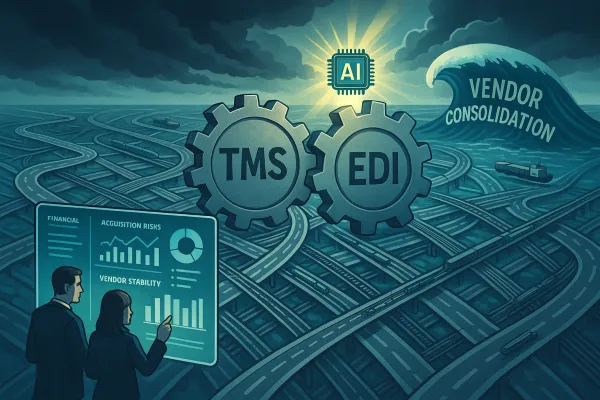
The 2026 market shift toward composable architecture represents more than technology evolution—it's a survival strategy. With WiseTech Global's $2.1 billion acquisition of E2open and Descartes Systems Group's $115 million acquisition of 3GTMS reshaping vendor options, EDI managers face urgent pressure to build vendor-neutral integration systems that survive consolidation.
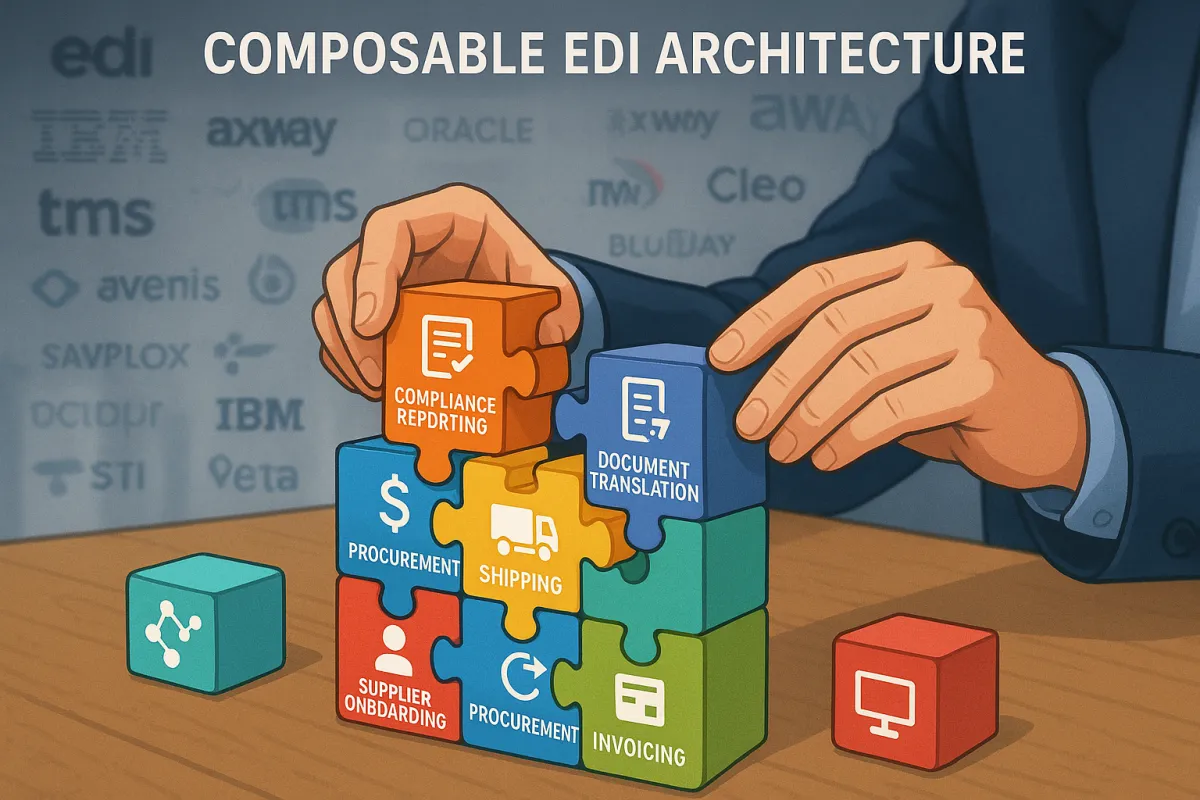
Composable EDI refers to a modular architecture where integration capabilities are interchangeable blocks rather than a monolithic system. This matters because it allows IT leaders to upgrade specific components without risking the stability of the entire EDI environment.
Traditional EDI systems—rigid, tightly coupled, and difficult to modify—are incompatible with modern business demands. Because each module scales independently, composable ecosystems lower the total cost of ownership by as much as 37%. For supply chain professionals managing complex supplier networks, this isn't theoretical; it's the difference between adapting to market changes or being trapped by vendor limitations.
The Composable EDI Architecture Revolution: Why PBCs Matter Now
Packaged Business Capabilities (PBCs) are self-contained components that deliver complete business functions within composable architecture, built from interchangeable components connected via APIs, allowing each capability to evolve, scale, and deploy independently.
The distinction matters. Think of it like this: a microservice might run a website's shopping cart. A different microservice might run the checkout screen. A different microservice might handle online payment. However, a PBC might handle your entire conversion user flow.
Market drivers are undeniable. Gartner forecasts that by 2026, 60% of enterprises will adopt composable architectures, while vendor consolidation accelerates. The European TMS market, valued at €1.4 billion in 2024 and growing at a compound annual growth rate of 12.2 percent, is forecasted to reach €2.5 billion by 2029 alongside unprecedented consolidation that's eliminating choice.
Modern TMS solutions including Cargoson, MercuryGate, Oracle TM, and SAP TM are increasingly embracing PBC approaches. The contrast with legacy EDI systems is stark: monolithic platforms force all-or-nothing upgrades, while PBC-based systems allow selective component replacement without disrupting core operations.
The Critical PBC Assessment Framework: 7 Evaluation Dimensions
Building acquisition-resistant EDI architecture requires systematic evaluation across seven critical dimensions. Notice how these differ from traditional feature checklists that miss architectural resilience.
Business Capability Independence and Reusability
Packaged Business Capabilities are generally "bigger" than microservices. Theoretically, a PBC can consist of exactly one microservice. As a rule, PBCs bundle several microservices so that all functions are available to users in order to perform a task. For EDI implementations, this means evaluating whether supplier onboarding, document translation, and compliance reporting can function independently.
API-First Design and Interoperability Standards
Open standards and well-defined APIs let individual components communicate and integrate regardless of their provider. Dependency on any single vendor drops significantly. The modular design lets you swap components in and out as needed to suit specific business requirements.
Vendor Neutrality and Portability Requirements
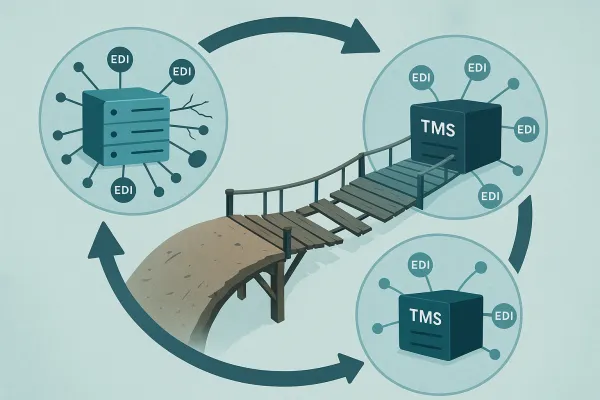
Composable architecture does not eliminate vendor lock-in, but it provides leverage. When systems are modular, organizations can replace components without rearchitecting the entire environment. Critical for EDI systems that must survive TMS vendor acquisitions.
Data Governance and Security Boundaries
Zero-Trust security assumes no transaction is safe by default, requiring continuous verification from every established trading partner. This approach mitigates supply chain risks by enforcing strict identity validation and encryption at every connection point in the network.
Scalability and Performance Characteristics
Each PBC must handle independent scaling without affecting related components. For EDI environments processing thousands of daily transactions across multiple trading partners, this separation becomes mission-critical during peak periods.
Integration Complexity and Maintenance Overhead
Breaking down a monolith creates freedom, but it also creates complexity. Each additional service introduces new points of integration, new dependencies, and new potential failures. The orchestration layer becomes as important as the individual modules themselves.
Cost Model Transparency
Traditional EDI pricing often bundles capabilities into opaque packages. PBC-based systems should offer per-capability pricing that scales with actual usage, not vendor convenience.
Technical Architecture Considerations for EDI PBCs
The modern enterprise ecosystem relies heavily on API management, microservices, and event-driven architecture (EDA), creating flexible, scalable, and resilient systems. These technologies are revolutionizing middleware and enterprise software integration while enabling AI-driven automation and real-time insights.
Event-driven architecture patterns enable PBC communication without tight coupling. When a purchase order arrives, the document parsing PBC triggers validation PBCs without direct integration dependencies. This pattern proves essential when integrating with transportation management platforms like Cargoson, Transporeon, and nShift.
Data consistency across distributed capabilities requires careful planning. Unlike monolithic EDI systems where all data lives in one database, composable systems must maintain consistency across PBC boundaries through event sourcing and eventual consistency patterns.
Vendor Consolidation Risk Mitigation Through PBC Strategy
TMS acquisitions create immediate risks for integrated EDI capabilities. For current e2open customers, the key question is whether WiseTech can maintain product investment and innovation while managing complex integration, with the main concern being whether innovation and product investment will be maintained during integration. Your feature requests get deprioritized as the new parent company focuses on platform consolidation rather than customer-specific enhancements.
The pattern repeats across vendor categories. The separation between EDI translators and API management is ending. The trend for 2026 is the migration toward platforms that handle everything in one place. When you unify these systems, you reduce vendor sprawl and future-proof your tech stack.
Building acquisition-resistant architecture using PBCs requires specific contract protections. Include specific clauses requiring 12-18 months advance notice of ownership changes, with automatic contract review rights triggered by acquisition announcements. Price protection clauses should lock pricing for 24 months following ownership changes, preventing immediate cost increases during integration periods. Functionality guarantee clauses protect against feature deprecation common during platform consolidation. Specify that current functionality levels must be maintained for minimum periods, with migration assistance provided if features are discontinued.
Modern TMS solutions supporting modular approaches include Cargoson, E2open, MercuryGate, and Blue Yonder. Each offers different risk-reward profiles: global mega-vendors provide comprehensive functionality but come with integration complexity and potential feature deprecation risks during acquisitions.
Implementation Roadmap: From Monolithic to Composable EDI
Successful integration starts with the business, not the technology. CIOs should map which parts of the organization change most frequently and modularize those first. Attempting to "go fully composable" all at once is a recipe for disruption and unmet expectations.
Current state assessment methodology begins with documenting existing EDI flows, trading partner requirements, and integration dependencies. Most organizations discover their "simple" EDI environment actually involves dozens of customizations and workarounds that must be preserved during migration.
PBC migration sequencing follows business priority, not technical convenience. Start with the most painful integration points—often supplier onboarding or exception handling—rather than the most technically straightforward components.
Testing strategies for distributed EDI capabilities require new approaches. Traditional EDI testing focused on single-system validation. Composable systems need end-to-end testing across PBC boundaries, simulating real-world failure scenarios where one PBC becomes unavailable.
Performance monitoring across PBC boundaries becomes complex but essential. With structured, complete, and accurate EDI data, supply chain leaders can embed autonomous AI agents into EDI workflows to alert, interpret, act on, and optimize data in real time. This shift suggests a move away from manual troubleshooting of EDI onboardings, mappings and transactions, which often drains day-to-day productivity.
Multi-carrier shipping platforms like Cargoson, ShippyPro, nShift, and Shippo demonstrate successful composable approaches to carrier connectivity. Rather than building monolithic carrier integration systems, these platforms expose carrier capabilities as interchangeable PBCs that can be mixed and matched based on operational requirements.
Cost-Benefit Analysis Framework for PBC Adoption
Hidden costs in PBC transitions often exceed initial estimates. Composable architecture isn't a single purchase — it's a collection of subscriptions and development work. The total cost of ownership is typically higher than a monolithic platform in year one — but the gap narrows over time. Monolithic platforms have hidden costs that compound: plugin maintenance, workaround development, scaling limitations, and vendor lock-in that makes future changes expensive. Composable front-loads the investment but reduces long-term friction.
ROI calculation models for modular EDI must account for option value—the business benefit of being able to respond quickly to new requirements. When a major customer demands specific EDI capabilities, composable systems can accommodate new requirements in weeks rather than quarters.
Total cost of ownership comparisons require longer time horizons than traditional software evaluation. Because each module scales independently, composable ecosystems lower the total cost of ownership by as much as 37% over three-to-five year periods, but the benefits require patience through higher initial implementation costs.
Future-Proofing Your PBC Architecture for 2027 and Beyond
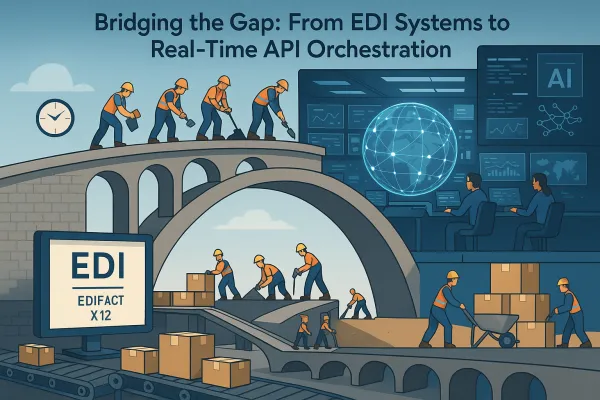
Emerging standards and protocols continue evolving beyond traditional EDI. APIs are unlikely to fully replace EDI in the near future because of EDI's entrenched role and robust standardization for batch processing. A hybrid approach is emerging where APIs handle real-time status updates while EDI manages complex, high-volume document exchanges.
The rise of Agentic AI is redefining what EDI can do. The standardized and structured nature of EDI formats (e.g. ANSI X12, EDIFACT) and EDI data exchanges means less data cleaning is likely required before feeding it into AI models. PBC architecture enables AI integration without disrupting core EDI functionality.
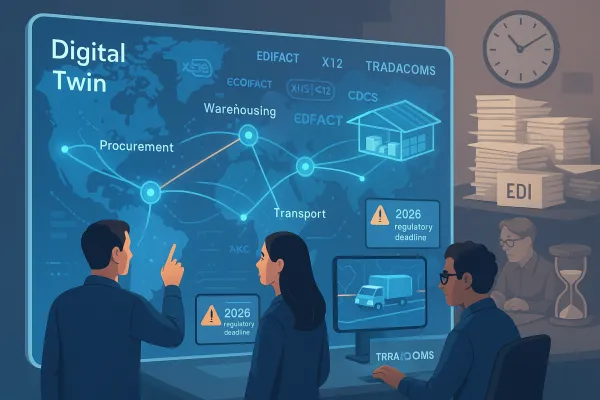
Regulatory compliance through modular design becomes increasingly valuable as requirements evolve. Rather than retrofitting monolithic EDI systems for new compliance requirements, PBC architectures can add compliance capabilities as new components without touching existing trading partner integrations.
Integration with next-gen TMS platforms including Cargoson, Oracle TM, and Manhattan Active requires API-first approaches that treat TMS systems as another PBC in the composable ecosystem. This prevents the vendor lock-in that occurs when EDI capabilities become tightly coupled with specific TMS platforms.
The measurement frameworks you build today determine competitive position post-2026. Smart shippers are instead leveraging transportation management system efficiency to build sustainable competitive advantages that compound over time. Your next strategic decision should focus on building measurement capabilities that survive regulatory changes, vendor consolidations, and market disruptions.
Success requires treating composable EDI as business strategy, not technical architecture. The organizations that begin PBC evaluation and implementation now position themselves to navigate 2026's perfect storm of regulatory requirements, vendor consolidation, and market disruption. Those who delay risk joining the statistics of failed implementations that plague reactive modernization strategies.