The Real-Time EDI Processing Migration Framework: How to Eliminate Batch Processing Delays and Unlock Instant Supply Chain Visibility Without Breaking Trading Partner Networks in 2026

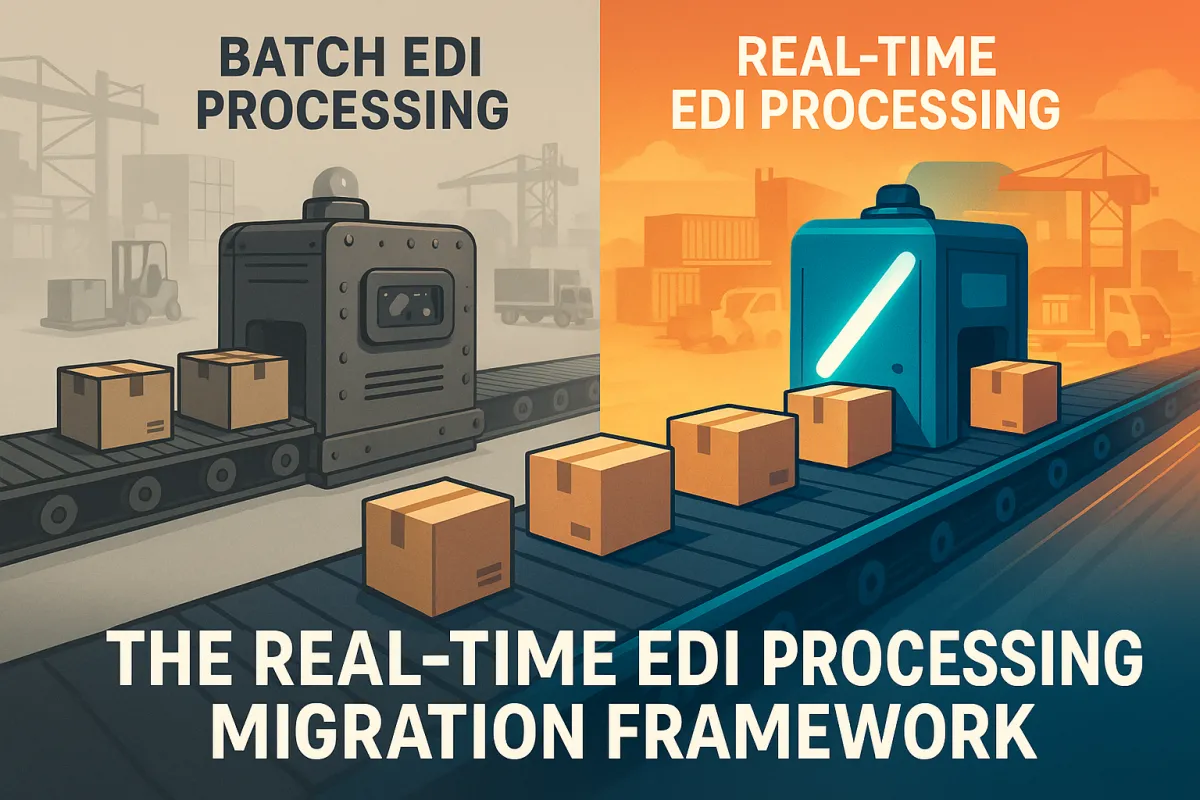
Real-time EDI processing instead of batch windows eliminates these scheduled delays by handling each document the moment it arrives, closing the data gaps that cause overselling, chargebacks, and fulfillment errors across supply chain operations. Yet your current batch EDI architecture might be processing purchase orders every 30 minutes while inventory levels shift by the second during peak sales periods.
This creates a fundamental disconnect between operational reality and system visibility that's costing you more than most supply chain teams realize. A purchase order that arrives at 2:05 PM might not reach the ERP until the 2:30 batch run, and the ERP might not process it until its 3:00 cycle. That is nearly an hour of latency for a single document, with every system in the chain operating on its own schedule.
The Hidden Costs of Batch EDI Processing in Modern Supply Chains
Batch-based EDI processes inventory updates on a schedule, typically every 15, 30, or 60 minutes. During that interval, your trading partners see inventory levels that may no longer reflect reality. When 200 units sell during a flash sale but the EDI batch does not fire for another 15 minutes, partners place orders against inventory that no longer exists.
The math here is straightforward but sobering. Inventory distortion, the gap between what systems report and what actually exists, costs the retail industry an estimated $1.2 trillion globally. For a growing brand shipping $10 million annually, even a small percentage of overselling-driven cancellations and chargebacks represents a significant margin hit.
Consider how TMS vendors handle this gap differently. MercuryGate offers access to over 10,000 carrier connections via EDI and API, though many are through standard EDI formats that carriers must implement, while Cargoson offers direct API/EDI integrations with carriers across all transport modes (FTL, LTL, parcel, air, and sea freight) and builds true API/EDI connections with carriers, not just accounts in software or standardized EDI messages that carriers must implement themselves. Descartes follows a similar pattern to MercuryGate with extensive but standardized integrations.
The financial impact extends beyond inventory accuracy. EDI chargebacks are margin killers—wrong labels, missing ASNs, and routing guide violations cost brands $10K-$50K per month in penalties. Best business practice requires transmitting your ASN within two hours of finalizing a shipment. If your ASN doesn't arrive before the physical goods, you're almost guaranteed a chargeback. The timing challenge is real—ASNs must be sent after the shipment is sealed (representing actual contents), yet arrive before the shipment is received.
Understanding the Real-Time vs Batch EDI Architecture Differences
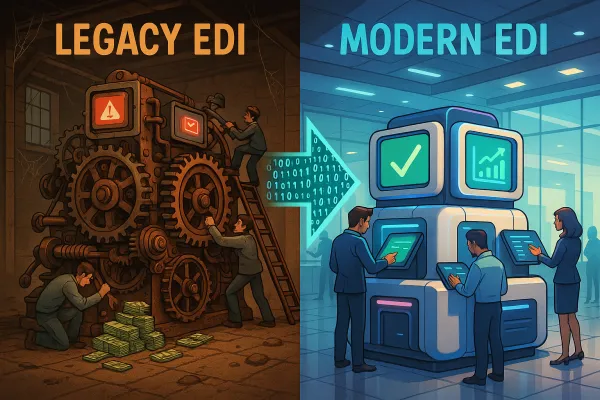
Modern systems eliminate the manual mapping, batch processing delays, and maintenance overhead common in legacy EDI environments, enabling faster partner onboarding, higher data accuracy, and operational efficiency that scales with business growth.
The technical difference comes down to processing architecture. Batch processing in EDI means collecting inbound and outbound documents over a set period and processing them all at once. A typical batch window runs every 15, 30, or 60 minutes. Some organizations still run batch cycles on hourly or daily schedules, depending on the document type and trading partner requirements.
Batch windows became standard because early EDI infrastructure was built around Value-Added Networks (VANs) that operated on store-and-forward models. Documents were deposited in a VAN mailbox and retrieved on a schedule. The translation software that converted EDI formats into ERP-compatible data also operated in batch mode, processing queued files and writing results to staging tables or flat files. This architecture made sense when trading partners exchanged documents once or twice a day and supply chain velocity was measured in days rather than hours.
Real-time processing handles documents individually as they arrive. Orderful's API-first EDI platform maintains real-time inventory accuracy by processing transactions through immediate API calls rather than scheduled batch files. Every inventory update is validated instantly against trading partner requirements before propagating downstream, preventing incorrect feeds and mismatched documents that cause stockouts or overselling.
When Batch Processing Still Makes Sense (And When It Doesn't)
Not every EDI document requires real-time processing. Compliance-Heavy Flows (850/855/856/810): Retailers and industry standards often require strict mapping and validation that batch EDI provides out-of-the-box. You know these runs—where every field is checked, formats are locked, and error logs are robust. Historical & Analytical Reporting: Monthly reconciliations, sales analysis, or multi-site inventory pulls aren't urgent. Running them overnight not only saves resources but can also drop costs compared to a real-time (and often redundant) data stream.
Documents like remittance advice (EDI 820), payment notifications, and periodic reporting do not have the same time sensitivity as purchase orders or advance ship notices. These documents inform back-office processes that operate on longer cycles, and processing them in batch windows introduces no meaningful business risk.
The decision framework should focus on business impact rather than technical capability. Start the transition with the document flows that generate the most chargebacks, the most manual reconciliation, or the longest processing delays. For most retail and distribution supply chains, this means advance ship notices and purchase orders. These are the documents where batch delays have the most direct financial impact.
Building the Business Case for Real-Time EDI Migration
Calculating ROI for EDI modernization starts with a standard formula: ROI = (Total Net Benefits – Total Costs) ÷ Total Costs × 100.
Start with quantifying your current batch processing costs. Labor: How many hours are spent keying in orders, chasing down errors, or clarifying with trading partners? Even at $20/hour, 20 extra hours weekly adds up to $20,800 a year. Error correction and chargebacks: Humans make mistakes. With a few percent error rate, one bad batch could cost you thousands in chargebacks, lost vendor confidence, and hours spent fixing preventable issues.
TMS integration costs vary significantly by vendor approach. MercuryGate typically starts at $30,000-$100,000 annually, with implementation costs sometimes reaching six figures, while Manhattan's total cost of ownership ranks as relatively high, while cloud-native solutions like Cargoson focus on reducing implementation complexity through pre-built integrations and European carrier connectivity.
Document the savings potential: Real-time EDI integration synchronizes inventory counts between your warehouse, ERP, and trading partner systems as changes occur rather than on a scheduled batch window. When a batch runs every 15 minutes, there is a 15-minute period where partners see inventory that may no longer exist. Real-time sync closes that gap to seconds, reducing order cancellations during high-volume sales events.
Most brands switching from manual EDI processing to automated systems eliminate $10K-$50K/month in chargeback costs within the first 30 days. Endust cut monthly EDI expenses by 50%, saw improved document retrieval, and had a seamless migration with no downtime. Razor USA migrated VANs in three days, achieved 100% trading partner compliance, and saved over 500 staff hours each month. Spanx saw an 83% reduction in monthly EDI costs, thanks to trading partner-based pricing and better support. Torani reduced costs by 54% and gained reliable, round-the-clock support—all without service interruptions.
The Step-by-Step Migration Framework Without Trading Partner Disruption
The transition from batch to real-time is rarely an overnight switch. Organizations need a platform that can run both batch and real-time processing simultaneously, allowing them to migrate document flows incrementally without disrupting existing trading partner relationships.
Moving from batch to real-time EDI does not require replacing your ERP or abandoning your existing EDI infrastructure. The transition targets the middleware and processing layers between your EDI endpoints and your core business systems.
The first step is mapping every batch schedule in your EDI processing pipeline. Document which systems run on what intervals, which document types are included in each batch, and what downstream processes depend on batch completion. Not all documents need real-time processing. Categorize your EDI document flows by latency sensitivity: High sensitivity: ASNs (856), purchase orders (850), inventory updates, these should move to real-time first.
Phase the migration by document type and trading partner volume. Start the transition with the document flows that generate the most chargebacks, the most manual reconciliation, or the longest processing delays. For most retail and distribution supply chains, this means advance ship notices and purchase orders. These are the documents where batch delays have the most direct financial impact.
Iterate and Measure: Start with one API-driven process—maybe live inventory sync. Track chargebacks, customer complaints, and time-to-resolve tickets. Expand your real-time ambition only where ROI is proven in hard savings or customer win-backs.
Critical Integration Points with TMS and ERP Systems
EDI can be integrated to work with APIs. While the APIs provide real-time, fine-grained integration, the EDI system provides standardized, high-volume batch exchange with governance and auditability. Using APIs to connect directly to an ERP system makes the data transfer path simpler because the intermediary file transfer server and associated manual processes are eliminated. Implementing EDI with a hybrid integration of APIs can deliver: EDI outside, APIs inside: Using the partner-facing EDI while using APIs to communicate across internal microservices.
Modern TMS platforms increasingly support this hybrid approach. Modern TMS platforms like Cargoson, MercuryGate, and Descartes now offer built-in carbon calculators that provide pre-calculated CO2 emission estimation before making transport booking, shifting carbon consideration from post-hoc reporting to proactive decision-making.
API-enabled data flows enhance and extend interactions between your ecosystem of customers, suppliers, carriers, and applications through real-time integration. With the MercuryGate integration, you get access to real-time shipment status updates that help keep your supply chain running smoothly.
Common Migration Pitfalls and Prevention Strategies
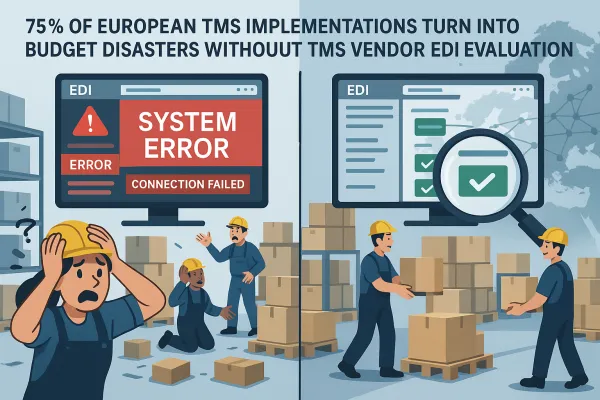
Industry data paints a sobering picture: a vast majority of data migration projects—often cited as over 80% [1, 3, 2]—run over budget and past deadlines, with a substantial percentage failing to meet their core objectives.
Data Quality is Foundational: Poor source data quality (incompleteness, inconsistency, duplicates in files) is a primary culprit behind errors, costly rework cycles, and project delays. Early investment in data cleaning software and robust validation processes is paramount, particularly before complex logic is applied.
Partner communication failures create the most visible issues. BOLD VAN handles onboarding, configures every trading partner, and finishes most migrations in a single day—with zero service interruption and 24/7 support. You never need to recontact a partner or put compliance at risk.
Testing scenarios must reflect real-world conditions. Brands should work with their EDI provider to implement rigorous testing of their EDI system – especially when setting up new transaction types or adding new trading partners. This testing should mimic real transaction conditions as closely as possible to catch any potential issues before going live.
The TMS vendor you choose affects migration support quality. Companies undergoing integration often experience 12-18 months of reduced innovation while they harmonize platforms and teams. Here's what procurement teams miss: Companies undergoing integration often experience 12-18 months of reduced innovation while they harmonize platforms and teams during vendor consolidations.
Performance Monitoring and Optimization Post-Migration
Continuous Monitoring and Reporting. Regular monitoring of EDI transactions helps brands identify and rectify errors quickly. Effective reporting tools can help pinpoint trends in errors, allowing for proactive corrective measures.
Measure processing time improvements directly. Inventory accuracy depends on how frequently stock levels are synchronized across systems. When EDI operates on 15-minute batch windows, there is a 15-minute period where the inventory count in your ERP does not match the actual inventory in your warehouse or the availability shown to your trading partners versus real-time synchronization.
Teams can test and validate transactions in real time, accelerating ROI and eliminating the manual rework common with legacy systems. Real-time visibility shortens feedback loops between trading partners, preventing costly delays. Modern API-enabled platforms provide faster partner onboarding, reducing the labor costs associated with manual setup and testing.
Track chargeback reduction as your primary success metric. Brands that systematize EDI compliance reduce chargebacks by 80-90% and improve retailer relationships. Distributors who treat EDI as a strategic, fully-integrated process (not just a compliance hurdle) see rapid drops in chargebacks and measurable improvements in order accuracy.
Set up dashboards for exception handling. Not monitoring and resolving EDI exceptions quickly leads to cascading problems. Poor exception handling causes $10K-$25K per month in additional chargebacks and $15K-$30K in operational disruption.
The path forward requires choosing platforms that support both batch and real-time processing during the transition. The future lies in hybrid cloud EDI software that enables gradual migration without requiring partners to change everything at once. Whether you select established platforms like MercuryGate and Descartes or modern alternatives like Cargoson, Cleo, or Orderful, ensure your chosen solution can handle incremental migration without disrupting existing trading partner relationships.
Your batch EDI architecture served its purpose, but real-time processing eliminates the artificial delays that cost you visibility, accuracy, and money. The migration framework outlined here provides a roadmap for making that transition while protecting the trading partner relationships that drive your business.