The Strategic AS2 to AS4 Migration Framework for TMS Integration: How to Evaluate Next-Generation EDI Protocols Without Breaking Your Transportation Management System in 2026

Transport management teams face a critical decision point in 2026. Major retailers like Walmart mandate AS2 for supplier communications, yet AS4 continues to be positioned as the "next-generation" protocol that promises better integration with modern enterprise architectures. The pressure to migrate isn't just technical—it's strategic.
The US transportation management system market reached USD 5.2 billion in 2025, growing from USD 4.8 billion in 2024, while the global TMS market size stands at USD 2.27 billion in 2025 and is forecast to reach USD 3.47 billion by 2030. This growth creates urgency around infrastructure decisions that will impact operations for the next decade.
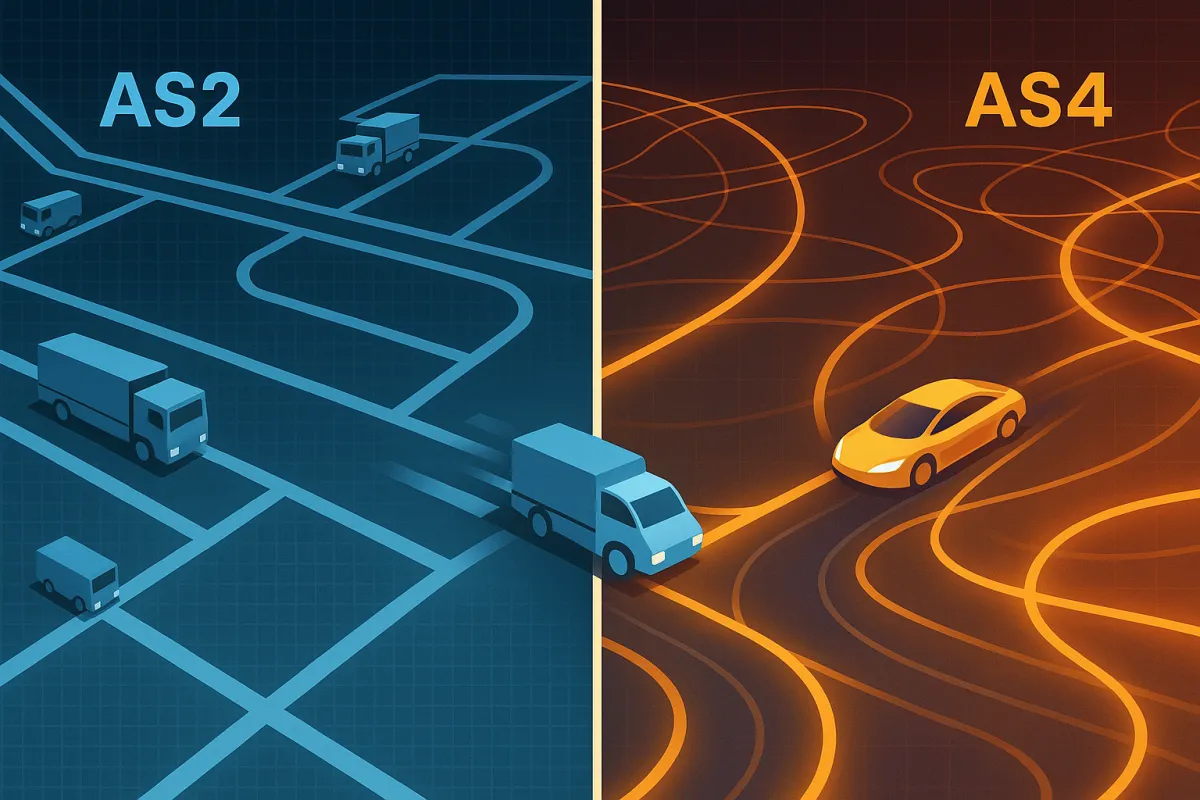
AS4 is a continued development of the AS2 standard that provides more agility and reliability for modern B2B/EDI integration use cases, acting as a bridge from traditional EDI to modern API-driven processes, and can be seen as a superset of AS2. The question isn't whether AS4 offers technical advantages—it clearly does. The question is whether those advantages justify the migration complexity for your TMS environment.
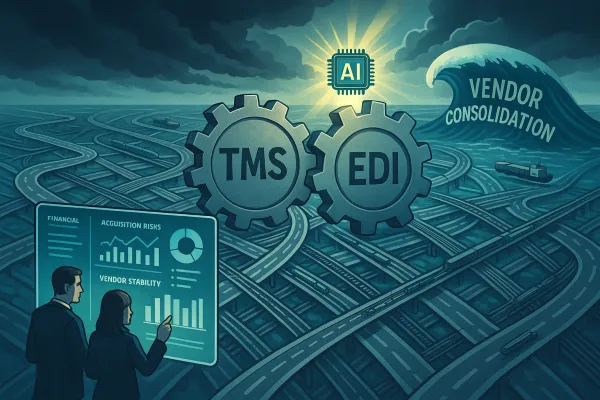
Three factors typically trigger AS2 to AS4 migration evaluation: regulatory compliance requirements pushing toward web services standards, vendor consolidation forcing protocol decisions, and API modernization initiatives seeking unified architectures. Recent market consolidation, like Körber AG's acquisition of MercuryGate in September 2024, enhances multimodal TMS capabilities but also pressures organizations to standardize on fewer, more capable protocols.
AS4 Technical Advantages Over AS2 for Transportation Management Systems
Compared to AS2, AS4 provides more agility and reliability for the modern B2B ecosystem thanks to SOAP-driven exchanges, XML, metadata, and WS-Security. Because AS4 is based on SOAP, it provides additional benefits to users compared to AS2: it is more compatible with a common enterprise IT ecosystem. This compatibility matters significantly when your TMS already uses SOAP-based web services internally.
The architectural differences run deeper than messaging formats. AS2 messages are structured using pure MIME formatting, whereas AS4 combines MIME with SOAP enveloping. AS4's WS-Security approach provides more robust integration with enterprise systems already using XML technologies. For TMS platforms built on modern service-oriented architectures, AS4's web services foundation eliminates translation layers that AS2 implementations often require.
AS4 allows for a push, as well as for the pull. This means that applications that are not always online, that do not have a permanent IP address or that is behind a firewall can connect occasionally and pull available messages. AS4 guarantees reliable message delivery using mechanisms such as acknowledgements and error recovery. This flexibility proves valuable for TMS implementations managing diverse carrier networks with varying connectivity capabilities.
Beyond basic messaging, it's possible to add metadata to AS4 messages, beyond simple data exchanges. You can transport any type of payload: XML, JSON, EDI, HL7, binary and ASCII, and so on. You can also carry multiple payloads if needed. Modern TMS environments increasingly need to handle mixed data types from IoT devices, mobile apps, and legacy systems within single transactions.
Security represents another key differentiator. Security is based on WS-Security, an extension to SOAP specification. WS-Security defines a framework for protecting the integrity, confidentiality, and authentication of each AS4 message. WS-Security describes how to encode security tokens and attach them directly to the message, enhancing traditional channel-based security mechanisms such as HTTPS.
The Hidden Costs and Complexity of AS2 to AS4 TMS Migration
The technical advantages come with substantial migration complexity. AS4 has not yet gained wide adoption, due to the popularity and the continued use of AS2. This is despite AS4 being more compatible with modern standard environments because many organisations use technologies like SOAP, XML, and EDI for their internal integrations. Limited adoption creates a catch-22: you want the benefits but face higher implementation costs due to smaller vendor ecosystems.
Implementation costs range from €30,000 to €900,000, and for shippers with freight spend exceeding $250M annually, implementation can cost 2-3 times the subscription fee. TMS implementation costs range from €30,000 to €900,000, depending on complexity and vendor approach. AS4 migrations often fall toward the higher end due to additional testing requirements and limited pre-built integrations.
Mapping mismatches represent a critical challenge: Every TMS platform structures its data differently. Without precise mapping between new and existing fields, critical information can be dropped or misrouted. AS4's enhanced metadata capabilities can exacerbate this—more flexible data structures mean more complex mapping validation.
The challenge multiplies with trading partner ecosystems. The average company that performs EDI has anywhere from 100-200 partners, and 400-500 maps—all of which will be impacted by the switch. Unlike AS2, where most partners have existing capabilities, AS4 often requires partner-by-partner capability verification and potentially phased rollouts.
Integrating EDI with TMS can be technically challenging, especially for organizations with outdated systems or limited IT resources. Businesses may need to invest in middleware solutions to bridge the gap between legacy systems and modern EDI requirements. Legacy Systems: Older systems may not support the latest EDI standards, requiring significant upgrades. Integration Costs: The initial investment for integration can be substantial, although it is often recouped through long-term savings.
AS4 Adoption Barriers Specific to Transportation and Logistics
Transportation and logistics face unique adoption barriers beyond general EDI challenges. While some believe it will ultimately surpass AS2 as the primary EDI protocol, AS2 continues to be the most widely-used protocol for EDI thanks to adoption by global giants like Walmart. In transportation, large retailers and 3PLs often dictate protocol choices to their entire carrier networks.
Regional differences compound the challenge. AS4 is also an exchange standard recommended by the European Commission for delivery and electronic invoicing projects. European transportation companies face regulatory pressure toward AS4 adoption, while North American operations remain heavily AS2-focused. Multi-regional TMS implementations must support both protocols simultaneously.
Carrier readiness assessment reveals significant gaps. While carriers can easily join platforms through portals, requesting completely new carrier API/EDI integrations is complex and costly - many providers don't build custom integrations themselves but provide standard EDI interfaces that carriers must implement. European shippers face unique challenges with cross-border carrier requirements. Most European shippers work with 20-30 regular carriers but could benefit from access to 200-300 qualified providers.
The cost implications vary dramatically by implementation approach. Transporeon and nShift require carriers to implement standard EDI interfaces themselves, while Cargoson builds true API/EDI connections with carriers rather than requiring standardized EDI messages that carriers must implement. This difference affects both migration timeline and carrier onboarding success rates.
The Complete AS2 to AS4 Migration Evaluation Framework
Building a comprehensive evaluation framework requires moving beyond feature comparisons to operational impact assessment. Start with technical readiness evaluation across four dimensions: current infrastructure compatibility, integration architecture maturity, development team capabilities, and testing environment adequacy.
Infrastructure assessment begins with protocol support analysis. Legacy protocol issues: Older EDI connections often rely on protocols like FTP or AS2. If the new TMS doesn't support those methods or supports them differently, message delivery can fail entirely. Document every current AS2 connection, its specific configuration requirements, and the effort required to replicate that functionality in AS4.
Trading partner ecosystem mapping demands partner-by-partner capability verification. Create a matrix showing current AS2 usage, AS4 readiness, migration timeline flexibility, and business criticality. Considering your trading partners' capabilities remains crucial—even the most advanced protocol provides little benefit if your business partners cannot support it. Prioritize high-volume, business-critical partners for early migration phases.
ROI calculation methodology should include both quantified and strategic benefits. Evaluate the total cost of ownership, including licensing fees, implementation costs and ongoing maintenance. Compare this cost against the anticipated return on investment (ROI) in terms of reduced operational costs, faster transaction processing and enhanced trading partner relationships. For AS4 migrations, add strategic value from API convergence, enhanced security capabilities, and regulatory compliance positioning.
The assessment checklist includes: Current AS2 connection inventory with configuration details, partner capability verification results, internal development resources and timeline availability, testing environment requirements and availability, integration complexity analysis for each TMS module, security and compliance requirement changes, and rollback procedure planning.
Hybrid AS2/AS4 Implementation Strategy for TMS Platforms
A hybrid approach often provides the best migration path, leveraging AS4's superset capabilities while maintaining AS2 compatibility. AS4 can be seen as a superset of AS2. It's a protocol that satisfies the needs of the modern market, fits the IT landscape of enterprises, and provides the needed level of security, resiliency, and agility. This superset relationship allows supporting both protocols from a single platform architecture.
Managed File Transfer (MFT) solutions significantly simplify protocol implementation. MFT tools provide certified support for AS2, AS3, and AS4, offering a "single pane of glass" for administration. Modern MFT platforms enable dual-protocol operation without duplicating infrastructure or administrative overhead.
Phased migration planning should prioritize business continuity throughout the transition. Begin with new trading partner onboarding using AS4, while maintaining existing AS2 connections. This approach validates AS4 capabilities with lower-risk partners before migrating critical connections. A standalone EDI solution can flow data based on the partner product migration to either the new or old ERP, until the migration is complete.
Testing procedures for dual-protocol environments require careful planning. Limited testing environments: Migration teams often lack a staging environment that accurately mirrors production, making it more challenging to identify issues before going live. Ensure your testing framework can validate both AS2 and AS4 message flows simultaneously, including failover scenarios and protocol-specific error handling.
Integration with popular TMS solutions varies by vendor approach. Solutions like Cargoson focus on European manufacturers, wholesalers, and retailers with direct API/EDI integrations across all transport modes, specifically addressing challenges that manufacturing, wholesale, and retail companies face. Evaluate how your chosen TMS platform handles protocol diversity in its native integration capabilities.
Future-Proofing Your TMS EDI Architecture Beyond 2026
AS4 is also an exchange standard recommended by the European Commission for delivery and electronic invoicing projects. This regulatory endorsement, combined with ongoing API convergence trends, positions AS4 as a strategic choice for organizations planning multi-year TMS architectures. The question shifts from whether to migrate to when and how quickly.
Long-term protocol evolution points toward API-first approaches with EDI compatibility layers. In a challenge to the dominance of traditional EDI, EDI processes are changing, and increasingly they now co-exist with other modern technologies such as APIs. By using SOAP messages rather than S/MIME, AS4 is well placed to act as a bridge in the transition of Businesses from traditional EDI to more modern API-driven processes. This speed of this transition will significantly increase in the future as these new technologies integrate across industry.
The convergence creates strategic opportunities for organizations willing to invest in AS4 migration now. Early adopters can position themselves advantageously for API integration initiatives, cloud-native TMS migrations, and regulatory compliance requirements. AS4 is a modern version of AS2, based on technology standards that are aligned with the modern IT ecosystem of enterprises: SOAP, API-communication, Web Services, cloud convergency, etc. AS4 allows for SOA (Service-Oriented Architecture), not only document interchange. This means you can extend your SOA to reach out to your ecosystem.
Preparation strategies should focus on building capabilities that support both current operations and future evolution. Invest in MFT platforms with strong AS4 support, develop team expertise in SOAP-based web services, establish testing frameworks that can validate complex message flows, and create documentation standards that support both EDI and API integration patterns.
The migration decision ultimately depends on balancing immediate costs against strategic positioning. If you are in an industry that needs to communicate with legacy EDI processes, then AS2 would probably be the necessary protocol to use. If, however, your business and your partners have newer technologies on both sides of the secure data exchange piece, AS4 could be the better protocol to use for the future.
Your AS2 to AS4 migration decision requires careful evaluation of technical benefits against implementation complexity. The framework above provides the foundation for making an informed choice that aligns with both current operational needs and future architectural direction. Whether you choose immediate migration, phased transition, or continued AS2 operation, ensure your decision supports your organization's broader digital transformation goals.