The Supply Chain Orchestration Implementation Framework: How to Bridge the Critical Execution Gap That Traditional EDI Integration Cannot Solve in 2026

Supply chain leaders in 2026 are learning a hard lesson. Data movement does not equal execution. The integration platforms that companies spent millions implementing over the past decade can connect systems and exchange documents efficiently, but they struggle when supply chains shift from business-as-usual into disruption mode. A single missed update can cascade into stockouts, order cancellations and damaged relationships.
Traditional EDI integration was designed for a predictable world. Your ERP talks to your warehouse. Purchase orders flow to suppliers. Invoices get processed. But when a container sits at port for three extra days, or a carrier changes delivery dates without warning, these systems just pass data around. They don't coordinate the response that protects your customer commitments.
Understanding Supply Chain Orchestration vs. Traditional Integration
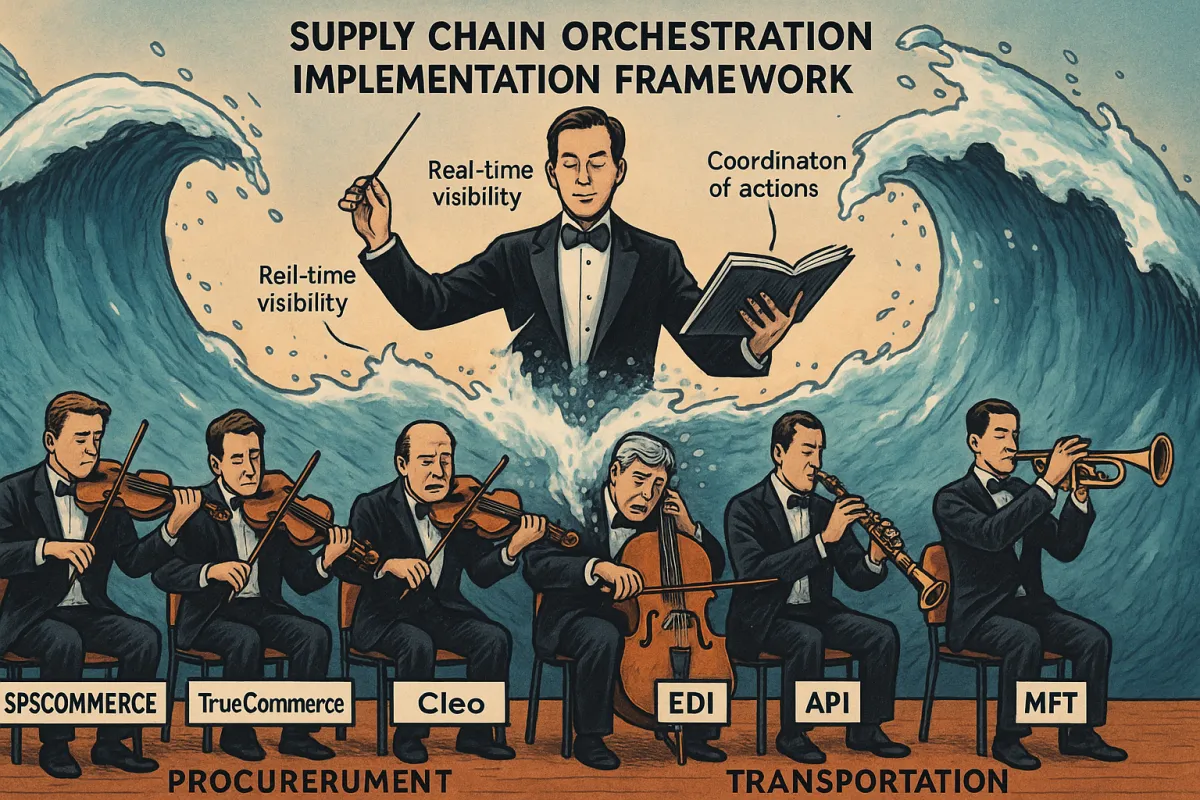
Supply chain orchestration is broader. It governs the end-to-end transaction lifecycle across partners and systems by combining EDI with APIs, managed file transfer, real-time visibility, workflow automation, and intelligence that helps teams coordinate action and protect revenue outcomes.
The difference shows up in how platforms handle exceptions. Your traditional EDI provider from SPS Commerce or TrueCommerce will alert you that a shipment confirmation is late. Cleo positions its approach as AI-native and states it can resolve operational disruptions 85% faster than legacy integration middleware. The orchestration approach spots the pattern, identifies which customer orders are at risk, and suggests the specific actions to take.
The best tools supply chain orchestration 2026 unify connectivity across API, EDI, and MFT, provide real-time visibility, and support coordinated action at scale. This matters because your partners increasingly expect both EDI compliance and API speed. More retailers, marketplaces, and logistics partners are using APIs in addition to EDI. A supply chain orchestration platform brings both together seamlessly in one place.
The Hidden Costs of Fragmented Integration Architectures
41% of SPS customers face integration challenges with ERP and WMS systems. This fragmentation creates costs that most finance teams don't see on their EDI invoices. When each integration runs in its own silo, your team spends hours tracking down why shipment data doesn't match between your TMS, WMS, and customer portals.
Many suppliers still process PDF orders manually while managing EDI connections and API integrations with the same retailer across different channels. The retail supply chain is transitioning from linear, single-channel fulfillment to a networked, multi-path ecosystem where every supplier must function as a precision node.
Companies using Blue Yonder or Manhattan Active for planning discover their execution layer can't keep pace. Platforms built through acquisitions carry technical debt that impacts AI performance and data access that provides the context required for the AI to make informed decisions. When AI needs real-time data from disparate modules acquired from different vendors, it works with incomplete information.
Modern supply chain orchestration platforms like Cleo, Cargoson, and others address this by unifying data flows from day one rather than stitching together separate tools.
The Orchestration Implementation Assessment Framework
Before evaluating supply chain orchestration platforms, assess your current integration maturity across four dimensions:
Partner Onboarding Speed: How quickly can you onboard new trading partners? Unify API, EDI, and MFT on a single AI-native platform to automate partner onboarding in hours and resolve disruptions 85% faster. Traditional EDI networks like those from IBM Sterling or SPS Commerce typically require weeks for new partner connections.
Exception Handling: When disruptions occur, can your systems automatically identify which orders, customers, and commitments are at risk? It is the ability to spot gaps between planned and actual execution, then close them before they become disruptions. These gaps can show up as OTIF risk, delayed confirmations, inconsistent shipment milestones, or recurring partner friction that slows fulfillment and payment.
Cross-Modal Coordination: If you manage both parcel and freight shipments, can your platform optimize across carriers and modes? Cargoson is a modern European TMS that bridges the gap between complex enterprise systems and simple shipping tools. It offers direct API/EDI integrations with carriers across all transport modes (FTL, LTL, parcel, air, and sea freight), allowing you to compare rates, book shipments, and track imports and deliveries from a single platform.
Real-Time Decision Support: Agentic resolution helps teams move faster from "what happened?" to "fix it now" by prioritizing, recommending next steps, and coordinating action across partners. This separates orchestration platforms from traditional integration tools that just move data.
Critical Implementation Challenges and Solutions
The biggest orchestration deployment obstacles aren't technical. They're organizational. Your team knows how to manage EDI mapping and API connections. But orchestration requires thinking about business processes across partners, not just data exchange between systems.
Cloud-based TMS implementation typically takes 1-4 weeks compared to 6-18 months for traditional on-premise systems. Solutions like Cargoson can have shippers managing freight within days of signing up. However, this speed advantage disappears if you don't address change management upfront.
Start with your highest-volume trading partners. Leading suppliers now treat "an order is an order" as their operating principle, investing in systems that provide single-pane visibility across all channels rather than managing each channel separately. Focus on standardizing processes before adding more partners or automation.
Legacy EDI providers like TrueCommerce and IBM Sterling built their architecture around document exchange. Modern orchestration platforms from Cleo, Descartes, and Cargoson design around business outcomes. This architectural difference affects everything from partner onboarding to exception handling.
Trading Partner Onboarding and Performance Management
Traditional EDI onboarding follows a predictable sequence: map documents, test connections, go live, then monitor for compliance. Supply chain orchestration flips this approach. Instead of starting with document formats, you begin with business commitments. What OTIF percentage does this partner need to maintain? How quickly should they respond to order changes?
Orchestration platforms provide SLA alerts, partner performance scorecards, and automation to reduce errors and avoid costly chargebacks. This becomes essential as partner networks expand beyond traditional EDI relationships.
Platforms like Oracle TM and SAP TM offer partner scorecarding as part of broader suite implementations. Standalone orchestration platforms like Cleo and Cargoson make partner performance visible from day one. Builds true API/EDI connections with carriers, not just accounts in software or standardized EDI messages that carriers must implement themselves.
The difference matters for supply chain resilience. When disruptions hit, you need to know which partners can absorb additional volume and which need support maintaining commitments.
Measuring Success: KPIs and ROI for Orchestration Platforms
Supply chain orchestration ROI shows up in operational metrics, not just IT cost savings. According to McKinsey research, companies with integrated data foundations spanning planning, execution, and analytics deliver 2-3 times greater ROI than disconnected solutions. That ROI difference comes from AI that actually works—because the platform architecture lets it.
Track these metrics to measure orchestration platform success:
Exception Resolution Time: Cleo positions its approach as AI-native and states it can resolve operational disruptions 85% faster than legacy integration middleware. Measure time from exception detection to corrective action, not just alert generation.
Partner Performance Consistency: Suppliers who can't maintain accuracy across multiple channels, systems and fulfillment methods become friction points, and friction points get removed from the network. Track OTIF performance across all channels and partners.
Onboarding Velocity: Century reduced new partner onboarding time by 75% With Cleo, Century has achieved rapid, sustainable growth across every facet of its integration landscape. And as their needs have expanded, Cleo's platform has scaled effortlessly to keep pace.
Total Cost of Integration: License fees represent just 20-30% of true TCO. Implementation timelines of 6-18+ months signal architectural complexity, unexpected cost implications, and delayed AI value delivery.
Companies evaluating platforms like MercuryGate, 3Gtms, and Descartes often focus on feature comparisons. The real differentiator is architectural approach. Cloud-native platforms with unified codebases enable AI to access complete data from day one.
The execution gap between data movement and business outcomes is widening. The speed gap between what businesses need and what manual processes can deliver is becoming insurmountable. AI orchestration promises to close this gap by coordinating decisions across the supply chain at machine speed. Success depends on choosing platforms designed for coordination, not just connectivity.