The TMS-EDI Integration Risk Prevention Framework: How to Eliminate the 73% Implementation Failure Rate and Protect Trading Partner Networks During Transportation System Transitions in 2026

76% of logistics transformations fail to achieve their performance objectives. When you factor in TMS-EDI integration specifically, that failure rate actually increases. The average company that performs EDI has anywhere from 100-200 partners, and 400-500 maps—all of which will be impacted by the switch. This is a huge challenge and workload to tackle for any company.
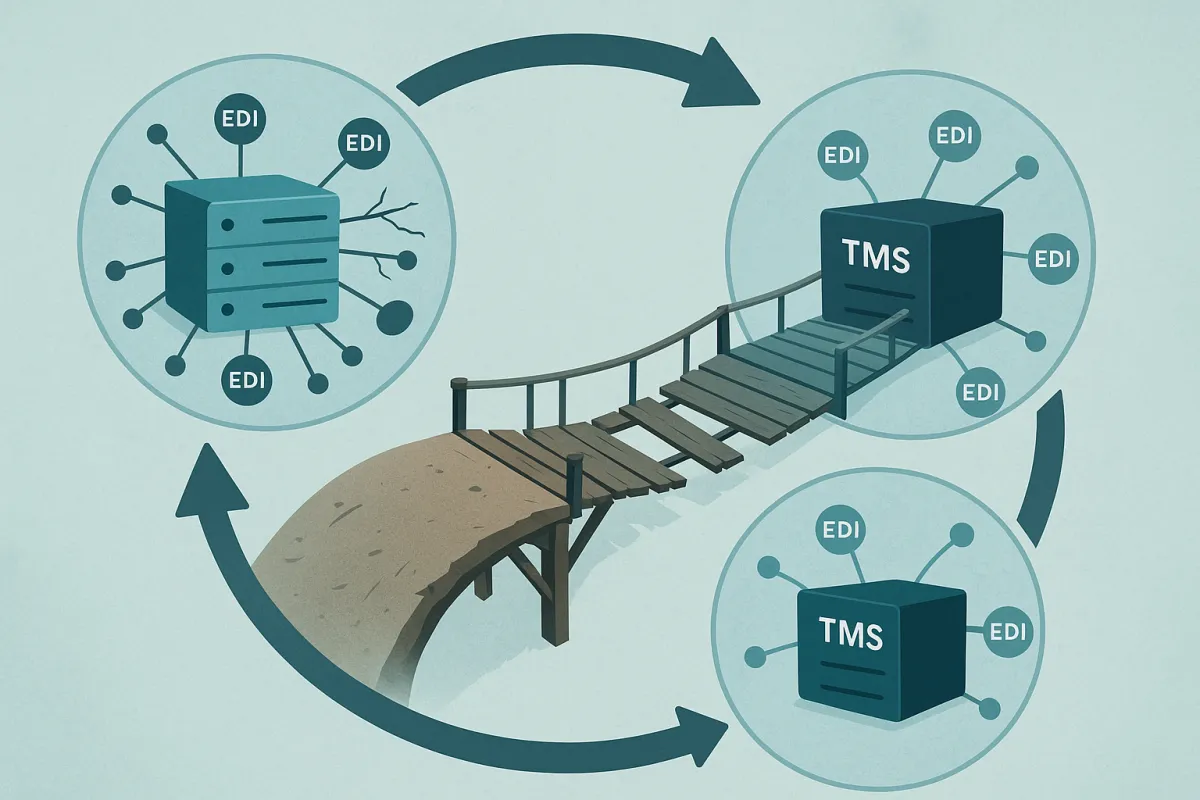
When it's time to upgrade or replace your transportation management system (TMS), those EDI connections often break, sometimes without warning. When a TMS system is swapped out or reconfigured without an EDI continuity plan, the result is often delays, chargebacks, or failed deliveries, which can damage partner relationships. The financial impact compounds quickly. For high-volume transportation environments, like ecommerce fulfillment, even small disruptions can cascade into larger issues downstream. Missed delivery windows can lead to chargebacks or strained relationships with partners and customers.
The root causes of these failures aren't mysterious. Because TMS and EDI systems are deeply connected, even minor mismatches between the two systems can lead to costly disruptions. EDI issues during a TMS migration can usually be traced back to one of these root causes: Mapping mismatches: Every TMS platform structures its data differently. Legacy protocol issues: Older EDI connections often rely on protocols like FTP or AS2. If the new TMS doesn't support those methods or supports them differently, message delivery can fail entirely.
Legacy Protocol Pitfalls That Break Trading Partner Networks
The complexity of transportation EDI often stems from outdated protocols, brittle connections, or limited visibility into message failures, all of which can be remedied by a system upgrade. Here's what typically goes wrong during TMS transitions:
FTP and AS2 compatibility issues surface first. Many carriers still depend on these older transmission protocols, and your new TMS might handle them differently than your previous system. Legacy protocol issues: Older EDI connections often rely on protocols like FTP or AS2. If the new TMS doesn't support those methods or supports them differently, message delivery can fail entirely.
Bundled EDI limitations create another trap. If performing EDI inside an ERP, it usually requires other solutions around the ERP to help complete the EDI processing. This is because ERP, TMS, and WMS tend to have very lightweight EDI processing. For example, a company may have a different communication software to support various protocols— scripts to complete EDI processing, scripts for database table lookups, or integration between different databases to pick up certain attributes and values.
Major TMS platforms handle these challenges differently. Enterprise solutions like SAP TM and Oracle TM typically require extensive customization to accommodate corridor inconsistencies. Mid-market platforms including Descartes, Alpega, and Cargoson often provide more flexible routing engines that can adapt to infrastructure gaps without major development work.
The Pre-Implementation Assessment Framework
Before you select any TMS platform, you need comprehensive visibility into your current EDI ecosystem. Start with mapping your partner network—not just the obvious tier-one carriers, but every logistics provider that touches your shipments.
Document your existing data flows. EDI requires business visibility into O2C, P2P, and L2I processes and transactions. As an example, ERP, TMS, and WMS do not have any visibility into linked transactions. Thus, forcing the daily operations and business teams to spend time searching for connected transactions. This visibility gap becomes a major problem when your new TMS doesn't maintain those connection threads.
Your assessment needs to capture data quality baseline measurements over 90-120 days. Integration Costs: The initial investment for integration can be substantial, although it is often recouped through long-term savings. Poor data quality drives 40% of integration failures, so understanding your starting point prevents costly surprises later.
When evaluating TMS vendors, consider established solutions like Oracle TM and MercuryGate alongside modern platforms including Cargoson, Blue Yonder, and nShift. Modern European TMS platforms like Cargoson, nShift, Alpega, and Transporeon focus specifically on European cross-border requirements, while global solutions like Oracle TM and SAP TM often require extensive customization for European operations.
Data Migration Risk Mitigation Strategies
Complete data lineage mapping from source systems prevents the most common migration failures. You need to trace every EDI transaction from its origination point through all transformation steps to final delivery. This mapping reveals dependencies that aren't obvious from system documentation alone.
Testing protocols require more than sample transactions. Testing: Run thorough tests before going live to ensure everything works smoothly. Create realistic load scenarios that match your peak volume periods, not just average daily processing. Many integrations work fine at low volumes but fail when transaction rates increase.
Validation frameworks must account for partner-specific variations. Different EDI Versions: Work with partners to establish compatible versions or use translation software. Even when trading partners use the same EDI standards, implementation details often vary enough to cause transaction failures.
The Hybrid EDI-API Strategy for Future-Proof Integration
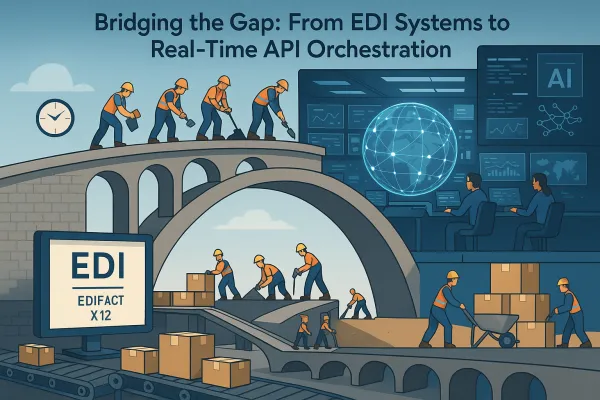
Delays in status updates, inconsistent message quality, and slow onboarding pushed companies toward API-first connectivity. Shippers discovered that API-enabled carriers delivered faster, more accurate insights and fewer manual interventions. But EDI isn't disappearing overnight. You need a strategy that leverages both technologies where they work best.
APIs are becoming the primary integration pathway for carriers who support real-time capabilities. With cloud-based solutions, API allows transportation management systems (TMS) to transmit data in less than a second. API is a helpful tool for freight brokers, freight forwarders, third-party logistics providers, various other logistics service providers, and bulk shippers who need to access TMS data, such as shipment status updates or inventory levels, without using an intermediary system.
However, Implementing API integration into a TMS can be overwhelming for a company without the fundamentals of EDI connection technologies. It's, therefore, unlikely that APIs will fully replace EDI as the standard means for connection in the next several years.
Modern platforms like Cargoson, alongside established solutions like nShift and ShippyPro, build hybrid architectures that support both protocols seamlessly. Modern TMS platforms from providers like nShift, Transporeon, Alpega, and Cargoson prioritize RESTful APIs with standardized data formats.
Protocol Selection and Partner Onboarding Automation
Multiple transport protocol support prevents single points of failure. Your TMS should handle AS2, SFTP, APIs, and portal automation without requiring separate middleware solutions. File transmissions are supported via FTP, SFTP, FTPS, or AS2 protocols.
AI-generated mappings accelerate partner onboarding. Partner Management: Simplify the onboarding and configuration of trading partners with support for custom rules and document formats for each. Instead of manually configuring each partner's specific requirements, intelligent platforms can analyze transaction patterns and suggest optimal mapping configurations.
Automated partner onboarding reduces the traditional 4-6 week setup timeframe to days or hours for standard EDI implementations. Transporeon and nShift require carriers to implement standard EDI interfaces themselves, while Cargoson builds true API/EDI connections with carriers rather than requiring standardized EDI messages that carriers must implement.
Implementation Best Practices That Prevent Network Disruption
Phased rollouts control risk by validating each integration layer before moving to the next. Start with your most stable, high-volume trading partners—these relationships can absorb minor disruptions better than fragile partnerships.
Phased implementation approaches control costs by validating functionality before full deployment. Start with core functionality in Q2-Q3 2025, activate AI features in Q4 2025, and ensure eFTI compliance by Q1 2026. TMS implementation usually takes 1-2 months for smaller shippers and 3-6 months for larger, more complex networks.
Cross-functional workshops surface resistance and build alignment before technical work begins. Employees may resist adopting new technologies due to fear of the unknown or concerns about job security. It is essential to address these concerns through effective communication and training. Include representatives from procurement, operations, IT, and customer service to identify workflow changes that might impact trading partners.
Timeline management requires buffer periods between partner migrations. Don't attempt to move all trading partners simultaneously—even minor technical issues can multiply into system-wide failures when you're managing dozens of simultaneous integrations.
Testing and Validation Protocols
Limited testing environments create one of the biggest implementation challenges. Integrating EDI with TMS can be technically challenging, especially for organizations with outdated systems or limited IT resources. Businesses may need to invest in middleware solutions to bridge the gap between legacy systems and modern EDI requirements.
Create realistic test scenarios that mirror actual production conditions. This includes peak volume testing, error recovery validation, and failover procedures. Many TMS implementations work perfectly in controlled environments but break under real-world stress.
Data migration validation requires comparing transaction outputs at multiple checkpoints. Don't just verify that transactions complete—confirm that all data elements transfer correctly and that trading partners receive information in the expected formats.
Partner Communication and Change Management Strategy
Re-onboarding requirements create the biggest relationship risks during TMS transitions. When an enterprise grows and is looking to implement a new ERP or TMS, the switch will impact EDI with its trading partners. The average company that performs EDI has anywhere from 100-200 partners, and 400-500 maps—all of which will be impacted by the switch.
Communication templates help maintain consistency across partner notifications. Develop standardized messages that explain technical changes, timeline expectations, and testing requirements. Include specific contact information for technical support during the transition period.
Partner prioritization prevents resource overload. Focus first on partners who generate the highest transaction volumes or represent the most critical business relationships. These partnerships justify additional attention and resources during migration.
Vendor Selection Criteria for Long-term Success
Integration capabilities extend beyond basic EDI support. Your TMS needs to connect with ELDs, fuel cards, accounting systems, and carrier portals. System Integration: EDI tools should easily connect with ERP, accounting, WMS, or TMS systems like SAP, Oracle, Microsoft Dynamics, or NetSuite to automate workflows.
Support and training quality varies dramatically between vendors. Support & Documentation: Reliable technical support, user guides, training resources, and community forums help ensure long-term success with minimal disruption. Evaluate training programs during vendor selection—implementation success depends heavily on user adoption rates.
Consider platforms from established providers like Transporeon and Manhattan Active alongside emerging solutions including Cargoson that focus specifically on European cross-border operations. Cargoson offers comprehensive support across all modes of transport, including road, air, sea, rail, courier, and parcel shipments, making it ideal for manufacturers, retailers, wholesalers, and mid-to-large enterprises who use different logistics modes. It provides quick, free-of-charge (included in subscription) integration with carriers via API/EDI, intuitive automation suitable for daily operational tasks, and transparent pricing with flexible contract terms.
Post-Implementation Optimization and Continuous Improvement
Regular vendor check-ins prevent small issues from becoming major problems. Schedule monthly reviews during the first six months, then quarterly assessments focused on performance metrics and partner satisfaction levels.
KPI monitoring should track both technical and business metrics. Monitoring & Alerts: Real-time dashboards and customizable alerts help track the flow of transactions and quickly detect any failures or issues. Include transaction success rates, processing times, error frequencies, and partner satisfaction scores.
System updates require careful change management. The systems that delivered the most value improved connectivity, reduced latency, and made planning more responsive. In 2026, transportation management will center on real-time coordination, AI-assisted decisions, and cleaner integration across the entire planning-to-execution spectrum.
Performance optimization opportunities emerge after your system stabilizes. Look for transaction patterns that suggest automation opportunities, carrier relationships that could benefit from deeper integration, and data insights that improve decision-making accuracy.
The 73% failure rate reflects implementations that ignored these fundamentals. Your TMS-EDI integration succeeds when you treat it as a strategic transformation rather than a technical upgrade. Focus on partner relationships, data quality, and change management—the technology follows these business foundations.