The TMS-Independent EDI Architecture Guide: How to Build Standalone Integration Systems That Survive Vendor Consolidation and Protect Trading Partner Relationships in 2026

Most companies tie their EDI processing directly to their Transportation Management System, creating a massive vulnerability when vendors change, merge, or get acquired. The average company that performs EDI has anywhere from 100-200 partners, and 400-500 maps—all of which will be impacted by the switch. Yet right now, you're facing the most significant TMS vendor consolidation wave in over a decade, while 61% of logistics leaders anticipate fully autonomous agentic AI within the next five years for TMS.
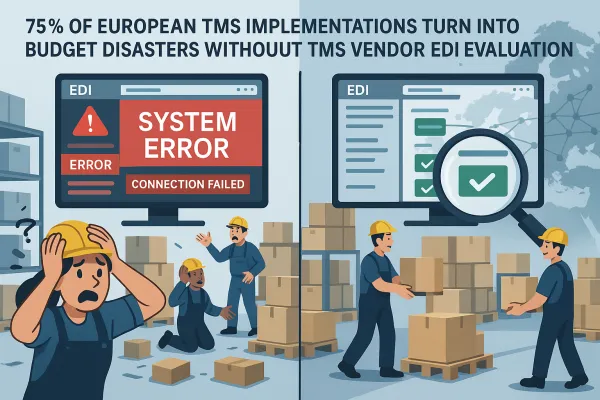
WiseTech's acquisition of E2open in 2025, Descartes' purchase of 3GTMS for $115 million in March 2025, and Körber's transformation of MercuryGate into Infios following their 2024 acquisition represent just the beginning of a fundamental market restructuring. Hidden costs in TMS procurement consistently add 25-30% more than initial estimates, turning what looked like smart investments into budget disasters.
This consolidation creates an urgent need for standalone EDI architectures that provide operational independence from TMS vendor changes. Companies building TMS-independent EDI systems maintain complete control over their trading partner relationships, avoid massive switching costs, and protect against vendor lock-in scenarios.
The Critical Problems with TMS-Embedded EDI
The first challenge of EDI inside an ERP, TMS, or WMS is that it will be tightly tied to the ERP. When an enterprise grows and is looking to implement a new ERP or TMS, the switch will impact EDI with its trading partners. This tight coupling creates massive switching costs and forces you to rebuild trading partner relationships every time you change core systems.
ERP, TMS, and WMS tend to have very lightweight EDI processing. For example, a company may have a different communication software to support various protocols— scripts to complete EDI processing, scripts for database table lookups, or integration between different databases to pick up certain attributes and values. These workarounds create technical debt and introduce failure points throughout your EDI infrastructure.
Visibility gaps compound the problem. The EDI software market is large but a lot of players are not innovative; especially integrated EDI solutions inside ERPs, TMSs, and WMSs. For ERP, TMS, and WMS providers, it would not be a worthwhile investment to innovate their EDI modules as it is not their main service, capability, or function. You end up stuck with outdated EDI capabilities while your business requirements evolve.
Consider the real impact: suppliers lose approximately $27K in yearly revenue per trading partner and pay 35% more in EDI costs when they fragment EDI across multiple embedded systems. EDI performance bottlenecks cost companies an average of $62,000 per day in delayed shipments and processing errors.
Understanding Composable EDI Architecture
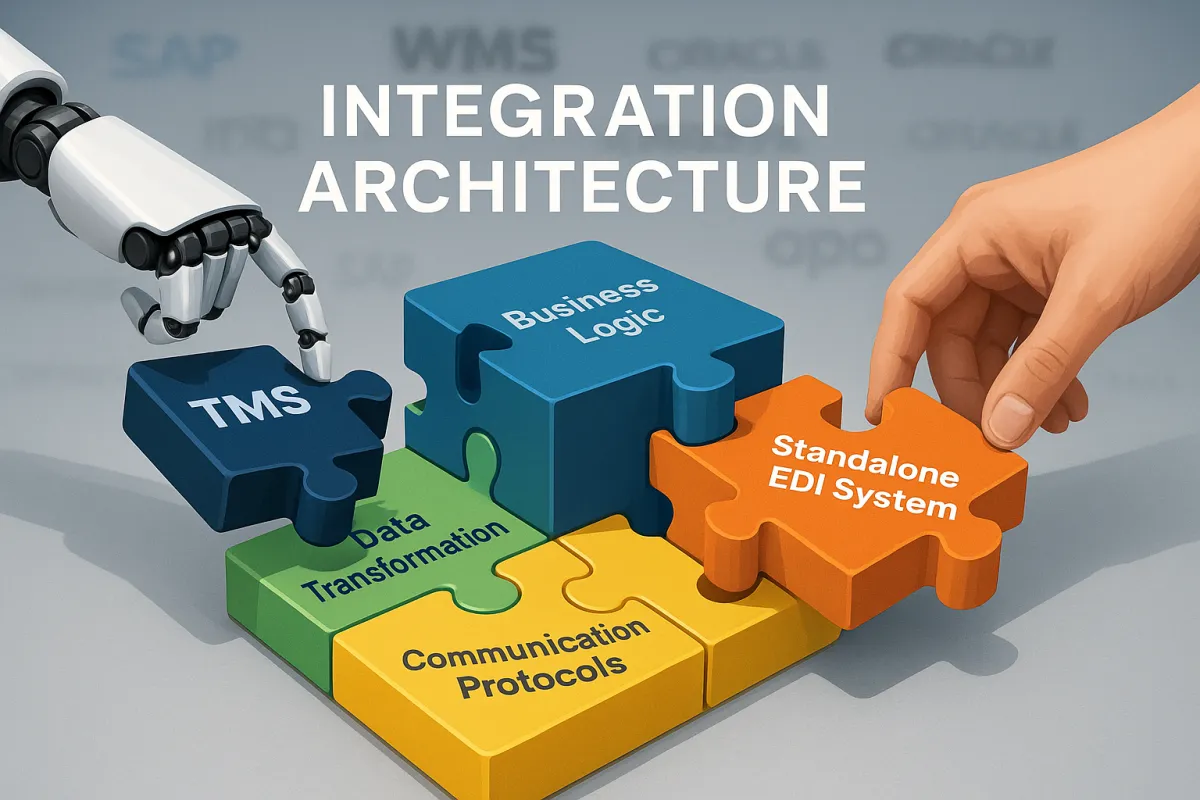
Composable EDI represents a fundamental shift away from monolithic, tightly-coupled systems. Composable architecture is a modular approach where a digital platform is built from interchangeable components (Packaged Business Capabilities) connected via APIs, allowing each capability to evolve, scale, and deploy independently. In EDI terms, this means separating data transformation, communication protocols, partner management, and business logic into independent modules.
Industry analyst Gartner predicts that organizations pursuing a composable approach will generate 30% more revenue than their conventionally inclined competitors by 2025. The acceleration is driven by modularity enabling rapid changes without system-wide impacts.
Components are chosen and wired together to match technical and business needs, rather than depending on a single vendor stack or a rigid, all-in-one system. Unlike monolithic or tightly coupled architectures, composable systems let you swap, upgrade, or scale individual parts without rewriting the whole platform.
Core principles include modularity (independent deployment of EDI components), interoperability (API-first integration), autonomy (components operate independently), and discoverability (services can locate each other dynamically). Organizations running composable architectures report 37% shorter time-to-market on average compared to monolithic systems, an edge that's proving decisive in fast-moving industries.
Building TMS-Independent EDI Systems
Standalone EDI engines are complete B2B solutions. Standalone EDI has EDI processing, communications, transformation, standards, visibility, code lists, look-ups, and orchestration. Unlike embedded EDI modules, standalone systems provide comprehensive capabilities without depending on host applications.
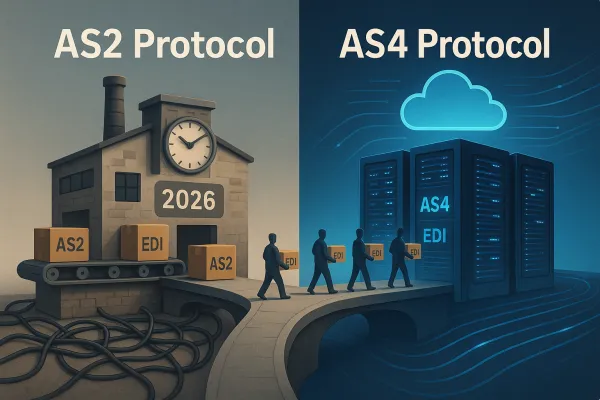
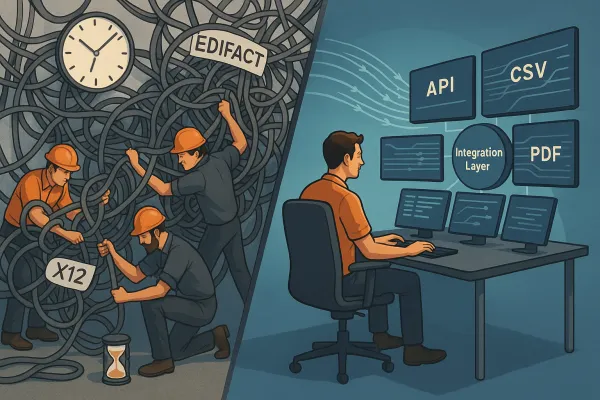
Critical capabilities include supporting any data format (JSON, XML, EDIFACT, X12, flat files), enabling multiple communication protocols (AS2, SFTP, REST, HTTP/S, VAN connections), and implementing automation with business rule engines. Standalone EDI systems are critical business applications that most organizations treat as tier 1 applications, since more than half of their business revenue goes through this platform. Companies want 100% uptime, even when performing upgrades to their ERP or TMS systems.
Implementation approach requires designing interfaces that act as EDI-to-TMS bridges while maintaining complete independence. Your EDI system receives transactions from trading partners, applies transformations and business rules, then forwards processed data to whatever TMS you're running. When you switch TMS providers, only the output interface changes—trading partner connections remain untouched.
Consider vendors like Cleo Integration Cloud, TrueCommerce, and Cargoson that provide standalone EDI platforms specifically designed for TMS independence. These solutions offer pre-built connectors for major TMS platforms while maintaining architectural separation that protects you during vendor changes.
The Complete Implementation Framework
Migration from TMS-embedded to standalone EDI requires systematic assessment and phased implementation. Start with current system evaluation: document all trading partner connections, map data flows between EDI and TMS, and analyze transformation logic currently embedded in your TMS.
Design considerations focus on API-first deployment and microservice-driven architecture. Jumping to composable ERP isn't about chasing the latest tech—or swapping one vendor for another. It flips the script by letting you assemble your own stack from modular, best-fit components. The same principle applies to EDI architecture.
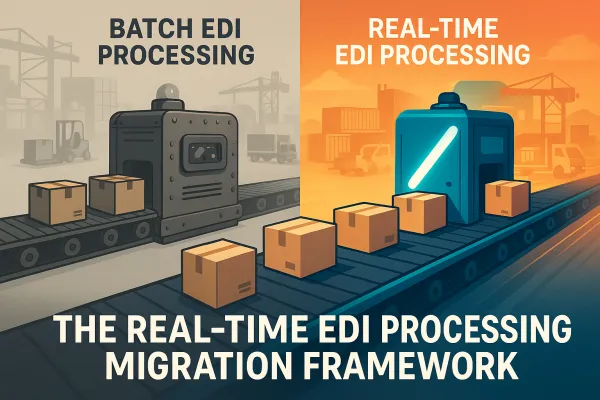
Rather than a risky "rip and replace," use the strangler fig migration pattern: gradually extract services from your monolith one at a time. Begin with a single high-volume trading partner or document type. Implement the standalone EDI system for that specific use case while maintaining existing embedded EDI for other partners.
Testing and validation require parallel processing during transition periods. Run both systems simultaneously until you verify data accuracy, transaction timing, and error handling in the new standalone architecture. This approach lets your IT and EDI teams respond to changes quickly, without breaking what works or losing visibility. No more costly upgrades just for compliance or a new document type. You add, remove, or adjust EDI flows in days, not quarters.
Future-Proofing Against Vendor Consolidation
Standard TMS procurement contracts don't address vendor acquisition scenarios, leaving European shippers vulnerable to post-acquisition changes without recourse. Acquisition-resistant contracts require specific protections including 12-18 months advance notice for ownership changes, guaranteed functionality preservation for minimum periods, and migration assistance rights.
Technical protection requires data ownership clauses, API access requirements, and export capabilities in standard formats. Ensure your contracts specify that EDI maps, partner configurations, and transaction histories remain your property and must be exportable without vendor assistance.
Vendor evaluation should use a six-dimension framework: financial resilience (analyze revenue trends and debt levels), technical architecture (assess composability and API maturity), regulatory compliance (evaluate multi-jurisdictional capabilities), acquisition history (review integration track records), market positioning (understand competitive vulnerabilities), and geographic focus (ensure alignment with your operational footprint).
While WiseTech has demonstrated consistent profitability and growth, e2open has struggled with financial performance in recent years, reporting declining revenue and net losses in recent fiscal years. European buyers should evaluate vendor acquisition likelihood based on financial performance, market position, and strategic value to potential acquirers.
Compare strategies across major vendors. TrueCommerce, Cleo, SPS Commerce, and Cargoson each offer different approaches to acquisition resistance, from private ownership structures to specialized market focus that reduces acquisition appeal.
Cost-Benefit Analysis and ROI Framework
Hidden costs in TMS procurement consistently add 25-30% more than initial estimates, turning what looked like smart investments into budget disasters. While procurement teams focus on feature checklists and license fees, the real financial impact lives in implementation complexity, carrier integration charges, and ongoing maintenance expenses that vendors rarely discuss upfront.
Seventy-six percent of logistics transformations never fully succeed, failing to meet critical budget, timeline or key performance indicator (KPI) metrics, with more than 80% of respondents attempting four transformations in fewer than five years. TMS-coupled EDI amplifies these risks by requiring complete rebuilds during system changes.
TCO considerations extend beyond licensing costs. Licensing fees (as in SaaS) or coding (as in custom development) are just the tip of the iceberg – so, you'll have to add indirect costs such as staff training, adapting business processes to software limitations, and, most critically, the consequences of vendor lock-in (which imposes scalability limitations or may require middleware development for seamless integration with third-party systems) as well. It's also worth noting that in the SaaS model, you don't own the code, so if the provider raises prices several times or discontinues support for a critical module, you'll have to go through data migration, which can cost tens of thousands of dollars.
ROI calculation should include reduced migration costs (avoiding the need to rebuild EDI connections during TMS changes), improved uptime (standalone systems maintain operations during TMS outages), and faster partner onboarding (dedicated EDI systems process new connections more efficiently than TMS add-ons).
Businesses using modular solutions report up to 30% higher ROI and dramatically shorter innovation cycles. Instead of waiting months for releases, companies can roll out new features weekly or even daily. Applied to EDI, this translates to rapid deployment of new document types, trading partner requirements, and compliance updates.
Calculate your specific ROI using transaction volume, partner count, and historical migration costs. A company processing 50,000 EDI transactions monthly across 150 trading partners typically saves $200,000-300,000 per TMS migration cycle by maintaining standalone EDI architecture. Over a five-year period with one major system change, the cost avoidance alone justifies the standalone approach—before considering operational benefits like improved uptime and faster partner onboarding.
The next TMS vendor consolidation wave is already underway. The question isn't whether your current vendor will be acquired or merged—it's whether your EDI architecture can survive the transition. Companies implementing standalone, composable EDI systems today protect their trading partner relationships, avoid massive switching costs, and maintain operational independence regardless of vendor marketplace changes.
Start by assessing your current EDI-TMS dependencies, then design a migration strategy that extracts your most critical trading partner connections first. Choose vendors with proven track records for acquisition resistance and technical modularity. Your future self will thank you when the next vendor consolidation announcement doesn't threaten your entire B2B integration infrastructure.