The TMS Vendor Consolidation Impact Assessment: How to Evaluate Transportation Management System Stability and EDI Integration Resilience Before Mergers Disrupt Your Supply Chain Operations in 2026

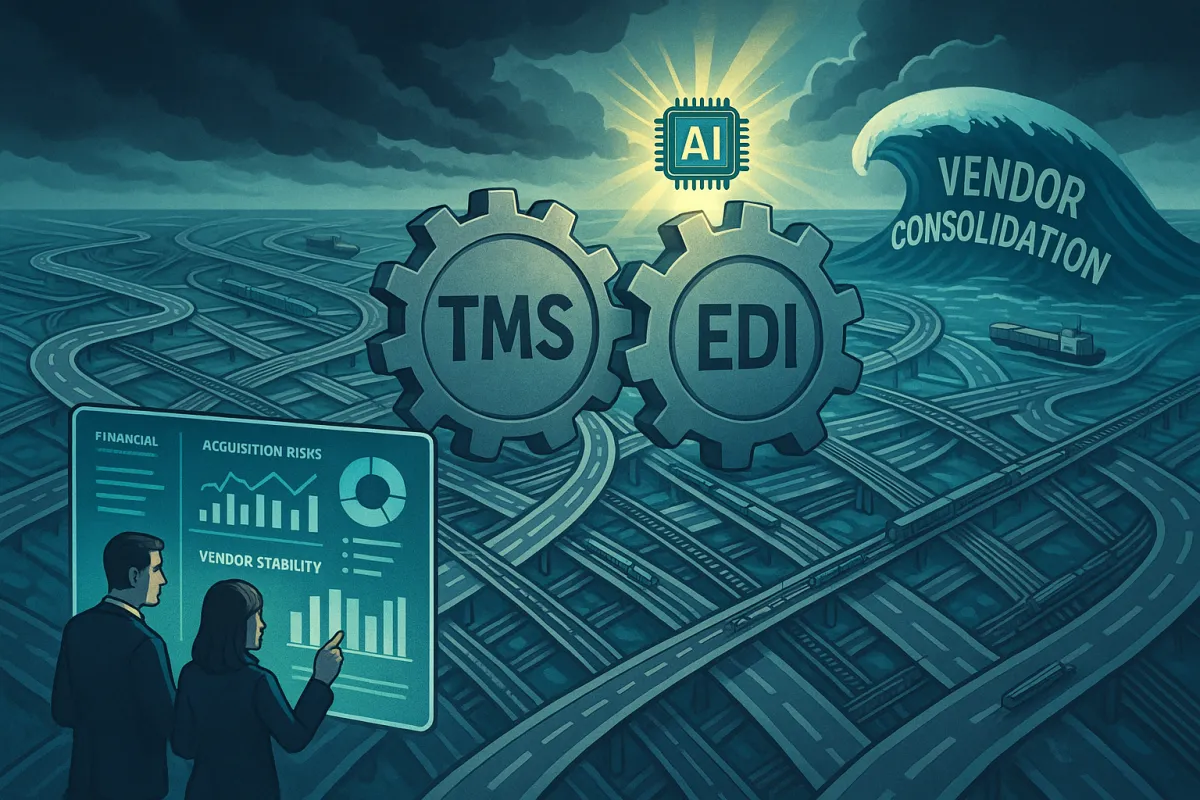
The $2.1 billion acquisition of e2open by WiseTech marks the largest TMS industry acquisition to date, while Descartes Systems Group has acquired Columbus, Ohio-based 3Gtms for $115 million, fundamentally reshaping vendor options for European buyers. The most significant TMS vendor consolidation wave in over a decade is reshaping European procurement decisions right now. You face a critical decision: how do you evaluate TMS vendor stability and EDI integration capabilities when 76% of logistics transformations never meet their budget, timeline, or performance targets?
This comprehensive assessment framework helps supply chain IT directors navigate TMS vendor consolidation risks while building acquisition-resistant procurement strategies. The rise of Agentic AI is redefining what EDI can do. The standardized and structured nature of EDI formats (e.g. ANSI X12, EDIFACT) and EDI data exchanges means less data cleaning is likely required before feeding it into AI models, making vendor evaluation more complex than traditional feature comparisons.
The Hidden Cost of TMS Vendor Instability: Integration Complexity During Acquisitions
A German automotive parts manufacturer faced €800,000 in additional costs when carrier integration failures emerged post-acquisition of their chosen vendor. Here's what most procurement teams miss: Companies undergoing integration often experience 12-18 months of reduced innovation while they harmonize platforms and teams.
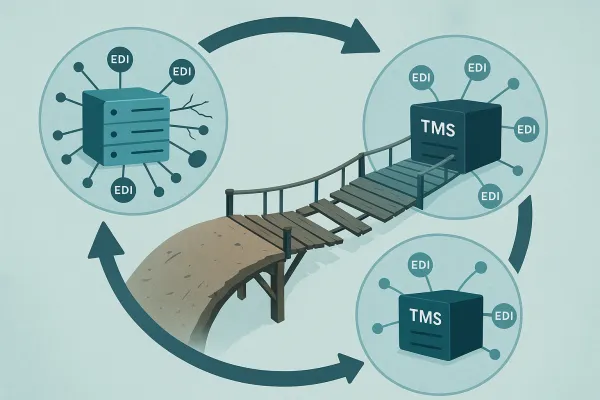
When two TMS platforms merge, customers inevitably face decisions about which system to standardize on, what features will be deprecated, and how long dual support will continue. When your TMS vendor becomes an acquisition target, you inherit integration complexity without managing the project timeline. Your feature requests get deprioritized as the new parent company focuses on platform consolidation rather than customer-specific enhancements.
The financial impact extends beyond obvious integration costs. Plan for 15-20% budget increases in 2026-2027 if reactive, or 8-12% if proactive with proper contract protection. Factor in regulatory compliance costs: Failure to comply with the regulations can result in severe penalties, which in some countries can reach up to 30,000 euros.
The Critical EDI Integration Vulnerability Framework
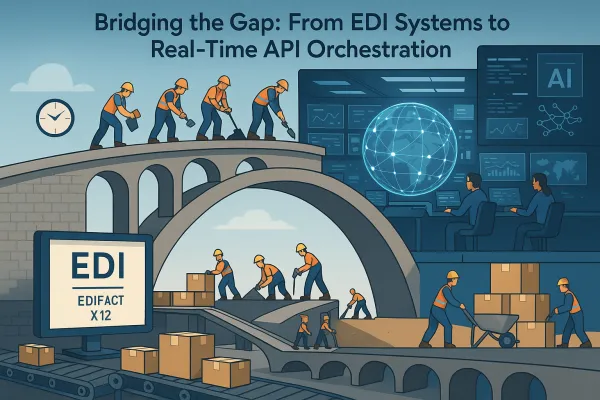
Vendor consolidation creates specific EDI mapping risks that traditional due diligence overlooks. EDI is not disappearing, but it showed its limitations in 2025. The solution lies in hybrid approach where APIs handle real-time status updates while EDI manages complex, high-volume document exchanges.
EDI mapping has long been a bottleneck in EDI integration projects. With AI-assisted mapping, companies can auto-generate integration logic and business process flows by analyzing historical data and deployed maps. Evaluate vendor capabilities in this area specifically.
Key assessment criteria for EDI resilience:
- Automated mapping capabilities: AI is revolutionizing EDI by automating data mapping, handling exceptions intelligently, and enabling predictive analytics. It's transforming EDI from a reactive to a proactive system
- Platform integration architecture: Traditional EDI relies on siloed, on-premise software focused solely on B2B exchange. iPaaS (Integration Platform as a Service) unifies EDI, APIs, and internal applications in the cloud
- Compliance automation: Modern EDI systems can track and validate granular supply chain data, such as carbon footprints or ethical sourcing certifications, within transaction metadata. This capability provides the auditable "paper trail" necessary for accurate Scope 3 emissions reporting
TMS Vendor Due Diligence: The Acquisition-Resistant Evaluation Matrix
European buyers should evaluate vendor acquisition likelihood based on financial performance, market position, and strategic value to potential acquirers. While WiseTech has demonstrated consistent profitability and growth, e2open has struggled with financial performance in recent years, reporting declining revenue and net losses in recent fiscal years.
Your evaluation matrix should include:
Financial Health Indicators
Look beyond current revenue figures. Understand how recent acquisitions impact the vendor's cash flow, development priorities, and customer service capacity. Descartes' 32nd acquisition since 2016 demonstrates an aggressive acquisition strategy that could affect product focus.
Geographic Focus Assessment
WiseTech's traditional focus on logistics service providers rather than shippers creates uncertainty about European manufacturer priority in integration planning. This geographic and market focus shift creates uncertainty about European feature development priorities and local market support commitments.
Technology Architecture Evaluation
This consolidation creates three distinct vendor categories for European shippers: global mega-vendors (Oracle TM, SAP TM, E2open/WiseTech), European specialists (Alpega, nShift, Transporeon), and emerging European-native solutions like Cargoson that focus specifically on cross-border European operations.
Building Integration Independence: The Standalone EDI Strategy
Protect against vendor consolidation by building vendor-neutral EDI capabilities. Acquisition-resistant contracts require specific protections including 12-18 months advance notice for ownership changes, guaranteed functionality preservation for minimum periods, and migration assistance rights.
Contract protection clauses should include:
- Price protection: Lock pricing for 24 months following ownership changes, preventing immediate cost increases during integration periods
- Functionality guarantees: Protect against feature deprecation common during platform consolidation. Specify that current functionality levels must be maintained for minimum periods, with migration assistance provided if features are discontinued
- Data portability requirements: Ensure your EDI mappings and trading partner connections remain accessible regardless of vendor changes
Vendor-Neutral Platform Options
Consider platforms that support multiple TMS integrations. Cargoson offers European-native solutions, while Transporeon, FreightPOP, and other specialists provide alternatives to mega-vendor dependencies.
The 2026 Implementation Timeline: Acting Before Options Disappear
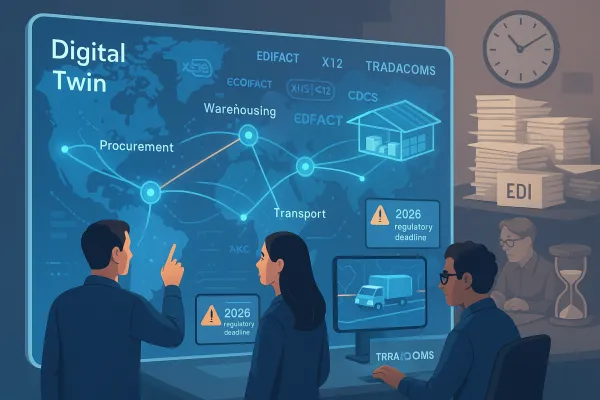
As of January 2026, eFTI platforms and service providers can start preparing for operations while Member States authorities may start accepting data stored on certified eFTI platforms for inspection. By July 2027, all Member States will be required to accept electronic transport data via eFTI-certified platforms, making 2026 the critical preparation year.
Companies that haven't initiated TMS selection processes by mid-2026 will find significantly fewer viable options as vendors focus resources on existing customer compliance rather than new client acquisition.
Your procurement timeline should address:
- Q1 2026: Complete vendor stability assessment and contract negotiations
- Q2-Q3 2026: Begin implementation with core TMS functionality
- Q4 2026: Activate AI-powered EDI features and compliance modules
- Q1 2027: Full eFTI compliance validation
The eFTI compliance deadline creates procurement leverage that savvy buyers can exploit. Vendors need your business to validate their eFTI implementations and demonstrate market traction to potential acquirers. Use this dynamic to secure better contract terms, comprehensive compliance support, and protection against post-acquisition changes.
Future-Proofing Your Transportation Technology Stack
Supply chain technology is shifting from isolated tools to integrated operational intelligence. Companies that modernize their data layers, adopt AI thoughtfully, and focus on execution will gain resilience faster than those chasing hype. The year 2026 will reward organizations that can interpret signals quickly, synchronize decisions, and act decisively across their networks.
Composable Architecture Principles
The future of EDI isn't optional. It's composable, intelligent, and mission-critical. Build TMS selection criteria around modular components that survive vendor consolidation. Look for platforms that support hybrid integration that lowers costs by routing data through the most efficient channel, using low-cost APIs for frequent status checks and reserving EDI bandwidth for massive batch files.
AI-Powered EDI as Consolidation Insurance
EDI AI will continue to develop in 2026—simplifying complex processes like enhanced partner onboarding, accelerated EDI mapping, improved visibility, advanced analytics that strengthen supply chain resilience. Platforms like Cleo go beyond "no-code onboarding" with AI-driven automation that reduces trading partner onboarding times, ensures compliance, and accelerates partner collaboration.
Adopting EDI AI doesn't have to be overwhelming. Identify one or two high-value use cases where AI can make an immediate difference, such as AI-assisted mapping or intelligent error resolution. Automating partner onboarding, reducing mapping time, or improving visibility with outlier detection will show fast ROI.
The TMS market will continue consolidating throughout 2026 and beyond. European shippers investing in acquisition-resistant vendor selection frameworks today position themselves to navigate this consolidation successfully. Your transport management software selection determines whether vendor consolidation becomes a competitive advantage or an expensive operational disruption.
Start your vendor stability assessment immediately. European shippers who act decisively within the next 90 days—with proper frameworks that account for both capacity and consolidation scenarios—position themselves to navigate 2026's perfect storm successfully. Those who delay risk joining the statistics of failed implementations and budget overruns that plague reactive procurement strategies.