The Vendor-Neutral EDI Integration Strategy: How to Build TMS-Independent Architecture That Survives Vendor Consolidation and Enables Multi-Carrier API Modernization in 2026

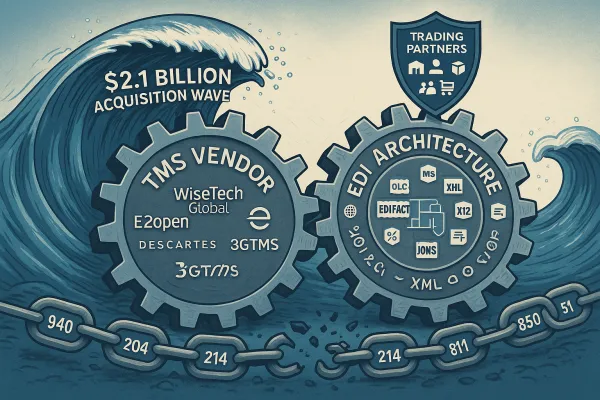
WiseTech's acquisition of e2open for $3.30 per share in cash equating to an enterprise value of $2.1 billion marks the largest TMS industry acquisition to date, while Descartes Systems Group has acquired Columbus, Ohio-based 3Gtms for $115 million isn't just another business headline. In 2026, major carriers including UPS, USPS, and FedEx will complete a shift that's been years in the making: retiring legacy carrier APIs in favor of more modern, secure platforms, creating a perfect storm for supply chain teams who've tied their EDI systems too closely to TMS platforms.
Companies discover the hard way that tightly tied EDI implementations will be impacted when an enterprise grows and is looking to implement a new ERP or TMS, with the average company that performs EDI having anywhere from 100-200 partners, and 400-500 maps—all of which will be impacted by the switch. That's exactly what happened when one manufacturer found their €800,000 TMS implementation became a complete platform re-implementation after their EDI connections broke during vendor consolidation.
The Critical Risk of TMS-Dependent EDI in 2026's Consolidation Wave
WiseTech Global's $2.1 billion acquisition of E2open, expected to complete in 1H26, alongside Descartes Systems Group's $115 million acquisition of 3GTMS in March 2025, represents the most significant TMS vendor consolidation wave in over a decade. The market is reshaping around three categories: global mega-vendors absorbing smaller players, European specialists defending their territories, and emerging solutions trying to carve out niches.
When transportation management systems are upgraded or replaced, EDI connections often break without warning. EDI and TMS systems are tightly intertwined—everything from tendering a load to confirming delivery relies on structured, automated data flows. When systems are swapped out without an EDI continuity plan, the result is often delays, chargebacks, or failed deliveries.
The statistics reveal the scale of this problem. According to the Standish Group's CHAOS 2020 report, 66% of technology projects end in partial or total failure, with McKinsey research showing that 17% of large IT projects threaten the very existence of the company. During vendor transitions, these failure rates climb even higher because teams lose control over integration timelines while inheriting the complexity of merging two different technology stacks.
Why Traditional TMS-Embedded EDI Fails During Transitions
The problem runs deeper than simple compatibility issues. EDI software market players inside ERPs, TMSs, and WMSs are not innovative. For ERP, TMS, and WMS providers, it would not be a worthwhile investment to innovate their EDI modules as it is not their main service, capability, or function. Additionally, without innovation, new EDI use cases like API integration and management of SLAs for different document flows will not be supported. Enterprises are then forced to build workarounds using other applications and scripts, or do manual processing to support these particular requirements.
Consider what happens during a typical TMS acquisition scenario. Legacy protocol issues mean older EDI connections often rely on protocols like FTP or AS2. If the new TMS doesn't support those methods or supports them differently, message delivery can fail entirely. Some organizations are forced to re-onboard all trading partners when switching systems.
Here's the business impact: You're not just dealing with technical disruption. Most EDI implementations today take months rather than days. Your suppliers wait four to six weeks just to get onboarded with traditional EDI vendors, and in practice, the theoretical 1-2 week timeline often stretches to 1-2 months. Multiply that across hundreds of trading partners during a system migration.
Building Vendor-Neutral EDI Architecture: The Strategic Framework
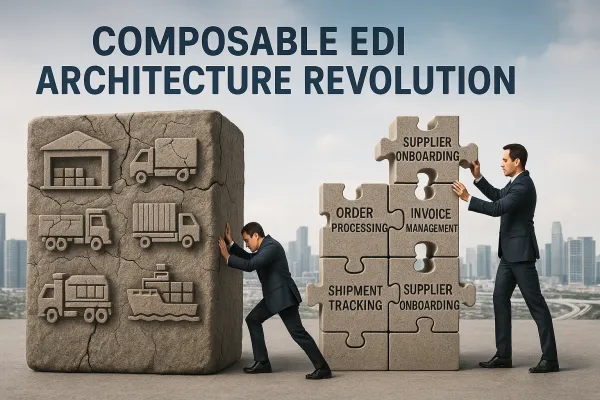
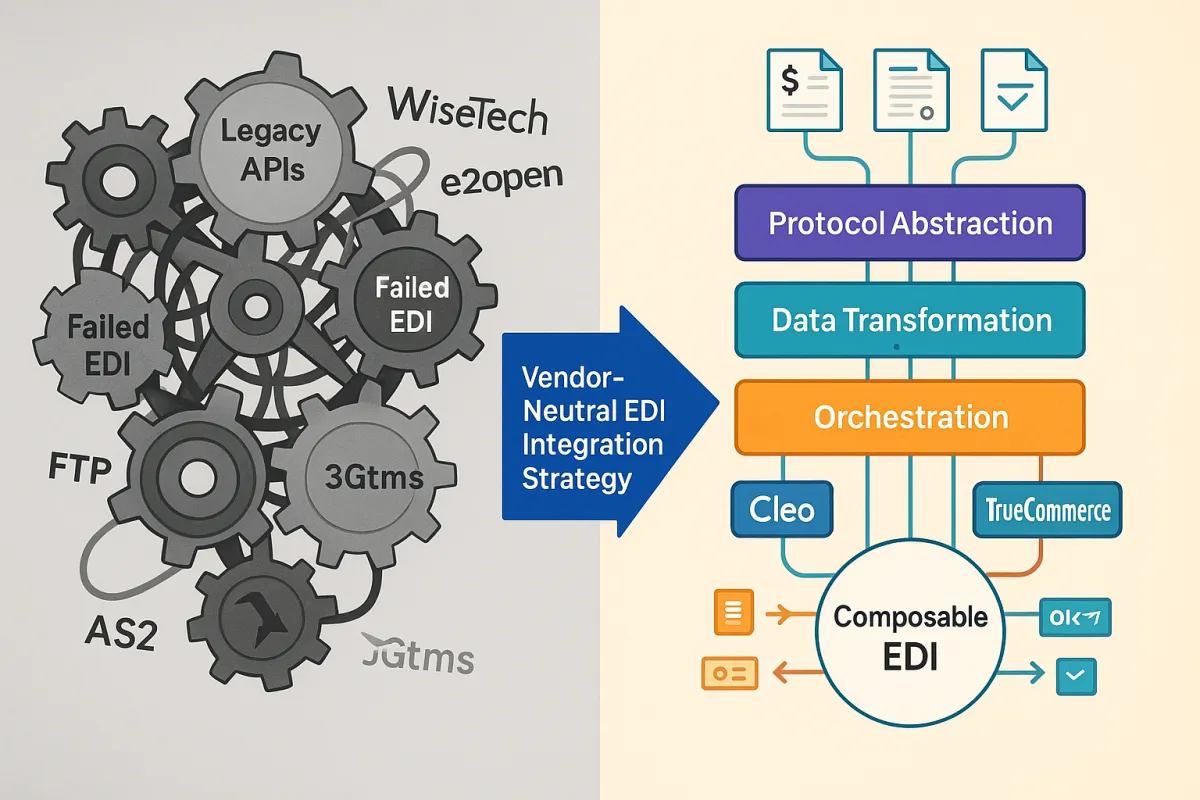
Smart companies are building what I call "composable EDI" – systems designed from the ground up to survive vendor changes. The core principle is simple: your EDI capability should be independent of any single TMS, ERP, or WMS vendor.
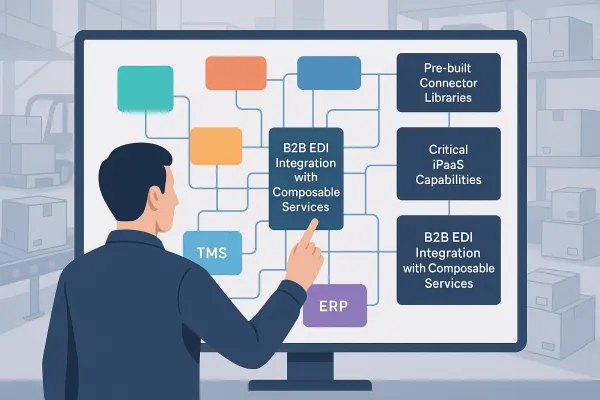
This means treating EDI as its own service layer that connects to multiple backend systems rather than embedding it within them. Deploy an EDI platform with any-to-any integration capabilities. Look for solutions that offer pre-built mapping templates but allow extensive customization. Companies like Cargoson, Cleo, and TrueCommerce excel at handling multiple format variations from a single interface.
The architecture needs three fundamental layers: a protocol abstraction layer that handles different communication methods, a data transformation engine that manages mapping between formats, and an orchestration layer that routes transactions to the correct systems. This separation means you can swap out backend systems without touching your trading partner connections.
API-first partner onboarding becomes crucial here. While roughly 25% of EDI connections have been replaced with APIs as of 2020, legacy applications and technologies are still handling the majority of connections. Freight brokers will stand a far better chance if their TMS systems utilize both API and EDI integrations.
Multi-Carrier API Integration Without TMS Lock-in
The carrier API modernization wave creates both opportunity and risk. USPS began gradually transitioning out older APIs and replacing them with OAuth-secured, RESTful APIs designed to improve reliability, reduce fraud, and deliver more precise shipping and delivery information. January 2025: USPS Web Tools API Versions 1 & 2 were retired. January 2026: USPS is switching off the last of its Web Tools APIs (Version 3). All merchants and solution providers should migrate integrations to the new USPS APIs by this date.
FedEx has been moving away from older SOAP-based APIs toward modern RESTful APIs, introducing new services, enhancements, and rate logic. Legacy FedEx Web Services WSDLs were disabled, replaced by FedEx REST APIs. June 2026: Remaining SOAP-based endpoints will be fully retired. After this, integrations must use FedEx's REST APIs to access rates, labels, tracking, and future service updates.
The solution? Build carrier connectivity through unified API management platforms that abstract individual carrier differences. Services like Cargoson, ShipStation, nShift, Sendcloud, and EasyPost handle carrier API changes automatically, protecting you from the constant churn of technical updates while maintaining connections across multiple carriers simultaneously.
Managing both EDI and API connections in parallel requires what I call "protocol agnostic" design. Your system should handle an EDI 204 (Load Tender) and a RESTful shipment booking API call through the same business logic, just with different serialization formats. This approach lets you migrate trading partners from EDI to APIs gradually rather than forcing big-bang transitions.
Implementation Roadmap for TMS-Independent EDI
Start with dependency mapping. Document every EDI transaction type, which systems currently handle them, and how data flows between systems. You'll probably discover that data in an organization flows into different applications from various ecosystem players. An order may go to the core ERP, stock transfers to the WMS, and shipping information to the TMS. This complexity is exactly why embedded EDI approaches fail.
Phase your architecture redesign around business criticality. Begin with high-volume, stable transaction types like advance ship notices (EDI 856) or load tenders (EDI 204). These provide immediate ROI while you build confidence in the new architecture.
Create abstraction layers using modern middleware. Instead of point-to-point connections between your TMS and EDI system, build API endpoints that your TMS calls for shipment data. Your EDI system handles the translation and protocol management independently. When you change TMS vendors, you only need to rebuild those API calls, not your entire trading partner network.
Testing becomes non-negotiable. Migration teams often lack a staging environment that accurately mirrors production, making it more challenging to identify issues before going live. These problems are especially common for companies running homegrown systems, heavily customized platforms, or brittle integrations built years ago. Build parallel testing capabilities that let you validate both old and new systems simultaneously.
Hybrid EDI-API Integration Patterns
Not every transaction type needs the same approach. Use EDI for batch processes where trading partners already have established capabilities: purchase orders, invoices, and inventory updates work well in traditional EDI formats. Reserve APIs for real-time processes: shipment tracking, carrier selection, and rate shopping benefit from immediate response capabilities.
The key is consistent data models across both protocols. Whether a shipment status update arrives via EDI 214 or webhook API call, your internal systems should process it identically. This requires building translation layers that normalize different input formats into common internal representations.
Consider transaction timing carefully. EDI typically works in batches – files processed every few hours or daily. APIs enable real-time processing but require more sophisticated error handling and retry logic. Design your hybrid system to take advantage of both: use APIs where speed matters, EDI where reliability and established partner capabilities matter more.
Vendor Selection Criteria for Consolidation-Resistant Solutions
Look for platforms that can operate independently of your core business systems. The vendor should provide direct trading partner connectivity, not just "integration capability" that depends on your TMS or ERP vendor's cooperation. Ask specific questions: Can the solution onboard new trading partners without involving your TMS vendor? Can it handle protocol changes independently?
Data portability becomes critical during vendor transitions. Ensure your EDI platform provides complete export capabilities for all trading partner configurations, mapping definitions, and transaction histories. You should be able to migrate to a different platform without re-onboarding every trading partner.
Contractual protections matter more than feature checklists. Include specific clauses requiring 12-18 months advance notice of ownership changes, with automatic contract review rights triggered by acquisition announcements. Price protection clauses should lock pricing for 24 months following ownership changes, preventing immediate cost increases during integration periods. Functionality guarantee clauses protect against feature deprecation common during platform consolidation. Specify that current functionality levels must be maintained for minimum periods, with migration assistance provided if features are discontinued.
Evaluate the vendor's acquisition resistance by examining their financial position, market strategy, and ownership structure. Independent companies with strong cash flow and clear market positioning are less likely to become acquisition targets than venture-backed platforms burning cash to gain market share.
Future-Proofing Against Continued Consolidation
Build internal capabilities strategically. While you shouldn't try to build your own EDI platform, develop enough internal expertise to evaluate alternatives and manage vendor relationships effectively. This includes understanding EDI standards deeply enough to validate vendor claims and identify potential lock-in scenarios.
Maintain multiple vendor relationships where possible. The cost of running parallel EDI platforms for different transaction types or trading partner segments provides insurance against vendor consolidation. Cargoson's unlimited carrier integration approach, for example, can complement more traditional EDI providers by handling carrier-specific API integrations while your primary EDI platform manages standard document flows.
Plan for regulatory changes that might force architecture decisions. From July 1, 2026, vans weighing 2.5-3.5 tons performing international transport will be subject to second-generation smart tachographs, while the Carbon Border Adjustment Mechanism definitively applies from 2026. Ensure your EDI architecture can adapt to new data requirements without vendor dependencies.
The vendor consolidation wave isn't slowing down. Companies that haven't initiated TMS selection processes by mid-2026 will find significantly fewer viable options as vendors focus resources on existing customer compliance rather than new client acquisition. Building vendor-neutral EDI integration strategies now protects your supply chain operations from tomorrow's inevitable changes while enabling the multi-carrier API modernization your business needs to stay competitive.
Success requires treating EDI as strategic infrastructure rather than a TMS feature. Companies that make this shift maintain operational continuity through vendor changes, adapt faster to new regulatory requirements, and preserve valuable trading partner relationships that took years to build. The question isn't whether more consolidation is coming – it's whether your EDI architecture will survive it.