The Zero Trust EDI Security Implementation Framework: How to Protect B2B Integration Networks Against the Supply Chain Attack Surge That's Compromising 23% of Trading Partner Connections in 2026

Supply chain attacks have quadrupled over the past five years, and cyber incidents across all industries nearly doubled in 2025 to 2,526 incidents. For EDI managers running critical trading partner integrations, these statistics represent more than abstract risk—they expose the vulnerability of trusted B2B connections that attackers now systematically exploit.
The traditional EDI security model relies on perimeter defenses and trusted partner relationships. You've built secure AS2 connections, maintained certificates, and isolated EDI networks. But "attackers have figured out that they don't need to break through your carefully guarded front door when they can walk right in through your supplier's back door with valid credentials". When a trading partner's credentials get compromised, their legitimate access becomes an attack vector into your EDI environment.
Consider the recent Jaguar Land Rover incident: by exploiting vulnerabilities in third-party supplier software, the attackers were able to move laterally into JLR's core systems, ultimately affecting more than 5,000 businesses across JLR's global supply chain and costing £1.9 billion with production halted for five weeks. Your EDI connections to compromised partners create similar exposure.
Zero Trust Fundamentals Applied to EDI: Beyond Perimeter Security
Zero trust operates on the principle of "never trust, always verify," requiring strict identity verification for every user and device requesting access to resources, emphasizing continuous authentication and authorization of every entity. For EDI environments, this means fundamentally rethinking how you authenticate trading partners and validate their transactions.
Traditional EDI security trusts a partner once they've established an AS2 connection or exchanged certificates. Zero Trust EDI security requires continuous validation of every trading partner interaction. Each EDI transaction—whether it's a purchase order from a trusted supplier or an advance shipping notice from a logistics partner—gets verified against current security posture and behavioral patterns.
The shift matters because a single compromise can disrupt multiple dependent entities simultaneously. When your largest customer's EDI systems get compromised, their authentic-looking purchase orders could carry malicious payloads or trigger fraudulent shipments. Zero Trust principles protect against these scenarios through continuous verification.
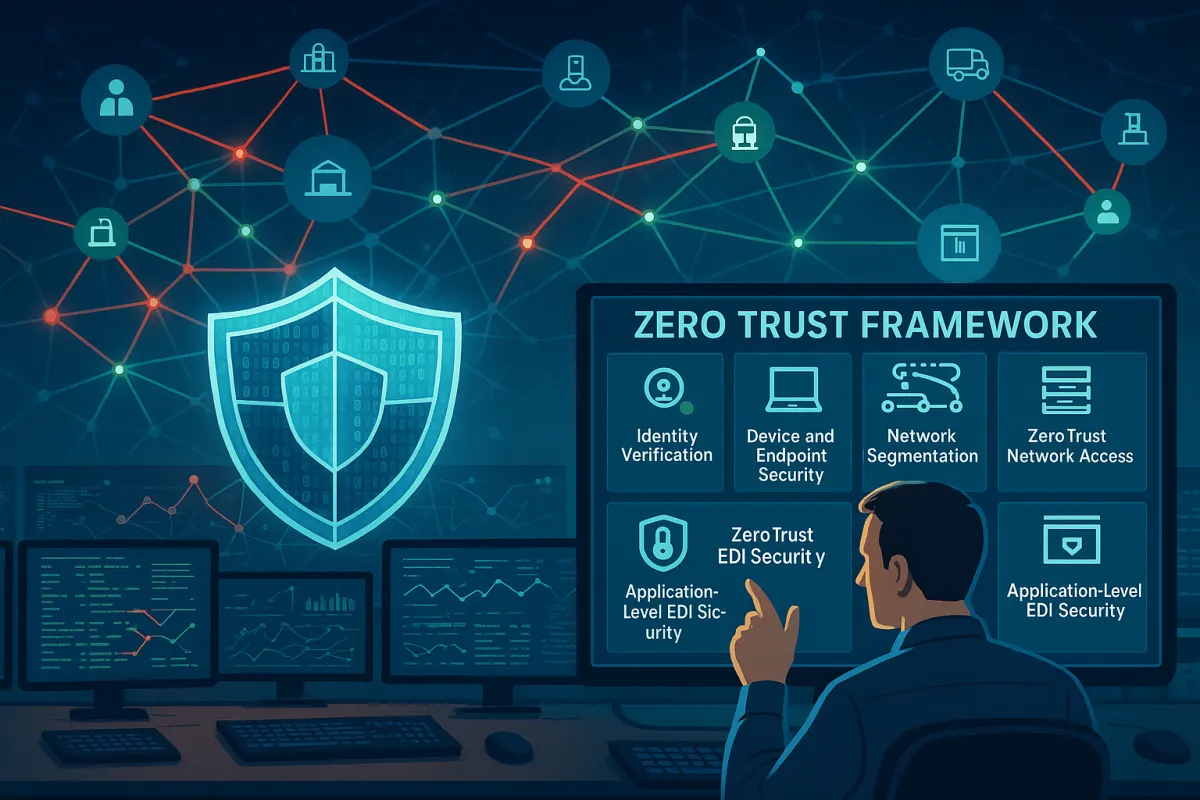
The Five-Pillar EDI Zero Trust Framework
Identity Verification for Trading Partners
Moving beyond passwords to context-aware authentication with phishing-resistant MFA (FIDO2 keys), SSO, and continuous biometric authentication applies directly to EDI environments. For your trading partners accessing EDI portals or API gateways, implement multi-factor authentication that validates both their identity and current security posture.
Modern EDI platforms like Cargoson, alongside solutions from Cleo and IBM Sterling, now support context-aware authentication. This means validating not just partner credentials, but their connection location, device characteristics, and behavioral patterns. If your regular automotive supplier suddenly submits EDI transactions from an unusual geographic location using different transmission patterns, the system flags it for verification.
Device and Endpoint Security
Device posture evaluation assesses the health and security status of any device before permitting network or data access, including OS patch levels, encryption, installed security software, and compliance with organizational standards. For EDI integrations, this extends to your partners' systems connecting to your network.
Platforms like TrueCommerce and SPS Commerce are implementing device compliance checks for partner connections. Before allowing EDI transactions, the system verifies that partner endpoints meet security standards: current OS patches, endpoint detection agents, and encrypted connections.
Network Segmentation and Zero Trust Network Access
Isolate workloads and sever lateral pathways through Zero Trust Network Access (ZTNA) to replace VPNs and microsegmentation, with vendors like Cloudflare Zero Trust, Zscaler, Illumio, and Palo Alto Prisma. This directly addresses EDI network architecture where trading partners need access to specific applications without broad network privileges.
Instead of granting trading partners VPN access to your EDI network, ZTNA creates application-specific tunnels. Your logistics partner gets access only to the transportation management functions they need, not your entire EDI infrastructure. If their connection gets compromised, lateral movement becomes nearly impossible.
Application-Level EDI Security
Every EDI transaction requires validation beyond format compliance. Modern EDI Zero Trust validates transaction authenticity, partner authorization for specific transaction types, and behavioral consistency. If a supplier who typically sends 10-20 purchase orders daily suddenly transmits 500 orders, the system automatically quarantines pending investigation.
Solutions from platforms like MercuryGate, Descartes, and Cargoson implement real-time transaction monitoring with machine learning-based anomaly detection. These systems learn normal patterns for each trading partner and flag deviations that could indicate compromise.
Data Protection and Encryption
Beyond AS2 encryption, Zero Trust EDI requires end-to-end data protection with granular access controls. Sensitive data elements within EDI transactions—customer information, pricing, inventory levels—get additional encryption layers and access restrictions based on partner roles and current trust levels.
12-Month EDI Zero Trust Implementation Strategy
Use a phased 12-month deployment strategy starting with establishing exact certainty of who is connecting and what they are connecting with by deploying robust IAM and enforcing phishing-resistant MFA across 100% of the workforce, rolling out EDR agents to all corporate endpoints, and implementing conditional access.
Phase 1 (Months 1-3): Identity Foundation
Deploy identity and access management across your EDI environment. Implement multi-factor authentication for all partner portal access and establish baseline security requirements for trading partner connections. Document current EDI partner relationships and access patterns.
Phase 2 (Months 4-6): Partner Device Compliance
Extend device security validation to trading partner connections. Implement endpoint compliance checks for partners accessing your EDI systems. Platforms like Oracle Transportation Management and SAP Transportation Management now support partner device validation alongside modern solutions like Cargoson.
Phase 3 (Months 7-9): Network Segmentation
Dismantle the legacy perimeter and shift to Zero Trust Network Access (ZTNA) by mapping out application dependencies, deploying ZTNA gateways, and transitioning remote workers off legacy VPN onto application-specific identity tunnels. For EDI, this means creating specific access paths for different partner types and transaction categories.
Phase 4 (Months 10-12): Continuous Monitoring
Implement real-time transaction monitoring and behavioral analytics. Integration with threat intelligence feeds allows your EDI security to adapt to emerging attack patterns. Solutions from Blue Yonder, nShift, and Cargoson provide this level of monitoring capability.
Protocol-Specific Security Controls
Different EDI protocols require tailored Zero Trust approaches. AS2 connections need certificate-based authentication enhanced with continuous validation. AS4 implementations require message-level security with real-time integrity checking. API-based integrations demand OAuth token management with scope restrictions and refresh validation.
For hybrid environments supporting EDIFACT, X12, XML, and JSON formats, implement protocol-aware security policies. A partner authorized for basic ORDERS transactions shouldn't automatically get access to sensitive INVOIC or REMADV message types. Granular authorization prevents privilege escalation even with legitimate credentials.
Modern platforms like Cleo Harmony, IBM Sterling B2B Integrator, and Cargoson provide multi-protocol security management. These systems allow different authentication requirements and monitoring levels based on protocol sensitivity and partner risk assessment.
Measuring Zero Trust EDI Success
Organizations successfully deploying Zero Trust Network Access reduce security breaches by 68%, throttle lateral movement by 80%, and slash incident response times by 60%. For EDI environments, additional metrics include trading partner onboarding security time, false positive rates in transaction monitoring, and mean time to detect anomalous partner behavior.
Key performance indicators should track both security and operational efficiency. Successful EDI Zero Trust implementations reduce security incidents while maintaining or improving partner integration speed. Monitor authentication success rates, device compliance percentages, and transaction processing times to ensure security doesn't impede business operations.
Zero Trust isn't a set-it-and-forget-it model as configurations drift, environments change, and new threats emerge over time. Regular assessment ensures your EDI security posture keeps pace with evolving attack methods and partner ecosystem changes.
Future-Proofing EDI Zero Trust
The most important evolution in zero trust mindset is happening "right now" with a shift from verifying identity to verifying intent in 2026. For EDI, this means analyzing transaction intent alongside partner identity. Is this purchase order consistent with normal business patterns? Does the requested shipping destination align with the partner's typical operations?
AI-powered threats require adaptive EDI security that evolves with attack sophistication. As autonomous agents begin making independent decisions across trading networks, your Zero Trust framework must validate both human and machine intent. Platforms like FreightPOP, E2open, 3Gtms, and Cargoson are already implementing AI-driven behavioral analysis for partner transaction validation.
Quantum-resistant encryption preparation becomes essential as quantum computing capabilities advance. EDI systems with long-term trading relationships and multi-year contracts need cryptographic upgrades that maintain backward compatibility while providing future security.
Integration with broader supply chain security initiatives positions EDI Zero Trust as part of enterprise-wide resilience strategies. Your EDI security framework should align with procurement risk management, supplier compliance programs, and corporate incident response procedures.
Start your EDI Zero Trust implementation by assessing current partner access patterns and identifying your highest-risk trading relationships. Focus on controls that address your highest-risk users and most critical assets. The trading partners handling your most sensitive data or highest transaction volumes deserve priority attention in your Zero Trust deployment strategy.