What Is an SSCC Number? EDI Pallet Labels Explained
What an SSCC number is, how its 18 digits work, and how it links a GS1-128 pallet label to your EDI 856 ASN — with a worked example.

What is an SSCC number?
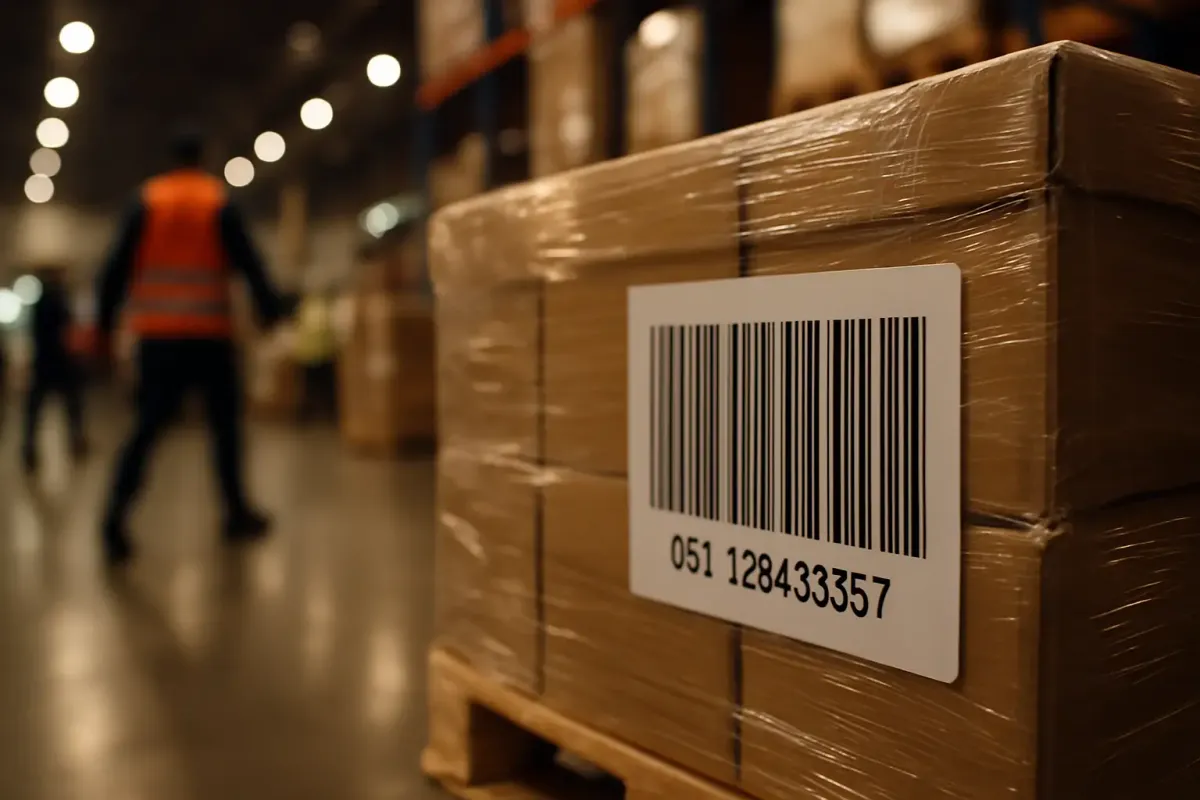
An SSCC (Serial Shipping Container Code) is an 18-digit, globally unique number that identifies one specific logistics unit — a pallet, case, or carton — rather than the product inside it. The Serial Shipping Container Code is an 18-digit number used to identify logistics units, often encoded in a barcode, generally GS1-128, and can also be encoded in an RFID tag. It's the number a dock worker's scanner reads first when a pallet rolls off the truck.
An SSCC number is assigned once, to one physical unit, and stays with that unit for its entire journey. Once assigned, this 18-digit number remains permanently linked to the unit's journey, and the design ensures the identifier is never reused, even after the unit is broken down or delivered. That's a meaningful distinction from most other codes in your ERP, which get recycled once a work order or shipment closes.
The SSCC is commonly used in the advance ship notice (ASN) EDI transaction, which is exactly why this number matters so much to anyone who's ever chased down a receiving discrepancy at 6am.
SSCC vs UPC vs GTIN — what's the difference
A UPC or GTIN identifies what a product is — the same 12-ounce can of soup gets the same GTIN whether it's the first one off the line or the millionth. An SSCC identifies which specific box or pallet is moving right now, and no two ever share a number. Similar to the relationship between a GTIN and a UPC, the SSCC is a number typically encoded into a GS1-128 barcode and included on a GS1 Logistics Label, sometimes called an SSCC label.
Retailers and their vendors often call the same barcode a "license plate" or "carton ID." It's the same thing, just informal shorthand. And note the barcode symbology (GS1-128, formerly known as UCC-128) is the container that carries the SSCC number — it's not the number itself. GS1-128 can hold plenty of other data too, including production dates and batch numbers, but the SSCC is the one field that has to be there.
How the 18 digits are built
The structure is fixed by GS1 and doesn't leave much room for improvisation. The SSCC comprises an extension digit, a GS1 company prefix, a serial reference, and a check digit. Broken down:
- Extension digit (1 digit): assigned at the company's discretion, mainly used to extend the available serial reference pool.
- GS1 Company Prefix (7–10 digits): licensed to your organization by GS1, identifying you as the assigning party.
- Serial reference (variable length): the sequential or system-generated number unique to this specific container. The combined length of the Extension Digit, GS1 Company Prefix, and Serial Reference will always total 17 digits.
- Check digit (1 digit): a calculated validation digit, using the same Mod-10 logic applied to UPC-A and EAN-13 barcodes.
Don't hand-key that check digit. Let your ERP, WMS, or label software calculate it — a single transposed digit anywhere in the sequence throws off the entire check digit calculation, and a receiving scanner will reject the barcode outright rather than guess.
Here's how this plays out for a manufacturer shipping a pallet to a Walmart regional DC. Walmart's Supply Chain Standards require all vendors to apply a Serialized Shipping Container Code to each pallet, and vendors need to assign a unique SSCC-18 for each pallet and incorporate it into a GS1-128 Shipping Label. The manufacturer's labeling system takes its licensed GS1 Company Prefix, appends the next serial reference in sequence, runs the Mod-10 calculation, and produces an 18-digit string. That string gets printed on the pallet label under Application Identifier (00) — AI (00) identifies the SSCC-18 — as a GS1-128 barcode, and the identical 18-digit string is written into the MAN segment of the outbound EDI 856 ASN. Same number, two places, one shipment.
Why it matters for EDI 856 / ASN accuracy
The SSCC is the bridge between the physical pallet and the electronic shipment record. Get it wrong and you're not looking at a shipping delay — you're looking at a chargeback. If you're shipping to Walmart, Target, Amazon, Kroger, Home Depot, or basically any large distribution center, your pallets need an SSCC label, and that label has to agree with your EDI 856 Advance Ship Notice down to the digit.
The scan-to-ASN match works in one motion: the dock scanner reads the SSCC off the label, the WMS looks up that exact code in the inbound 856, and if it finds a match, it confirms PO, SKU, quantity, and putaway location without anyone opening the pallet. Get it right and the pallet glides through receiving in seconds; get it wrong and it gets pulled aside, processed by hand, and billed back to you.
Most SSCC mismatches aren't exotic data errors. They tend to happen when labels are reprinted without updating the ASN, when labels and ASNs are generated from different data sources, or when label generation and ASN generation run at different times with different data snapshots. If you've read our earlier posts on 856 chargebacks, this is the root cause behind a good chunk of them.
Who generates SSCC labels today
Three broad approaches exist, and most mid-to-large shippers end up running a mix depending on the trading partner.
| Approach | Examples | How SSCC generation works |
|---|---|---|
| WMS/ERP-integrated | SAP, Oracle, Manhattan Associates | SSCC is generated at pack-out inside the same system that builds the ASN, reducing the risk of a mismatch since both draw from one data source. |
| Standalone label design software | BarTender, NiceLabel | Pulls a GS1 Company Prefix and serial range from a database or manual entry; requires a separate integration step to sync with the ASN. |
| EDI-provider-integrated | SPS Commerce, TrueCommerce, Cleo, Commport, which comes with built-in shipping label generation for GS1-128 / MH10 labels | Label and ASN are generated from the same EDI transaction data, which is generally the safest setup for compliance. |
| Multi-carrier shipping / TMS platforms | ShippyPro, Shippo, EasyPost, ProShip, Cargoson | Auto-generates GS1-128/SSCC labels at booking time as part of a broader shipment workflow, alongside waybills and other transport documents. |
That last category is worth watching. Platforms in this space let users compare prices and transit times, book shipments, generate labels, electronic waybills, CMRs, and DGDs, and track collection and arrival — and Cargoson is one example, connecting to carriers via both API and EDI so the label data and the shipment record come from the same booking event rather than two disconnected systems. That structural fix, generating everything at one point instead of stitching it together afterward, is exactly what closes the "printed label doesn't match the ASN" failure mode.
For further reading on the barcode side, GS1's own SSCC standard page is the authoritative reference if you need to check edge cases in prefix length or check digit calculation.
FAQ
Is an SSCC the same as a UPC? No. A UPC (or GTIN) identifies the product itself and stays the same across every unit produced. An SSCC identifies one specific pallet or carton and is never repeated.
Can I reuse an SSCC number? Not once it's been assigned to a physical unit. GS1's design intent is that the number is permanently retired for that container once it's created, regardless of whether the unit is later broken down.
Do I need a GS1 Company Prefix to create SSCCs? Yes. To generate an SSCC, you first need a GS1 Company Prefix, which you apply for on the GS1 website. Without it, you can't legally construct a compliant number.
What happens if my SSCC label doesn't match my ASN? Typically a compliance chargeback, and often a shipment that gets pulled from automated receiving and processed by hand, which is slower and costs your partner labor they'll bill back to you.
Is an SSCC required on every shipment? It depends on the trading partner, but most large retailers and automotive OEMs require it at the pallet or case level as a condition of EDI 856 compliance, and it's worth checking your specific routing guide rather than assuming a blanket rule.