Does FSMA 204 Food Traceability Require EDI?
FSMA 204 explained for EDI teams: what KDEs and CTEs mean for your 856, GS1 labels, and TMS data before the 2028 deadline.

Not entirely, but for most food manufacturers and distributors, existing EDI infrastructure gets you most of the way there. The FSMA 204 Food Traceability Rule requires entities that manufacture, process, pack, or hold foods on the Food Traceability List to maintain enhanced traceability records, assign Traceability Lot Codes, capture Key Data Elements at Critical Tracking Events, and produce records to the FDA within 24 hours of request. Your 856/ASN and GS1 labeling can carry almost all of that data. What EDI can't fix is broken data capture inside your own four walls, which is where most compliance programs actually fail.
This isn't a theoretical question anymore. Walmart's supplier traceability mandate has been live since August 2025, and chargebacks are already hitting vendor scorecards. Here's what EDI teams need to know before they build the wrong project.
What is the FSMA 204 compliance deadline now?
July 20, 2028. The FDA proposed extending the original compliance date by 30 months, from January 20, 2026 to July 20, 2028, and Congress made that extension binding. In November 2025, Congress passed the Continuing Appropriations Act of 2026 directing the FDA not to enforce the rule before July 20, 2028, and the FDA is complying with that directive.
Nothing about the underlying rule changed. The rule itself is unchanged, only the compliance and enforcement date moved, and covered entities should not treat the extension as a reprieve. You still need Traceability Lot Codes, Key Data Elements at every Critical Tracking Event, and a 24-hour retrieval capability. You just have longer to get there federally. Retailers didn't wait for that clock.
Does the 2028 extension mean EDI teams can wait?
No. Walmart's own supplier requirement is already live and running ahead of the federal timeline. Walmart now expects all food suppliers to provide an ASN containing KDEs for food shipments, with SSCC-18 pallet labels linked to the ASN and GS1-128 case labels, and those requirements took effect August 1, 2025.
Walmart isn't treating the FDA's extension as license to slow down either. Walmart and Sam's Club required suppliers of all food and beverage items to meet ASN and packaging requirements as of August 1, 2025, and Walmart's supplier guidance addresses the FDA extension directly, stating it expects suppliers to meet the original compliance timelines regardless. And Walmart isn't alone. Albertsons, Sam's Club, KeHE, Kroger, Walmart, and Target have all moved to require traceability data on all foods rather than only listed foods, making the rule the floor that each buyer builds its own requirements on top of.
This is the same pattern the blog has covered around SSCC label enforcement and ASN chargebacks before: retailers turning a future federal requirement into a live vendor scorecard item. If you're managing supplier onboarding for a food manufacturer, the practical deadline was months ago, not 2028.
What data does an EDI 856 need to add for FSMA 204?
Lot code, GTIN, and location data mapped to specific segments, most of which fits into your existing ASN structure rather than requiring a new transaction set. GS1 US has published implementation guidance for exactly this. The Shipping CTE requires a handful of Key Data Elements to be linked to the Traceability Lot, and for this lot to be recorded as the Traceability Lot Code. For the TLC KDE, guidance recommends recording both the GTIN and the batch/lot number of the food, submitted at the Pack level.
Location data maps the same way. The Ship To location in EDI is specified on the shipment level and links to attributes exchanged following the GLN Data Model which fulfills the Location Description KDE requirement, expressed in an ASN as an N1 Party Identification segment. The identifiers do the heavy lifting here. GS1 issues global identifiers, GTIN for products and GLN for locations, that map directly to the FDA's CTEs and KDEs, and by scanning GS1 barcodes and sending EDI shipping notices, companies can automatically exchange key lot and product data with trading partners.
Practically, that means:
- Lot/batch code and GTIN carried at the pack level in the 856, tied to the physical case and pallet labels
- GLN references for ship-from and ship-to locations, mapped through existing N1 party segments
- Date/time of shipment in the DTM segment, which the rule requires at date-level granularity, not necessarily time
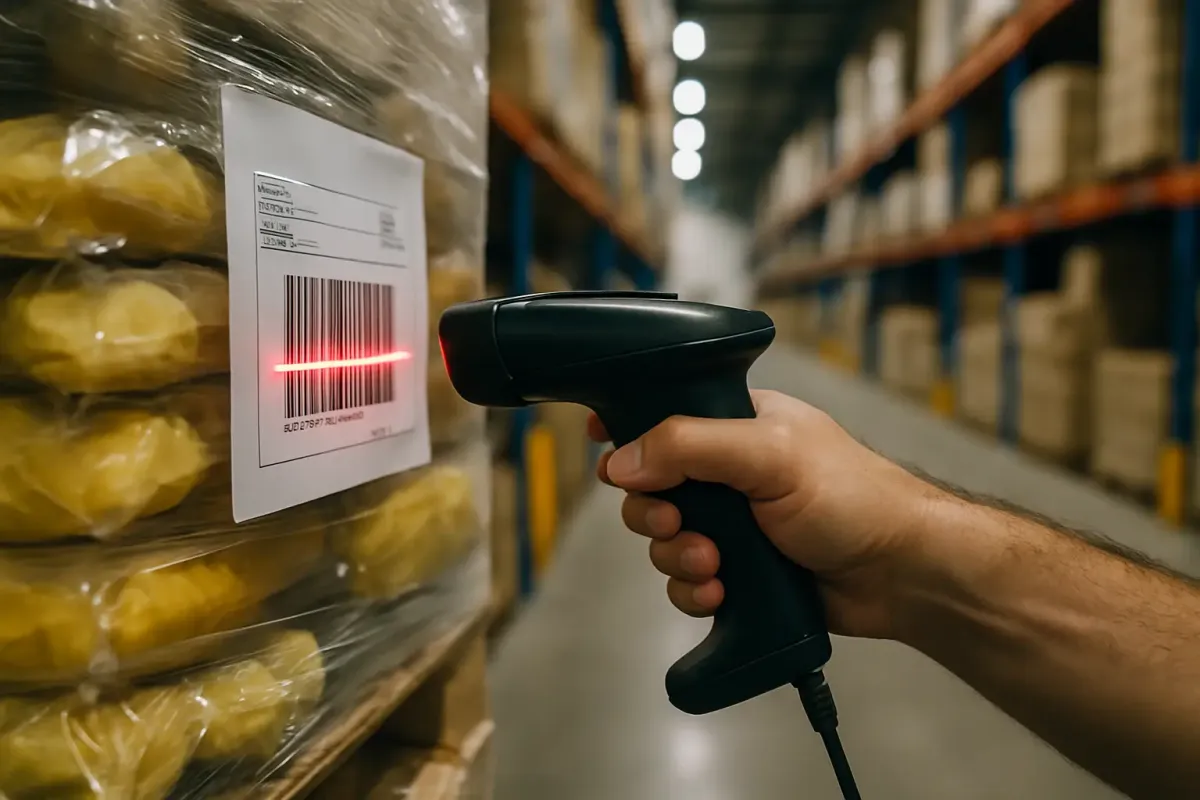
- SSCC-18 on the pallet label, linked back to the ASN so receiving can scan-match rather than key-match
Where teams get tripped up is co-packed or mixed pallets, where one physical unit carries multiple lot codes from different production runs, and the ASN has to reflect that split cleanly rather than collapsing it to a single lot.
Where does EDI alone fall short for FSMA 204?
EDI moves data between trading partners. It does nothing to fix the fact that your receiving, shipping, and production records might live in three different systems that don't talk to each other. That's where compliance actually breaks.
Operations creates the data, and receiving, shipping, production, labeling, EDI, and inventory control all have to participate the same way every shipment, every shift, every lot. When those workflows are disconnected, with receiving sitting in the WMS, shipping data living in EDI exports, production records in a quality system, and lot information in a spreadsheet, the 24-hour sortable spreadsheet the FDA expects becomes a manual scramble. You can write the most rigorous traceability plan in the industry and still fail a mock recall if the receiving clerk on the night shift captured the wrong lot code on the wrong line.
Transport execution and carrier connectivity tools have a real role to play here, not as an EDI replacement but as the layer that feeds clean, timestamped CTE data (dock scans, carrier handoff, pickup/delivery confirmation) into the same 856 workflow instead of leaving it in a driver's paper log. Multi-carrier visibility platforms like Cargoson, alongside Descartes, MercuryGate, and Alpega, exist to close exactly this kind of gap between what happens on the dock and what shows up in your EDI stream. None of them replace the 856. They make sure the data going into it is accurate at the moment of capture.
Do you need blockchain or IoT for FSMA 204, or is EDI/GS1 enough?
For most manufacturers and distributors, GS1 labeling plus EDI is sufficient to meet the rule's data requirements. Blockchain and IoT sensors are accelerants for specific risk categories, not a baseline requirement.
Vendors will pitch both, and there's a real case for each in the right context. Blockchain systems create tamper-proof, shared batch records across suppliers for transparent traceability, while IoT sensors like temperature, GPS, RFID, and NFC tags automatically log Critical Tracking Events in real time. But one detail gets lost in the sales pitch: temperature data is not a primary Key Data Element under FSMA 204, and that distinction matters, even as food shippers, distributors, and retailers increasingly expect condition monitoring data to travel alongside traceability records.
Don't rip out working EDI and GS1 infrastructure to bolt on sensor networks or a distributed ledger because a vendor demo looked impressive. Add that layer where cold-chain risk or a specific FTL commodity justifies the cost, not as a default architecture decision.
What should EDI teams do before the 2028 deadline?
Audit lot-code capture at every CTE now, align labeling with GS1 and retailer-specific requirements, and treat live retailer mandates as the real forcing function rather than the federal date.
- Map each of the seven Critical Tracking Events to your existing 856, 945, or 947 flows and identify which KDEs are already carried versus missing
- Confirm GLN and GTIN coverage across every ship-from and ship-to location, including third-party warehouses and co-pack facilities
- Run a mock 24-hour retrieval test pulling a single lot code across receiving, production, and shipping systems, not just the ASN
- Prioritize by retailer contract deadlines over the federal 2028 date, since chargebacks and vendor scorecard hits are already happening at Walmart regardless of where FDA enforcement stands
This mirrors what's already played out with SSCC labeling and ASN chargeback enforcement at major retailers over the past few years. The federal deadline moved. The retailer deadline didn't. Build for the one that's already being enforced.