EDI vs API: what's the actual difference?
EDI vs API explained: how each moves supply chain data, when trading partners require one over the other, and how to run both together.

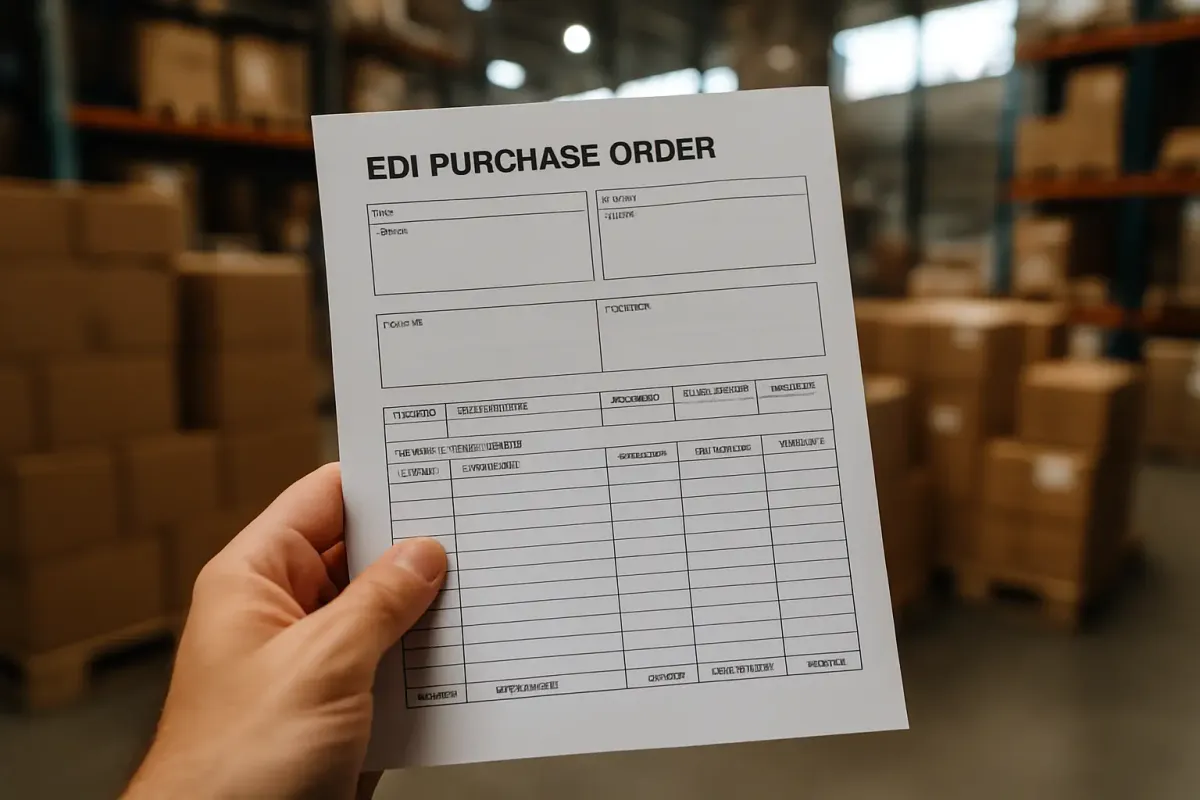
Ask ten supply chain people to define EDI vs API and you'll get ten different half-answers, usually followed by "it's complicated." It isn't, really. Both are methods for moving business data between two computer systems, but they solve different problems and were built decades apart. Here's the actual difference, plus what happens when the same purchase order runs through each.
What is EDI?
EDI (Electronic Data Interchange) is a standardized method for exchanging structured business documents, purchase orders, invoices, shipping notices, between two systems using a fixed format like ANSI X12 or UN/EDIFACT, typically sent in batches over AS2, SFTP, or a VAN. EDI automates the exchange of structured business documents, purchase orders (850), invoices (810), advance ship notices (856) between trading partners using standardised formats like ANSI X12 or UN/EDIFACT, transmitted over private networks on a fixed schedule.
EDI predates the commercial internet by a couple of decades, and it hasn't gone anywhere. Quite the opposite: 85% of supply chain transactions are still managed through EDI, according to IBM. If you trade with a large retailer, you're almost certainly still sending fixed-segment documents on a schedule, whether you like it or not.
What is an API?
An API (Application Programming Interface) lets two systems request or send data on demand, usually over HTTPS as JSON, enabling real-time, single-record interactions instead of batch files. An API lets two software systems exchange data in real time, over the web, the moment an event happens, a dock slot booked, a gate check-in logged, or inventory updated.
Here's the part people miss: there's no universal API "document" the way there's a universal 850 purchase order. Every API is partner-specific unless a shared framework standardizes the payload (FHIR in healthcare is the closest analogue). Two retailers can both expose a REST API for orders and still send you completely different JSON schemas, different field names, different auth methods. EDI gives you one fight to have (mapping the segments); APIs can give you one fight per partner.
EDI vs API: the core distinction
The two aren't really competing standards. One is a document format with a delivery method attached; the other is a delivery method with no fixed document format at all. Here's how they stack up on the things that actually matter during implementation:
| Factor | EDI | API |
|---|---|---|
| Data format | Fixed segments (X12, EDIFACT) | Usually JSON, partner-defined |
| Timing | Batch, scheduled windows | Real-time, event-driven |
| Setup | Trading partner agreement + mapping | API docs + auth keys per partner |
| Transport | AS2, SFTP, VAN | HTTPS/REST |
| Compliance exposure | Retailer chargebacks for non-conformance | Fewer standardized penalties, but no audit trail unless built |
| Best fit | High-volume, mandated retail/carrier documents | Tracking, rate lookups, one-off order flows |
One common confusion worth clearing up: "API" is not inherently newer or better than EDI, it's a different transport model. A lot of what gets marketed as an "API integration" is actually X12 or EDIFACT data riding inside a JSON wrapper. Stedi and Orderful convert X12 to JSON, allowing EDI to plug directly into web APIs and data warehouses. The document standard hasn't changed. Only the pipe it travels through has.
The same pattern shows up in transport management. TMS platforms like Cargoson, MercuryGate, Descartes, and Alpega maintain EDI connections to satisfy legacy retail and carrier mandates, while exposing APIs on top for real-time tracking and status updates. Multi-carrier parcel tools like Shippo, EasyPost, and Sendcloud run the identical playbook on the small-parcel side.
Worked example: one purchase order, two paths
Take a supplier fulfilling an order for a large home improvement retailer. Depending on the channel, the exact same order can move through the business in two completely different ways.
- Via EDI: the retailer transmits an 850 purchase order over AS2. The supplier's translator parses the segments, an 855 acknowledgment goes back confirming receipt and pricing, an 856 advance ship notice follows once the order is picked and packed, and an 810 invoice closes the loop after shipment.
- Via API: the same supplier, selling through a newer digital or marketplace channel, receives a JSON order object the instant the retailer's system posts it, and is expected to fire a webhook response confirming receipt, with no fixed segment structure to parse.
Large retailers rarely swap one for the other. Retail trading partners rarely replace EDI with APIs. Large enterprises such as The Home Depot, CVS Health via Mercury Gate, and Walgreens continue to require structured EDI documents for compliance and receiving automation. More broadly, major retailers including Walmart, Amazon, Costco, Home Depot, and Target mandate EDI compliance and issue chargebacks for deviations. APIs get layered on for the newer, faster-moving parts of the relationship, not swapped in for the compliance-critical documents.
Why most companies end up running both
Nobody plans to run two integration stacks. It happens because retailers, carriers, and internal systems all move at different speeds, and rebuilding a working EDI compliance program just to chase a trend is a bad use of budget. 55 percent of supply chain executives considered web service APIs as an alternative to EDI at one point, and the honest answer, years later, is that it wasn't an either-or decision at all. The pattern that actually works is a translation layer: something sits between your partners and your ERP, converting outbound API calls into EDI 850s for partners who require them, and parsing inbound EDI documents back into structured data your internal systems can use without anyone touching an X12 segment by hand. That's exactly the role platforms like Cargoson, MercuryGate, Descartes, and Transporeon play on the transport side, translating carrier API data into EDI 214 or 990 status feeds and back, so dispatchers get real-time visibility without every carrier needing to rebuild their EDI setup.
FAQ
Is API replacing EDI?
No. 85% of supply chain transactions are still managed through EDI, and large retailers keep EDI mandatory for compliance regardless of what APIs a supplier offers elsewhere.
Do I need to pick one for my whole business?
No, and almost nobody does. Most companies run EDI for compliance-mandated retail and carrier documents, and APIs for newer channels, real-time tracking, or internal system connections, often through the same integration layer.
Is "EDI over API" the same as EDI?
Functionally, yes, on the data side. Tools like Stedi and Orderful still convert X12 to JSON, allowing EDI to plug directly into web APIs and data warehouses, but the underlying document is still an X12 or EDIFACT payload. Only the transport changed, from AS2/VAN to REST.
Which is cheaper to implement?
It depends heavily on partner count and volume. A handful of high-frequency API integrations can be cheaper to build and maintain than mapping dozens of EDI trading partner agreements, but a supplier onboarding 200 retail partners will find EDI's standardization pays for itself precisely because the document format doesn't change per partner.
What's a good first step if we only run EDI today?
Add an API for one high-frequency, non-compliance workflow, shipment tracking or rate lookups are the usual starting points, before touching the core document flows that retailers actually audit.