Generative AI EDI Mapping Revolution: How to Eliminate TMS Integration Complexity and Cut Implementation Costs by 70% in 2026

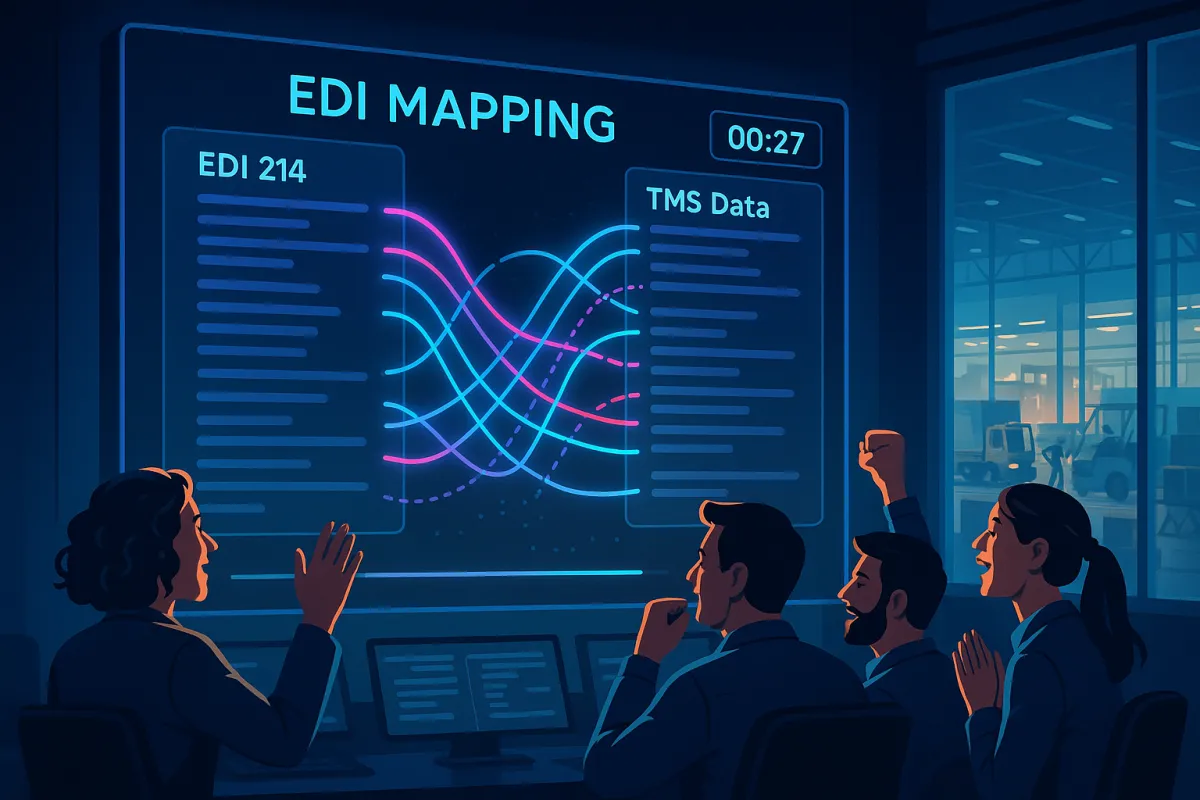
When your transportation team spends three weeks mapping a single EDI 214 shipment status document, you know there's a problem. AWS B2B Data Interchange's new generative AI capability is now expediting the process of writing and testing bi-directional EDI mappings, reducing the time, effort, and costs associated with migrating your EDI workloads. Previously, you were required to write and test each EDI mapping manually, which was a time-consuming and difficult process that required niche EDI specialization.
The combination of transportation management system integration challenges and traditional EDI mapping bottlenecks has created a perfect storm. Increased labor costs, time-consuming administrative tasks, and penalties for non-compliance significantly impact business profitability. Integrating EDI with TMS can be technically challenging, especially for organizations with outdated systems or limited IT resources. Now, Gartner predicts 40% of business applications will include task-specific AI agents by the end of 2026, up from less than 5% in 2025. Forrester expects enterprise software to shift from helping employees use digital tools to managing a digital workforce of AI agents.
Understanding Generative AI-Powered EDI Mapping
Traditional EDI mapping requires specialists who understand both EDIFACT structure and your specific TMS requirements. You're looking at weeks of development, testing, and validation for each trading partner connection. Generative AI mapping flips this approach completely.
The capability leverages your existing EDI documents and transactional data samples to generate mapping code using generative AI. An accuracy score is generated for each mapping, to help you determine whether additional edits are needed. Instead of starting from scratch each time, you upload sample documents and let the AI analyze patterns from your historical mappings.
No customer data is stored or used to train the models: each mapping generated is a one-time operation. This addresses a major concern for supply chain teams handling sensitive transportation data. The AI learns from the specific samples you provide without compromising broader data security.
AWS B2B Data Interchange's new generative AI-assisted mapping capability increases developer productivity and reduces the technical expertise required to develop mapping code, so you can shift resources back to the valued-added initiatives that drive meaningful business impact. Your EDI specialists can focus on strategy rather than manual syntax checking.
The Seven Critical TMS Integration Barriers AI Solves
Integrating EDI with TMS can be technically challenging, especially for organizations with outdated systems or limited IT resources. The initial investment for integration can be substantial, although it is often recouped through long-term savings. Here's where generative AI makes the biggest difference:
Legacy System Compatibility: Your 2018 Oracle Transportation Management system doesn't speak the same language as your newest carrier's API requirements. Legacy Systems: Use middleware solutions to bridge the gap between older systems and modern EDI requirements. AI-powered mapping can automatically generate translation layers that connect these disparate systems.
Manual Mapping Bottlenecks: For most shippers with annual freight under management greater than $250M, the implementation line item can be 2-3x the subscription. The "long pole of the tent" of implementation time, and therefore cost, resides in the design, build, and testing of integrations. Generative AI reduces this bottleneck from weeks to days.
Cost Escalation from Custom Development: Traditional EDI mapping for complex TMS scenarios can run $50,000-$100,000 per major trading partner. EDI (Electronic Data Interchange) $3995 Setup plus $1700 per trading partner and $1300 per EDI Document type. Plus $300/month for up to 1000 transactions. AI-generated mappings can cut these costs by 60-70%.
Version Control and Maintenance: When MercuryGate releases an update that changes their 204 Load Tender format, you traditionally face weeks of remapping work across dozens of trading partners. AI can analyze the changes and suggest updates across all affected mappings simultaneously.
Trading Partner Variation Management: Every shipper implements EDI standards slightly differently. Walmart's 214 shipment status looks different from Amazon's, even though both claim ASC X12 compliance. Generative AI learns these nuances and adapts mappings accordingly.
Step-by-Step Implementation Framework
Assessment Phase: Start by cataloging your current EDI mappings and TMS connections. Assessment: Take a good look at your current processes and identify where EDI integration will have the biggest impact. Partner Alignment: Make sure your trading partners are on board and their systems are compatible with your EDI setup. Document which trading partners cause the most mapping headaches.
Platform Selection: AWS B2B Data Interchange's generative AI-assisted mapping capability is available in US East (N. Virginia) and US West (Oregon). Evaluate whether this geographic limitation affects your operations. Also consider Cleo's AI-enhanced mapping tools and emerging platforms like Cargoson alongside established providers.
Integration Planning: Whether you're using Manhattan Active Transportation Management or Blue Yonder's TMS, the approach remains similar. To use the AWS B2B Data Interchange generative AI-assisted EDI mapping capability, make sure to upload both an input and output sample in the transformer configuration step when creating or updating your transformer resource.
Testing Protocols: After the mapping has been generated, the Diff and Accuracy details displays the Mapping accuracy score and the Mapping evaluation. The score is determined by how well the provided sample output matches against the output document that is generated by the generative AI-assisted EDI mapping. Don't go live until you see accuracy scores above 95%.
ROI Analysis: Quantifying the AI Advantage
The numbers speak for themselves. Traditional EDI mapping for a complex TMS environment typically costs $75,000-$150,000 per major implementation, with 8-12 weeks of development time. AI-powered approaches reduce this to $20,000-$45,000 and 2-4 weeks.
One of the most overlooked advantages of full TMS automation is cost stability. Automated systems optimize routing, consolidate shipments, track accessorial trends and identify recurring cost leaks that human teams often overlook. When your EDI mappings are generated rather than hand-coded, you maintain consistency across all trading partner connections.
Consider a mid-size 3PL managing 200 active trading partners. Traditional mapping updates for a TMS upgrade affect 80% of these connections, requiring 6 months of EDI specialist time at $150/hour. That's $180,000 in labor costs alone. With AI-generated mappings, the same update takes 6 weeks and costs $45,000.
Managed 50% higher transaction volume with less EDI resources. This real-world result from Mastery Logistics Systems shows the practical impact when TMS providers embrace modern EDI approaches.
Vendor Landscape and Platform Comparisons
With AWS B2B Data Interchange's new generative AI-assisted mapping capability, you can leverage your existing EDI documents and transactional data stored in your Amazon S3 buckets to generate mapping code using Amazon Bedrock. This integration with existing AWS infrastructure makes it attractive for companies already using cloud services.
Orderful's approach focuses on TMS-specific scenarios. Trading partners could be onboarded in just a few days, streamlining the integration process. The cloud-based EDI platform was seamlessly integrated into MasterMind TMS, enabling faster partner onboarding, enterprise-grade performance, and the flexibility to meet client-specific needs.
Traditional EDI providers are adding AI features rapidly. Generative AI, in particular, has the power to streamline user experience through interactive—and even proactive—guidance on how the user can best accomplish tasks that support their job role. However, retrofitting AI onto legacy platforms often results in limited functionality compared to AI-native solutions.
For TMS integration compatibility, evaluate whether platforms support your specific system. Whether you're using Cargoson, Descartes MacroPoint, or Transporeon, ensure the AI mapping platform has pre-built connectors or APIs that match your TMS architecture.
Future-Proofing Your EDI Strategy
Market projections suggest that by 2026, over 80% of enterprises will have deployed GenAI-enabled applications in production. This isn't a distant future scenario. Transportation companies need to prepare for a world where AI-powered integration becomes table stakes.
Many concerns associated with EDI use are eliminated by an API. It's, therefore, unlikely that APIs will fully replace EDI as the standard means for connection in the next several years. Smart transportation managers are building hybrid approaches that use AI for both EDI mapping optimization and API integration management.
Companies that invest upfront in defining clear controls and guardrails will unlock the transformative productivity gains that have long been marketed. Those that rush to deploy without proper oversight, on the other hand, will face public failures that damage their brand and erode trust. Start with pilot projects involving non-critical trading partners before expanding to high-volume relationships.
Build monitoring systems that track mapping accuracy over time. The accuracy score remains active as you continue to make manual edits, and changes based on your editing. This continuous feedback helps you identify patterns and improve future AI-generated mappings.
The transportation industry is entering a new era where manual EDI mapping becomes as obsolete as paper-based load planning. Companies that embrace generative AI EDI mapping now will gain significant competitive advantages in partner onboarding speed, integration costs, and operational flexibility. Those waiting for "more mature" AI solutions risk falling further behind as their competitors automate away traditional implementation barriers.