The 7 Critical Agentic AI-EDI Implementation Barriers That Doom 40% of Projects: Your Complete Success Roadmap to Overcome Legacy Integration, Data Quality, and Governance Challenges in 2025

Gartner's stark prediction hits close to home: over 40% of agentic AI projects will be canceled by the end of 2027, due to escalating costs, unclear business value or inadequate risk controls. For supply chain professionals evaluating autonomous EDI systems, this statistic isn't just another industry forecast—it's a warning about very real implementation barriers that turn promising pilot projects into expensive failures.
The appeal of agentic AI in EDI environments is undeniable. Imagine autonomous agents negotiating delivery schedules, automatically adjusting purchase orders based on demand fluctuations, and resolving transaction errors without human intervention. The rise of agentic AI is redefining what EDI can do, and AI can more easily extract patterns and insights from EDI across different trading partners and business networks. Yet 60% of AI leaders surveyed report their organization's primary challenges in adopting agentic AI are integrating with legacy systems and addressing risk and compliance concerns, followed closely by lack of technical expertise.
Why are so many promising agentic AI-EDI initiatives failing? The barriers aren't just technical—they're systemic, financial, and organizational. Understanding these seven critical obstacles, and more importantly, how to navigate them, determines whether your implementation joins the successful 60% or becomes another costly write-off.
The Agentic AI-EDI Revolution: Promise vs. Reality in 2025
Agentic AI represents a fundamental shift from traditional rule-based EDI automation to intelligent systems capable of autonomous decision-making. Unlike conventional AI that responds to single prompts, agentic AI can perform multi-step tasks and work with different systems to achieve a more complex goal. In EDI contexts, this means AI agents that can resolve supplier compliance issues, optimize routing decisions, and even initiate purchase orders based on real-time demand signals.
The structured nature of EDI data creates an ideal foundation for agentic systems. The standardized and structured nature of EDI formats (e.g. ANSI X12, EDIFACT) and EDI data exchanges means less data cleaning is likely required before feeding it into AI models, enabling supply chain leaders to embed autonomous AI agents into EDI workflows to alert, interpret, act on, and optimize data. Leading transportation management systems like Cargoson, alongside platforms from Descartes, MercuryGate, and nShift, are already exploring how autonomous agents can transform logistics orchestration.
Gartner forecasts that by 2028, a colossal 15% of all day-to-day decisions will be made autonomously by AI agents. But implementation reality tells a different story. While 30% of surveyed organizations are exploring agentic options and 38% are piloting solutions, only 14% have solutions that are ready to be deployed and a mere 11% are actively using these systems in production.
Barrier 1: Legacy System Integration Crisis - The $2M Lock-In Problem
Your SAP ECC 6.0 system wasn't designed to communicate with autonomous AI agents. Neither was that AS/400 running critical warehouse operations, or the collection of flat-file FTP processes that still handle 60% of your partner integrations. Traditional enterprise systems weren't designed for agentic interactions, and most agents still rely on application programming interfaces (APIs) and conventional data pipelines to access enterprise systems, which creates bottlenecks and limits their autonomous capabilities.
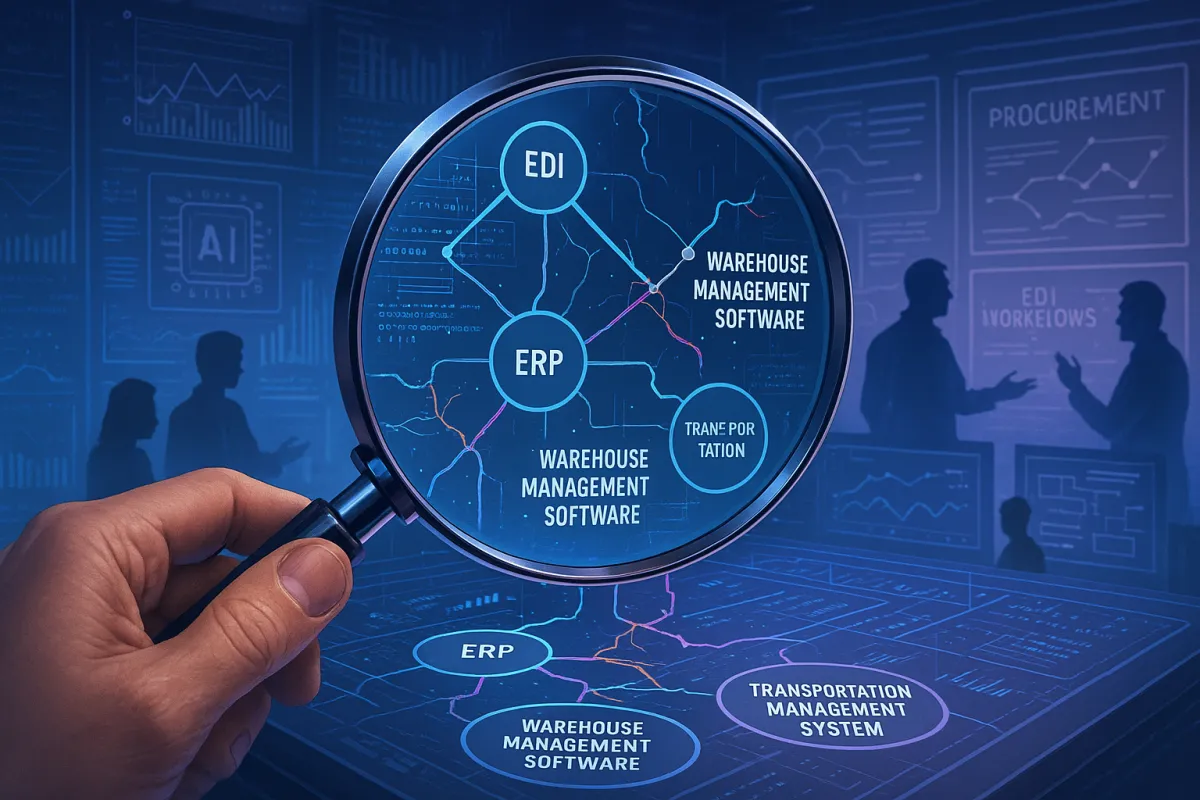
The integration challenge goes beyond simple API connectivity. A fragmented landscape of disconnected systems creates barriers, preventing AI from drawing on comprehensive data across the organization, and without unified access, insights remain partial. When your EDI platform, ERP system, warehouse management software, and transportation management system operate in silos, agentic AI agents can't access the contextual information needed for intelligent decision-making.
The cost implications are staggering. A Deloitte report found that companies using outdated integration tools spend 25–30% more annually compared to those using cloud-based EDI platforms. For a mid-sized manufacturer processing 50,000 EDI transactions monthly, this translates to $200,000-$400,000 in additional annual costs before factoring in agentic AI complexity.
Consider the typical integration scenario: connecting an autonomous procurement agent to legacy systems requires custom middleware, data transformation layers, and sophisticated error handling mechanisms. Integration costs can range from $5,000–$20,000+ depending on complexity and include custom programming to connect your EDI system with your internal systems for seamless data flow. Multiply this across multiple legacy touchpoints, and integration costs quickly escalate beyond initial budgets.
Barrier 2: Data Quality and Governance Nightmare
One of the biggest barriers to embedding AI into EDI workflows is inconsistent or poor-quality data, as EDI transactions often span multiple partners and systems, leading to fragmented, outdated, or non-standardized datasets. Agentic AI systems require pristine data to make autonomous decisions. Feed them inconsistent partner specifications, incomplete transaction histories, or conflicting business rules, and they'll make expensive mistakes at machine speed.
The EDI data quality challenge is uniquely complex. Each trading partner maintains their own interpretation of EDI standards. A supplier's 850 purchase order might include custom fields that your system doesn't recognize, while another partner sends critical delivery instructions in non-standard segments. For these systems to be effective, the underlying models need to be trained on realistic, high-quality data that reflects the complexities of the real world, requiring continuous iterations, sometimes involving thousands of scenarios, before the model can reliably make critical decisions.
Establishing data governance for autonomous systems requires rethinking traditional EDI data management. You need consistent data lineage tracking, real-time validation rules, and automated quality scoring across all partner connections. Organizations need strong data governance practices and a clear strategy for capturing, validating, and organizing EDI data before deploying AI solutions, which means standardizing formats, investing in automated validation tools, and enforcing a governance framework early on.
The governance complexity multiplies when autonomous agents start making decisions based on incomplete or contradictory data. Unlike human operators who can recognize and escalate unusual situations, AI agents may proceed with flawed assumptions, creating cascading errors across your supply chain.
Barrier 3: The Skills Gap Crisis - Finding AI-EDI Expertise
More than two thirds (67 percent) of organizations believe users need more skills training to increase agentic AI adoption, with lack of skilled personnel (55 percent) cited as the top implementation challenge. The intersection of EDI expertise and agentic AI knowledge represents one of the most constrained talent markets in enterprise technology.
Traditional EDI specialists understand EDIFACT standards, VAN configurations, and mapping complexities, but they lack experience with AI model training, prompt engineering, and autonomous agent governance. Conversely, AI engineers familiar with agent frameworks may not understand the nuances of EDI compliance requirements or the business implications of autonomous transaction decisions.
The training challenge is substantial. Your existing EDI team needs education on AI concepts, autonomous system design, and agent monitoring techniques. Meanwhile, AI specialists require deep training on EDI standards, supply chain business processes, and industry-specific compliance requirements. Agentic AI requires not only a lot of effort to actually build the agents, but also that organizations establish new governance policies and make org structure decisions about who will lead implementation and oversee these agentic systems during the pilot and through the full production phases.
Organizations face three strategic choices: build internal expertise through extensive training programs, hire scarce dual-skilled professionals at premium salaries, or partner with managed service providers. Platforms like Cargoson offer AI-enhanced EDI services alongside traditional solutions from IBM Sterling, Cleo, and TrueCommerce, providing expertise without internal hiring challenges.
Barrier 4: Risk Management and Compliance Paralysis
Unsecured agentic AI is a ticking time bomb, as these systems can take actions across your tech stack, access sensitive customer and financial data, and make decisions on behalf of employees—all with little to no oversight. In EDI environments processing purchase orders worth millions of dollars daily, autonomous agents present unprecedented risk exposure.
Consider an autonomous procurement agent that misinterprets a supplier's capacity constraints and automatically places orders exceeding their production capability. Or an inventory management agent that fails to recognize a partner's holiday schedule and triggers emergency replenishment orders at premium rates. Unlike traditional EDI errors that typically require human approval to execute, autonomous agents can commit your organization to significant financial obligations without human oversight.
Regulatory compliance adds another layer of complexity. EDI transactions involve sensitive business and customer data, making privacy and security non-negotiable, and introducing AI adds complexity, as models may process, analyze, and even infer patterns from confidential information. GDPR, SOX compliance, and industry-specific regulations like FDA 21 CFR Part 11 for pharmaceutical supply chains require detailed audit trails that traditional autonomous agents may not provide.
Implementing effective governance requires establishing autonomous agent boundaries, defining escalation triggers, and creating comprehensive audit capabilities. You need the ability to explain every autonomous decision, roll back agent actions, and demonstrate compliance during regulatory audits.
Barrier 5: ROI Measurement and Business Case Challenges
Traditional EDI ROI calculations focus on transaction cost reduction, faster partner onboarding, and error elimination. Most agentic AI propositions lack significant value or return on investment (ROI), as current models don't have the maturity and agency to autonomously achieve complex business goals or follow nuanced instructions over time. These metrics don't capture the value—or risk—of autonomous decision-making capabilities.
The hidden costs of agentic AI implementation often inflate project budgets by 200-300%. Deploying agentic AI requires considerable upfront investment, not just in hardware and infrastructure, but also in acquiring specialized talent, as companies may need to invest in memory management systems, new GPUs, and new data infrastructures, while in-house teams must be trained to build inference models and manage AI systems.
Consider the cost structure for a mid-sized retailer implementing autonomous EDI agents:
- Initial platform licensing: $50,000-$150,000 annually
- Integration and customization: $100,000-$300,000
- Training and change management: $75,000-$200,000
- Ongoing monitoring and governance: $50,000-$100,000 annually
- Risk mitigation and insurance adjustments: $25,000-$75,000 annually
Measuring autonomous system value requires new frameworks that account for decision quality, risk reduction, and strategic agility. Rather than just transaction cost reduction, you need metrics for autonomous problem resolution, proactive exception handling, and competitive advantage through faster market response.
Barrier 6: Vendor Lock-in and Technology Evolution Risks
The agentic AI landscape evolves rapidly, with new frameworks, models, and capabilities emerging monthly. Many vendors are contributing to the hype by engaging in "agent washing" – the rebranding of existing products, such as AI assistants, robotic process automation (RPA) and chatbots, without substantial agentic capabilities, and Gartner estimates only about 130 of the thousands of agentic AI vendors are real.
Selecting the wrong agentic AI platform creates expensive switching costs. Proprietary agent development frameworks, custom integration APIs, and platform-specific training data lock organizations into specific vendors. When these platforms fail to deliver promised capabilities or become obsolete, migration costs can exceed initial implementation investments.
The technology evolution risk is particularly acute in EDI environments where system changes impact multiple trading partners. Unlike internal applications that affect only your organization, EDI system changes require partner testing, certification, and cutover coordination. Switching agentic AI platforms mid-implementation can require renegotiating hundreds of partner connections.
Organizations are adopting hybrid strategies to mitigate vendor lock-in risks. Organizations are pursuing sophisticated implementations, mixing custom-built and purchased agents (44 percent), multi-agent systems (37 percent), and agents from different providers in the same workflow (28 percent). Platforms supporting multiple AI frameworks and open standards provide flexibility as the technology landscape evolves.
Your Proven 90-Day Agentic AI-EDI Implementation Roadmap
Successful agentic AI-EDI implementations follow a structured approach that addresses each barrier systematically. This 90-day framework balances rapid value delivery with risk mitigation.
Phase 1: Assessment and Pilot Selection (Days 1-30)
Begin with comprehensive infrastructure assessment. Catalog your existing EDI platforms, integration points, and data quality status. Identify the cleanest, most standardized EDI workflows for initial agentic AI deployment. Start off at the low end of the risk spectrum, but also find use cases with impact and enough complexity that you can learn from it.
Focus pilot selection on high-volume, low-risk scenarios like automated exception handling or routine order acknowledgments. Establish baseline metrics for transaction processing time, error rates, and manual intervention requirements. These metrics become your success criteria for autonomous agent performance.
Conduct skills gap analysis across your EDI and IT teams. Identify training requirements and potential external partnerships. Evaluate your data governance maturity and establish minimum data quality standards for agentic AI implementation.
Phase 2: Proof of Concept Development (Days 31-60)
Implement a limited-scope autonomous agent addressing your selected use case. Focus on integration architecture that supports both existing EDI workflows and future agent capabilities. Agents must work across systems, reason through ambiguity, and interact with people—not just as tools, but as collaborators, requiring alignment across goals, tools, and people.
Establish agent monitoring and governance frameworks during POC development, not as an afterthought. Implement audit logging, decision transparency, and rollback capabilities from the beginning. Test integration with your existing EDI platform, whether that's Cargoson, OpenText, Cleo, or other providers.
Document every integration challenge, data quality issue, and performance metric. This documentation becomes your implementation playbook for scaled deployment and helps identify additional barriers before they impact production systems.
Phase 3: Scaled Deployment and Optimization (Days 61-90)
Expand autonomous agent capabilities to additional EDI workflows based on POC results. Implement comprehensive monitoring dashboards that provide real-time visibility into agent performance, decision quality, and business impact.
Establish partner communication protocols for autonomous agent interactions. Some trading partners may require notification or approval for AI-driven transaction modifications. Create escalation procedures for situations requiring human intervention.
Optimize agent performance based on production data and user feedback. Fine-tune decision parameters, expand training datasets, and refine governance policies. Document lessons learned and create standard operating procedures for ongoing agent management.
Success metrics should include both quantitative and qualitative measures: transaction processing speed improvements, error reduction rates, manual intervention frequency, and trading partner satisfaction scores. Most importantly, track the business value of autonomous decisions—faster problem resolution, proactive exception handling, and improved supply chain agility.
The organizations that navigate these seven barriers successfully don't just implement agentic AI-EDI systems—they transform their supply chain operations for competitive advantage. The key is recognizing that technological capability alone isn't sufficient; success requires systematic attention to integration architecture, data governance, skills development, risk management, and strategic planning.
We need a bit of patience before we start to see enterprise adoption at scale, but some larger enterprises say they are showing meaningful progress. The companies that start now, with realistic timelines and comprehensive barrier mitigation strategies, position themselves to lead their industries as agentic AI capabilities mature.