
The AI-Powered EDI Partner Onboarding Revolution: How to Cut Trading Partner Setup Time from 12 Weeks to 9 Days Using Automated Mapping and Real-Time Validation While Meeting Belgium's PEPPOL Compliance Lessons for 2026's European Mandate Wave

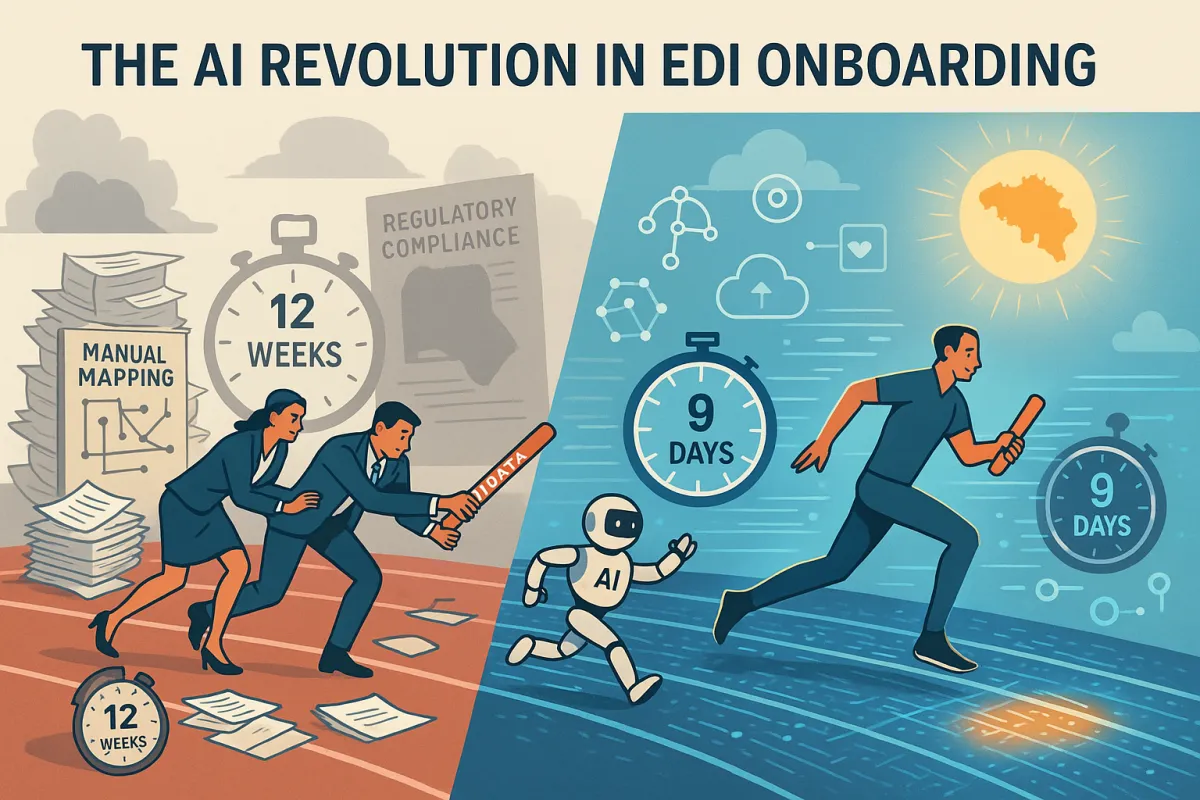
Watch any EDI team scramble to meet onboarding deadlines: three months to get a single partner live while competitors are already exchanging data. Belgium's tolerance period ended March 31, 2026, forcing companies that demonstrated "reasonable and timely steps" into full compliance mode, but this regulatory pressure reveals a deeper operational crisis in B2B integration.
The numbers tell the real story. 45% of integration experts say EDI trading partner onboarding takes between one week and one month, while 42% report more than one month, with timelines increasing over the past two years. Meanwhile, the average trading partner onboarding takes 8-12 weeks using traditional EDI methods. For Belgian companies racing against compliance deadlines, that's potential revenue lost to faster competitors.
The Hidden Cost Crisis Behind Traditional EDI Partner Onboarding
Your sales team closes a major European distributor. Contract signed, everyone celebrates. Then reality hits: Week 1 means exchanging specification documents via email, Week 3 still involves manual data field mapping, Week 5 brings the first round of testing with 12 errors, and Week 8 leaves partners frustrated with zero real transactions processed.
This isn't an outlier. It's standard for traditional EDI systems. 63% of IT decision-makers say EDI onboarding takes too long due to customized trading partner requirements, with 47% reporting slow supplier onboarding prevents capturing new revenue opportunities, and 24% of companies losing $500K or more to supply chain integration issues.
Belgian companies faced additional pressure when mandatory B2B e-invoicing requirements took effect January 1, 2026, applying to all Belgian-established businesses engaging in local B2B transactions. The combination of PEPPOL compliance requirements and traditional EDI onboarding bottlenecks created the perfect storm for operational delays.
Consider the math: most EDI onboarding processes take between two and six weeks depending on trading partner requirements and testing timelines. For companies managing 50+ suppliers, that translates to 12-18 months of continuous onboarding work just to maintain existing partnerships, let alone expand.
Why Belgium's PEPPOL Implementation Reveals Universal EDI Challenges
Belgium requires invoices to follow European EN 16931 standard with Peppol BIS in UBL format as the default, transmitted over the Peppol network already used for B2G invoicing. This structured approach highlighted common validation issues that plague traditional EDI systems worldwide.
The validation challenges become clear when you examine typical error patterns. Starting January 1, 2026, VAT rounding rules applied only to e-invoices, allowing rounding only on total amounts per VAT rate while prohibiting line-by-line rounding. These precise compliance requirements demonstrate how modern regulatory frameworks demand automated validation rather than manual checking.
Companies using traditional EDI providers like IBM Sterling, OpenText, or legacy TrueCommerce setups found themselves struggling with the same issues that make standard partner onboarding take 8-12 weeks. The manual mapping, email coordination, and linear validation cycles that worked for simple document exchanges couldn't handle the real-time validation requirements of PEPPOL BIS compliance.
Modern solutions like Cargoson, alongside Orderful and Stedi, eliminate these bottlenecks through automated mapping and real-time validation. The contrast becomes stark when you see companies onboard new PEPPOL partners in 9 days versus the 12-week standard for traditional EDI trading partner setup.
The Five-Stage AI-Powered Onboarding Framework That Eliminates Manual Bottlenecks
AI can dramatically reduce the time it takes to bring new trading partners into an EDI ecosystem by automating partner profile creation, document format mapping, and validation, cutting weeks of manual setup into hours or days.
The transformation happens through intelligent orchestration. AI-generated mappings integrate with orchestration engines, enabling real-time validation and correction during partner onboarding. Instead of the traditional approach where experienced EDI teams routinely spent seven to ten days per trading partner building and validating mappings, AI systems process specifications and generate working configurations in hours.
For most organizations adopting AI-powered EDI, partner onboarding speed provides immediate impact, shrinking industry average timelines from 4-12 weeks to days because AI handles the heavy lifting that previously consumed analyst time.
The framework breaks down into five interconnected stages that replace sequential manual processes with parallel automated workflows. Each stage builds on AI-driven insights while maintaining human oversight for strategic decisions.
Stage 1: Intelligent Requirements Capture and Document Analysis
Pre-built templates capture every variable including EDI document types (810, 850, 856), communication protocols (AS2, FTP, VAN), expected data flow, security needs, and compliance mandates, ensuring nothing gets lost and partners know exactly what's needed upfront.
AI systems analyze trading partner specifications in multiple formats. Traditional EDI trading partner onboarding takes 6-10 weeks because of manual implementation guide mapping, while AI can read the PDF and generate configuration automatically. This capability transforms how companies handle the most time-consuming part of requirements gathering.
The automation extends to compliance checking. Instead of manually cross-referencing trading partner requirements against regulatory standards like EN 16931 or ANSI X12, AI systems flag potential conflicts during requirements capture. This early detection prevents the cascade of errors that traditionally surface during testing phases.
Stage 2: Automated Mapping Generation and Semantic Field Matching
AI accelerates data mapping by learning from semantic models and automating field matching, reducing setup time and simplifying updates, as data mapping has always been one of the most time-consuming aspects of EDI.
AI-native EDI uses zero-mapping architecture standardizing data into single JSON structure, then dynamically translating to meet individual partner requirements without static rule sets, with self-healing integrations continuously learning from transaction patterns across thousands of connected partners.
The semantic matching capabilities become powerful when dealing with variations in implementation guides. While traditional approaches require custom mapping for each partner variation, AI systems recognize patterns across similar implementations and suggest mappings based on successful configurations. This learning compounds across the partner network.
AI-driven mapping technology builds maps directly from specifications, validates them against network intelligence, and applies reusable document models, reducing timelines from seven to ten days per partner down to two to three days.
Real-Time Validation Systems That Prevent the 90% Post-Implementation Error Rate
Testing cycles that used to stretch across days or weeks now wrap up in hours, with AI-generated test plans systematically covering edge cases that manual testers often miss, leading to fewer surprises in production.
The validation happens at multiple levels. Document-level validation ensures structural compliance with EDI standards. Business-level validation checks logical consistency between related documents. Partner-level validation confirms compliance with specific trading partner requirements. Each validation layer provides immediate feedback instead of waiting for batch processing cycles.
AI agents achieve superior data accuracy rates of approximately 98-99% according to industry benchmarks while reducing exception handling time by 70%. This accuracy improvement comes from continuous learning across transaction patterns rather than static validation rules.
Real-time validation prevents the cascading failures common in traditional EDI implementations. Instead of discovering mapping errors during testing cycles that can add weeks to onboarding timelines, AI systems flag issues during configuration and suggest corrections based on successful patterns from similar implementations.
Building Adaptive Validation Rules for European Compliance Standards
Belgian regulations require structured invoices in EN 16931 format transmitted via the Peppol network, with real-time e-reporting to tax authorities planned for 2028. This requirement demonstrates how modern compliance frameworks demand adaptive validation beyond static rule checking.
AI validation systems adapt to country-specific implementation rules automatically. Companies with existing EDI communication can maintain alternative channels if both parties agree and invoices comply with European standards EN 16.931-1 and CEN/TS 16.931-2, but systems must remain technically capable of handling Peppol BIS invoices regardless.
The adaptive approach handles variations in VAT validation, rounding rules, and CIUS (Core Invoice Usage Specification) requirements across different European implementations. Instead of maintaining separate validation rules for each country, AI systems learn the semantic relationships between compliance requirements and apply them contextually.
Automated rounding rule compliance becomes critical as Belgium enforces VAT rounding only on total amounts per VAT rate, prohibiting line-by-line rounding for e-invoices starting January 1, 2026. AI validation catches these requirements automatically rather than relying on manual checking that often misses country-specific rules.
Implementation Roadmap: From Legacy Manual Processes to AI-Driven Automation
Supply chain leaders can embed autonomous AI agents into EDI workflows to alert, interpret, act on, and optimize data in real time, suggesting a move away from manual troubleshooting toward using AI to free up resources for solving bigger supply chain challenges.
The transformation requires embedding AI capabilities into existing EDI infrastructure without disrupting current operations. Start by identifying the highest-impact automation opportunities: partner onboarding bottlenecks, recurring mapping patterns, and common validation failures. These areas provide immediate ROI while building organizational confidence in AI capabilities.
Phased rollout strategies work better than big-bang implementations. Begin with pilot partners that represent common scenarios rather than edge cases. For complex networks, onboard high-priority or representative partners as pilots before rolling out to the larger group, allowing you to spot issues early and refine your playbook.
Modern platforms like Cargoson, Orderful, and Stedi provide AI-powered capabilities without requiring custom development. Traditional providers like IBM Sterling and OpenText are adding AI features, but their legacy architecture limits the transformation potential compared to cloud-native solutions built for automation.
Modern EDI platforms connect trading partners in 9 days or less through automated validation, standardized configurations, and real-time monitoring using API-first, cloud-native architecture that enables automated partner onboarding.
The 90-Day Transformation Timeline for Mid-Market Companies
The transformation follows a predictable pattern across successful implementations. Days 1-30 focus on platform setup and initial AI training using existing partner data and mapping libraries. Days 31-60 involve pilot partner onboarding using AI-assisted workflows while maintaining parallel manual processes for comparison. Days 61-90 scale the automated approach across the broader partner network.
For most SMBs, a single trading partner should take 2-4 weeks with standard timelines, faster if prebuilt maps exist. AI automation compresses this timeline further by eliminating the manual mapping and testing cycles that consume most onboarding time.
Success metrics should track both speed and quality improvements. Measure onboarding time reduction, error rates during testing, post-implementation validation failures, and partner satisfaction scores. The combination of faster onboarding with higher accuracy demonstrates AI's compound value.
When manufacturers shift from custom emails and disjointed tracking to robust templates and live dashboards, onboarding times drop dramatically, with many customers seeing onboarding times slashed by 50% or more once these best practices were in place.
The 90-day timeline assumes commitment to change management and training. While technology is important, people make onboarding successful, with dashboards and automation helping only if someone guides you through them, requiring a human project manager you can call rather than just an AI chatbot.
Companies achieve dramatic improvements: Owlet went live with their first connection in two weeks, Society6 cut onboarding time by 75%, and Liquid Death achieved go-live times that were 400% faster without managing custom configurations. These results demonstrate what becomes possible when AI automation eliminates traditional EDI onboarding bottlenecks.
The transformation from 12-week partner onboarding to 9-day automated workflows isn't just about speed. It's about building the operational agility needed to compete in markets where regulatory compliance, partner expectations, and business opportunities move faster than traditional EDI infrastructure can support. Companies that embrace AI-powered onboarding now position themselves to capture opportunities while competitors struggle with legacy limitations.