The AI-Powered EDI Trading Partner Onboarding Revolution: How Intelligent Automation Cuts Setup Time from Months to Days While Eliminating the $500K Revenue Loss Crisis in 2025

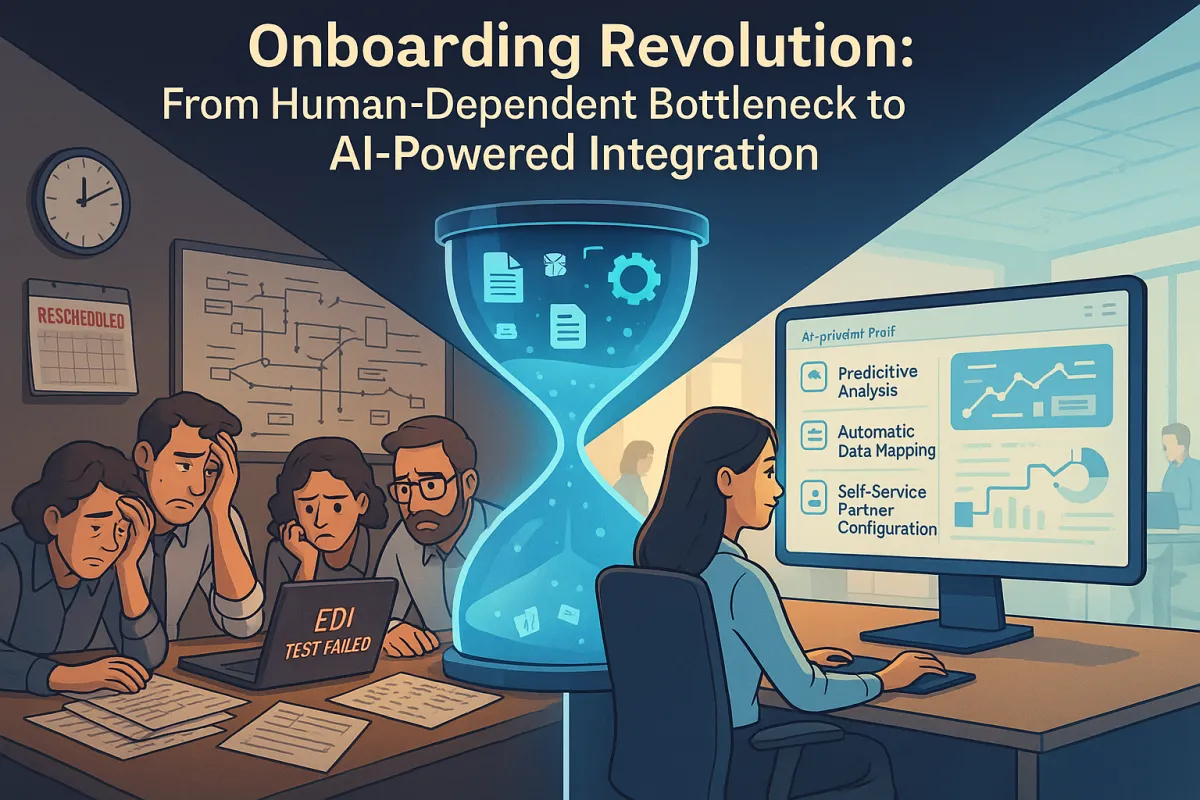
Nearly two-thirds (63%) of IT decision-makers say the EDI onboarding process takes too long because of all the different customized requirements demanded by trading partners. Up to 47% of IT managers say that slow EDI supplier onboarding is currently keeping their businesses from capturing new revenue opportunities. The problem runs deeper than mere inconvenience. Research by Ovum indicates that approximately 40% of enterprises require over 30 days to onboard a new trading partner, while EDI performance bottlenecks cost companies an average of $62,000 per day in delayed shipments and processing errors.
The math becomes stark when you calculate the real impact. A company losing $500,000 in blocked revenue over six months because they can't onboard new trading partners fast enough faces a choice: invest in modern AI-powered automation or watch competitors capture those opportunities instead. Most companies have come to accept 8-10 week EDI onboarding times, but this acceptance is costing them millions.
For supply chain IT directors managing 100+ suppliers, the traditional onboarding process creates a constant bottleneck. In theory, it should take 1-2 weeks to onboard a new EDI customer. However, in practice, it can take 1-2 months or even longer. Meanwhile, your sales team closes deals that can't be fulfilled because the integration pipeline is backed up for months.
The Human-Dependent Bottleneck: Why Traditional EDI Onboarding Fails
EDI onboarding is driven by humans, which includes back and forth feedback loops that aren't in real time. This results in wasted time and delays. Every step requires manual configuration, from data mapping to testing validation, creating a house of cards where one delayed email can push timelines out by weeks.
The complexity multiplies when each trading partner demands their own flavor of supposedly "standard" EDI formats. Despite EDI being a standard protocol, trading partners often have their very own flavor of EDI transaction sets. A standard EDI purchase order varies from one trading partner and industry to another. Your team spends more time deciphering partner-specific requirements than actually implementing connections.
Testing becomes a coordination nightmare. EDI testing requires both partners to collaborate in the same time frame, but when partners are located across different time zones with varying priorities, simple test cycles can drag on for weeks. One missing field validation or incorrect character encoding sends you back to square one.
Data mapping is a critical part of EDI onboarding, as different systems use varying data formats. If these discrepancies aren't mapped correctly, it can lead to costly errors like incorrect inventory or delayed shipments, affecting business operations and customer satisfaction. The manual nature of this process means errors are inevitable, and finding them often happens after they've already caused problems in production.
How AI-Powered EDI Trading Partner Onboarding Transforms the Process
AI‑driven EDI is no longer an experimental feature; it's an essential technology in 2025 for businesses aiming to stay competitive. The combination of machine learning, structured data, secure platforms and experienced consultants gives companies the edge they need. Instead of waiting months for manual configurations, AI systems can analyze partner specifications and generate working connections in days.
Pattern recognition changes everything. While traditional mapping requires manual configuration for each new partner, AI uses machine learning to recognize patterns in data structures, reducing onboarding time, and minimizing errors. When your AI system encounters a new partner specification that's 80% similar to a previous successful configuration, it can automatically generate the base mapping and flag only the differences for human review.
Machine learning tackles the testing bottleneck by predicting integration issues before they surface. AI proactively scans transaction histories to identify anomalies, preventing costly disruptions before they occur. Instead of discovering problems during testing, the system identifies potential mismatches in data structures, missing required fields, or format incompatibilities during the initial setup phase.
AI-driven data mapping will simplify integration by adapting to different formats automatically, reducing manual effort and improving accuracy. Modern AI systems can parse partner documentation, extract requirements, and generate test scenarios automatically. Companies report data accuracy rates of approximately 98-99% and exception handling time reduced by 70% when implementing AI-powered EDI automation.
Self-Service Onboarding Portals: Letting Partners Configure Themselves
The most advanced AI-powered EDI platforms now include self-service portals that flip the traditional onboarding model entirely. Instead of your team manually configuring each partner connection, partners can use guided workflows to set up their own integrations using pre-built templates and automated validation.
Deploy self-service onboarding portals that allow partners to configure basic connection parameters themselves. These portals leverage AI to guide partners through setup processes, automatically detecting their system capabilities and suggesting optimal configuration options. Partners answer business-focused questions ("What ERP system do you use?" "Which document types do you need?") while the AI handles the technical translation behind the scenes.
Pre-built connector libraries eliminate the custom development bottleneck. Leading platforms like Cleo, Boomi, and Cargoson maintain databases of thousands of pre-configured templates for common ERP systems, trading partner formats, and industry-specific requirements. Cleo's network includes thousands of pre-connected trading partners. And if you don't see your trading partner listed, Cleo can onboard any specified trading partner in a matter of days.
Automated validation prevents the endless test-fix-retest cycles that plague traditional onboarding. AI systems can simulate transactions, validate data mappings, and identify potential issues before partners even submit their configurations. This means partners know immediately if their setup will work, rather than discovering problems weeks into the testing process.
The Complete AI-Powered Onboarding Architecture
Modern AI-powered EDI platforms operate on cloud-native architectures designed for horizontal scaling and rapid deployment. Unlike legacy systems that require extensive customization for each partner connection, these platforms use containerized services that can be instantiated and configured automatically based on partner requirements.
The integration layer connects seamlessly with major ERP systems including SAP S/4HANA, Oracle, NetSuite, and Microsoft Dynamics through both EDI standards and modern APIs. Cleo simplifies EDI integration with nearly all major ERPs, including SAP, Oracle, NetSuite, Acumatica, Microsoft Dynamics, and Sage, through APIs and prebuilt connectors. This hybrid approach allows companies to modernize their EDI infrastructure while maintaining existing trading partner relationships.
AI-powered monitoring provides proactive issue resolution that eliminates the after-hours crisis calls that plague traditional EDI operations. AI-driven EDI solution instantly identifies and corrects partner errors in real time, preventing costly order delays and revenue loss. Get clear, actionable insights and automated resolution paths within seconds. The system doesn't just alert you to problems—it provides specific remediation steps and can often resolve issues automatically.
Document processing leverages OCR and natural language processing to handle unstructured data inputs. In legacy EDI, preparing unstructured data from invoices, purchase orders, and emails is slow and error-prone. AI can leverage OCR-powered processing to help extract, categorize, and format information for EDI transmission. This means partners who can't generate perfect EDI formats can still integrate effectively through email attachments or PDF uploads.
ROI Analysis: The Business Impact Numbers That Matter
The financial impact of AI-powered onboarding becomes clear when you run the numbers against current bottlenecks. 47% of IT managers identified slow EDI supplier onboarding as blocking new revenue opportunities, while consolidation reduces new trading partner setup from months to just 5 days.
Time savings translate directly to revenue acceleration. A typical implementation reduces onboarding time from 30-90 days to 5-7 days on average. For a company that signs 24 new partners per year, this means recovering 60-80% of previously lost time-to-revenue. If each partner generates $50,000 in monthly revenue once active, the acceleration alone justifies the AI investment.
Companies achieve up to 70% cost savings through volume-based contracts and the elimination of duplicate fees across multiple providers. The cost reduction comes from eliminating manual labor, reducing testing cycles, and preventing the expensive remediation work that comes from production errors.
Resource optimization allows IT staff to focus on strategic initiatives rather than tactical firefighting. AI reduces manual tasks by using machine learning to classify documents, ensure data accuracy, convert data formats, resolve errors, and optimize processes. Teams report being able to reassign 2-3 full-time employees from EDI maintenance to higher-value projects after implementing AI automation.
Error reduction prevents the hidden costs that rarely appear on traditional ROI calculations. 99% data accuracy rates, 70% reduction in exception handling time, and onboarding cycles measured in days instead of months mean fewer chargebacks, faster dispute resolution, and improved partner relationships that lead to expanded business opportunities.
Choosing Your AI-Powered EDI Platform: Practical Implementation Guidance
When evaluating AI-powered EDI solutions, look for platforms that offer both immediate automation benefits and long-term scalability. Leading providers include Cleo with their AI-powered network approach, Boomi's iPaaS-integrated EDI platform, and emerging players like Cargoson that focus specifically on transport and logistics integrations.
Fast Onboarding: We guarantee onboarding new trading partners in a few business days, backed by structured and automated mapping and testing. Look for providers that offer specific onboarding time guarantees rather than vague promises of "faster" setup times.
Hybrid EDI-API support is essential for future-proofing your investment. While EDI onboarding typically takes months before data can be exchanged between parties, AI agents enable "Day 1" readiness to send and receive information with suppliers and carriers. Modern platforms should support both traditional EDI standards and contemporary API integrations within the same workflow.
Testing and certification automation prevents the coordination bottlenecks that delay traditional onboarding. Cleo automates supplier testing and certification, validating partner documents and managing the full testing workflow to ensure compliance before go-live. The platform should handle test scenario generation, execution, and validation without requiring manual coordination between multiple parties.
Consider the total cost of ownership beyond software licensing fees. TCO often involves integration costs, onboarding delays, ongoing support, internal resource strain, and even opportunity costs. AI-powered platforms typically require higher upfront investments but deliver lower operational costs through reduced manual intervention and faster onboarding cycles.
Future-Proofing Your EDI Strategy: What's Coming Next
Fully Autonomous Workflows — From partner onboarding to invoicing, AI will handle transactions end-to-end. The next evolution includes predictive partner onboarding based on industry patterns, where the system proactively suggests optimal configurations before partners even request integration.
Blockchain integration is emerging for immutable audit trails and enhanced security. Blockchain offers a transparent and tamper-proof ledger for transactions, bolstering trust among trading partners. Blockchain is a decentralized, distributed ledger technology that records transactions across multiple computers, providing the foundation for automated compliance reporting and dispute resolution.
Advanced AI agents will handle autonomous error resolution without human intervention. These AI agents can automatically perform tasks like creating shipment records based on supplier ASNs by capturing shipment, carrier details into their TMS or auditing freight invoices by extracting data directly from the documents, expanding beyond simple data mapping to complete transaction orchestration.
Integration with emerging technologies like IoT sensors and 5G networks will enable real-time supply chain visibility that goes beyond document exchange. In 2025, Electronic Data Interchange (EDI) is no longer just a tool for exchanging documents—it's a foundational enabler of enterprise automation and artificial intelligence. EDI acts as the digital nervous system of modern enterprises—feeding the intelligence layer that powers automation, agility, and innovation.
Companies implementing AI-powered EDI onboarding now position themselves to capitalize on these emerging capabilities without requiring platform migrations. The investment in intelligent automation pays dividends immediately through faster partner onboarding and reduced operational overhead, while building the foundation for next-generation supply chain orchestration capabilities.
The choice isn't whether to modernize your EDI onboarding process—it's whether to lead the transformation or follow competitors who have already made the jump to AI-powered automation.