The Citizen Developer Solution: How No-Code EDI Platforms Are Solving the $8.4 Trillion Skills Crisis in Supply Chain Integration

Many of the professionals who initially implemented and managed EDI systems are now reaching retirement age, creating a talent vacuum that's hitting supply chains worldwide. EDI professionals are in high demand but there is a limited supply. Meanwhile, by 2030, you may find yourselves among leaders facing a daunting talent shortage of 85.2 million workers, exceeding the entire population of Germany. This gap could result in an astonishing $8.452 trillion in unrealized annual revenues by 2030.
The timing couldn't be worse. As more businesses seek to automate their processes, improve efficiency, and enhance their data-driven decision-making, the need for EDI expertise has surged. The recent global supply chain disruptions have only highlighted the importance of robust and scalable EDI solutions, further increasing the demand for trained professionals.
When Traditional Training Models Hit a Wall
Here's the problem most EDI managers won't admit: Most EDI professionals learn on the job, picking up knowledge as they go, which makes it difficult to scale expertise across the industry. Without targeted training and certification programs, companies are left to rely on a dwindling pool of experienced professionals or invest heavily in training new hires.
The numbers get worse when you look at integration resources. As many as 29% of businesses say that they lack the skilled resources to build and manage integrations between systems, applications, and partner ecosystems. A lack of cloud skills cost businesses up to $258 million annually, according to the London School of Economics.
Traditional EDI implementations can take 6-12 months for partner onboarding. That's time most companies don't have in today's fast-moving markets. The old model of hiring experienced professionals and training newcomers internally simply can't keep pace with demand.
The Citizen Developer Revolution
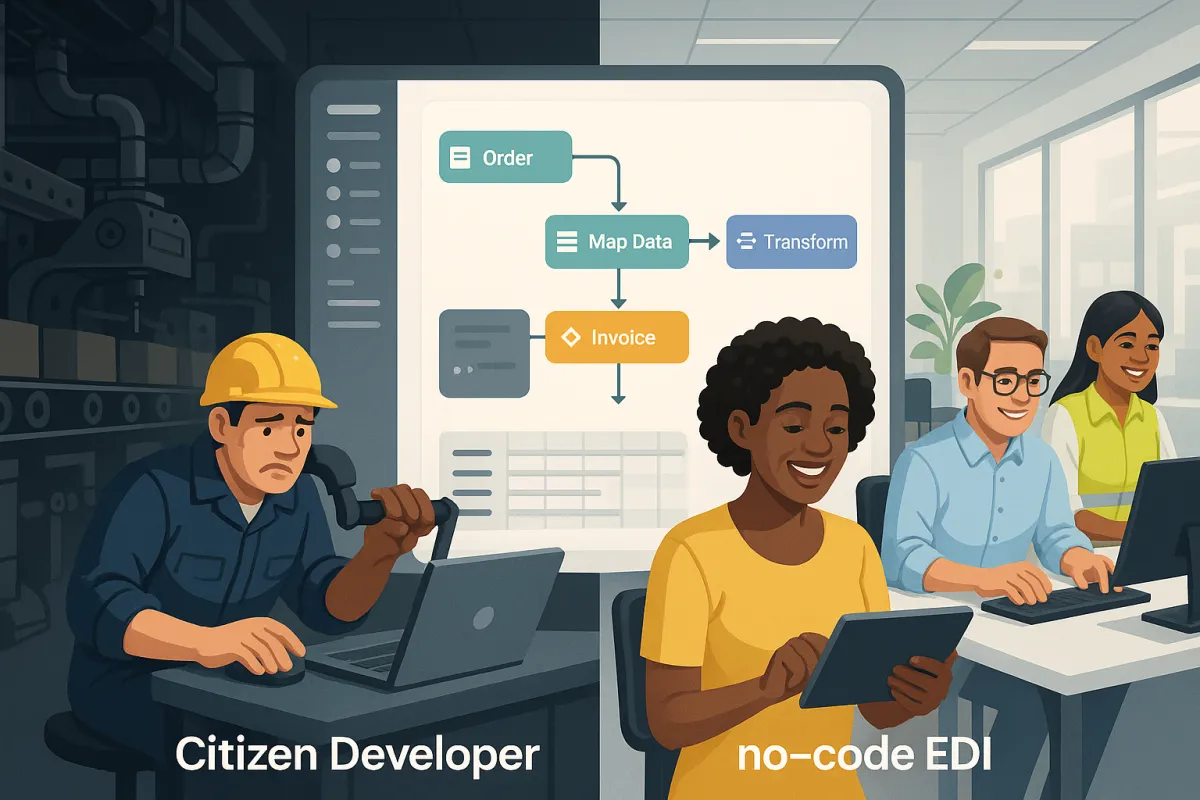
Enter citizen development - a concept that's transforming how organizations approach software creation. Citizen developer definition, according to Gartner, is a user who creates new business applications for the consumption by others, using development and runtime environments sanctioned by the corporate IT.
The growth is staggering. By 2024, non-IT professionals will create 80% of IT products and services. Actually, 41% of non-IT employees are already building or customizing technology solutions. According to Gartner's research, "by 2024, low-code application development will be responsible for more than 65 percent of application development activity".
The economics make sense. With developers in big software companies charging a minimum of $200 per hour, the cost of traditional developers is high and resource-draining.
No-Code EDI Integration: Finally, A Solution That Scales
Modern no-code EDI platforms are changing the fundamental economics of supply chain integration. Take Cleo's latest platform updates: Bring on any new trading partner 10x faster by leveraging no-code onboarding and the Cleo Network's pre-built EDI integrations to automate direct integrations into your back-office application.
CIC 2024 brings an accelerated, no-code onboarding experience, so companies can now easily and quickly onboard trading partners and begin testing and validating EDI transactions within minutes. Compare this to traditional 6-12 month implementations and the difference is clear.
Other platforms are following suit. Gartner has predicted that "by 2024, three-quarters of large enterprises will be using at least four low-code development tools for both IT application development and citizen development initiatives". 84% of businesses use low-code/no-code platforms to reduce the strain on IT.
Companies using no-code EDI platforms are seeing real results. Duraflame chose Cleo to help mitigate any risks that peak season brings to their B2B integration strategy. They're now spending less time resolving EDI issues and more time focusing on onboarding new business.
For organizations looking for comprehensive integration solutions, platforms like Cargoson offer TMS capabilities that work seamlessly with no-code EDI platforms, creating end-to-end supply chain visibility without requiring specialized EDI expertise.
Building Your Citizen Developer EDI Program
The key isn't replacing IT departments but empowering business users who understand the actual processes. The business users know their domain better than anyone else and working collaboratively will ensure that the right processes and technology are in place. Citizen developers have front-line knowledge of various business units and are aware of potential process improvements.
Start with your procurement, logistics, and customer service teams. These are the people who deal with EDI transaction failures daily. They understand what needs to work. Citizen development initiatives like contact management and data integration may support key groups such as the IT help desk, HR, and accounts management.
Here's what works: Set up a Center of Excellence (COE) that pairs business domain experts with IT oversight. Low-code and no-code platforms have also fostered greater collaboration between internal departments. This has become a way of bringing the business side into the development process so that the final outcome reflects the business's specific goals.
Focus on governance early. Citizen development requires new tools and processes to ensure the delivery of high-quality, secure software applications that are maintainable, extensible, and secure. The key enabling factors of citizen development are modern low-code application platforms (LCAPs) and the involvement of skilled software professionals throughout the process.
AI-Powered EDI: The Next Evolution
The future goes beyond just no-code platforms. AI is starting to transform EDI integration in ways that address the skills shortage head-on. AI can help to automate and streamline EDI-based processes in several ways, including: Automating data entry and conversion: AI can be used to automate the entry and conversion of EDI data into different formats, which can save time and reduce errors. Improving data quality: AI can be used to identify and correct errors in EDI data, which can help to improve the accuracy of B2B transactions.
Smart platforms are beginning to offer natural language interfaces where users can describe what they want to happen, and the system builds the integration. This removes even more barriers for citizen developers who understand the business process but don't want to deal with technical mapping.
The combination of no-code platforms, AI assistance, and citizen development creates a sustainable path forward. Businesses adopting citizen developers are addressing the challenges of talent shortage head-on; By allowing business users to build the solutions that solve their immediate problems.
Getting Started Before the Crisis Hits
Additionally, newer technologies such as APIs and blockchain are becoming more prevalent in supply chain management, leading to concerns that EDI will eventually be phased out or replaced. This perception may discourage younger professionals from pursuing careers in EDI, further contributing to the shortage. But despite forecasts of EDI technology dying out in the future, it is not only here to stay but is expected to continue expanding. Globally, the EDI (electronic data interchange) market is projected to reach $49.21 billion by 2027.
The smart move? Start building your citizen developer EDI capability now, before the talent crunch forces your hand. Look for platforms that offer:
- True no-code onboarding that takes minutes, not months
- Pre-built integrations with major retailers and logistics providers
- AI-powered error detection and resolution
- Business user-friendly interfaces that don't require technical training
- Governance controls that keep IT comfortable
The EDI skills shortage isn't going away. An extensive new Korn Ferry report finds that by 2030, more than 85 million jobs could go unfilled because there aren't enough skilled people to take them. But with no-code EDI integration and citizen development, you don't have to wait for the next generation of EDI experts to be trained. Your business users can become the integration experts your supply chain needs - starting today.