The Complete Composable EDI Architecture Evaluation Framework: How to Select TMS Vendors with Future-Proof Integration Capabilities That Survive Vendor Consolidation and Platform Changes in 2026

WiseTech's acquisition of e2open for $3.30 per share in cash equating to an enterprise value of $2.1 billion marks the largest TMS industry acquisition to date, while Descartes Systems Group has acquired Columbus, Ohio-based 3Gtms for $115 million USD in cash, reshaping vendor options for European buyers. If you're selecting a TMS platform in 2026, this consolidation wave creates more than just fewer choices. It fundamentally changes how you evaluate vendors and architect your integrations.
The companies surviving this consolidation are the ones who built for flexibility from day one. Budget overruns hit 75% of European TMS implementations, and 66% of technology projects end in partial or total failure. Notice the pattern? Organizations that rely on monolithic, vendor-locked EDI connections become casualties when platforms merge or change direction.
Composable EDI architecture offers a different path. Instead of betting everything on a single vendor's vision, you assemble integration capabilities from modular components that can survive platform changes, ownership transfers, and technology shifts.
Understanding Composable EDI Architecture in TMS Selection
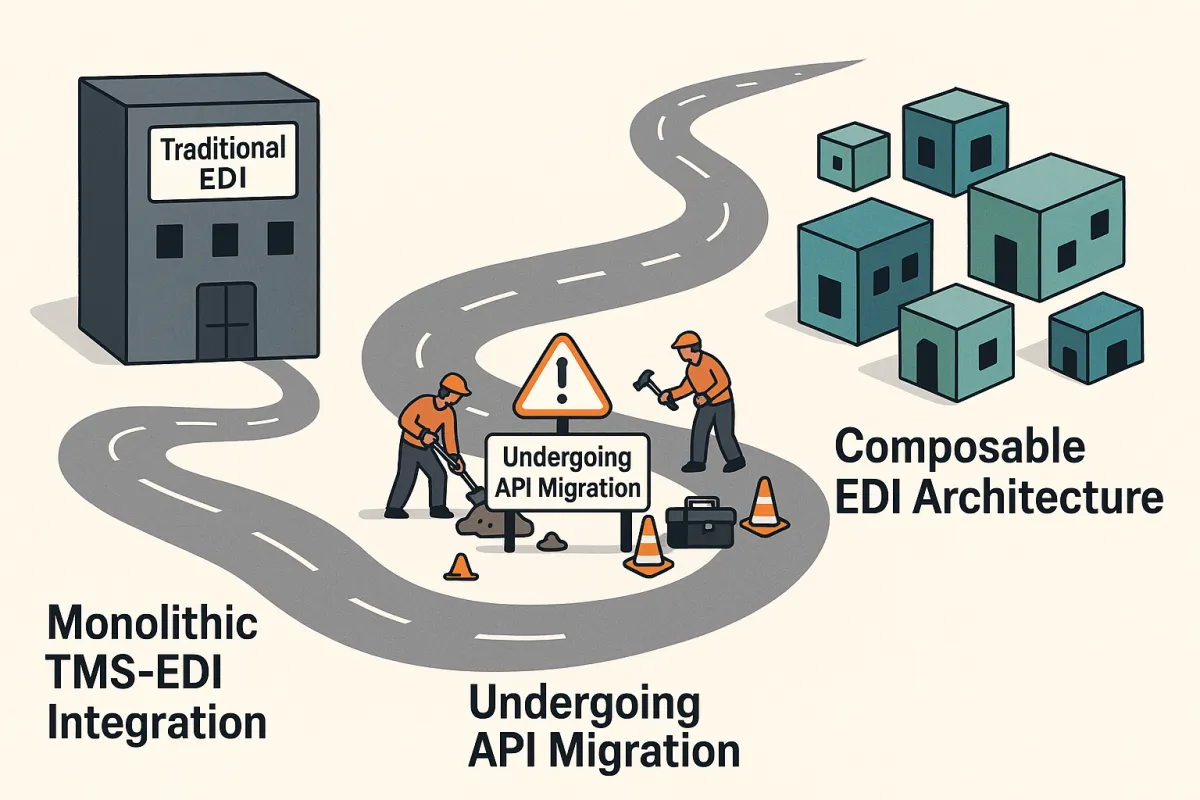
Traditional EDI systems were often built as monolithic platforms—rigid, tightly coupled, and difficult to modify. The future lies in Composable EDI: a modular approach where components can be independently deployed, replaced, or upgraded without impacting the entire system.
Think of it this way: your current TMS probably handles EDI as a black box. Purchase orders go in, acknowledgments come out, and you pray nothing breaks when the vendor releases updates. Composable architecture emerges as the answer—a paradigm that treats every business capability as a replaceable component that can be assembled, reassembled, and upgraded without disrupting the entire system.
Established vendors are already implementing these principles. Platforms like Cargoson, Manhattan Active, MercuryGate, and Descartes each bring different approaches to ICS2 compliance, but European-native solutions often provide better understanding of cross-border complexity and multi-country regulatory variations. The difference? Some build composable architectures that allow component replacement, while others maintain monolithic structures that create vendor lock-in scenarios.
While microservices break applications into independent services, composable architecture extends this concept by ensuring that all components can be dynamically combined to suit different business needs. For TMS selection, this means your EDI processing, carrier connectivity, and compliance reporting can evolve independently without requiring complete system replacement.
The Hidden Risks of Monolithic TMS-EDI Integration
A German automotive parts manufacturer discovered their €800,000 TMS implementation mistake the hard way. Six months into deployment, they realized their new system couldn't handle their complex carrier network across 12 European countries. Sound familiar?
The failure wasn't random. Their procurement team evaluated feature checklists instead of architectural flexibility. When carrier integration requirements changed post-implementation, the monolithic platform couldn't adapt without expensive customizations. Companies undergoing integration often experience 12-18 months of reduced innovation while they harmonize platforms and teams. When vendor acquisitions happen mid-implementation, your project timeline extends while support resources get redistributed.
Monolithic EDI integration creates three specific failure modes:
First, vendor roadmap dependency. Your feature requests get deprioritized when vendors focus on internal platform consolidation. When two TMS platforms merge, customers inevitably face decisions about which system to standardize on, what features will be deprecated, and how long dual support will continue.
Second, upgrade brittleness. Platform changes break rigid EDI connections because monolithic systems couple transport management logic with integration protocols. A simple carrier API update can cascade into weeks of system downtime.
Third, compliance inflexibility. Start of application of the new version (v3) of ICS2 messages on 3 February 2026, and decommissioning of older version (v2) means your integration must handle messaging format updates automatically - not through manual system adjustments. Monolithic platforms require complete testing cycles for regulatory changes, while composable architectures isolate compliance modules for independent updates.
Core Evaluation Criteria for Composable EDI Capabilities
API-first architecture requirements protect against platform changes by ensuring your integrations don't depend on proprietary connections that may be deprecated during vendor consolidations. API-led connectivity is a multi-layered approach that scales IT capacity through its emphasis on modular components, decentralized authority over application development, and reusable assets. It is a fundamental shift in the IT operating model and promotes decentralized access to data and capabilities while retaining security.
When evaluating TMS vendors, demand specific documentation showing how EDI components can be deployed independently. At its core, a composable architecture breaks a monolithic data stack into interchangeable, plug-and-play components: data ingestion, storage, transformation, orchestration, and analytics. Instead of relying on one rigid system, composable frameworks allow enterprises to swap or scale individual modules without re-engineering the entire infrastructure.
Look for platforms demonstrating these composable principles: This includes established platforms like MercuryGate, Descartes, E2open, Manhattan Active, Oracle TM, and SAP TM alongside European specialists like Alpega, nShift, Transporeon, and modern alternatives including Cargoson that focus specifically on European cross-border operations. Each approaches modularity differently, but the critical test is whether you can upgrade EDI processing logic without affecting carrier management or compliance reporting.
Technical Assessment Framework
Microservices decompose applications into independently deployable units, each responsible for a single business capability. Unlike monolithic services that bundle multiple functions together, microservices allow teams to update billing logic without touching inventory management, or modify recommendation algorithms without redeploying the entire application.
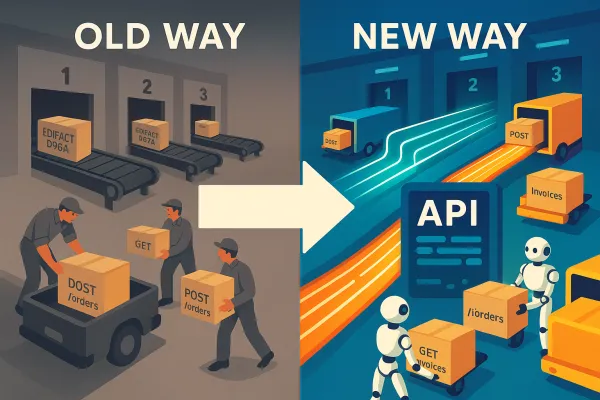
Your technical evaluation should focus on four architectural layers: microservices decomposition, where EDI translation, carrier connectivity, and compliance validation operate as separate services; container orchestration capabilities that allow independent component scaling during peak processing periods; EDI-to-API translation layers that abstract legacy protocols from modern integration patterns; and real-time versus batch processing flexibility that supports both immediate status updates and bulk document exchanges.
For existing B2B/EDI interfaces, organizations can use a microservices-based approach to reuse processing logic between trading partners (e.g. common message validation or message enrichment processing logic to avoid duplication of effort and decrease the time it takes to onboard new partners). This reusability becomes crucial when managing multiple carrier connections across European markets with varying technical capabilities.
Vendor Stability Assessment in the Consolidation Era
Financial health indicators become critical evaluation criteria in a consolidating market. While WiseTech has demonstrated consistent profitability and growth, e2open has struggled with financial performance in recent years, reporting declining revenue and net losses in recent fiscal years.
Due diligence now requires analyzing acquisition likelihood alongside feature comparison. Philip Damas, managing director and head of Drewry Supply Chain Advisors, noted how e2open acquired INTTRA and Amber Road in recent years but could not turn its acquisitions into a profitable integrated business... It will be interesting to see if it can turn the former e2open business around and integrate it into its software offerings.
Your vendor evaluation framework must address post-acquisition scenarios directly. Acquisition-resistant contracts require specific protections including 12-18 months advance notice for ownership changes, guaranteed functionality preservation for minimum periods, and migration assistance rights.
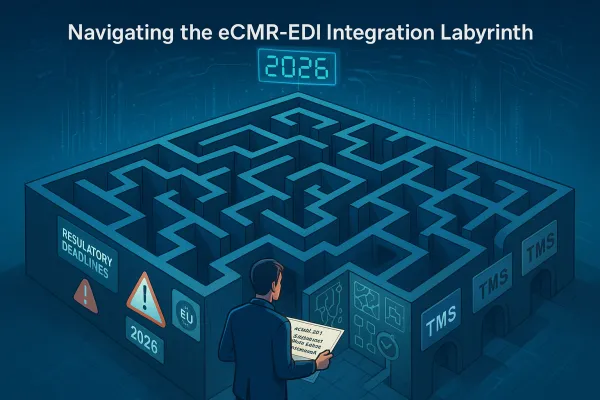
European compliance becomes a litmus test for vendor commitment. As of January 2026, eFTI platforms and service providers can start preparing for operations while Member States authorities may start accepting data stored on certified eFTI platforms for inspection, creating the first practical deadline for TMS platforms to demonstrate compliance capabilities. By July 2027, all Member States will be required to accept electronic transport data via eFTI-certified platforms, making 2026 the critical preparation year.
Vendors demonstrating integrated CBAM compliance and eFTI readiness reveal their commitment to European markets. Solutions from Cargoson, SAP, and Oracle that address these requirements comprehensively indicate vendor stability during the regulatory transition ahead.
Implementation Strategy for Composable EDI Architecture
Phased implementation strategies protect against vendor disruption by establishing core functionality first, then adding compliance modules and specialized features in subsequent phases. This approach allows platform changes or vendor consolidation to be addressed without complete system replacement.
Start with carrier connectivity in Q2 2026, focusing on your top 20% of freight volume. Start with core functionality in Q2-Q3 2025, activate AI features in Q4 2025, and ensure eFTI compliance by Q1 2026. TMS implementation usually takes 1-2 months for smaller shippers and 3-6 months for larger, more complex networks. Build EDI translation layers as independent services that can be replaced or upgraded without affecting transport management logic.
Testing frameworks for modular components prevent the cascade failures that plague monolithic deployments. Create separate test environments for EDI processing, carrier integration, and compliance validation. A basic domestic shipper requires 10-15 integrations minimum, potentially totaling 1,000-1,500 hours of labor. For shippers with freight spend exceeding $250M annually, implementation can cost 2-3 times the subscription fee.
Change management for existing EDI workflows requires acknowledging that your teams are comfortable with current processes, even when they're inefficient. Introduce composable components gradually, allowing parallel operation with legacy systems during transition periods. Document rollback procedures for each module to maintain operational confidence.
Cost-Benefit Analysis Framework
Cloud TMS pricing ranges from $1.00 to $4.00 per freight load booked in the system, while licensed options demand significant upfront investment plus ongoing maintenance fees... For many European shippers, this translates to predictable monthly costs that scale with business growth rather than fixed infrastructure investments.
The license is typically only about 20–25% of total cost; the rest hides in integration, add-on modules, and disruption. Plan for 8–12 months to implement properly. Plan for 15-20% budget increases in 2026-2027 if reactive, or 8-12% if proactive with proper contract protection.
Long-term TCO calculation for composable versus monolithic architectures reveals where flexibility pays off. Because each module scales independently, composable ecosystems lower the total cost of ownership by as much as 37% (IDC, 2025). The savings compound over time as regulatory changes, vendor updates, and business expansions require less system disruption.
ROI metrics for architectural flexibility include reduced downtime during platform changes, faster onboarding of new carriers, and decreased dependency on vendor-specific customizations. Composable architectures enable enterprises to plug in new analytics or visualization tools instantly, reducing innovation lead time by up to 50%.
Hidden costs of vendor consolidation scenarios multiply when your architecture can't adapt independently. Budget for potential data migration, contract renegotiation, and feature replacement that becomes necessary when platform consolidation forces system changes.
Future-Proofing Your TMS Integration Investment
From July 1, 2026, vans weighing 2.5-3.5 tons performing international transport of goods will be subject to the obligation to use second-generation smart tachographs (G2V2). Simultaneously, as of 1 January 2026, the transitional phase of the Carbon Border Adjustment Mechanism (CBAM) has ended and the definitive phase has begun with importers now subject to full financial obligations under the scheme.
Regulatory compliance preparation demands architecture that can adapt to changing requirements without system replacement. Modern EDI systems can track and validate granular supply chain data, such as carbon footprints or ethical sourcing certifications, within transaction metadata. Composable platforms isolate compliance processing from core transport management, enabling regulatory updates without operational disruption.
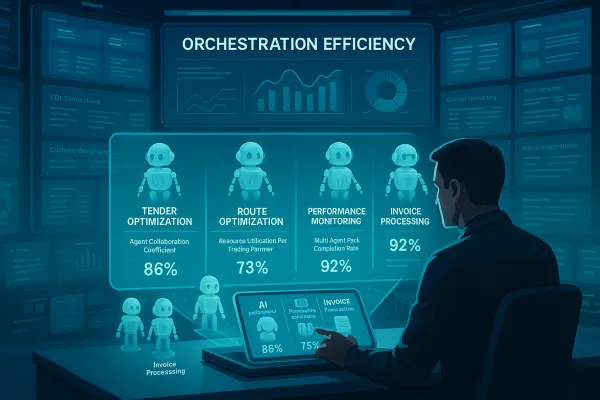
Emerging integration patterns point toward AI-powered mapping and real-time orchestration becoming standard capabilities. One of the most defining trends shaping the EDI software market in 2026 is the convergence of cloud-native architecture, artificial intelligence, and API-led integration. Traditional EDI systems, which relied heavily on manual mapping and rigid infrastructure, are being replaced or enhanced by platforms that leverage AI-driven automation and low-code environments.
In 2026, enterprises are not choosing between EDI and APIs; instead, they are combining both to create flexible, scalable integration frameworks. Leading platforms that demonstrate composable principles include Manhattan Active and Blue Yonder alongside Cargoson, each approaching modularity with different strengths in European cross-border operations.
Your evaluation timeline for 2026 procurement needs to account for both regulatory deadlines and vendor consolidation pressures. The procurement window for securing optimal TMS platforms before vendor consolidation eliminates choices and capacity shortages worsen cost structures runs through Q1 2026.
Start your composable EDI architecture evaluation now. The vendors with flexible, modular approaches are positioning themselves to survive consolidation and regulatory changes. Those still building monolithic platforms are becoming acquisition targets or market casualties.
Your transport management investment determines whether vendor consolidation becomes a competitive advantage or an expensive operational disruption. Choose composability, and you'll adapt to whatever changes 2026 brings.