The Complete Enterprise EDI Total Cost of Ownership Framework: How to Calculate True Implementation Costs and Avoid Hidden Expenses That Inflate Budgets by 300% in 2025

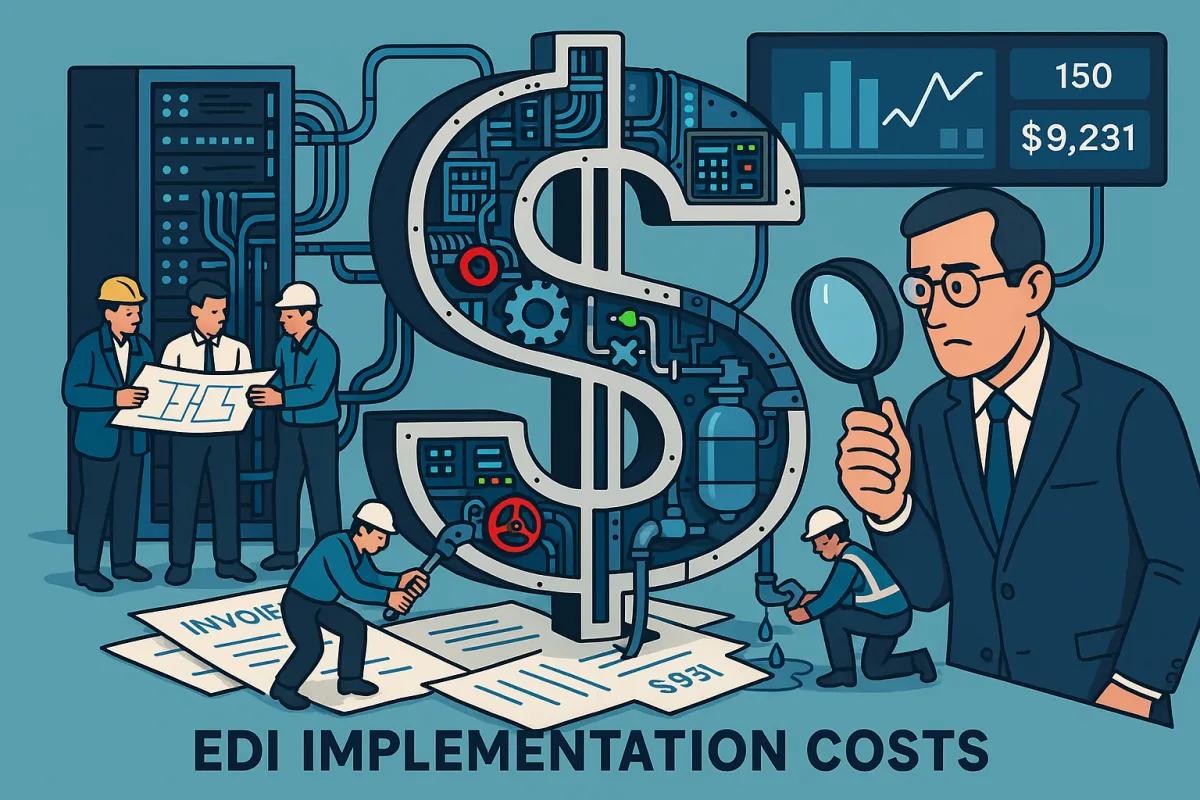
Your enterprise EDI project budget just went from $150,000 to $450,000. Sound familiar? You're experiencing what mid-market companies regularly face when the annualized EDI TCO comes to $40,000, much more than the sticker price of the software alone. The reality? Most organizations systematically underestimate their enterprise EDI implementation costs by 200-400%, creating budget crises that derail digital transformation initiatives.
This comprehensive enterprise EDI total cost of ownership framework reveals every hidden expense category that catches CFOs off guard and provides actionable calculation methodologies to accurately forecast true implementation costs. You'll learn how to identify the indirect costs that can double your actual costs and build financial models that prevent budget overruns.
The Hidden Crisis in EDI Cost Estimation
Finance teams consistently miss the mark on EDI budget forecasting. The total cost of owning an EDI system often exceeds that initial quote. From onboarding delays to maintenance headaches, the financial impact of EDI shows up more often than most teams anticipate. Organizations focus on software licensing fees and setup costs while completely overlooking the operational expenses that accumulate month after month.
The problem becomes acute when you examine real-world cost structures. Small businesses using basic web EDI portals might pay $200 to $500 per month, while mid-sized companies with moderate transaction volumes typically spend $1,000 to $5,000 monthly. Enterprise implementations with hundreds of trading partners and high volumes can range from $10,000 to $50,000+ annually. However, these published rates represent only the baseline investment.
Legacy systems often add hidden fees for mapping, VAN mailboxes, per-document charges, and support that can double your actual costs. Organizations discover these additional expenses after contracts are signed, when quarterly bills arrive with charges for data mapping updates, compliance failures, or technical support incidents.
Modern platforms like Cargoson TMS integration solutions, Orderful, and SPS Commerce are positioning themselves as alternatives to traditional VANs with transparent pricing models, but the underlying challenge remains: calculating accurate enterprise EDI total cost of ownership requires a comprehensive framework.
Understanding the Three Pillars of EDI TCO
A reliable framework combines direct costs, indirect costs, and opportunity costs into a single view. A simple calculation to calculate TCO reads like this: EDI TCO = (Direct Costs + Indirect Costs + Opportunity Costs) ÷ Time Period.
This EDI TCO framework provides the foundation for accurate financial planning. Each pillar captures different expense categories that impact your budget in distinct ways. Direct costs appear on invoices and purchase orders. Indirect costs consume internal resources without clear attribution to EDI line items. Opportunity costs represent revenue impact from delayed partner onboarding or competitive disadvantages.
Direct Costs: The Visible Expense Categories
Direct EDI implementation costs include the obvious budget line items that appear in vendor quotes and monthly statements. The primary cost components of implementing EDI include software licensing fees, setup and integration costs, VAN (Value Added Network) fees for communication, ongoing maintenance and support costs, and potentially, EDI training for staff.
Software licensing varies significantly across deployment models. On-premise solutions require upfront capital investments for perpetual licenses, often ranging from $20,000 to $100,000 for enterprise installations. Cloud-based platforms use subscription pricing with monthly or annual fees based on transaction volume or trading partner connections.
VAN and network connectivity fees represent ongoing operational expenses. For 500-1000 transactions per month, you will be charged $0.50 or 0.30 per transaction so that comes out to $250 or $150. These per-transaction charges scale with business growth, creating variable costs that impact long-term budgets. EDI solution providers calculate pricing by total number of KCs. So, understand that 1 EDI document/transaction may or may not mean 1 KC, it could be multiple. So check with your EDI solution provider what is their record length of the characters to avoid any hidden costs.
Indirect Costs: The Budget Killers Organizations Miss
Indirect EDI expenses consume internal resources without clear attribution to specific budget categories. Soft EDI costs, which are also known as indirect costs, are those that you don't see on your monthly expense reports, but chew up your resources, distracting them from contributing to your business growth. These costs result from problems that take employee time to identify, work around, and/or resolve.
IT labor represents the largest hidden cost category. Manual data entry, error corrections, and custom mapping fees consume IT labor hours that rarely get tracked against EDI line items. A typical mid-market company allocates 200-300 IT hours annually for EDI troubleshooting, mapping updates, and trading partner onboarding. At $150 per hour for senior technical resources, this represents $30,000-$45,000 in untracked labor costs.
Training expenses extend beyond initial implementation. The need for training employees and managing the transition to a new system is often overlooked, leading to poor adoption and inefficiencies. Budget for comprehensive training programs for your team and trading partners. Organizations require multiple training cycles as staff turnover occurs and business requirements evolve.
Compliance management creates ongoing administrative overhead. Hard EDI costs can come in the form of compliance charges if the problem you're having means your outbound documents aren't meeting your trading partners' requirements. Often charged per document, these can add up quickly if the problem is a systemic one that isn't caught.
Opportunity Costs: The Revenue Impact of Poor EDI Decisions
Opportunity costs in enterprise EDI implementations represent revenue loss from operational inefficiencies and competitive disadvantages. Opportunity costs add another layer, from slower trading partner enablement to lost revenue when a customer chooses a competitor with faster onboarding.
Partner onboarding delays directly impact revenue generation. Traditional EDI implementations require 8-12 weeks for new trading partner connections, compared to 3-5 days with modern API-enabled platforms. Each month of delayed onboarding for a major retailer relationship can represent $15,000-$50,000 in lost revenue for mid-market suppliers.
Other hard costs can arise as a result of either missed orders that get lost in 'the cloud', or invoices that are never delivered to your customers. Missed orders may not only mean that you miss out on that specific revenue, but can also aggressively sour your customer relationship, which in turn can contribute to declining sales. Invoices that don't make it to your customers on time can have a serious impact on your cash flow, as payments become delayed.
The 5-Step EDI TCO Calculation Framework
Accurate EDI cost calculation requires systematic evaluation across all expense categories and time horizons. This practical framework provides the methodology for realistic budget planning and vendor comparison.
Step 1: Inventory Current and Future EDI Requirements
Begin by documenting your complete EDI ecosystem requirements. This assessment forms the foundation for accurate cost modeling. Create an inventory that includes current trading partner volumes, document types (850 purchase orders, 856 advance ship notices, 810 invoices), transaction volumes per month, peak capacity requirements, and integration points with existing ERP systems.
Project future growth scenarios across 3-5 year timeframes. Factor in expected trading partner additions, transaction volume growth rates, new document type requirements, and geographic expansion plans. Organizations consistently underestimate growth rates, leading to costly platform migrations when initial solutions reach capacity limits.
Step 2: Calculate Direct Implementation Costs
Document all visible expenses across software licensing, implementation services, and ongoing operational costs. Setup and Implementation Costs may include software licensing fees, integration costs with existing systems, setup fees for trading partner connections, and consulting fees for customization and configuration. Failing to account for these upfront costs can lead to unexpected expenses down the line.
Compare pricing models across vendors. Transaction-based models work for low-volume scenarios but become expensive at scale. Subscription models provide predictable costs but may include usage caps. Partner-based pricing charges per connection regardless of transaction volume.
When evaluating solutions, consider platforms like Cargoson for transport management integration, Orderful for API-first architecture, and traditional providers like IBM Sterling or TrueCommerce for enterprise-grade features. Each offers different cost structures that impact long-term TCO calculations.
Step 3: Quantify Hidden Operational Costs
Track internal resource consumption across IT support, business operations, and administrative functions. Create time-tracking mechanisms to capture hours spent on EDI-related activities including system maintenance, error resolution, mapping updates, trading partner support, compliance reporting, and performance monitoring.
Calculate fully-loaded hourly rates for internal staff including salary, benefits, and overhead allocation. Apply these rates to tracked time to quantify true labor costs. Organizations typically discover that internal labor represents 40-60% of total EDI costs when properly measured.
Step 4: Assess Opportunity Cost Scenarios
Model revenue impact scenarios from EDI performance issues. Calculate lost revenue from delayed partner onboarding using average deal values and sales cycle compression. Factor in customer retention risks from poor EDI performance affecting order processing accuracy or speed.
Benchmark competitor capabilities to identify competitive disadvantages. If competitors can onboard new trading partners in days while your process requires weeks, quantify the revenue impact from delayed market entry or lost competitive responses.
Step 5: Model Long-term Financial Projections
Build 3-5 year TCO models incorporating growth scenarios and cost scaling patterns. Cloud EDI typically reduces total cost of ownership by 40% to 60% or more compared to on-premise systems. Cloud platforms eliminate capital expenses for hardware, servers, and infrastructure maintenance.
Create sensitivity analysis across key variables including transaction volume growth, trading partner additions, pricing model changes, and internal resource cost inflation. This analysis reveals break-even points between different platform architectures and identifies optimal migration timing.
Modern vs Legacy EDI Cost Structures
Cloud-native EDI platforms fundamentally change TCO calculations by eliminating infrastructure overhead and providing predictable scaling costs. They replace software license fees with predictable operational costs through subscription pricing. Automatic updates remove maintenance fees, while built-in mapping and validation reduce rework and chargebacks. Cloud EDI also eliminates VAN mailbox charges and per-kilobyte data transfer fees common in legacy systems.
Legacy VAN-based solutions create unpredictable cost escalation through per-document fees, custom mapping charges, and maintenance overhead. Organizations often discover that annual costs increase 15-25% year-over-year as transaction volumes grow and business requirements evolve.
Modern platforms like those offered through Cargoson's transport management ecosystem, MercuryGate, and Descartes provide transparent pricing models with flat-rate partner connections. This approach provides budget predictability while eliminating the transaction volume risk inherent in legacy pricing structures.
Cost Optimization Strategies for Different Organization Sizes
EDI cost optimization requires different approaches based on organizational size and technical capabilities. In most cases, in-house EDI implementation is done only by very large supply chain operators with significant IT resource availability, such as Walmart and Amazon. For most other, using a VAN is a more cost-effective choice as it does not require investment in many of the fixed assets.
Small and mid-market companies should prioritize cloud-based platforms with transparent pricing and minimal implementation complexity. The majority of organizations choose to utilize a third-party provider that can provide the above infrastructure without the high initial cost of EDI implementation. This significantly helps small and medium-sized businesses that do not have the IT investment, budget, or roles to launch their own EDI infrastructure within their company. Utilizing an EDI provider will save you a great deal of time, internal resources and implementation costs.
Enterprise organizations should evaluate hybrid approaches that provide control over critical processes while leveraging managed services for routine operations. Consider factors like compliance requirements, integration complexity, and internal technical capabilities when choosing between build, buy, or managed service models.
Action Plan: Implementing Your EDI TCO Assessment
Begin your EDI TCO assessment by implementing this practical checklist. First, collect 12 months of current EDI-related expenses including software licenses, support fees, VAN charges, and internal labor time. Document existing pain points and quantify their business impact including delayed onboarding, compliance failures, and manual workarounds.
Create vendor evaluation criteria incorporating total cost of ownership alongside functional requirements. Include assessment of pricing model transparency, scaling cost predictability, implementation timeline, and ongoing support quality. When evaluating transport management solutions, consider Cargoson's integration capabilities alongside comprehensive EDI platforms.
Always calculate the Total Cost of Ownership (TCO), including setup fees, transaction fees, VAN charges, integration costs, ongoing support, and future scaling. Consider the long-term financial commitment, not just the initial investment.
Budget for contingency planning. Set aside a contingency fund. Unexpected costs can arise, especially in complex integrations. A contingency fund of 10-20% of the total budget can provide a financial cushion.
Download our comprehensive TCO calculation template to begin quantifying your enterprise EDI costs today. This framework will transform your budget planning process and prevent the cost overruns that derail EDI initiatives.