The Complete SAP S/4HANA EDI Integration Migration Framework: How to Prevent Trading Partner Disruptions During Your ECC 6.0 Transition While Unlocking Advanced System Capabilities

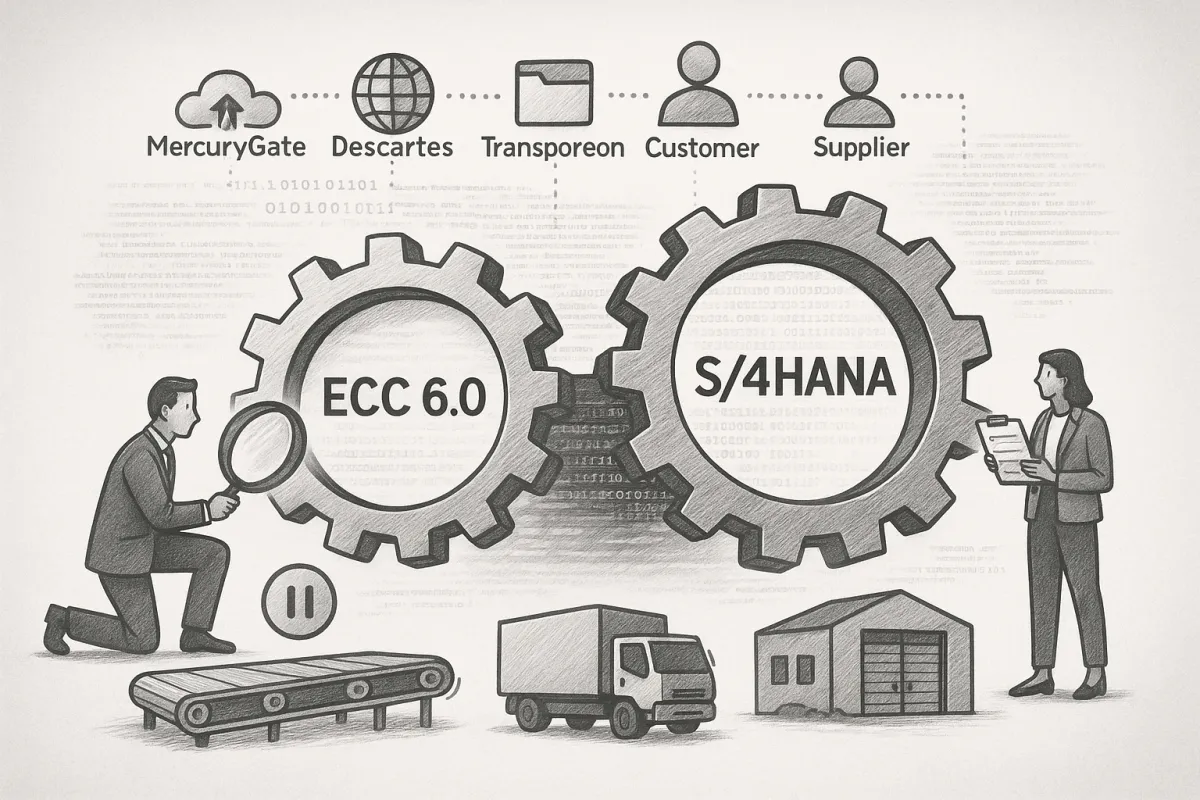
When mainstream maintenance for SAP Business Suite 7, which includes SAP ERP Central Component (ECC), running out in 2027, SAP users are increasingly making progress in the planning and execution of digital transformation projects. Nearly half (45%) of the research respondents reported they're already live on SAP S/4HANA or have started to move, while 30% indicated their organizations will go live on SAP S/4HANA in the next six to 24 months, one reality becomes unavoidable: your EDI integrations face massive disruption during migration. For SAP users already live on SAP S/4HANA, 49% of respondents indicated costs exceeded their original budgets, and EDI integration complexity frequently drives these overruns.
You're not just upgrading software when you move from ECC 6.0 to SAP S/4HANA. S/4HANA replaces the separate customer and vendor records in ECC with a unified Business Partner (BP) model. This means all customer/vendor master data must be migrated into BP entities—each with the correct roles (e.g., "Customer," "Supplier") assigned. SAP's Customer-Vendor Integration (CVI) framework handles this technically, but if roles are missing or mappings are incomplete, EDI processes tied to those records can fail.
The Hidden SAP S/4HANA EDI Migration Complexity That 70% of Projects Underestimate
The numbers tell a sobering story. Projects are taking an average 30% longer than originally planned. Only 8% of companies that have completed the transition to S/4HANA did so on schedule. What catches most organizations off guard isn't the core system migration—it's the ripple effects through their EDI ecosystem.
Respondents cited business process change (49%), customizations (44%), and organizational resistance (37%) as the top barriers. Many companies are struggling to transform how core SAP data creation and management processes are structured, align SAP ECC customizations with SAP's Clean Core approach, and navigate the complexities of large-scale cultural change.
Your EDI integrations built over decades often lack comprehensive documentation. Teams resort to "brute force" manual reviews of hundreds of trading partner connections. These issues tend to surface only after go-live, when partner transactions fail and supply chain disruptions begin.
Data migration effort is cited as the biggest challenge by 39% of organizations, closely followed by the complex adaptation of the existing system landscape or IT architecture (37%) and a lack of resources in the relevant specialist departments (36%).
The Three Critical EDI Architecture Changes in S/4HANA
S/4HANA introduces fundamental architectural shifts that break existing EDI patterns:
Business Partner Consolidation: In S/4HANA, the EDI partner profile setup via WE20 becomes more complex. You not only define inbound/outbound parameters for a partner but must also account for multiple partner types—including Business Partner (BP), Logical System (LS), Vendor (LI), Customer (KU), and more—each requiring their own profile setup.
IDoc Format Changes: S/4HANA can change the structure of the iDoc format. Fields are longer, new segments added, and some segments deprecated. Existing EDI maps break or worse, silently misbehave (e.g., truncated data, unmapped fields). Even subtle IDoc changes in key messages like INVOIC02 or ORDERS can ripple through supply chains. Inaccurate mappings can lead to failed transactions, chargebacks, or customer dissatisfaction.
Output Management Overhaul: S/4 introduces BRF+ (Business Rule Frame Plus) to replace classic NAST message control for triggering EDI outputs. Companies must reconfigure EDI output logic from scratch. Early versions of BRF+ lacked full IDoc support, which often forced a fallback to NAST for business-critical flows. If output logic fails post-migration, trading partners may not receive critical docs like ASNs or invoices, causing order disruptions and SLA violations.
The Pre-Migration EDI Assessment Framework: Mapping Your Current State
Before you touch a single line of configuration code, you need comprehensive visibility into your existing EDI ecosystem. EDI specialists can capture partner requirements faster than internal teams attempting manual discovery approaches.
Start with partner dependency analysis. Identify which trading relationships generate the highest transaction volumes and revenue impact. Your largest retail customers using EDI 850 purchase orders shouldn't face disruption during migration, even if smaller suppliers experience temporary delays.
Document current IDoc versions for each message type. Perform a detailed comparison of ECC and S/4 IDoc versions for each message type. Update EDI maps and test each transaction type end-to-end. Use test IDocs and partner simulations before go-live to validate translations.
Modern TMS vendors like MercuryGate, Descartes, and Transporeon, alongside emerging platforms like Cargoson, require the same assessment approach. Each integration point needs mapping and testing validation.
The Four-Phase Migration Strategy
**Phase 1: Stabilization** - Keep the EDI aspects as simple as you can. Modularize the S/4HANA project wherever possible and do not reinvent the wheel just for the sake of it. Focus S/4HANA migration on core system functionality while maintaining existing EDI processes through external platforms.
**Phase 2: Translation** - Inventory all NAST-based outputs and map to S/4 equivalents. Decide case-by-case whether to use BRF+ or retain legacy NAST for specific IDocs. Confirm IDoc output support within the new framework using SAP OSS Notes. Choose direct mapping for simple transformations or canonical (indirect) approaches for complex multi-partner scenarios.
**Phase 3: Modernization** - SAP considers IDOCs an outdated technology, and the use of APIs is recommended for S/4HANA implementations. Gradually introduce API-based integrations alongside existing EDI processes. This enables real-time data transmission capabilities without disrupting established partner relationships.
**Phase 4: Optimization** - Leverage S/4HANA's advanced digitalization functionalities for new partner onboarding and market expansion. Existing EDI processes are technically migrated and enhanced to leverage the new S/4HANA capabilities. Outdated processes that previously served as workarounds can now be optimized or replaced using S/4HANA's advanced automation and analytics features.
Critical Implementation Challenges and Proven Solutions
**Business Partner Setup Complexity:** Outbound EDI messages may carry new codes partners don't recognize. Inbound messages might fail without remapping. Also, if BP records are missing key roles or identifiers, EDI messages may fail to generate, route incorrectly, or be rejected by partners. These mismatches can disrupt core processes like order-to-cash and procure-to-pay. Unfortunately, these issues tend to surface only after go-live.
Solution: Use SAP CVI Cockpit to assign correct roles and maintain legacy number references. Cross-reference new BP records in middleware or maps to ensure partners recognize them. Test EDI flows for both outbound and inbound messages using converted master data.
**Data Quality Issues:** Nearly four-fifths (77%) reported data management presented a challenge when moving to S/4HANA from SAP ECC 6.0. Only 7% found it not challenging. Poor data quality creates silent failures in EDI processing that surface weeks after go-live.
**Inadequate Monitoring:** Consulting fees are the main source of unexpected costs, increasing by 20% since 2023. Organizations frequently underestimate ongoing monitoring requirements post-migration. "Big Bang" approaches increase risk exposure across all trading partners simultaneously.
Modern TMS integration platforms including Oracle TM, SAP TM, and cloud-based options like Cargoson require similar data quality and monitoring frameworks during S/4HANA transitions.
The Hybrid Integration Platform Strategy
If you utilize a true Hybrid Integration Platform (HIP) with a solid B2B/EDI integration in place, you will protect your supply chain and you will have the flexibility to gradually add API integration and API management as the business needs it. Keep in mind though that workflows and handling of API related content errors takes place at different locations and thus the Line-of-Businesses processes may need to be amended.
Decoupling EDI integration using separate platforms provides multiple benefits. The established message standards (ANSI x12, EDIFACT…) together with the message types and the established protocols (AS2, OFTP2, VAN…) are a kind of demarcation line between the SAP customer and the trading partner. It is important that these established messages and the data conversion between them (as well as the protocols and the communication) remain as untouched as possible. Otherwise, one may need to deal with changing hundreds of trading partner connections in the middle of the S/4HANA migration project.
Canonical mapping approaches protect existing investments while reducing overall project risk. Leading EDI platforms include OpenText, SEEBURGER, Cleo, TrueCommerce, alongside modern cloud integration providers like Cargoson for comprehensive transport and logistics integration.
Testing and Validation Framework
SAP Community members confirm that after conversion, IDoc segment versions often change, and middleware will not process them correctly until the updated definitions are imported and remapped. Your testing framework must validate every IDoc version change across all message types.
Establish partner simulation protocols before touching production systems. Create test scenarios covering edge cases: truncated data fields, new segment handling, deprecated segment removal. Run end-to-end validation with actual trading partner test systems where possible.
Consider managed services during migration to maintain EDI operations while internal teams focus on S/4HANA core system functionality. External EDI providers can capture partner requirements and handle testing coordination more efficiently than stretched internal resources.
Post-Migration Optimization Opportunities
S/4HANA's real-time processing capabilities unlock new EDI integration possibilities. S/4HANA leverages an in-memory architecture that enables real-time processing and advanced analytics. Traditional batch-oriented EDI processing can evolve toward event-driven, real-time document exchange.
Automated compliance EDI in S/4HANA helps companies meet legal requirements and industry-specific standards. Automated, auditable documentation ensures the highest level of compliance and reduces the risk of penalties from tax authorities.
Integration with modern TMS solutions including Cargoson's transport execution capabilities enables end-to-end supply chain visibility. AI and automation capabilities built into S/4HANA can enhance EDI processing through intelligent exception handling and predictive partner relationship management.
ROI Framework and Success Metrics
Nearly half of the organizations surveyed reported that migration costs exceeded their original budgets, primarily due to unforeseen consulting fees and implementation services. However, on average, the timeline for migration projects was consistent with initial expectations, taking approximately 1.5 years to complete.
Migration costs range dramatically based on complexity. Mid-size manufacturers might spend $250,000 on EDI-specific migration components, while large enterprises with hundreds of trading partners can reach millions in integration costs. Partner relationship protection provides quantifiable value through avoided chargebacks, maintained SLA compliance, and uninterrupted revenue flows.
Time savings become measurable post-migration. Organizations report processing improvements where "what used to take hours now takes less than two minutes" for routine EDI document handling. Long-term scalability benefits include simplified new partner onboarding and enhanced flexibility for market expansion.
The complete SAP S/4HANA EDI integration migration framework requires balancing technical complexity with business continuity. EDI is not just a technical add-on; it's a strategic enabler for businesses using SAP S/4HANA. Understanding how EDI fits into the overall SAP S/4HANA ecosystem is crucial for designing a future-proof solution.
Success depends on treating EDI migration as a strategic business initiative, not just a technical project. Your trading partner relationships represent years of investment in established processes, negotiated terms, and operational workflows. Protecting these relationships while unlocking S/4HANA's advanced capabilities requires the comprehensive framework approach outlined above.