The Complete Supply Chain Orchestration Platform Implementation Guide: How to Unify EDI, API, and TMS Integration for Multi-Partner Execution That Eliminates the 70% Visibility-to-Action Gap in Modern Trading Networks

Most supply chain leaders understand the frustration. Your team exchanges thousands of documents through EDI. Your TMS handles transportation execution. APIs connect newer systems. But when disruption hits, in 2026, supply chain leaders are learning a hard lesson. Data movement does not equal execution.
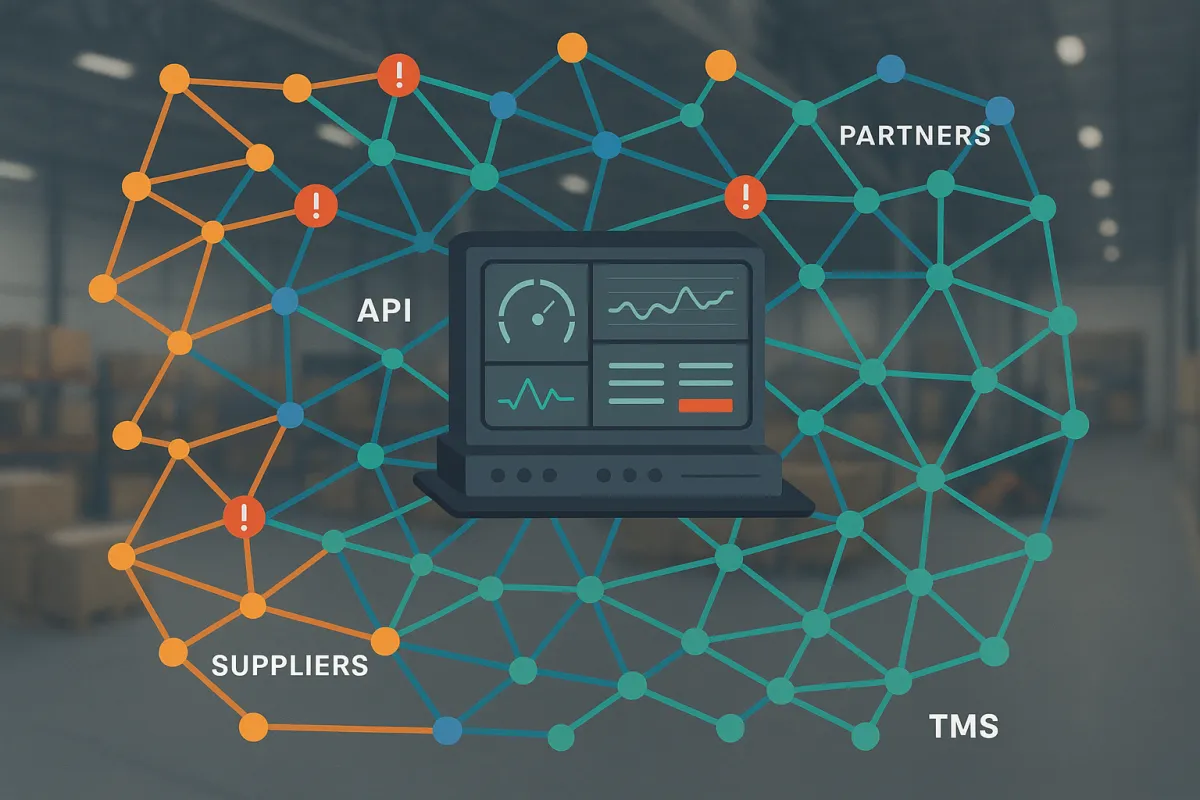
The challenge isn't connectivity anymore. Most supply chains use a mix of automated EDI, APIs, and managed file transfer (MFT) to work with different partners, systems, and compliance requirements. When those connection types sit in different tools, data fragments across teams and processes. In disruption mode, that fragmentation slows response and weakens resilience.
This guide covers how to evaluate and implement supply chain orchestration platforms that unify EDI, API, and TMS integration for coordinated multi-partner execution beyond traditional document exchange.
The Critical Shift from Document Exchange to Supply Chain Orchestration
Legacy integration platforms were built to connect systems and exchange documents. They do that job well, but they often break down when the supply chain shifts from "business as usual" into disruption mode.
Traditional EDI and TMS integrations excel at moving structured data between known partners. Purchase orders flow to suppliers. Advance ship notices update warehouse systems. Invoice data triggers payment workflows. But these point-to-point connections create operational blind spots when exceptions occur.
Consider a typical scenario: your largest supplier reports a manufacturing delay that will impact 40% of this month's deliveries. Your EDI system receives the advance ship notice updates. Your TMS shows revised carrier schedules. But connecting those dots to determine customer impact, alternative sourcing options, and inventory allocation priorities? That requires manual analysis across multiple systems.
The organizations that win are not the ones that only move data faster. They are the ones that can manage outcomes in real time. Modern supply chain orchestration platforms address this gap by what were once disparate data points become a single, automated engine for supply chain visibility but more importantly, decision-making.
The shift impacts how you evaluate platforms. Instead of asking whether a solution can handle 10,000 EDI transactions per hour, ask whether it can identify the 50 transactions that require immediate attention and route them to the right decision-maker with context.
Core Orchestration Platform Capabilities That Separate Leaders from Legacy Providers
Supply chain orchestration depends on three capabilities. Unified connectivity, real-time visibility, and actionable intelligence. Understanding these capabilities helps distinguish between platforms that merely aggregate data and those that enable coordinated execution.
Unified Connectivity Architecture Assessment
A single platform for API, EDI, and MFT reduces fragmentation and creates one place to manage partners, track activity, and standardize workflows. But unification goes beyond technical connectivity. The architecture should support different integration patterns without forcing all partners into the same mold.
Evaluate whether platforms handle mixed connectivity naturally. Can a supplier connect via EDIFACT while their 3PL uses REST APIs and their carrier supports only email-based communication? Our user interface enables partners to use any format (X12, EDIFACT, IDoc, CSV, Custom, etc.), with any method (UI, API integration, asynchronous message integration), over multiple protocols (HTTPS, SFTP, AS2). The OPUS platform supports a comprehensive set of business transactions at three integration levels: Business-to-Network, Hybrid, and UI.
Look for platforms that treat connectivity as a service layer rather than requiring dedicated implementations for each protocol. Modern cloud-based shipping software connects directly with hundreds of carriers through pre-built API and EDI integrations. Instead of setting up separate technical connections with each transport provider, you get access to your whole carrier network through one platform.
TMS-native integration capabilities matter more than bolt-on solutions. Platforms like Cargoson build connectivity into their core architecture, Cargoson's cloud-based TMS platform integrates with carriers by setting up direct API connections that automatically sync rates, transit times, and tracking information. Lots of these API connections are already pre-built and ready for use, but any customer can request a new carrier integration, for free, and this will be done within a few weeks.
Real-Time Visibility vs Traditional Monitoring
Traditional EDI monitoring shows transaction status: sent, received, processed, failed. Orchestration platforms show business impact: orders at risk, shipments requiring expediting, suppliers deviating from performance baselines.
The difference becomes clear during disruptions. Traditional EDI environments often limit visibility to a small group of specialists, making it harder for operations, customer service, and supply chain teams to respond quickly when issues arise. At the same time, manual processes and reactive troubleshooting continue to slow teams down.
Modern platforms provide systems that can coordinate across partners, trigger actions in real time, and provide visibility into both transactions and the processes behind them. This means moving from "this EDI file failed" to "customer order 12345 will be delayed unless we source from backup supplier within 4 hours."
Platforms like Cleo demonstrate this evolution through Most tools show you "technical success." Cleo shows you business success. Our dashboards translate cryptic EDI codes into business language: "Load Tender Accepted" or "Invoice Rejected due to Price Mismatch."
TMS Vendor Orchestration Readiness Evaluation Framework
Not every TMS platform can evolve into an orchestration hub. Traditional transportation management systems focus on execution: route optimization, carrier selection, freight audit. Orchestration-ready platforms add coordination: workflow automation, exception handling, multi-party decision support.
Native vs Integrated Orchestration Capabilities
The distinction between native and integrated orchestration capabilities affects long-term platform flexibility. Native capabilities are built into the platform architecture. Integrated capabilities depend on third-party additions.
Cloud-native TMS platforms like Cargoson demonstrate native orchestration through their architecture. Cargoson is a modern European TMS that bridges the gap between complex enterprise systems and simple shipping tools. It offers direct API/EDI integrations with carriers across all transport modes (FTL, LTL, parcel, air, and sea freight), allowing you to compare rates, book shipments, and track imports and deliveries from a single platform.
Partner onboarding capabilities reveal orchestration maturity. Cleo's pre-built TMW-specific connectors allow you to onboard new trading partners in days, not months. Compare this to traditional approaches where Research by Ovum shows that 53% of enterprises experience limitations with their current B2B integration solutions when onboarding trading partners, with approximately 40% requiring over 30 days to bring a new partner online.
Workflow automation separates orchestration platforms from basic TMS solutions. Look for systems that can automatically escalate exceptions, route approvals based on business rules, and trigger cross-functional notifications. DOSS transforms procurement from manual purchase order generation to automated workflow orchestration. The platform analyzes inventory levels, consumption patterns, production schedules, and lead times to suggest optimal purchase orders. Automated workflows generate POs when inventory reaches reorder points, route approvals based on dollar thresholds, transmit orders to suppliers via email/ EDI /portal, and track acknowledgments and delivery commitments.
Implementation Strategy for Hybrid EDI-API-TMS Orchestration
Moving from fragmented EDI and TMS tools to unified orchestration requires phased implementation that minimizes business disruption while proving value quickly.
Phased Migration from Legacy Integration
Start with integration assessment before platform selection. EDI issues during a TMS migration can usually be traced back to one of these root causes: Mapping mismatches: Every TMS platform structures its data differently. Without precise mapping between new and existing fields, critical information can be dropped or misrouted.
Phase 1 should focus on consolidating high-volume, stable trading relationships. EDI integrations may take several months, whereas, API integrations can take a matter of weeks, if not days, and files may have complex formats requiring the labor of specialists. Here's the practical impact: when you need to onboard a new carrier urgently, APIs give you that flexibility. When you're managing stable, high-volume relationships with established partners, EDI's reliability becomes an asset.
Cloud-native platforms accelerate migration timelines significantly. Cloud-based TMS implementation typically takes 1-4 weeks compared to 6-18 months for traditional on-premise systems. Solutions like Cargoson can have shippers managing freight within days of signing up.
Change management becomes critical during orchestration adoption. Employees may resist adopting new technologies due to fear of the unknown or concerns about job security. It is essential to address these concerns through effective communication and training. Focus on demonstrating how orchestration eliminates manual work rather than replacing decision-making.
Vendor Selection Matrix for Orchestration-Ready Platforms
The supply chain orchestration market includes several categories of vendors, each with different strengths in enterprise scale, compliance depth, and implementation speed.
Enterprise-focused platforms like SAP and Blue Yonder provide comprehensive orchestration capabilities for large-scale operations. SAP has confirmed general availability of SAP Supply Chain Orchestration in the first half of 2026. It is built for businesses looking to shorten time-to-recover, improve decision-making and anticipate global shifts before they escalate. SAP Integrated Business Planning (SAP IBP) receives a major upgrade, combining a harmonised data model with AI tools to deliver faster, more connected planning.
Specialized integration platforms like Cleo focus on B2B connectivity with orchestration capabilities. Cleo positions its approach as AI-native and states it can resolve operational disruptions 85% faster than legacy integration middleware.
Cloud-native TMS platforms like Cargoson, nShift, and MercuryGate offer different orchestration approaches. Platforms like Cargoson, alongside solutions from Transporeon, nShift, and others, have responded by offering dual-mode capabilities. This approach acknowledges that European shippers don't have the luxury of choosing just one integration standard.
Industry-specific platforms like TraceLink demonstrate vertical orchestration for life sciences and healthcare. Discover how agentic orchestration is transforming AI-enabled, end-to-end supply chain execution in life sciences and healthcare. In these FutureLink Barcelona highlights, Lucy Deus, SVP of Supply Network Products, and Shabbir Dahod, President & CEO of TraceLink, share insights on the journey from establishing the digital foundation for AI to orchestrating partners, processes, and products at scale.
Cost structures vary significantly across vendor categories. TMS pricing varies widely: Cargoson starts from €199/month, nShift has a base subscription of €999-€1,499/year plus per-carrier fees, Freightview ranges from $99-$599/month based on volume, enterprise solutions like Oracle and SAP typically start at $250,000+ annually, and some providers like Transporeon or Uber Freight use transaction-based pricing.
Measuring Orchestration Success Beyond Integration Metrics
Traditional integration metrics focus on technical performance: transaction throughput, error rates, system uptime. Orchestration success requires business impact metrics that measure decision-making speed and outcome quality.
Key supply chain KPIs include on-time delivery with predictive ETAs and OTIF (On-Time, In-Full). Also, perfect order delivery rate, order accuracy, and punctuality of orders are vital. These metrics connect directly to orchestration effectiveness.
Exception resolution time becomes a critical orchestration metric. Focus on metrics connecting data quality to operational and financial outcomes: order-to-shipment cycle time, exception resolution speed, inventory turns, stockout frequency, and perfect order rate.
Partner relationship quality metrics reveal orchestration value beyond internal efficiency. Track supplier performance consistency, carrier service level adherence, and customer satisfaction scores across trading partners.
Financial validation confirms orchestration effectiveness. Financial validation confirms the effectiveness of these metrics. Gains in asset turnover, ROA, ROE, and ROIC show that operational supply chain KPIs lead to lasting returns.
ROI frameworks should capture both direct and indirect benefits. Through an ROI framework, this helps ensure you're not just crunching numbers but also aligning your investment with clear business goals. A strong ROI framework typically includes the following steps: Set Clear Objectives: Before adapting any new technology, you need to define what success looks like for you since it gives you a clear vision of what you want to achieve. For example, do you want to reduce order processing time by 50%, or eliminate 90% of shipping errors. By setting clear objectives, you can align your technology adoption with your business strategy and track your progress over time.
Future-Proofing Your Orchestration Investment
Supply chain orchestration platforms are evolving toward autonomous operation through AI agents and machine learning. Understanding these trends helps ensure platform investments remain valuable as technology advances.
Supply chain orchestration technology continues to evolve rapidly, with new developments in AI-driven decision making and predictive analytics making supply chains more autonomous. Platforms are moving beyond reactive monitoring toward predictive intervention.
AI-powered supplier onboarding demonstrates this evolution. Supplier Onboarding Agent: Speeds up onboarding by reasoning over supplier data, issuing invites, validating information and handling exceptions. This allows procurement teams to scale quickly and concentrate on supplier development. These agents bring automation into high-friction areas of the supply chain, reducing delays and error rates while supporting high-speed decision-making.
Agentic AI represents the next orchestration frontier. Evolinq is an AI-powered supply coordination platform that enables autonomous supply chains. It replaces manual buyer and expediting work with AI agents that follow up on orders, validate supplier commitments, and detect risks in real time.
Platform selection should consider AI readiness and data architecture flexibility. AI becomes most valuable as a co-pilot, reducing the time needed to diagnose issues and prioritize actions. Choose platforms that treat AI as an enhancement to human decision-making rather than a replacement.
Your orchestration platform investment should support both current integration needs and future autonomous capabilities. Focus on vendors demonstrating clear AI roadmaps while delivering proven orchestration value today.