The Complete TMS Vendor Agentic AI Evaluation Framework: How to Assess Transportation Management System Orchestration Capabilities That Enable Autonomous Supply Chain Operations and Prevent the 85% Implementation Failure Rate in 2026

The evaluation of TMS vendor agentic AI capabilities isn't about finding the best chatbot for your supply chain. Agentic AI in supply chain management refers to autonomous AI systems that perceive real-time operational data, reason about what action is needed, execute decisions across connected systems, and adapt based on outcomes, all without waiting for human instruction at each step. The defining distinction from traditional and generative AI in supply chain is execution. Your TMS needs to move beyond generating recommendations to actually taking action.
Gartner predicts over 40% of agentic AI projects will be canceled by end of 2027. Only 16% of organizations report success in their digital transformation efforts, while seventy-six percent of logistics transformations never fully succeed, failing to meet critical budget, timeline or key performance indicator (KPI) metrics. The framework below helps you avoid becoming part of that majority.
The Agentic AI Supply Chain Revolution: Why TMS Evaluation Must Evolve
Agentic AI gains early ground in TMS platforms: Instead of waiting for a command, agentic AI takes the next step on its own. Expect to see more traction in this area in 2026 as workflow-focused platforms add more agentic AI features that can sit on top of core systems like ERP. This represents a fundamental shift from traditional TMS evaluation criteria.
Most TMS assessments still focus on connectivity protocols, user interface design, and carrier network size. Those factors matter, but they miss the operational reality of 2026: Supply chains don't break because of a lack of data. They break because the time between an anomaly appearing in the data and a corrective action being taken is measured in hours or days.
The major TMS players — MercuryGate, Descartes, Manhattan Active, and SAP TM — are racing to embed agentic capabilities. Trimble introduced a next-generation, cloud-native transportation management system with embedded AI at its Nov. 16-18 Insight 2025 conference in New Orleans. The company said the modular TMS and new AI agents will automate order intake, invoicing and breakdown responses to cut manual work and improve fleet visibility. Meanwhile, newer platforms like Cargoson and Numeo are building agentic architecture from the ground up.
The scale of agentic AI adoption in supply chain in 2026 is significant: More than half of supply chain executives surveyed report deploying AI agents to automate workflows. The question isn't whether your next TMS will include agentic AI — it's whether those capabilities will actually execute workflows or just make better dashboards.
Core Agentic AI Capabilities Every TMS Vendor Should Provide
Autonomous Decision-Making Architecture
Your TMS vendor should demonstrate how their agents reason through complex scenarios without human intervention. Agentic AI acts: it detects that a supplier shipment will be three days late, evaluates alternative suppliers and rerouting options, initiates a purchase order with the next-best qualified supplier, updates the production schedule, and alerts the customer service team with revised delivery timelines, all within minutes of the disruption signal appearing.
Ask vendors for specific examples of bounded autonomy. On factory floors and in logistics operations, the handoff between agent autonomy and human decision-making is safety-critical. An agent that can autonomously reroute shipments needs different guardrails than an agent that can autonomously adjust a heat treatment process. The organizations getting this right implement graduated autonomy — different permission levels for different agent types, with escalation paths that are tested as rigorously as the agent's primary logic.
The best implementations include explainable decision trees. Agentic AI acts as a digital co-pilot for supply chain leaders, planners, and operators. It explains decisions, presents alternatives, and escalates exceptions that require human judgment. Your agents should document their reasoning, not just their actions.
Multi-Agent Orchestration Capabilities
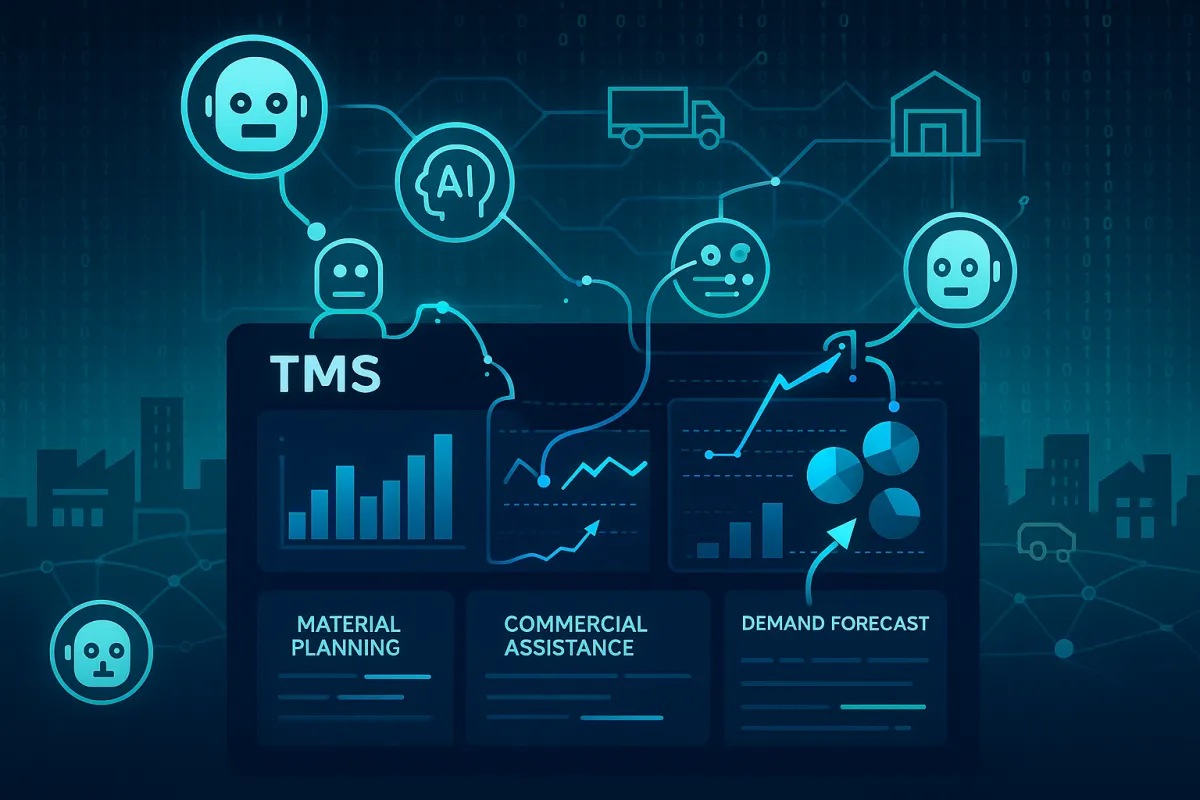
Single-agent workflows are proof-of-concept thinking. Production agentic AI requires coordination between multiple specialized agents. Your TMS should demonstrate how material planners, commercial assistants, and demand forecast assistants collaborate on complex scenarios.
Evaluate how agents share context and coordinate actions across ERP, WMS, and TMS boundaries. Agents have the ability to reason over data, take action across workflows, reduce manual effort, and support faster, more consistent execution—while keeping humans in control of decisions and outcomes. Frontier firms are moving beyond isolated AI use cases and focusing on how decisions and actions connect and orchestrate across end-to-end processes.
Blue Yonder and Oracle TM have made significant investments in multi-agent coordination, while Cargoson emphasizes cross-system orchestration through unified data models. Ask vendors to walk through scenarios where multiple agents negotiate competing priorities — like minimizing cost versus meeting delivery commitments.
EDI-TMS Integration Assessment Criteria
Real-Time EDI Processing and Exception Management
In 2026, supply chain orchestration closes the execution gap—unifying EDI, APIs, and AI to protect OTIF, speed resolution, boost resilience, and provide real-time data. Your TMS vendor needs to prove their agentic AI can operate seamlessly across traditional EDI and modern API workflows.
Traditional EDI integration still matters. EDI vs API integration for supply chain data is not a question of replacement, but of architecture. EDI remains the compliance backbone for retail trading partners, while APIs power real-time operational workflows. Your agentic AI agents must handle both data exchange patterns without creating integration gaps.
Test how quickly their AI can generate new trading partner mappings. Automate onboarding and exception handling to better manage trading partner diversification and volatility. The platforms that can auto-generate mappings during partner onboarding while validating data in real-time will scale more effectively as your network grows.
Standards Support and Protocol Flexibility
Evaluate each vendor's approach to X12, EDIFACT, and TRADACOMS support within their agentic framework. A hybrid approach offers flexibility, which helps organizations modernize without disrupting existing workflows or supply chain operations. APIs that work with EDI and can connect to common ERPs like ERPs, like SAP S/4HANA, Oracle Fusion, NetSuite, and MS Dynamics 365, are essential for businesses seeking agile, efficient, and future-ready supply chain integration.
Traditional EDI vendors like IBM Sterling and OpenText are retrofitting agentic capabilities onto existing architectures. Platforms like Cleo and Cargoson built orchestration-first architectures that treat EDI as one protocol among many. Transporeon focuses on network effects across standardized integrations.
The key distinction: can their agents reason across different data standards simultaneously, or do they require separate workflows for EDI versus API-based partners?
Production Readiness and Governance Evaluation
Autonomous Operation Safeguards
Unsecured AI agents can access sensitive customer data, make decisions on behalf of employees, and take actions across your entire tech stack with little oversight. According to PwC's AI Agent Survey, only 20% of leaders trust AI agents for financial transactions, and just 22% for autonomous employee interactions.
Your evaluation framework must include rigorous governance assessment. Based on the deployments that are working, we see a consistent pattern: Data foundation first: Ontology mapping, asset registries, and data quality monitoring deployed before agents. This is the boring infrastructure that nobody demos. It accounts for 60-70% of project time — and the majority of your enterprise AI agent TCO.
Demand detailed audit trails from every vendor. Your agents will make thousands of micro-decisions daily across multiple trading partners. When something goes wrong, you need to understand exactly what triggered each action and what alternative paths the agent considered.
Scalability and Performance Metrics
The promise of AI in the supply chain has evolved from passive visibility to active intervention. In 2026, organizations utilizing agentic AI systems can realize double-digit efficiency gains and reduce decision latency from days to seconds. But these gains only materialize if the underlying architecture scales without degradation.
Test each platform's multi-enterprise coordination capabilities. FreightPOP, E2open, and nShift handle large carrier networks but vary significantly in their ability to coordinate decisions across multiple shippers simultaneously. Cargoson emphasizes cloud-native scaling and faster regional deployment as core architectural advantages.
Ask for specific performance benchmarks: How many simultaneous agent decisions can the platform handle? What happens to response time as you add more trading partners or transaction volume?
Implementation Timeline and ROI Assessment Framework
Pilot Deployment Strategies
The successful implementations focus on specific operational workflows rather than broad AI deployments. The organisations that have deployed AI agents in logistics are not running experiments. They are running production systems. The question for every supply chain leader in 2026 is not whether to deploy but which workflow to start with.
Start with logistics exception management or inventory replenishment. These workflows provide measurable outcomes within 3-6 months while building the foundation for more complex multi-agent scenarios over 6-18 months.
Your pilot should prove three specific capabilities: autonomous decision-making under defined parameters, seamless integration with existing EDI workflows, and clear escalation paths when human judgment is required.
Cost-Benefit Analysis Methods
In 2026, organizations utilizing agentic AI systems can realize double-digit efficiency gains and reduce decision latency from days to seconds. But implementation costs extend far beyond software licensing.
Factor in data foundation requirements, change management, and ongoing governance. It accounts for 60-70% of project time — and the majority of your enterprise AI agent TCO. It's also the difference between working and failing.
Compare platforms claiming 85% faster resolution than legacy integration middleware against realistic baseline metrics from your current operations. Include the cost of failed implementations in your risk assessment — 3Gtms, Uber Freight, and Alpega offer different risk profiles compared to platforms like Cargoson with orchestration-first architectures.
Vendor Comparison Matrix and Decision Framework
Structure your evaluation around execution capabilities, not feature checklists. The shift to the agentic age is real and happening now. Decision-centric planning is transforming supply chains, moving from reactive responses to continuous, autonomous decision-making.
Score each vendor on autonomous decision-making depth, multi-agent coordination capabilities, EDI-API hybrid orchestration, and production governance frameworks. Weight these scores against implementation complexity and total cost of ownership.
Track outcomes, not activities. Measure deltas in cost per shipment, service level adherence, cycle time reduction, and planner productivity. Gartner predicts 60% of supply chain disruptions will be resolved without human intervention by 2031. Your vendor selection should position you to reach that capability progressively.
Established vendors like MercuryGate, Descartes, Manhattan Active, and SAP TM bring proven enterprise integration capabilities but may require longer implementation timelines for full agentic functionality. Emerging platforms including Cargoson offer faster deployment but require more careful assessment of enterprise scalability.
2026 Implementation Action Plan
Begin with immediate assessment of your current EDI-TMS integration gaps. This phased approach reduces risk while ensuring your organization benefits from agentic AI capabilities without joining the majority of implementations that fail to deliver their promised value.
Document your most manual, high-frequency exception handling workflows. These become your first agentic AI targets. Build orchestration foundations before autonomy scales — your agents need reliable data and clear decision frameworks.
Include these specific questions in vendor RFPs: How do your agents handle conflicting optimization objectives? What happens when agents disagree on priority? How quickly can you add new trading partners without custom development? How do you ensure compliance across different regulatory requirements?
Your RFP should require live demonstrations of agent decision-making under simulated disruption scenarios. Avoid vendors who only show static dashboards or pre-scripted workflows. Agentic AI is reshaping logistics operations by moving the industry beyond traditional TMS- and ERP-driven workflows. Your evaluation process should test their ability to prove that claim.