The Complete TMS Vendor EDI Integration Assessment Framework: How to Evaluate Transportation Management System Data Exchange Capabilities That Survive Vendor Consolidation and Build Future-Proof Hybrid Operations in 2026

Recent research shows that 73% of TMS implementations face significant disruptions, while 66% of technology projects end in partial or total failure. The root cause isn't poor planning or inadequate budgets. Unfortunately, some TMS platforms make EDI connectivity more difficult than it should be, and because TMS and EDI systems are deeply connected, even minor mismatches between the two systems can lead to costly disruptions.
You're evaluating TMS vendors using the same feature checklists your team used five years ago. Meanwhile, your competitors are building integration architectures that survive vendor acquisitions, regulatory changes, and the hybrid EDI-API future that's already here. EDI issues during a TMS migration can usually be traced back to mapping mismatches—every TMS platform structures its data differently, and without precise mapping between new and existing fields, critical information can be dropped or misrouted.
Understanding the 2026 Vendor Consolidation Impact on EDI Operations
WiseTech's acquisition of E2open in 2025, Descartes' purchase of 3GTMS for $115 million in March 2025, and Körber's transformation of MercuryGate into Infios following their 2024 acquisition represent just the beginning of a fundamental market restructuring. WiseTech Global's $2.1 billion acquisition of E2open has sent shockwaves through the European transportation management systems market, marking the most significant consolidation move in recent TMS history.
This marks Descartes' 32nd acquisition since 2016, and signals a fundamental shift in how procurement teams need to approach TMS vendor selection. Consider the integration challenges: 66% of technology projects end in partial or total failure, with 17% of large IT projects threatening company existence. When your TMS vendor becomes an acquisition target, you inherit these integration risks without directly managing the project.
Here's what most procurement teams miss: these aren't just financial transactions. They're fundamentally altering the competitive landscape that European shippers rely on for carrier connectivity, pricing leverage, and implementation flexibility. Product roadmap uncertainties are already surfacing. When two TMS platforms merge, customers inevitably face decisions about which system to standardize on, what features will be deprecated, and how long dual support will continue.
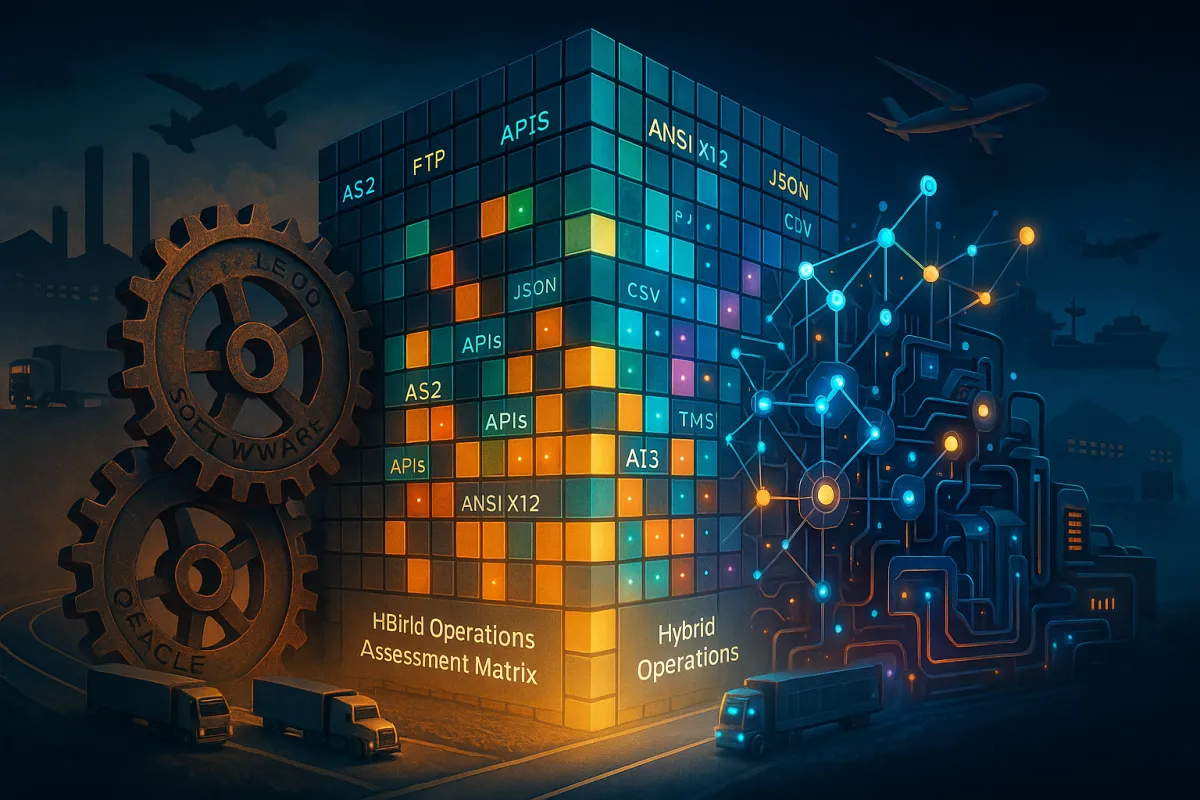
The EDI Integration Capability Assessment Matrix
Traditional TMS vendor evaluations focus on transportation features while treating EDI as a checkbox item. Smart procurement teams reverse this priority. Standalone EDI systems are critical business applications that most organizations treat as tier 1 applications, since more than half of their business revenue goes through this platform. Companies want 100% uptime, even when performing upgrades to their ERP or TMS systems.
Your assessment matrix needs four capability dimensions that actually predict implementation success:
Core EDI Infrastructure Requirements
Support for multiple protocols and formats: AS2, FTP, APIs, and standardized formats such as ANSI X12 should all be supported. Don't accept promises about "planned support" for protocols your trading partners require today. Legacy protocol issues often plague older EDI connections that rely on protocols like FTP or AS2. If the new TMS doesn't support those methods or supports them differently, message delivery can fail entirely.
Fast trading partner onboarding: New trading partner connections shouldn't require custom development or extended lead times, especially under tight transportation deadlines. Most EDI implementations today take months rather than days. Your suppliers wait four to six weeks just to get onboarded with traditional EDI vendors, and in practice, the theoretical 1-2 week timeline often stretches to 1-2 months or longer.
Cloud-native deployment offers better scalability, real-time monitoring, and fewer on-premise maintenance headaches, while built-in data validation can spot and fix errors before they cause failed transmissions or chargebacks.
Hybrid API-EDI Architecture Support
The fastest-scaling mid-market companies have stopped treating EDI and API as a binary choice. They have built hybrid integration architectures that use each protocol where it delivers the highest value. What ties this together is an integration middleware layer that bridges both worlds, ensuring that EDI transactions can feed real-time API-driven dashboards, and that API-generated orders can be translated and transmitted as EDI 850s to partners who require them.
EDI vs API integration for supply chain data is not a question of replacement, but of architecture. EDI remains the compliance backbone for retail trading partners, while APIs power real-time operational workflows. The competitive advantage comes from synchronizing both through a unified integration layer that eliminates batch delays and data inconsistencies.
Look for platforms that excel at handling multiple format variations from a single interface. Companies like Cargoson, Cleo, and TrueCommerce understand this hybrid reality. API-hybrid platforms address this complexity by combining APIs, EDI, and file-based integration within a single environment. This allows organizations to support both modern and legacy requirements without introducing additional tools, custom code, or fragmented workflows.
Vendor Stability and Acquisition-Resistance Evaluation
Smart procurement teams now evaluate vendor stability as rigorously as functionality fit. Companies with high customer concentration in specific industries or geographies become attractive acquisition targets when consolidating vendors want to enter those markets quickly.
Financial health assessment goes beyond traditional metrics. Review vendor financial statements for debt levels, revenue concentration, and cash flow patterns. Independent specialists like Cargoson and Alpega often provide better insulation against consolidation dynamics while maintaining specialized capabilities that mega-vendors dilute post-acquisition.
Standard TMS contracts rarely address acquisition scenarios adequately. Include specific language requiring 12-18 months advance notice of any acquisition discussions that might impact service delivery or platform functionality. Price protection clauses should extend through acquisition transitions. Specify that pricing remains locked for 24 months following any ownership change, regardless of platform migration requirements or feature consolidation decisions.
Implementation and Migration Risk Assessment Framework
TMS implementation costs range from €30,000 to €900,000, depending on complexity and vendor approach. But here's what catches European shippers off-guard: recurring costs spread over 10+ years while capacity shortage scenarios create additional cost pressures that standard budgets miss.
The hidden costs multiply during vendor transitions. The first challenge of EDI inside an ERP, TMS, or WMS is that it will be tightly tied to the ERP. When an enterprise grows and is looking to implement a new ERP or TMS, the switch will impact EDI with its trading partners. The average company that performs EDI has anywhere from 100-200 partners, and 400-500 maps—all of which will be impacted by the switch. This is a huge challenge and workload to tackle for any company.
Data Migration and Continuity Planning
Integrating EDI with TMS can be technically challenging, especially for organizations with outdated systems or limited IT resources. Businesses may need to invest in middleware solutions to bridge the gap between legacy systems and modern EDI requirements. Legacy Systems: Older systems may not support the latest EDI standards, requiring significant upgrades. Integration Costs: The initial investment for integration can be substantial, although it is often recouped through long-term savings.
Your migration timeline needs buffer zones. TMS implementation usually takes 1-2 months for smaller shippers and 3-6 months for larger, more complex networks. European mid-market manufacturers typically fall between these timeframes due to cross-border complexity combined with smaller operational scale than enterprise implementations.
Solutions like Orderful, Cargoson, and IBM Sterling provide data portability requirements that become your insurance policy against vendor lock-in. Specify formats, export procedures, and transition support that guarantee your ability to migrate operations if consolidation forces system changes. Include regular data backup requirements and audit rights to verify export capabilities.
Future-Proofing Your TMS-EDI Architecture for 2027 and Beyond
Traditional EDI systems were often built as monolithic platforms—rigid, tightly coupled, and difficult to modify. The future lies in Composable EDI: a modular approach where components can be independently deployed, replaced, or upgraded without impacting the entire system. By adopting clean architectural principles, organizations gain the flexibility to evolve their integrations, introduce new capabilities, and adapt to changing business requirements without disrupting core operations.
The most critical trends include the shift toward Composable EDI architectures and the adoption of iPaaS for unified integration. Other major trends are the rise of Agentic AI to automate error resolution and the move to hybrid EDI-API environments with Zero-Trust security.
Regulatory deadlines are forcing infrastructure decisions. By 9 July 2027, the eFTI Regulation will apply in full, requiring Member State authorities to accept information shared electronically via certified eFTI platforms, while CBAM obligations take effect from 1 January 2026. The regulatory landscape creates three simultaneous compliance requirements that transform TMS from operational improvement to mandatory infrastructure.
The procurement window for securing optimal TMS platforms before vendor consolidation eliminates choices and capacity shortages worsen cost structures runs through Q1 2026. After this window closes, three dynamics work against European shippers. First, Europe's driver shortage is projected to triple by 2026 if no action is taken, creating capacity constraints that shift pricing power toward carriers and their technology partners. Second, companies that haven't initiated TMS selection processes by mid-2026 will find significantly fewer viable options as consolidation eliminates redundant platforms. Third, mega-vendors emerging from consolidation face reduced competitive pressure to accommodate European-specific requirements.
The path forward combines pragmatic vendor evaluation with architectural future-proofing. Winning enterprises build hybrid integration platforms: robust EDI for established relationships and regulatory needs, complemented by API layers for innovation and agility. This approach delivers the best of both worlds—reliability and compliance from EDI, speed and flexibility from APIs.
Your TMS-EDI integration assessment framework needs to evaluate vendors on post-consolidation criteria while building architecture that survives the next wave of market changes. Companies like Cargoson, MuleSoft, and Cleo understand this hybrid reality and design platforms accordingly. The vendors that survive the next 18 months will be those that can demonstrate both technical depth and acquisition resistance. Choose accordingly, but don't delay—the vendor landscape will look dramatically different by 2027.