The Composable EDI Implementation Pattern Guide: How to Build Modular Integration Architecture That Prevents 73% of TMS Vendor Lock-in Failures and Survives the 2026 Consolidation Wave

The question marks around traditional EDI architecture won't disappear by avoiding them. 66% of technology projects end in partial or total failure, with only 29.7% of software development projects fully successful in meeting time, budget, and quality goals. Now consider this alongside your EDI integration challenges: over 80% of data integration projects either fail or exceed their original budget by more than 170%. These aren't isolated incidents — they represent a systemic architectural problem that composable EDI patterns can solve.
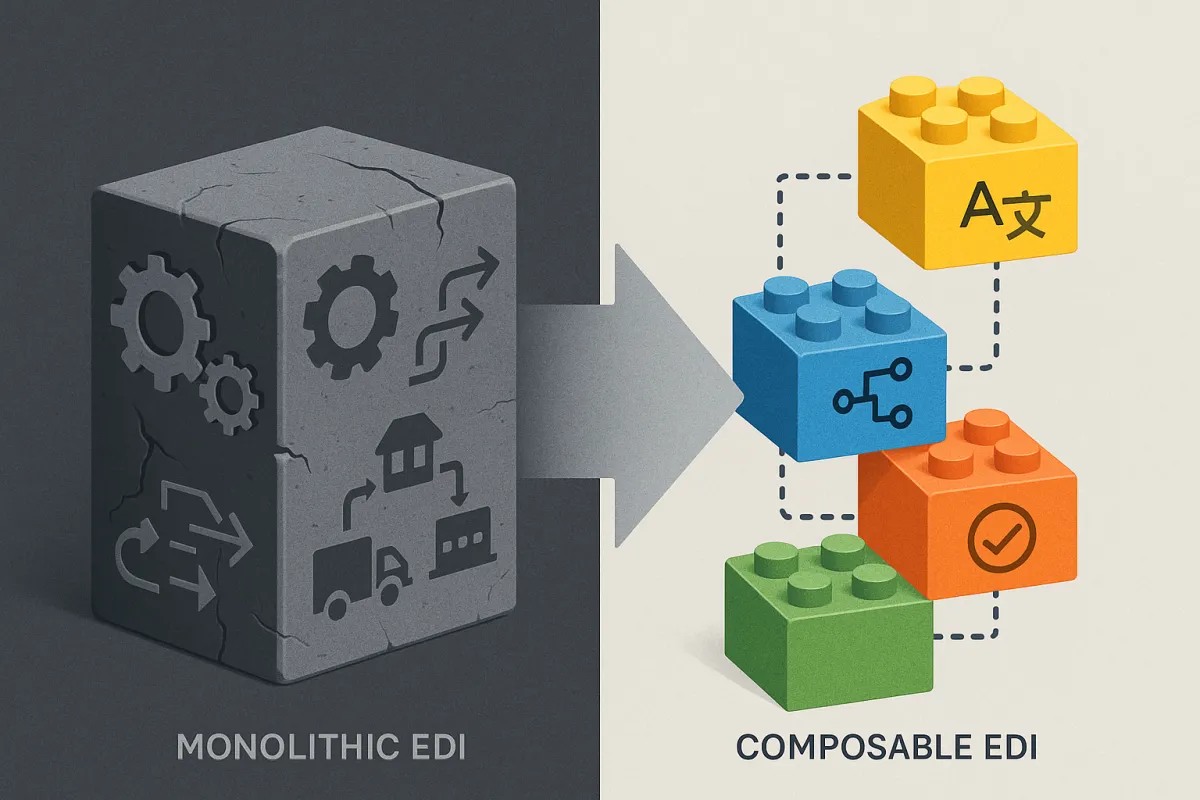
The most critical trends include the shift toward Composable EDI architectures, where traditional monolithic EDI systems are replaced with a modular approach where components can be independently deployed, replaced, or upgraded without impacting the entire system. This shift addresses a fundamental weakness in how supply chain teams build B2B integration. Where monolithic systems create vendor dependency and brittle connections, composable patterns enable resilient, vendor-agnostic architectures that survive the consolidation pressures reshaping the TMS market.
The Composable EDI Architecture Crisis: Why Traditional Integration Approaches Are Breaking
A German automotive manufacturer faced €800,000 in additional costs when carrier integration failures emerged post-acquisition of their chosen vendor. Their mistake wasn't technical incompetence. They followed the standard playbook: feature comparison spreadsheets, traditional vendor scoring, and the assumption that EDI integrations would remain stable through vendor ownership changes.
The numbers reveal why this approach fails consistently. WiseTech Global's $2.1 billion acquisition of E2open and Descartes Systems Group's acquisition of 3GTMS for $115 million signal the most significant vendor consolidation wave in TMS market history. Your future integration options are shrinking as independent platforms disappear into larger ecosystems.
Traditional monolithic EDI systems weren't designed for this market volatility. Traditional EDI systems were often built as monolithic platforms—rigid, tightly coupled, and difficult to modify. When your primary TMS vendor gets acquired, these tightly coupled integrations become liability anchors. The acquiring company prioritizes platform consolidation over customer-specific integration requirements, leaving you with expensive re-architecture projects or degraded functionality.
The €800K Integration Disaster Pattern
The German manufacturer's story follows a predictable pattern. Their mistake wasn't technical incompetence—it was using procurement frameworks that don't address the hidden bias and vendor dependency risks now plaguing European TMS selection. After vendor acquisition, their carefully mapped EDI connections required complete rebuilding because the new parent company deprecated legacy integration methods.
These failures compound beyond initial implementation costs. 66% of organizations reported losing up to $500,000 in 2020 due to non-compliance issues, while automotive manufacturers face downtime costs of $22,000 per minute. When EDI integrations fail during vendor transitions, these costs multiply across every affected trading partner relationship.
Compare this with organizations implementing composable EDI patterns. By abstracting integration logic from vendor-specific implementations, they avoid complete re-architecture when vendor circumstances change. Their modular components can connect to new platforms through standardized interfaces, protecting the investment in business logic while adapting to market consolidation.
Understanding Composable EDI Patterns vs. Traditional Monolithic Systems
Composable EDI refers to a modular architecture where integration capabilities are interchangeable blocks rather than a monolithic system. This matters because it allows IT leaders to upgrade specific components without risking the stability of the entire EDI environment.
The architectural shift follows established enterprise patterns. GraphQL and REST APIs provide the communication layer, while event-driven patterns using Kafka or AWS EventBridge enable asynchronous coordination between components. This API-first approach ensures vendor independence by treating each integration component as a replaceable service rather than a permanent dependency.
Four principles define successful composable EDI implementation:
- Modularity: Independent, reusable components that handle specific EDI functions (translation, routing, validation) without dependencies on vendor-specific platforms
- Interoperability: Seamless communication using standard protocols that work across different vendor ecosystems
- Autonomy: Each module functions independently, allowing targeted updates without system-wide testing
- Discoverability: Components are documented and accessible through API catalogs that enable rapid integration
Traditional vendors like IBM Sterling and SPS Commerce built their platforms during an era of vendor stability. Their architectures assume long-term partnerships with minimal platform changes. Modern solutions like Cargoson, TrueCommerce, and Orderful recognize market volatility and design for architectural flexibility from day one.
The Three Core Composable EDI Components
Composable EDI architecture requires three distinct layers that work together while maintaining independence:
Communication Layer: GraphQL and REST APIs provide the communication layer, while event-driven patterns using Kafka or AWS EventBridge enable asynchronous coordination between components. This layer handles protocol differences between partners without requiring custom integration for each connection.
Business Logic Layer: Domain-specific rules for partner requirements, document validation, and compliance checking operate independently of the underlying communication or storage systems. Changes to partner specifications don't require platform-wide updates.
Integration Layer: Standardized connectors that translate between EDI formats and internal systems. Modern data integration platforms prioritize defining APIs upfront using specifications like OpenAPI, allowing cross-platform consistency and reducing dependency on vendor-specific solutions.
Implementation Framework: Building Vendor-Agnostic EDI Architecture
Composable EDI implementation requires systematic progression through architectural layers. API gateway, event bus, and integration patterns must be in place before components can be composed effectively, preventing later re-architecture. Companies attempting to retrofit composability into monolithic systems face the same vendor lock-in risks they're trying to escape.
The implementation follows a three-phase approach that balances risk with operational requirements while building architectural independence.
Phase 1: Data Layer Abstraction and API Gateway Setup
Begin with data abstraction that isolates business logic from vendor-specific formats. Traditional monolithic data integration systems are giving way to composable architectures built on APIs and microservices. This shift enables modular, reusable data flows that align with agile development practices.
Establish an API gateway that normalizes partner communication regardless of underlying EDI standards. Whether partners use EDIFACT, X12, or proprietary formats, your internal systems interact through consistent APIs. This abstraction layer protects against vendor changes while enabling rapid partner onboarding.
Document mapping requirements using standards-based patterns rather than vendor-specific configurations. When platform changes occur, only the abstraction layer requires updates while business logic remains unchanged.
Phase 2: Business Logic Decoupling and Event-Driven Workflows
Separate partner-specific requirements from platform operations through event-driven architecture. Every data source and destination within an enterprise can be abstracted into two fundamental interface types—synchronous APIs for request-response patterns and asynchronous events for streaming, real-time data flows.
Business rules for document validation, partner compliance, and exception handling operate as independent services that consume events from the communication layer. This decoupling enables rules updates without platform downtime and supports complex workflows that span multiple partners.
Event-driven patterns also enable real-time monitoring and alerting that traditional batch EDI processing cannot provide. Traditional EDI connections become liability anchors when regulatory requirements change monthly and carrier onboarding delays compound operational risks.
Preventing the 73% TMS Integration Failure Rate Through Modular Design
76% of logistics transformations never meet their budget, timeline, or performance targets, yet European manufacturers face mandatory compliance requirements that leave no room for implementation delays. The convergence of vendor consolidation and regulatory pressure creates perfect storm conditions where traditional integration approaches break down.
Composable patterns reduce failure risk through bounded contexts that isolate partner-specific requirements. When one partner's integration encounters problems, other connections remain operational. Traditional monolithic systems create systemic failure points where platform-wide issues affect every trading relationship.
The architectural approach also addresses the hidden costs that drive budget overruns. Custom EDI mappings, API rate limits, and carrier-specific data formatting requirements cost €5,000-€50,000 per connection. Composable patterns amortize this cost across multiple partners through reusable components.
The Bounded Context Strategy for Trading Partner Onboarding
Implement bounded contexts that isolate partner-specific logic from core integration infrastructure. Each partner operates within defined boundaries where their unique requirements don't affect system-wide operations. Nearly two-thirds (63%) of IT decision-makers report that the EDI onboarding process takes too long due to customized partner requirements.
Design partner contexts with standardized interfaces that expose necessary functionality while hiding implementation complexity. New partners integrate through the same APIs regardless of their EDI standards or communication protocols. This approach transforms partner onboarding from custom development projects into configuration exercises.
Bounded contexts also enable gradual migration from legacy systems. Partners can move to new integration methods individually rather than requiring coordinated platform-wide upgrades that create systemic risk.
Surviving the 2026 Vendor Consolidation Wave with Architecture Independence
WiseTech Global's $2.1 billion acquisition of E2open and Descartes Systems Group's acquisition of 3GTMS for USD 115 million signal the most significant vendor consolidation wave in TMS market history. The timing isn't coincidental — regulatory requirements including eFTI compliance by July 2027 and ICS2 version 3 messaging from February 2026 create urgency that accelerates vendor decision-making.
Organizations with composable EDI architectures navigate consolidation with minimal disruption. Their standardized integration patterns work across vendor platforms, reducing switching costs and eliminating vendor lock-in scenarios. When MercuryGate becomes Infios or E2open integrates with WiseTech, API-first architectures adapt through configuration changes rather than complete re-implementation.
Implementation costs often running 2-3x the subscription fees for shippers with annual freight under management exceeding €250M reflect the hidden expenses of platform-specific customizations. Composable patterns eliminate these costs by treating vendor platforms as interchangeable infrastructure rather than architectural foundations.
Future-Proofing Through Standards-Based Integration
Build integrations using industry-standard protocols that transcend vendor implementations. Modern data integration platforms prioritize defining APIs upfront using specifications like OpenAPI, allowing cross-platform consistency and reducing dependency on vendor-specific solutions.
Standards-based approaches protect against the feature deprecation risks that follow vendor acquisitions. When acquiring companies consolidate platforms, they typically maintain support for industry standards while eliminating proprietary features. Organizations built on composable patterns continue operating while competitors face costly migration projects.
The investment in standards compliance pays dividends during regulatory changes. Starting July 1, 2026, European manufacturers managing significant transport operations face mandatory eFTI compliance, ICS2 version 3 messaging, and integration requirements that EDI-based TMS platforms cannot handle efficiently. Composable architectures adapt to new requirements through modular updates rather than platform replacement.
Measuring Success: KPIs and ROI Frameworks for Composable EDI
Traditional EDI metrics focus on transaction volumes and error rates. Composable architectures require different measurement approaches that capture architectural resilience and vendor independence.
Track deployment frequency and lead time for changes as indicators of architectural flexibility. Composable architectures enable enterprises to plug in new analytics or visualization tools instantly, reducing innovation lead time by up to 50%. Organizations with modular EDI environments onboard new partners faster and adapt to regulatory changes without extended development cycles.
Monitor total cost of ownership including hidden vendor dependency costs. Because each module scales independently, composable ecosystems lower the total cost of ownership by as much as 37%. Calculate savings from avoided re-architecture projects, reduced vendor switching costs, and eliminated custom integration maintenance.
Measure team productivity through reduced time spent on vendor-specific troubleshooting and platform maintenance. Composable patterns enable development teams to focus on business requirements rather than integration complexity, accelerating feature delivery and reducing technical debt accumulation.
The implementation timeline varies by organizational complexity, but an MVP of composable architecture works well within 12–16 weeks on average, including data modeling and first activation destinations. This timeline compares favorably with traditional EDI implementations that often require 6-12 months for equivalent functionality.
Start your composable EDI transition now, while vendor options remain diverse and implementation timelines allow proper testing. The procurement window for securing optimal TMS platforms before vendor consolidation eliminates choices runs through Q1 2026. Organizations that delay risk joining the 73% of integration projects that fail when market dynamics shift beyond their control.