The Critical EDI Capacity Planning Crisis: Your Complete Framework to Prevent Holiday Volume Crashes and Transaction Bottlenecks in Peak Season 2025

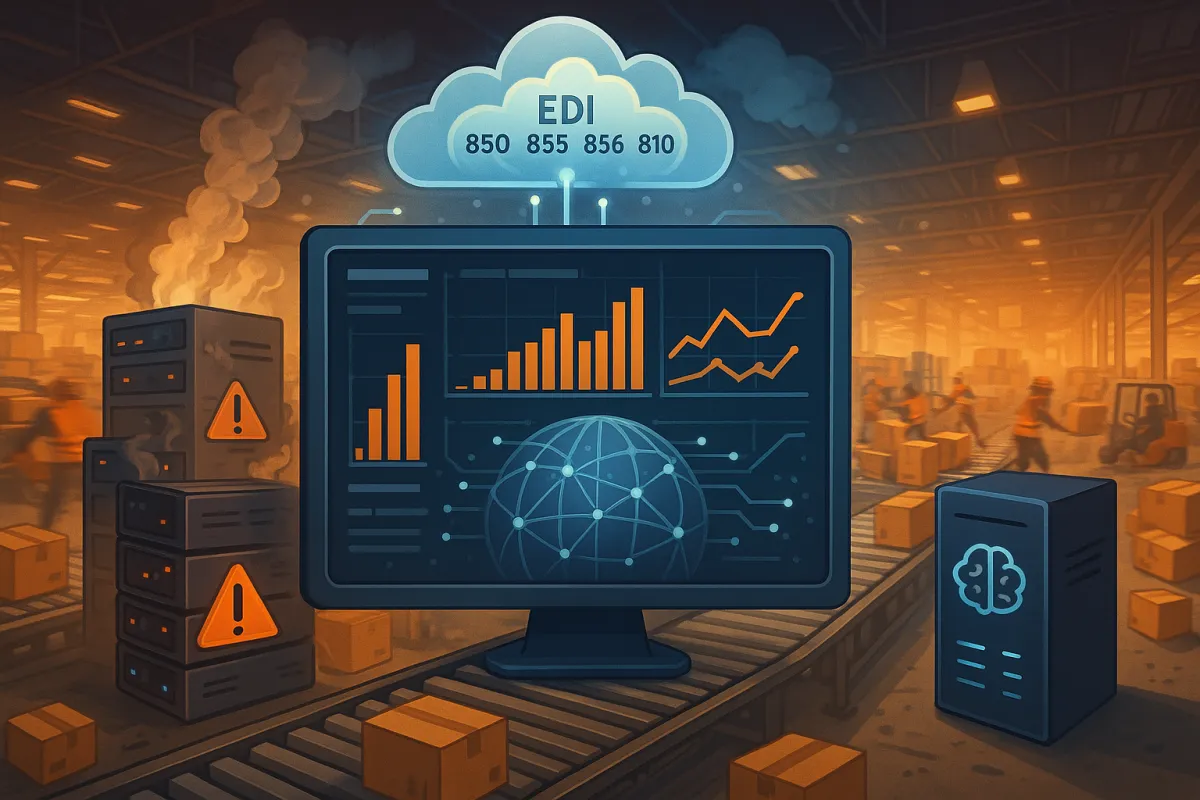
Peak season EDI capacity planning has become one of the most challenging aspects of supply chain management, as transaction volume surges during holiday periods like Black Friday and Cyber Monday can overwhelm infrastructure and cause costly disruptions. Research shows that even modest peak season increases can shift suddenly, with some companies expecting reduced activity while others anticipate growth, creating an unpredictable capacity planning environment. Companies using reactive supply chain management lose up to 10% of annual revenue due to inefficiencies from excess inventory, stockouts, and increased transportation expenses.
Most EDI managers know the frustration of watching their systems buckle under unexpected transaction spikes. You've likely experienced the 3 AM phone calls when transaction processing slows to a crawl during a flash sale, or dealt with trading partner complaints about delayed EDI acknowledgments during peak shipping windows. The traditional approach of over-provisioning infrastructure year-round costs too much, while under-provisioning risks catastrophic failures during your most profitable periods.
Why Static EDI Infrastructure Fails When Volume Explodes
Testing systems under simulated peak volume conditions reveals whether EDI software and hardware can handle increased transaction volumes, but many organizations only discover capacity limitations during actual peak periods. Traditional EDI capacity planning relies on historical data patterns that don't account for the increasing volatility of modern supply chains.
Spot market truck rates can rise by 20-30% during retail shipping peaks, but the same capacity constraints affect EDI transaction processing when backend systems become overwhelmed. The problem compounds when multiple trading partners experience simultaneous volume spikes, creating a cascading effect across your entire EDI network.
Consider what happens during a typical Black Friday weekend. Your largest retail partner suddenly processes 400% more purchase orders than normal. Each PO generates multiple EDI transactions: the initial 850 purchase order, followed by 855 acknowledgments, 856 advance ship notices, and 810 invoices. A single surge in retail orders creates a multiplicative effect on EDI processing requirements.
The global EDI market is projected to reach $49.21 billion by 2027, with adoption continuing to rise as organizations realize the value EDI brings to operations. Yet most companies still rely on static infrastructure that can't adapt to demand fluctuations.
AI-Powered Demand Forecasting: Moving Beyond Historical Patterns
AI in demand planning introduces precision, agility, and responsiveness by understanding historical patterns, detecting emerging trends, and rapidly responding to market disruptions in real-time, which improves forecast accuracy and strengthens the entire supply chain.
EDI archives contain rich transactional histories, and AI can use this data for inventory management, demand forecasting, and anomaly detection, with machine learning models able to predict late shipments or inventory shortages based on past EDI 856 Advance Ship Notices.
Modern AI forecasting systems analyze multiple data streams simultaneously. Amazon's AI models analyze sales trends, social media activity, economic indicators, and weather patterns to predict demand fluctuations, allowing for dynamic inventory adjustments across warehouses. You can apply similar approaches to EDI capacity planning.
Here's what intelligent EDI forecasting looks like in practice: Your system monitors transaction velocity across all trading partners, correlates spikes with external events (holidays, promotions, weather disruptions), and identifies leading indicators that precede volume surges. Machine learning models trained on your historical EDI transaction logs can predict capacity needs 72 hours before peak periods begin.
AI-driven demand forecasting reduces forecast errors by 20% to 50% and reduces lost sales by up to 65%. Predictive analytics enables accurate demand forecasting and smarter capacity planning by analyzing historical data. When applied to EDI infrastructure, these accuracy improvements translate directly into more reliable transaction processing during critical periods.
Building Dynamic EDI Infrastructure That Scales in Real-Time
Leading companies deploy agentic AI systems that update supply, production and logistics plans in real time, scanning demand updates, supplier signals, inventory imbalances, transit delays and external risks, then adjusting plans within minutes. The same principle applies to EDI capacity management.
With structured, complete, and accurate EDI data, supply chain leaders can embed autonomous AI agents into EDI workflows to alert, interpret, act on, and optimize data in real-time. This means your EDI infrastructure can automatically scale computing resources, prioritize critical trading partner connections, and reroute transaction processing loads without human intervention.
Real-time resource allocation works through several mechanisms. Cloud-based EDI platforms like those offered by Cargoson, IBM Sterling, TrueCommerce, and Cleo can automatically provision additional processing capacity when transaction queues reach predefined thresholds. Hybrid architectures combine on-premise EDI servers for baseline capacity with cloud bursting for peak demand periods.
Advanced concurrent planning engines synchronize demand, supply, inventory, and capacity in real-time, targeting large companies who need lightning-fast responsiveness to disruptions, with systems enabling millions of scenario simulations in seconds. Similar concurrent processing approaches can handle EDI transaction spikes across multiple trading partners simultaneously.
The key is implementing tiered processing priorities. Critical trading partners and high-value transactions get processed first, while lower-priority EDI traffic queues during peak periods. Automated failover systems redirect processing loads across multiple data centers when individual servers approach capacity limits.
Your Complete EDI Capacity Assessment Framework
Accurate forecasting enhances the ability to anticipate bottlenecks and determine optimal levels of labor, warehouse space, and capacity well in advance of peak seasons. The same systematic approach applies to EDI infrastructure planning.
Start by establishing performance baselines across four key metrics: CPU utilization during normal operations versus peak periods, memory consumption patterns for different EDI transaction types, storage throughput requirements for archive and retrieval operations, and network latency measurements for trading partner connections.
Review historical data to identify common peak season issues and establish thresholds for alerts ensuring notifications reach the right teams. Your assessment should identify the specific transaction types that consume the most resources. EDI 850 purchase orders with complex line items require more processing power than simple 997 functional acknowledgments.
Map transaction flows across your entire EDI ecosystem. Document how many 850s typically generate 855s, what percentage require manual intervention, and which trading partners consistently send high-volume batches during specific time windows. This transaction topology becomes the foundation for capacity modeling.
Compare your infrastructure capabilities with industry benchmarks. Modern agentic EDI platforms can process thousands of transactions per minute, while traditional systems may struggle with hundreds. Understanding these performance gaps helps prioritize infrastructure investments.
Vendor comparisons reveal significant capability differences. IBM Sterling offers robust on-premise processing with cloud scaling options, TrueCommerce provides fully managed EDI services with guaranteed uptime, Cleo focuses on hybrid integration capabilities, while Cargoson's TMS integration enables dynamic resource allocation across transportation and EDI workflows.
Peak Season Stress Testing and Performance Optimization
Testing systems under simulated peak volume conditions, confirming backups and redundancies are operational, and ensuring EDI software is updated to the latest version are essential preparation steps. However, most companies conduct inadequate stress testing that doesn't reflect real-world peak scenarios.
Effective EDI stress testing requires multiple simulation approaches. Volume testing pushes transaction processing to 300-500% of normal capacity to identify breaking points. Burst testing sends concentrated transaction spikes over short time periods, mimicking flash sale scenarios. Endurance testing sustains elevated transaction volumes for extended periods, replicating multi-day peak seasons.
Testing failover systems ensures smooth transitions during disruptions. Your testing protocol should include simulated trading partner outages, network connectivity failures, and primary server crashes during peak processing periods. Document recovery times and identify bottlenecks that slow failover procedures.
Performance optimization focuses on the most resource-intensive processes. Data mapping and transformation consume significant CPU cycles, especially for complex EDI formats. Consider pre-processing common trading partner formats during off-peak hours, caching frequently accessed code sets, and optimizing database queries that retrieve partner-specific mapping rules.
Data mapping has always been one of the most time-consuming aspects of EDI, but AI now accelerates this process by learning from semantic models and automating field matching, reducing setup time and simplifying updates. Intelligent mapping reduces processing overhead during peak periods by eliminating redundant transformation steps.
Implementing Intelligent Auto-Scaling and Failover Systems
Having a backup plan for system downtime includes identifying alternative communication methods for critical transactions and preparing failover systems with emergency contacts to maintain transaction flow. Modern EDI infrastructure requires more sophisticated auto-scaling than basic backup procedures.
Intelligent auto-scaling triggers respond to multiple variables simultaneously. Transaction queue depth, processing latency, error rates, and trading partner connection status all influence scaling decisions. Simple CPU-based triggers often respond too slowly for EDI workloads that can spike instantly when large batch files arrive.
Cloud bursting strategies enable hybrid EDI architectures that maintain on-premise processing for baseline capacity while automatically provisioning cloud resources during peaks. Large commitments to compute capacity increase overall availability, with compute scarcity previously being a bottleneck for organizations wanting to run forecasting models more frequently. This improved capacity availability benefits EDI auto-scaling implementations.
Disaster recovery protocols must account for EDI-specific requirements. Unlike typical application failover, EDI systems require maintaining transaction sequence integrity, preserving trading partner connection states, and ensuring compliance with partner-specific communication protocols. Your failover system should automatically notify trading partners of processing delays and provide estimated recovery times.
Suppliers and trading partners need to manage disruptions during peaks in real-time, limiting excess inventory while preparing for unexpected surges in sales or disruptions that can cause early shortages. Your EDI failover system becomes part of this broader supply chain resilience strategy.
Enterprise solutions offer varying approaches to auto-scaling. IBM Sterling provides policy-based scaling with integration to major cloud platforms, TrueCommerce handles scaling automatically through managed services, while Cargoson's TMS platform integrates EDI scaling with transportation capacity management for comprehensive supply chain optimization.
Cost-Benefit Analysis and ROI Measurement
Organizations evaluate AI integration effectiveness by examining KPIs like decreased expenses, enhanced forecasting precision, and better operational effectiveness, with metrics including inventory turnover rates, order fulfillment speed, and customer satisfaction assessed to determine real benefits and ROI.
EDI capacity planning investments require careful cost modeling. Cloud-based scaling costs fluctuate with usage patterns, making peak season expenses predictable but potentially expensive. On-premise infrastructure requires larger upfront investments but provides more predictable operating costs during high-volume periods.
Early adopters of AI in supply chain improve logistics costs by 15%, inventory levels by 35%, and service levels by 65%. Applied to EDI infrastructure, these improvements translate into reduced transaction processing costs, fewer failed transmissions requiring retransmission, and improved trading partner satisfaction scores.
Managed service versus in-house cost models vary significantly based on transaction volumes and complexity. Companies can hire outside providers to tackle all EDI-related responsibilities, with some managed service providers allowing custom plans where customers decide which tasks remain in-house versus outsourced.
ROI calculations should include avoided costs from system failures during peak periods. A single day of EDI downtime during Black Friday weekend can cost retailers millions in delayed orders and trading partner chargebacks. The cost of intelligent capacity planning often pays for itself by preventing one major outage.
Strategic vendor positioning reveals different value propositions. Traditional providers like IBM Sterling and TrueCommerce offer proven reliability with premium pricing. Cargoson provides cost-effective scaling solutions by integrating EDI capacity management with transportation optimization, potentially reducing total supply chain technology costs.
Consider implementing a phased approach to capacity planning investments. Start with basic auto-scaling for your highest-volume trading partners, then expand AI-powered forecasting to additional EDI connections. This approach allows forecasting accuracy to improve over time, positioning your business to take advantage of peak seasons and improve profitability. The measurement framework you establish during initial implementation becomes the foundation for justifying expanded AI investments across your entire EDI infrastructure.