The Critical EDI Staffing Crisis Decision Framework: In-House vs Managed Services Cost-Benefit Analysis and Implementation Guide for Supply Chain Leaders in 2025

The shortage of trained EDI professionals is leaving many companies struggling to maintain and expand EDI capabilities, and the situation has reached crisis levels. Many of the professionals who initially implemented and managed EDI systems are now reaching retirement age, taking with them years of specialized knowledge and hands-on experience. Add to this the brutal truth that EDI professionals are in high demand but there is a limited supply, and you're looking at a supply chain technology crisis that's forcing companies to make critical decisions about how they manage their EDI operations.
The numbers paint a stark picture. As many as 29% of businesses say that they lack the skilled resources to build and manage integrations between systems, applications, and partner ecosystems. Meanwhile, IDC predicts that by 2026, more than 90% of organizations worldwide will feel the pain of the IT skills crisis, amounting to some $5.5 trillion in losses caused by product delays, impaired competitiveness, and loss of business.
This puts supply chain leaders in an impossible position: maintain complex EDI operations with a shrinking talent pool, or find an alternative that doesn't compromise their trading partner relationships.
The EDI Skills Crisis Reality Check
Industries such as retail, healthcare, automotive, and logistics — which rely heavily on the smooth flow of electronic documents — are feeling the pressure to upgrade their EDI systems to support modern supply chain operations. The recent global supply chain disruptions have only highlighted the importance of robust and scalable EDI solutions, further increasing the demand for trained professionals to manage these critical systems.
Here's what makes this crisis particularly challenging: While many universities and technical schools offer degrees in information technology, computer science, and business management, EDI is rarely a focus of these programs. As a result, few graduates enter the workforce with a specific understanding of EDI systems, protocols, and standards. Most EDI professionals learn on the job, picking up knowledge as they go.
The generational shift compounds the problem. Additionally, newer technologies such as APIs and blockchain are becoming more prevalent in supply chain management, leading to concerns that EDI will eventually be phased out or replaced. This perception may discourage younger professionals from pursuing careers in EDI, further contributing to the shortage.
Sound familiar? You're probably dealing with one of these scenarios: an aging EDI specialist threatening retirement, failed attempts to hire qualified replacements, or astronomical contractor rates for basic EDI maintenance. Transport management vendors like MercuryGate and Descartes are facing the same staffing challenges, making the competition for qualified professionals even fiercer.
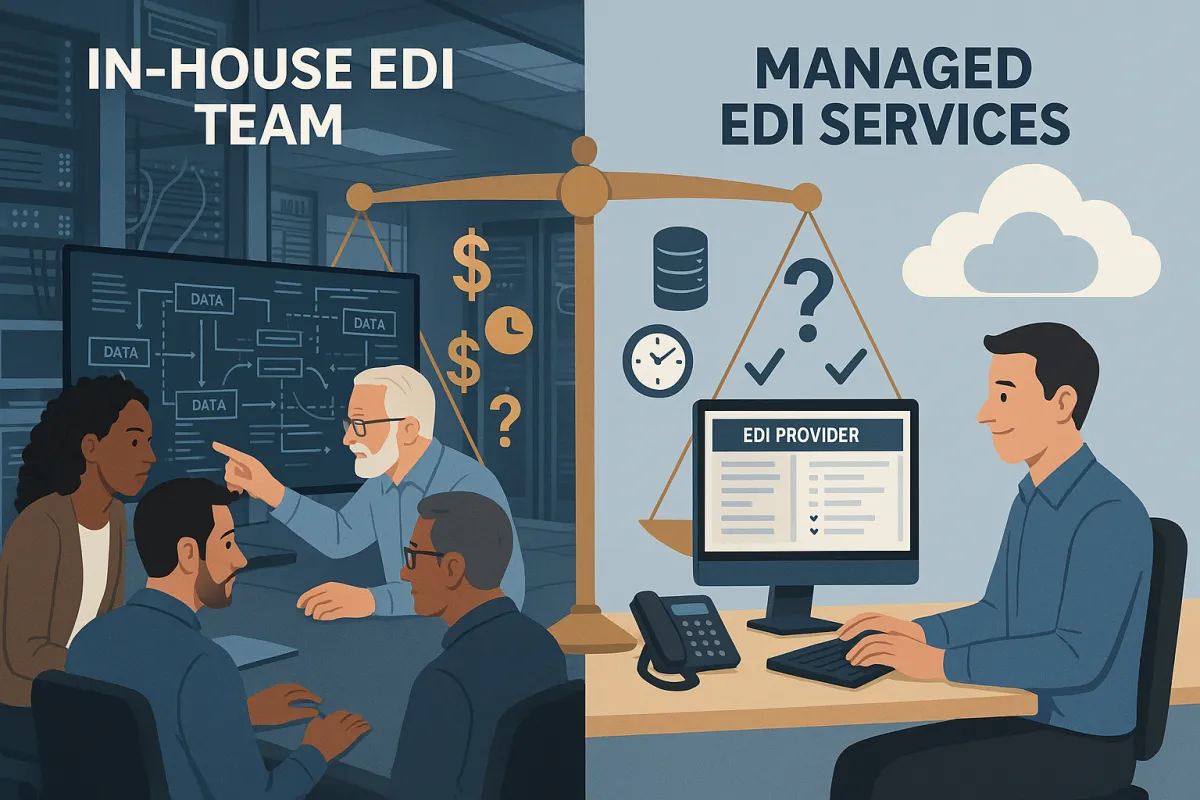
The Hidden Costs of In-House EDI Teams
However, the need for good talent within an IT department is as high as it's ever been. Staffing on-premise resources is often competitive as well as quite expensive. But the salary is just the tip of the iceberg when calculating the true cost of maintaining an in-house EDI operation.
Consider the full scope of responsibilities for your EDI staff: This can be a time-consuming and intricate role as the employee is responsible for onboarding new trading partners, creating new connections, building maps, tracking orders, monitoring for issues and discrepancies, performing error resolution, and more. You're not just paying for one person; you're funding a complex operational function that requires diverse skills.
The real costs break down like this:
- Personnel costs: Senior EDI analysts command $85,000-$120,000+ annually, plus benefits that typically add another 30-40%
- Training and certification: New hires require months of training on your specific systems and trading partner requirements
- Software licensing: EDI mapping tools, translation software, and monitoring platforms can cost $15,000-$50,000+ annually
- Infrastructure maintenance: Server costs, backup systems, security updates, and disaster recovery planning
- Turnover replacement: When specialists leave, you're looking at 3-6 months to find and train replacements
Here's the part most executives miss: For larger organizations, managing a large EDI ecosystem can quickly become complex and overwhelming for internal teams. You're not just maintaining current operations; you're expected to onboard new partners, handle increasing transaction volumes, and adapt to changing compliance requirements. All while hoping your key person doesn't get poached by a competitor offering a 25% raise.
Transport management solutions like Cargoson have integrated EDI capabilities precisely because they recognize the complexity companies face when managing separate systems and teams.
Managed EDI Services: The Strategic Alternative
For organizations looking to outsource the heavy lifting, managed EDI services or B2B managed services from a third-party EDI provider are the most hands-off and scalable option. This approach is ideal for companies with limited internal IT resources or those seeking access to outsourced expertise.
The value proposition is compelling: By leveraging the expertise of EDI managed service providers, businesses can enhance their ability to meet trading partner requirements, ultimately fostering better business relationships and driving growth. You're essentially trading capital expense for operational expense while gaining access to specialized expertise that would be impossible to maintain in-house.
Modern managed services go far beyond basic transaction processing. Our comprehensive EDI support can include everything from onboarding trading partners, adding or changing maps, monitoring SLAs, resolving errors, updating trading partner certificates, 24/7 customer support, and much more. This includes integration with your existing systems, whether that's your ERP, transport management platform like Cargoson, or warehouse management system.
The service levels typically break down into three categories:
- Self-managed: You maintain control over mapping and configuration while the provider handles infrastructure and connectivity
- Fully-managed: The provider handles all aspects of EDI operations, from partner onboarding to error resolution
- Blended approach: Strategic elements remain in-house while operational tasks are outsourced
Major providers like TrueCommerce, SPS Commerce, IBM Sterling, and Cleo offer various managed options. The key differentiator isn't just the technology platform but the level of expertise and support you're gaining access to.
The Decision Matrix: 8 Critical Evaluation Criteria
Making the right choice requires evaluating your specific situation against eight critical factors. This isn't about finding the cheapest option; it's about finding the most sustainable approach for your organization.
1. Current staffing situation and skills gap
Do you have qualified EDI staff, or are you relying on someone nearing retirement? But the issue is that there are only so many qualified IT pros to go around and that the cost of an integration skills shortage is far from insignificant. If you're already understaffed or facing turnover risk, managed services becomes more attractive.
2. Trading partner volume and complexity
Managing 10 partners is different from managing 100. Smaller businesses may not be able to afford to pay a full-time employee to handle all their EDI tasks, while large enterprises may need dedicated teams. The tipping point is usually around 25-30 active trading partners where internal management becomes cost-prohibitive.
3. Integration requirements
How many systems need EDI connectivity? Your ERP is obvious, but what about your transport management system, warehouse management platform, or e-commerce systems? Modern solutions like Cargoson offer built-in EDI capabilities that can simplify integration requirements.
4. Compliance and regulatory requirements
Healthcare, automotive, and government sectors have specific EDI compliance requirements. Managed services providers typically maintain compliance expertise across multiple industries, while internal teams may struggle to stay current with changing regulations.
5. Growth trajectory and scalability needs
Are you planning to add trading partners, enter new markets, or increase transaction volumes? Speed Time-to-Revenue: Onboard trading partner in as little as a few hours when utilizing our thousands of customizable pre-built integrations. Internal teams often become bottlenecks during growth phases.
6. Budget structure preferences
Most businesses find the right balance between cost-efficiency and operational capability with option 2 or option 3 to avoid the overhead of in-house systems. Do you prefer predictable monthly costs or are you comfortable with variable staffing expenses?
7. Control and transparency requirements
Some organizations need complete visibility into their EDI operations for audit or competitive reasons. Unlike other EDI managed service providers that hold your data hostage and provide zero insight into integrations and data, with Cleo, you own your integrations. You have glass-box transparency and control, meaning you can look into any integration and transaction to find critical data.
8. Risk tolerance
What happens if your EDI specialist leaves tomorrow? How long can your business operate with disrupted partner communications? Managed services provide redundancy that's nearly impossible to achieve with internal teams.
Implementation Roadmap for Each Path
Building an In-House Team: The 12-Month Journey
Month 1-2: Strategic planning and needs analysis
- Document current EDI requirements and trading partner specifications
- Assess integration needs with existing systems (ERP, TMS, WMS)
- Define staffing requirements and budget allocation
Month 3-4: Solution selection and procurement
- Evaluate EDI software platforms and infrastructure requirements
- Select integration tools and monitoring systems
- Negotiate software licensing and support contracts
Month 5-6: Team recruitment and system setup
- Hire EDI specialists (expect 2-4 months for qualified candidates)
- Install and configure EDI software and infrastructure
- Establish development and testing environments
Month 7-9: Integration and mapping development
- Build connections to existing business systems
- Develop and test data mapping for key trading partners
- Establish monitoring and error handling procedures
Month 10-12: Testing, training, and go-live
- Conduct end-to-end testing with critical trading partners
- Train internal staff on system operations and troubleshooting
- Migrate live trading partner connections from legacy systems
Managed Services Implementation: The 90-Day Fast Track
Month 1: Provider selection and initial configuration
- Complete provider evaluation and contract negotiation
- Begin discovery process for existing EDI requirements
- Establish project timeline and milestone schedule
Month 2: Integration and testing
- Configure API connections to ERP and other business systems
- Set up trading partner connections using provider's existing templates
- Conduct integration testing with transport management systems like Cargoson
Month 3: Go-live and optimization
- Migrate trading partners to new managed platform
- Establish monitoring dashboards and reporting procedures
- Complete knowledge transfer to internal stakeholders
The timeline difference is significant. While in-house implementation requires 12 months and significant internal resources, managed services can be operational in 90 days with minimal internal involvement.
Risk Mitigation and Success Factors
Both approaches carry risks, but they're different types of risks that require different mitigation strategies.
In-House Risks and Mitigation
The biggest risk is personnel dependency. The lack of effective knowledge transfer within organizations exacerbates the problem, as new hires often face a steep learning curve when it comes to understanding legacy systems and the complexities of EDI implementation and integration. Mitigate this by:
- Maintaining detailed documentation of all trading partner configurations
- Cross-training multiple team members on critical systems
- Establishing relationships with EDI consultants for emergency support
- Creating succession plans for key personnel
System integration failures present another major risk. Ensure success by maintaining separate development and production environments, establishing comprehensive testing procedures, and planning for rollback scenarios.
Managed Services Risks and Mitigation
Vendor dependency becomes your primary risk with managed services. And while some providers claim to offer managed services, they actually outsource the services to a third-party business to handle, meaning they are just a middleman which can drive up costs and complexities. Protect yourself by:
- Negotiating data portability clauses in your contract
- Maintaining copies of all mapping specifications and trading partner documentation
- Establishing performance metrics and service level agreements
- Planning for provider transition scenarios
Performance and communication issues can also emerge. Address these by establishing clear escalation procedures, regular performance reviews, and maintaining internal EDI knowledge even when outsourcing operations.
Both approaches require ongoing attention to compliance and security. Modern threats require continuous monitoring and updates, whether you're managing internally or through a provider.
2025 Market Outlook and Strategic Recommendations
The EDI landscape is evolving rapidly, driven by the EDI (electronic data interchange) market is projected to reach $49.21 billion by 2027. This growth is being fueled by API integration, cloud adoption, and artificial intelligence capabilities that are changing how EDI systems operate.
The growth of cloud computing has rewritten the rules for EDI integration software deployment as well as service consumption models. Businesses continue to migrate applications, connections, data, and integration to the cloud, including EDI. This shift favors managed services providers who can invest in modern infrastructure and maintain expertise across multiple platforms.
AI integration is becoming a competitive advantage. As we see artificial intelligence continuing to break into nearly every sector of business, there is no doubt artificial intelligence (AI) can and will be integrated with electronic data interchange (EDI) to enhance B2B processes. AI can help to automate and streamline EDI-based processes in several ways, including: Automating data entry and conversion.
Based on these trends and the staffing crisis reality, here are strategic recommendations by company profile:
Small to Mid-Size Companies (Under 50 trading partners)
Managed services is almost always the better choice. Smaller businesses may not be able to afford to pay a full-time employee to handle all their EDI tasks. Focus on providers who offer transparent pricing, quick onboarding, and integration with your existing transport management systems like Cargoson.
Mid-Market Companies (50-200 trading partners)
This is where the decision becomes complex. If you have strong IT capabilities and expect significant growth, a blended approach might work best. Maintain strategic control while outsourcing operational tasks. Consider your industry's compliance requirements and integration complexity.
Large Enterprises (200+ trading partners)
The choice depends more on strategic priorities than cost. In-house teams make sense if EDI is a competitive differentiator or if you have unique requirements that require custom development. Otherwise, managed services can provide better scalability and expertise access.
Companies in Transition
If you're currently struggling with staffing gaps or facing retirement of key personnel, managed services provides the fastest path to stability. You can always bring capabilities back in-house later if your situation changes.
The EDI skills shortage isn't going away. If anything, it's going to get worse as remaining professionals retire and younger talent gravitates toward newer technologies. Making the right decision now positions your organization for sustainable growth while protecting your trading partner relationships.
Your next step should be conducting an honest assessment of your current situation against the eight evaluation criteria. Whether you choose to build internal capabilities or partner with managed services, the key is making a decision based on your long-term strategic needs rather than short-term cost considerations.