The Critical EDI-to-E-Invoicing Transformation Framework: How to Navigate EU Compliance Mandates Without Disrupting Your Supply Chain Operations in 2025

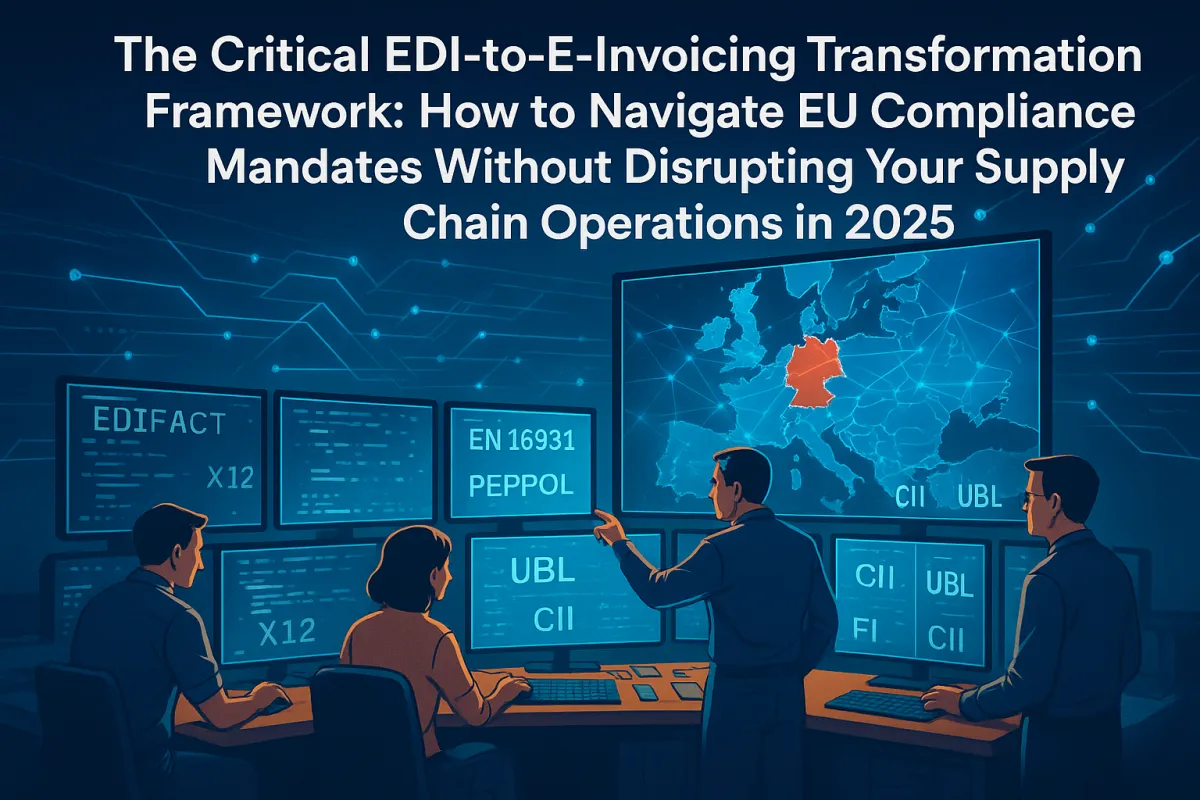
Since January 2025, many German taxpayers are subject to mandatory e-invoicing requirements for business-to-business transactions. The first phase of Germany's business-to-business (B2B) e-invoicing mandate comes into effect, requiring German businesses to be able to receive e-invoices for B2B transactions. All German businesses must accept electronic invoices in a structured format. This puts Germany at the forefront of the EU's digital transformation push, but it also creates a massive challenge for companies running traditional EDI systems that weren't designed for European Norm (EN) 16931 compliance.
Most supply chain professionals built their EDI infrastructure around EDIFACT INVOIC messages, X12 810 transactions, or custom XML formats. Today's accepted practices, such as PDFs, traditional EDI, or audit-compliant file storage, will no longer meet the legal requirements. EDI procedures will no longer be permitted as of 2028 if the required information cannot be extracted into a format that complies with or is compatible with the European standard. The gap between your current EDI invoice processing and EN 16931 compliance isn't just technical - it's a complete structural mismatch that requires strategic planning, not just a software upgrade.
Understanding the Technical Requirements: EN 16931, PEPPOL, and Format Compatibility
This is the core European standard for e-invoicing. Compliance ensures interoperability across different systems. EN 16931 is the European standard for electronic invoicing. Compliance with this standard ensures interoperability between different e-invoicing systems across Europe. But here's what most EDI managers miss: The European Standard EN 16931 provides two types of XML schemas: Universal Business Language (UBL) and UN/CEFACT Cross Industry Invoice (CII). For SAP systems this represents the first challenge. SAP systems are unable to populate UBL or CII data on the SD side (Sales and Distribution) out of the box.
Your traditional EDIFACT INVOIC format contains most of the required data elements, but the structural differences are significant. Acceptable e-invoicing formats must be compatible with standards outlined in European Norm (EN) 16931, such as XRechnung and ZUGFeRD. If an e-invoice is to meet the requirements of the EU standard EN 16931 then the XRechnung and ZUGFeRD formats mentioned above come into play, as well as the Peppol BIS format.
The PEPPOL network advantage becomes clear when you're dealing with multiple European trading partners. Behind this abbreviation stands Pan-European Public Procurement On-Line – the most important network for e-procurement and business transactions in Europe. Simply put, Peppol, as a so-called eDelivery network provides standardized technical specifications and protocols so that companies, authorities and organizations can send and receive electronic documents securely and efficiently. Peppol promotes cross-border trade and improves interoperability between different e-procurement systems by providing a unified EU-compliant approach to the exchange of information such as invoices, orders and shipping notices.
Data mapping between EDI and EN 16931 requires careful attention to mandatory fields. When sending e-invoices, great attention should be paid to carefully validating the data to ensure that the transmitted information is correct and complete. This can be achieved by means of appropriate validation rules and procedures, which ensure that the invoice data meets the defined standards and contains no errors.
The 5-Phase EDI-to-E-Invoicing Transformation Strategy
Here's the framework we've used successfully across three different manufacturer implementations, adapted specifically for the German mandate timeline:
Phase 1: Current State Assessment and Gap Analysis
Start by inventorying your existing EDI invoice flows. Document which trading partners use EDIFACT, which use X12, and which use proprietary formats. Map your current data elements against EN 16931 mandatory fields. The next step is to identify the relevant systems and interfaces that need to be considered to send and receive invoices in compliance with the EU standard. To do this, you need to determine what additional data is required to create e-invoices. This is the only way to ensure seamless integration with your financial accounting, ERP, archiving and document management systems.
Most EDI systems capture 70-80% of EN 16931 requirements already. The common gaps include payment terms specifications, tax category details, and buyer/seller identification in PEPPOL format. You'll need VAT numbers in the correct ISO format and proper party identification schemes.
Phase 2: Technical Architecture Planning and Vendor Selection
Parties should agree on the method of delivery of the e-invoice. Among the methods of transmission allowed are sending e-invoices by e-mail, making the data available via an electronic interface, shared access to a central storage location within a group of companies, or the possibility of downloading via an Internet portal. The minimum e-invoicing requirements per BMF is "The provision of an e-mail inbox is sufficient for the receipt of an e-invoice" Alternatively, taxpayer counter parties may agree on other electronic data exchange methodologies.
However, email isn't scalable for enterprise EDI volumes. Consider PEPPOL network integration through established providers like TrueCommerce, SPS Commerce, or Cargoson for transport-integrated solutions. Each offers different strengths: TrueCommerce excels in retail EDI migration, SPS Commerce handles supplier onboarding at scale, while Cargoson provides integrated transport management alongside EDI transformation.
The decision between building internal EN 16931 mapping capabilities versus using a managed service depends on your transaction volumes and technical resources. For companies processing over 10,000 invoices monthly, hybrid approaches work best - maintain critical EDI connections while migrating smaller partners to PEPPOL.
Phase 3: Pilot Implementation with Key Trading Partners
Select 3-5 trading partners representing different complexity levels. Start with partners already using structured data formats. EDI companies benefit greatly from the interoperability improvements of eB2B. With the new framework, EDI companies can send existing e-invoices through the Peppol network without significant changes required.
Run parallel processing during the pilot - continue existing EDI flows while testing EN 16931 compliant invoices. This approach reveals data quality issues and timing problems before full rollout. Document error patterns and create validation rules for common issues like incorrect VAT number formats or missing payment terms.
Phase 4: Full Rollout and Partner Onboarding
The German mandate timeline gives you breathing room: As part of Germany's phased approach to implementing e-invoicing, the requirement to issue e-invoices for businesses of all sizes and turnover will be in place by January, 2028. German authorities clarify that while all businesses must be capable of receiving e-invoices by January 2025, issuing them remains optional until 2027.
Use this transition period strategically. January 1, 2027: Companies with an annual turnover of at least 800,000 euros must issue e-invoices that comply with EN16931. January 1, 2028: All companies must issue invoices electronically in compliance with EN16931. Focus on receiving capabilities first, then gradually convert outbound EDI flows.
Partner communication becomes critical here. Many smaller suppliers won't understand the technical requirements. Provide clear documentation showing exactly what EN 16931 data elements they must supply and in what format. Consider offering web-based invoice submission portals for low-volume partners who can't justify EDI infrastructure.
Phase 5: Optimization and Compliance Monitoring
Both the supplier and buyer must archive legal for at least 10 years from the end of the year the document was issued. E-invoices must be archived in their original received format without alterations. But Starting January 1, 2025, the required archiving retention time for invoices will decrease from ten to eight years.
Build monitoring dashboards tracking EN 16931 compliance rates, rejection reasons, and processing times. The goal isn't just compliance - it's improving overall invoice processing efficiency. Most companies see 30-40% reduction in manual invoice handling after full EN 16931 implementation.
Critical Integration Challenges and Proven Solutions
ERP system integration creates the biggest headaches. For SAP systems this represents the first challenge. SAP systems are unable to populate UBL or CII data on the SD side (Sales and Distribution) out of the box. You'll need middleware that can extract the required EN 16931 data elements from your ERP and format them correctly.
Trading partner onboarding at scale requires standardized processes. Create template configurations for common partner types - automotive suppliers need different data elements than retail buyers. EDI (Electronic Data Interchange)is useful in high-volume supply chains with customised agreements, but is more expensive and less universal. National/hybrid formats (e.g. Factur-X/ZUGFeRD in Germany/France) are worthy alternatives, but EN 16931 + Peppol offers ultra-convenient and, above all, EU-wide integration options, as well as faster onboarding.
Data mapping and validation requirements go beyond simple field mapping. An invoice is considered to have a format error if it does not follow the permitted syntaxes or if mandatory VAT fields cannot be extracted from interoperable invoice formats. Build robust validation that checks not just format compliance but business rule compliance - VAT calculations, payment term consistency, and party identification accuracy.
Real-time processing versus batch processing considerations impact your architecture decisions. Traditional EDI runs in batches, but EN 16931 compliance often requires real-time validation and status updates. PEPPOL networks provide immediate delivery confirmations, which changes how you handle exception processing.
Cost implications vary significantly. Plan for €50,000-200,000 for mid-sized implementation including software, consulting, and integration work. Larger enterprises with complex EDI networks should budget €500,000+ for full transformation. However, operational savings from automated processing typically provide 18-24 month ROI.
Maximizing Business Benefits Beyond Compliance
Operational efficiency gains from automated processing extend far beyond invoice handling. While the introduction of e-invoicing in B2B transactions will result in substantial changes for affected businesses, it will bring considerable efficiencies in the form of automation, quicker invoice processing times and likely reduced administrative burdens.
Improved supplier relationships through faster processing create competitive advantages. Suppliers prefer customers who can process invoices automatically without queries or delays. EN 16931 compliance eliminates most data quality issues that cause processing delays.
Enhanced visibility and reporting capabilities emerge when all invoice data follows standardized formats. You can build analytics across trading partner performance, payment timing, and exception patterns that weren't possible with mixed EDI formats. Real-time cash flow forecasting becomes significantly more accurate.
Cost reduction opportunities include elimination of manual data entry, reduced exception handling, and faster approval cycles. Companies typically see 60-70% reduction in invoice processing costs within 12 months of full EN 16931 implementation.
Technology Partner Selection: Build vs Buy vs Hybrid Approaches
Evaluation criteria for EDI/e-invoicing platforms should prioritize EN 16931 compliance depth, not just basic format support. Test how well platforms handle edge cases like credit notes, multi-currency invoices, and complex tax scenarios. Corrective invoices: The correction of an invoice must be done in the same way as the original structured invoice. It is not possible to modify or correct invoice data by non-electronic means.
When to use managed services versus in-house solutions depends on your technical capabilities and transaction volumes. Managed services make sense for companies processing under 50,000 invoices annually or those with limited IT resources. In-house solutions provide better control for high-volume operations but require significant ongoing maintenance.
Integration capabilities with transport management systems matter especially for logistics-heavy operations. Solutions like Cargoson combine transport management with EDI transformation, providing integrated visibility across shipping and invoicing processes. Traditional EDI providers like OpenText and TrueCommerce offer more comprehensive B2B integration but require separate TMS connections.
Leading providers offer different strengths. SPS Commerce excels in supplier enablement and onboarding. TrueCommerce provides robust format transformation capabilities. IBM Sterling offers enterprise-grade message handling. Evaluate based on your specific industry requirements and existing system landscape.
2025 Implementation Timeline and Action Plan
Immediate actions for Germany mandate compliance start with receiving capability setup. Businesses operating in Germany must prepare to receive EN 16931-compliant e-invoices by January 1, 2025. Businesses operating in Germany must prepare to receive EN 16931-compliant e-invoices by January 1, 2025. The minimum e-invoicing requirements per BMF is "The provision of an e-mail inbox is sufficient for the receipt of an e-invoice" All German resident businesses must be able to receive e-invoices since 1 January 2025.
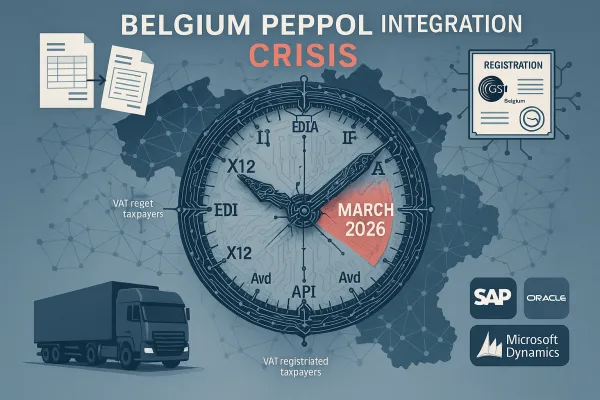
Preparation for upcoming France, Belgium, and other EU mandates requires strategic coordination. Starting January 2026, every Belgian enterprise with a valid VAT number must issue and receive structured e-invoices that comply with the European EN 16931 (Peppol BIS 3.0) format. From January 2026, e-invoicing is mandatory in Belgium via Peppol. Build systems that handle multiple country requirements from the start rather than implementing country-by-country solutions.
Q1 2025: Complete receiving infrastructure setup and test with at least 5 trading partners. Document any format or validation issues.
Q2 2025: Begin pilot programs for outbound EN 16931 invoice generation. Focus on largest trading partners first.
Q3 2025: Scale outbound capabilities to cover 50% of trading partners by volume. Start planning for 2027 issuing requirements.
Q4 2025: Complete integration testing and exception handling procedures. Prepare for mandatory issuing deadlines.
Risk mitigation strategies include maintaining parallel EDI flows during transition periods, building comprehensive validation and error handling, and establishing clear escalation procedures for compliance issues. Document everything - regulatory audits will focus heavily on process compliance, not just technical implementation.
The transformation from traditional EDI to EU e-invoicing compliance isn't just a technical upgrade - it's an opportunity to modernize your entire invoice processing architecture. Companies that approach this strategically will emerge with more efficient operations, better trading partner relationships, and enhanced competitive positioning across European markets.